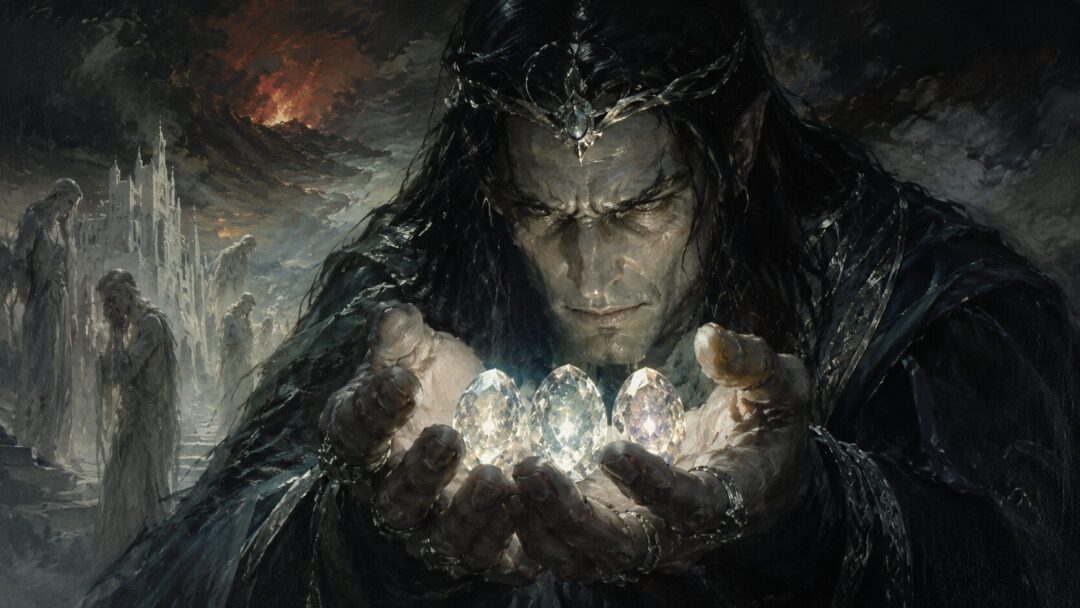
The Silmarils begin as jewels, but they do not remain merely jewels. In the legends of the First Age, they become memory, pride, grief, inheritance, and judgment locked inside crystal. For Fëanor, they are the works of his hands and the last preserved light of the Two Trees. For Morgoth, they are trophies of theft. For the sons of Fëanor, they become something even more dangerous: a burden they did not create, but willingly bound themselves to carry.
The tragedy is not that Fëanor did not love his sons. The texts give no reason to imagine him as indifferent to them. They followed him, stood beside him, and took his vow with him. The deeper horror is that his love became trapped inside a greater demand. The Oath did not erase fatherhood in a single moment. It rearranged the order of loyalty until even family could no longer stand above possession, vengeance, and self-declared right.
That is why Fëanor’s story is so disturbing. His ruin is not built on lovelessness. It is built on love bent out of shape.
The Oath Was Not Only a Promise
When Fëanor and his seven sons swore to pursue anyone in Arda who withheld a Silmaril from them, the act was more than political defiance. The Silmarillion presents the Oath as terrible, binding, and spiritually perilous. It is sworn in the names of Ilúvatar, Manwë, and Varda, which makes it far heavier than a family pledge or a royal command.
This matters because Fëanor did not merely tell his sons what to do. He drew them into a sacredly framed vow from which the story repeatedly suggests there is no clean escape. The Oath becomes an active force in the lives of the sons after Fëanor’s death. It “pursues” them, in the language of the legend, and it drives them into acts they might otherwise have avoided or regretted.
Tolkien never states in simple psychological terms, “Fëanor loved the Oath more than his sons.” But the narrative shows something close to that in consequence. Once the Oath is sworn, the sons are no longer only sons. They are co-oath-takers. They become instruments of the same vow that Fëanor made out of grief, rage, pride, and possessive love for the Silmarils.
A father’s love normally protects the future of his children. Fëanor’s Oath mortgages that future.
The Silmarils Became His Wounded Heart
To understand why the Oath grew stronger than ordinary love, the Silmarils have to be seen as more than treasure. Fëanor made them, and their light preserved something no one could remake: the mingled radiance of the Two Trees of Valinor. When the Trees are destroyed, the jewels become the last surviving vessel of that light.
This gives Fëanor’s attachment a tragic logic. He had created something that was both personal and cosmic. The Silmarils were his work, but they also held a beauty that belonged to the blessed realm before its darkening. When the Valar ask whether their light might be used to heal the Trees, Fëanor refuses before he even knows the jewels have already been stolen. He says, in effect, that breaking them would break him.
That moment reveals the danger already present before the Oath. The jewels have become bound to his identity. Their loss is not only theft. It feels like a violation of self, house, father, and world. Then the news comes that Morgoth has murdered Finwë, Fëanor’s father, and taken the Silmarils. Two wounds fuse into one: bereavement and dispossession.
Here the order of grief becomes crucial. Fëanor names Melkor “Morgoth,” the Black Foe, after learning of Finwë’s murder and the theft. Yet the Oath he swears is not simply an oath to avenge Finwë. It is directed toward recovering the Silmarils from whoever holds them. One reading is that Fëanor’s grief for his father is real but is immediately absorbed into the larger obsession with the jewels. The murdered father becomes part of the fire that drives the oath over the sea.
That pattern foreshadows what happens to Fëanor as a father himself. Personal love is not absent. It is consumed into the logic of possession and vengeance.
His Sons Were Drawn Into His Fire
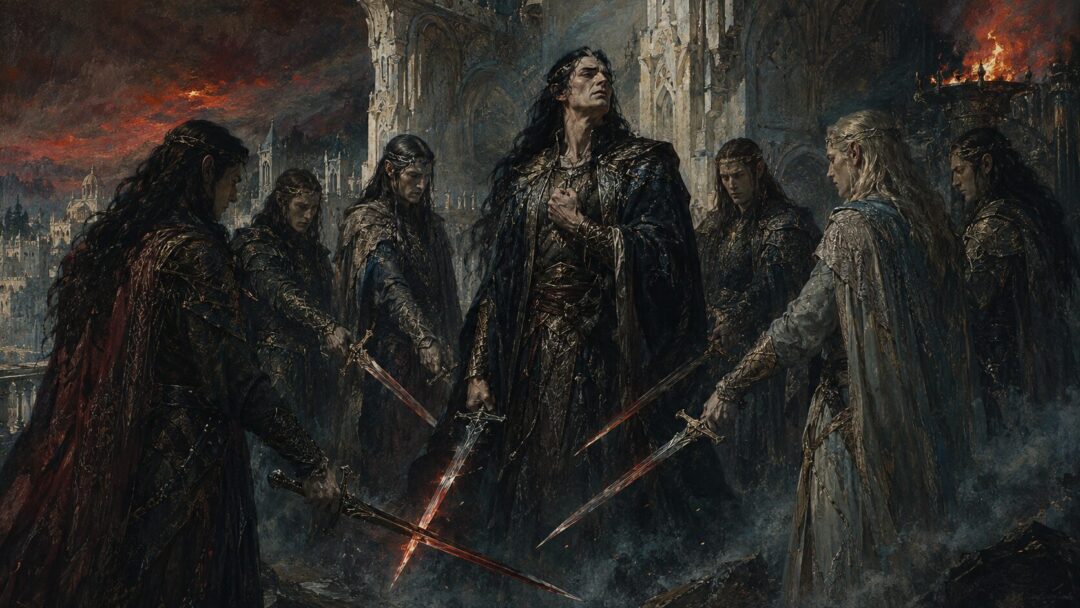
The seven sons do not merely obey from a distance. They leap to Fëanor’s side and take the same vow. This is one of the most chilling images in the early rebellion of the Noldor: drawn swords, torchlight, a family united in a single act that will divide them from almost everyone else.
At first glance, this can look like loyalty. The sons share their father’s cause. They bind themselves to recover what belongs to their house. But the very unity of the moment is part of the tragedy. Fëanor’s charisma, wrath, and grief create a family identity centered on the Silmarils. To stand with him is to swear. To be his son is to inherit not merely blood, craft, or honor, but compulsion.
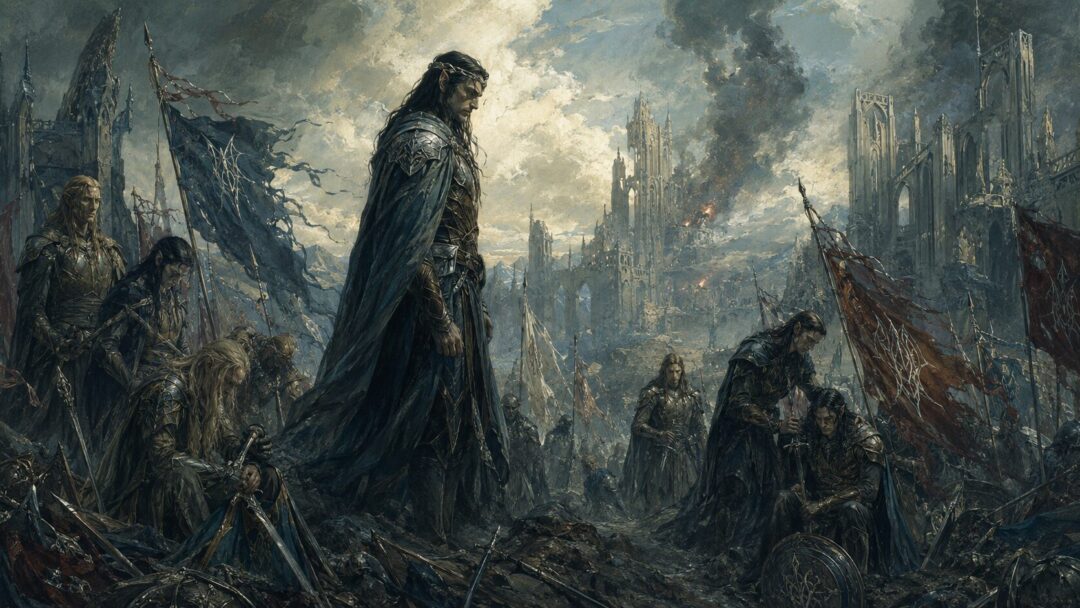
The texts do not give us private conversations in which Fëanor weighs his sons’ safety against his vow. What they do give us is the record of his actions. He leads them from Aman into rebellion. He is involved in the violence at Alqualondë, where the Noldor seize the ships of the Teleri. He then has the ships burned at Losgar after crossing to Middle-earth, abandoning many of the Noldor who had followed but were not with him.
This last act is not directly against his sons, who are with him, but it reveals the governing principle of Fëanor’s mind after the Oath. Those who are useful to the immediate pursuit are carried forward. Those who complicate, delay, or challenge his will are left behind. A leader in that state cannot safely remain a father first. The Oath has narrowed the world.
The Oath Survived Fëanor More Powerfully Than He Did
Fëanor dies early in the wars of Beleriand, after rushing too far ahead in battle against Morgoth’s forces. Even at the end, he does not release his sons from the Oath. Instead, seeing with dying perception that the Noldor will not overthrow Thangorodrim by their own strength, he still charges his sons to hold to their vow and avenge him.
This is perhaps the clearest answer to the topic. At the moment when a father might seek to spare his children from his own ruin, Fëanor confirms the burden. The Oath becomes his legacy.
Again, the text does not say he ceased to love them. But love, if it remained, was subordinate. His final command does not free them. It fastens them more tightly to an impossible demand. In practical terms, Fëanor leaves his sons not peace, not repentance, not counsel toward mercy, but an obligation that will follow them through centuries of bloodshed.
The irony is severe: Fëanor cannot continue the quest himself, but the Oath can. His body falls; his will remains active through his sons.
Maedhros Shows What Fëanor Could Not Become
The contrast with Maedhros is important because it shows that the sons were not simple extensions of their father. Maedhros, after terrible suffering in captivity and rescue by Fingon, makes choices that Fëanor probably would not have made. He yields the high kingship of the Noldor to Fingolfin, helping reduce open conflict among the divided Noldor. This does not erase his guilt, but it shows political humility and an ability to seek repair.
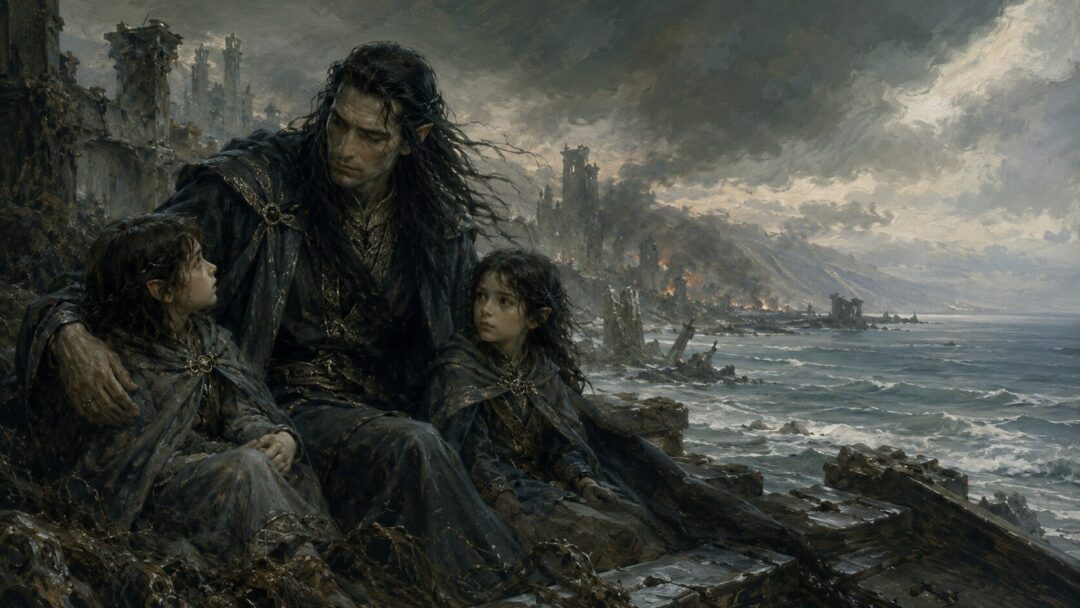
Maedhros also becomes one of the most tragic figures of the Oath because he seems capable of seeing its horror while still being unable, or unwilling, to escape it. The same is true in another way of Maglor. After the later ruin brought by the sons of Fëanor, Maglor shows pity toward Elrond and Elros, the young sons of Eärendil and Elwing. The tradition says love grew between them.
That detail matters. It proves that the Oath did not turn Fëanor’s sons into creatures without tenderness. They could pity. They could foster. They could regret. They could understand loss in others. Yet the Oath still returns.
This is the most devastating pattern in their story: love survives, but it does not rule.
The Kinslayings Reveal the Oath’s True Mastery
The Oath’s strength is measured not by words but by what it eventually demands. The sons of Fëanor take part in repeated violence against other Elves in the pursuit of the Silmarils. The first Kinslaying at Alqualondë happens while Fëanor still lives, in the seizure of the Telerin ships. Later, after Fëanor’s death, the claim to the Silmaril held by others leads to further ruin: the attack on Doriath after Dior possesses the jewel, and the assault on the Havens of Sirion after Elwing has it.
These events are not presented as noble recoveries. They are catastrophes within the Elven world. The Oath that began as a cry against Morgoth becomes a cause of Elf killing Elf. That is the moral inversion at the center of the tragedy. A vow sworn against the Black Foe ends by making the oath-takers bring grief to people who are not Morgoth.
The deaths of Fëanor’s own sons across the long unfolding of the Oath sharpen the point. Celegorm, Curufin, and Caranthir die in the attack on Doriath. Amrod and Amras die in the assault on the Havens of Sirion. Only Maedhros and Maglor remain at the end. The Oath does not preserve the house of Fëanor. It consumes it.
If Fëanor’s love for his sons had stood above the vow, the story would require some moment of release, warning, or sacrifice to save them. Instead, the vow becomes the shape of their doom.
The Final Silmarils Judge the Oath-Takers
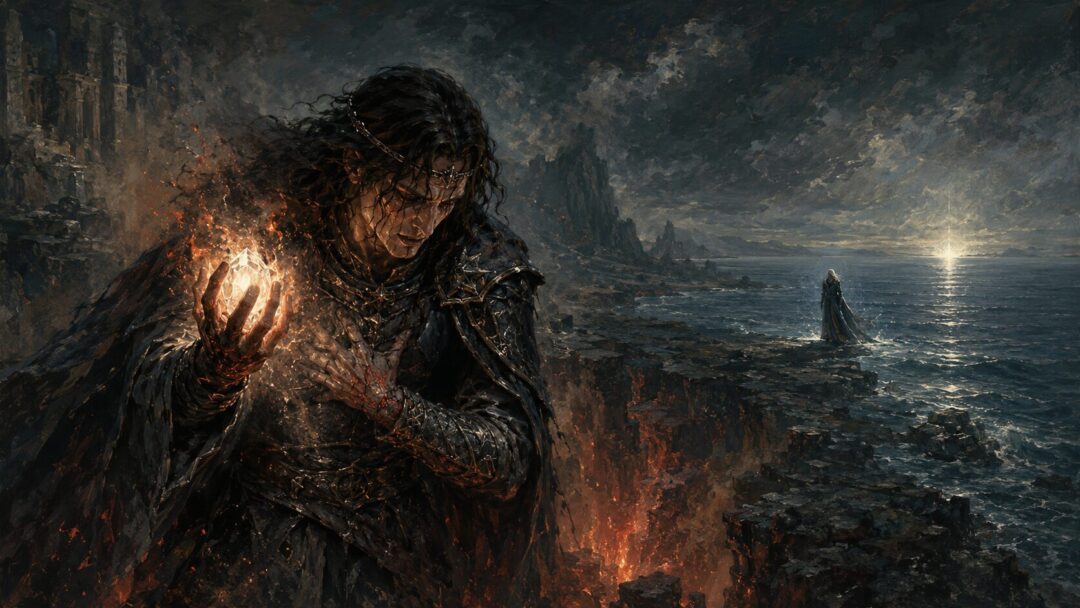
After Morgoth’s defeat in the War of Wrath, the two remaining Silmarils are recovered by the victorious host. Maedhros and Maglor still feel bound by the Oath and demand the jewels. When their claim is denied because of their deeds, they take them by stealth and violence. But the Silmarils burn their hands, showing that their right to possess them has been lost.
This ending is essential. The Oath insists that the jewels must be recovered by Fëanor’s house, but the hallowed jewels themselves reject the surviving sons. The vow and moral reality no longer match. Maedhros, in despair, casts himself into a fiery chasm with one Silmaril. Maglor throws the other into the sea and wanders in grief.
The Silmarils end in sky, earth, and sea, beyond the grasp of the house that claimed them most fiercely. This is not accidental symbolism. It shows the failure of possessive ownership over sacred beauty. The more the sons pursue the jewels as property guaranteed by oath, the less fit they become to hold them.
The Oath has become stronger than love because it has become stronger than truth. It cannot adapt to repentance. It cannot recognize changed moral condition. It cannot say, “We have done too much evil to continue.” It only commands.
Why Fëanor Could Not Put His Sons First
Fëanor’s tragedy is not that he lacked greatness. He is among the most gifted of the Eldar, unmatched in craft and intensity. But his gifts are joined to possessiveness, suspicion, pride, and wrath. The Oath grows out of those flaws at the exact moment when grief makes him most dangerous.
His sons stand beside him, but the Silmarils stand at the center. The family is gathered around the jewels, not the jewels around the family. That order explains everything that follows.
Fëanor’s love for his sons was likely real, but it was not free. It was caught inside his love for his own creation, his fury at Morgoth, his grief for Finwë, and his refusal to surrender what he believed was his beyond all challenge. Once he swore the Oath and drew his sons into it, he gave the vow a claim over them that even death did not break.
The most painful answer, then, is this: the Oath became stronger than Fëanor’s love for his sons because he made the recovery of the Silmarils the highest loyalty of his house. After that, fatherhood could still exist, but it could no longer save them. Love remained in the story as flashes of loyalty, pity, and regret. The Oath remained as command.
And in the First Age, command won until almost nothing of Fëanor’s house was left to obey.
Sources & Notes
- J.R.R. Tolkien, The Silmarillion, “Of the Silmarils and the Unrest of the Noldor” — Fëanor’s making of the Silmarils, his refusal to break them, and the way their loss binds personal pride to cosmic grief.
- J.R.R. Tolkien, The Silmarillion, “Of the Flight of the Noldor” — the terrible Oath of Fëanor and his seven sons, sworn against anyone withholding a Silmaril, and the first Kinslaying at Alqualondë.
- J.R.R. Tolkien, The Silmarillion, “Of the Return of the Noldor” — Fëanor’s burning of the ships at Losgar and his dying charge that his sons hold to the Oath and avenge him.
- J.R.R. Tolkien, The Silmarillion, “Of the Ruin of Doriath” — the Oath driving the sons of Fëanor toward the attack on Doriath after Dior possesses the Silmaril.
- J.R.R. Tolkien, The Silmarillion, “Of the Voyage of Eärendil and the War of Wrath” — the assault on the Havens of Sirion and the final judgment of Maedhros and Maglor when the Silmarils burn their hands.