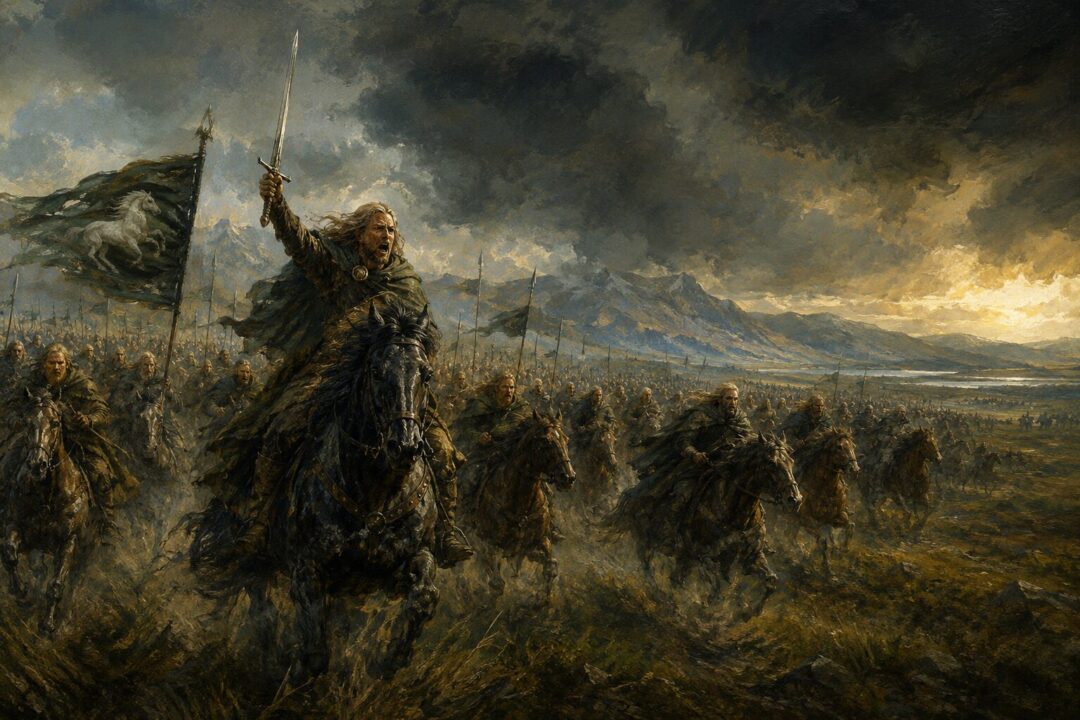
When the horns of Rohan sounded on the Pelennor Fields, it felt like one of the great rescue moments in all of fantasy. As Minas Tirith stood on the edge of destruction and the armies of Mordor closed in, the Riders appeared from the north like salvation itself.
But the arrival of Rohan was not a lucky coincidence.
It was not simply a neighboring kingdom deciding to help. Nor was it a sudden act of generosity by King Théoden. The charge of the Rohirrim was the fulfillment of an obligation stretching back centuries—an old debt rooted in gratitude, loyalty, and a promise made between two peoples whose survival had once depended upon one another.
Understanding why Rohan came to Gondor changes the meaning of the Battle of the Pelennor Fields. The Riders were not outsiders arriving unexpectedly to save the day. They were answering a call that their ancestors had sworn never to ignore.
The Forgotten Origin of the Alliance
By the end of the Third Age, many readers encounter Gondor and Rohan as established allies. Their friendship feels ancient and permanent.
Yet Rohan itself was a relatively young kingdom.
The land known as Rohan had once been Gondorian territory called Calenardhon, a vast province north of the White Mountains. Over time, Gondor's population declined. Centuries of war, plague, and internal troubles left many regions sparsely settled and difficult to defend.
At the same time, a people known as the Éothéod lived far to the north. They were skilled horsemen descended from the same broad cultural traditions that had once produced the Northmen, peoples long associated with friendship toward Gondor.
The fate of these two peoples would become intertwined during one of Gondor's darkest crises.
Gondor's Hour of Need
The turning point came in Third Age 2510.
A massive invasion struck Gondor from the east. The Balchoth, enemies allied with dark powers, crossed the Anduin and threatened the kingdom. Gondor's northern defenses were overwhelmed, and the situation became desperate.
The Steward of Gondor at the time, Cirion, recognized that ordinary military measures might not be enough. Gondor needed help quickly, and from an unexpected source.
Cirion sent messengers north to seek aid from the Éothéod.
The request was risky. The Éothéod lived far away, and there was no certainty that they could arrive in time. Yet the danger facing Gondor was so severe that Cirion took the chance.
The response would reshape the history of Middle-earth.
The Ride of Eorl
The leader of the Éothéod was Eorl the Young.
When the message reached him, Eorl chose to act.
The decision was extraordinary. The Éothéod were not Gondorian subjects. They were not bound by treaty. Answering the call meant committing thousands of riders to a long and dangerous journey far from their own lands.
Nevertheless, Eorl gathered his people and rode south.
The timing proved decisive.
As Gondor's position deteriorated near the Field of Celebrant, Eorl's horsemen arrived unexpectedly and struck the enemy. Their charge shattered the Balchoth offensive and transformed what appeared to be a looming disaster into victory.
In Gondorian memory, the arrival of the Éothéod became one of the great moments of deliverance in the kingdom's history.
Without them, the consequences might have been catastrophic.
A Kingdom Given in Gratitude
Cirion understood the magnitude of what Eorl had done.
This was not a minor military contribution. The Éothéod had helped preserve Gondor at a moment when its future was genuinely threatened.
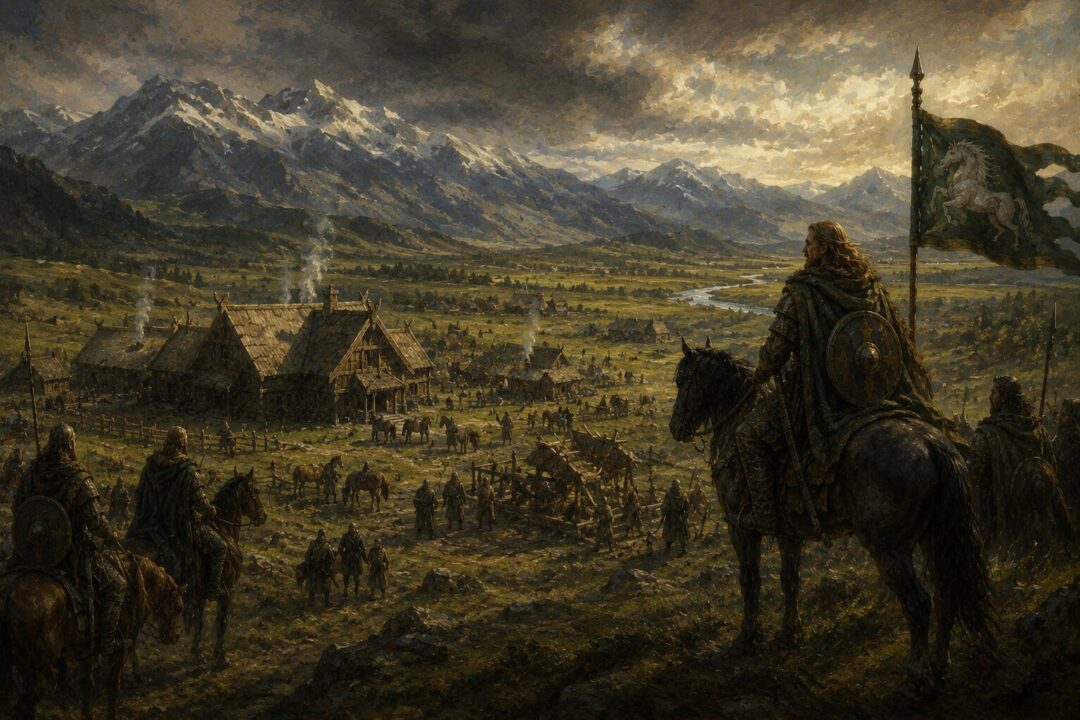
As a reward, Cirion offered Eorl the largely depopulated province of Calenardhon.
The gift was not merely payment for military services. It was a strategic partnership that benefited both peoples.
Gondor gained a strong and loyal ally guarding its northern approaches. The Éothéod gained fertile lands in which to settle and establish a permanent kingdom.
From this arrangement emerged the land that would become known as Rohan and the people who would become the Rohirrim.
Their kingdom existed, in part, because Gondor had entrusted them with lands that it could no longer adequately defend.
The relationship between the two realms was therefore built into the very foundation of Rohan's existence.
The Oath of Cirion and Eorl
The alliance was formalized in one of the most important agreements of the Third Age.
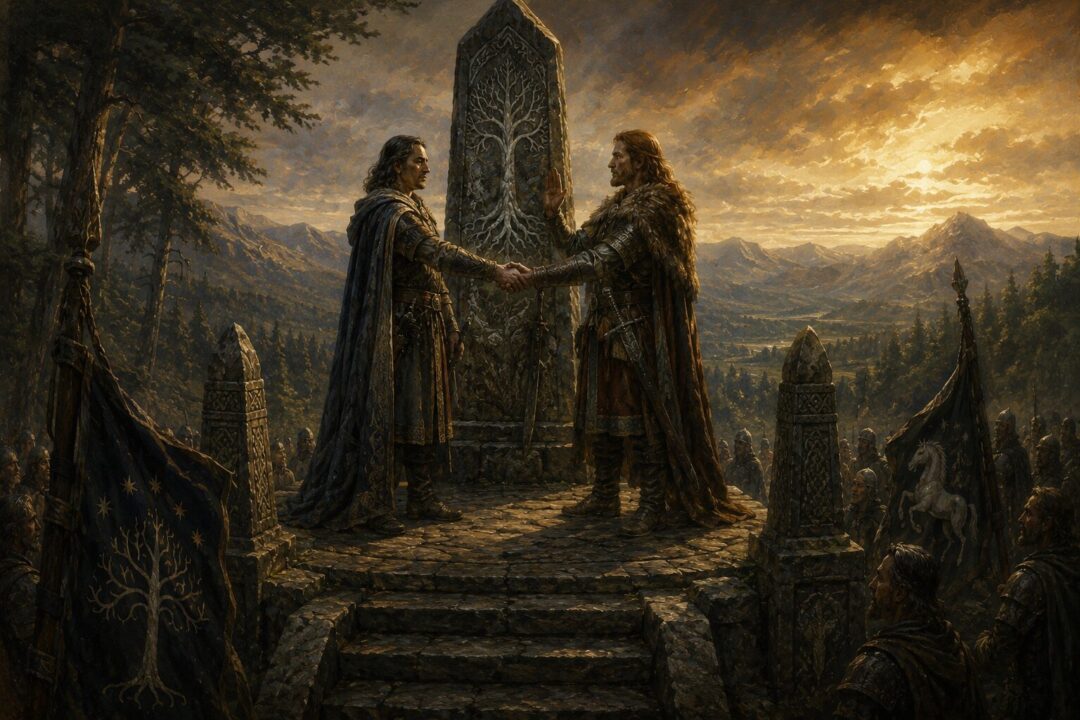
After the victory, Cirion and Eorl met at the hill of Halifirien. There they swore a solemn oath establishing perpetual friendship and mutual aid between their peoples.
The significance of this oath is difficult to overstate.
In Middle-earth, oaths carry profound weight. Again and again throughout the legends, vows shape destinies, bind generations, and carry moral consequences.
The Oath of Cirion and Eorl was not a casual diplomatic arrangement. It was a sacred commitment.
The exact circumstances and language surrounding the oath underscore its seriousness. It established a lasting bond between Gondor and the newly founded realm of the Rohirrim.
Future generations inherited not only the benefits of the alliance but also its obligations.
When Gondor later called for aid, the Rohirrim would remember that they were responding to a promise woven into their kingdom's origin.
A Debt That Worked Both Ways
It is tempting to view the relationship as one-sided.
After all, Gondor granted the Rohirrim a kingdom.
Yet the historical reality was more balanced.
Without Eorl's intervention, Gondor might have suffered devastating losses or perhaps even a long-term strategic collapse in its northern territories. The gift of Calenardhon was given because the Éothéod had already rendered an enormous service.
Likewise, Rohan benefited greatly from receiving a homeland.
The alliance therefore rested on reciprocal gratitude rather than simple dependency.
Each side owed something to the other.
Gondor remembered the riders who had arrived when all seemed lost.
Rohan remembered the kingdom that had welcomed them and given them land.
This mutual indebtedness explains why the alliance endured for centuries despite political changes, wars, and shifting circumstances.
It was not maintained solely through convenience. It was sustained through memory.
Why Théoden Could Not Simply Ignore the Call
By the time of the War of the Ring, more than five hundred years had passed since the days of Cirion and Eorl.
Generations had lived and died.
Kings and stewards had come and gone.
Yet the oath remained.
When Gondor finally lit the beacons and sent the Red Arrow, the request carried the weight of history.
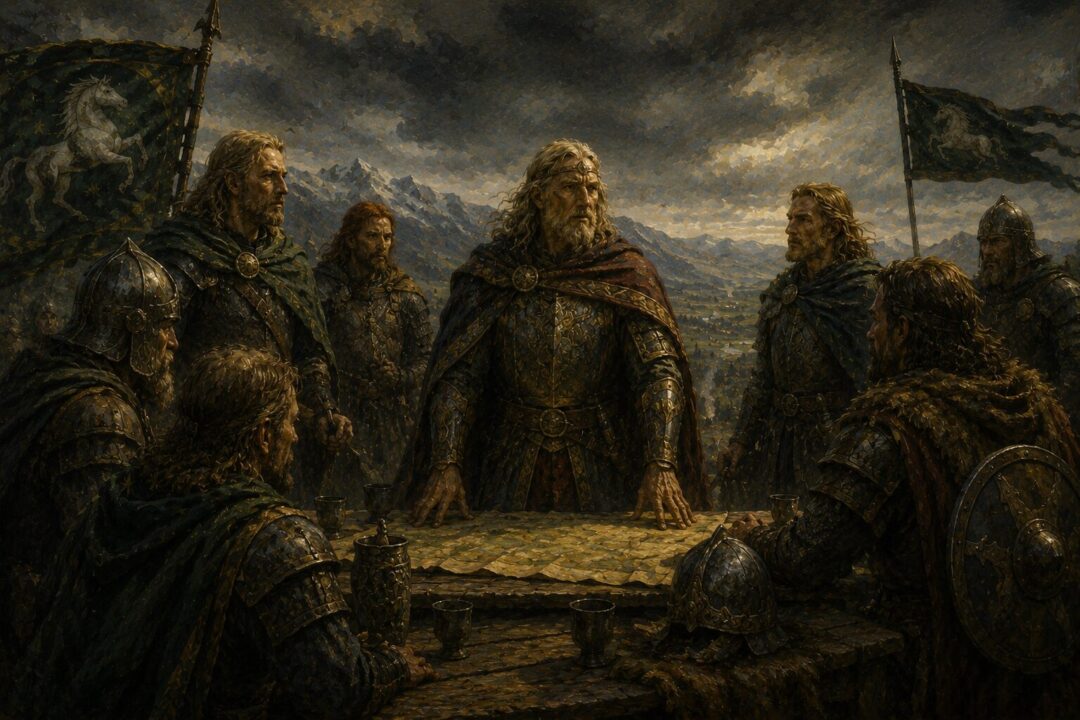
The decision facing Théoden was therefore far more complicated than a simple military calculation.
Rohan itself was under threat. Saruman had devastated parts of the kingdom. Many riders had already fallen. The people had only recently survived the crisis at Helm's Deep.
From a purely practical perspective, there were reasons to hesitate.
Yet Théoden understood the deeper significance of the summons.
Gondor was not merely requesting assistance from a neighboring state.
An ancient ally was invoking a bond that had existed since the founding of Rohan itself.
To refuse without overwhelming necessity would have meant abandoning part of the kingdom's own identity.
The Tragic Timing of the War
One of the most striking aspects of the story is that Rohan answered the call despite severe obstacles.
Saruman's actions were not accidental.
Part of the strategy employed by the enemies of the West involved keeping Rohan isolated and weakened. Delays, attacks, and manipulation all threatened to prevent the Riders from ever reaching Minas Tirith.
Even after Théoden committed to the march, danger remained everywhere.
The Rohirrim were not riding toward an easy victory.
They were riding toward a battlefield where many of them expected death.
The decision becomes even more significant when viewed through this lens.
This was not help offered from safety.
It was aid given at great cost.
The Charge on the Pelennor Fields
When the Rohirrim finally arrived before Minas Tirith, they fulfilled more than a military objective.
They fulfilled centuries of obligation.
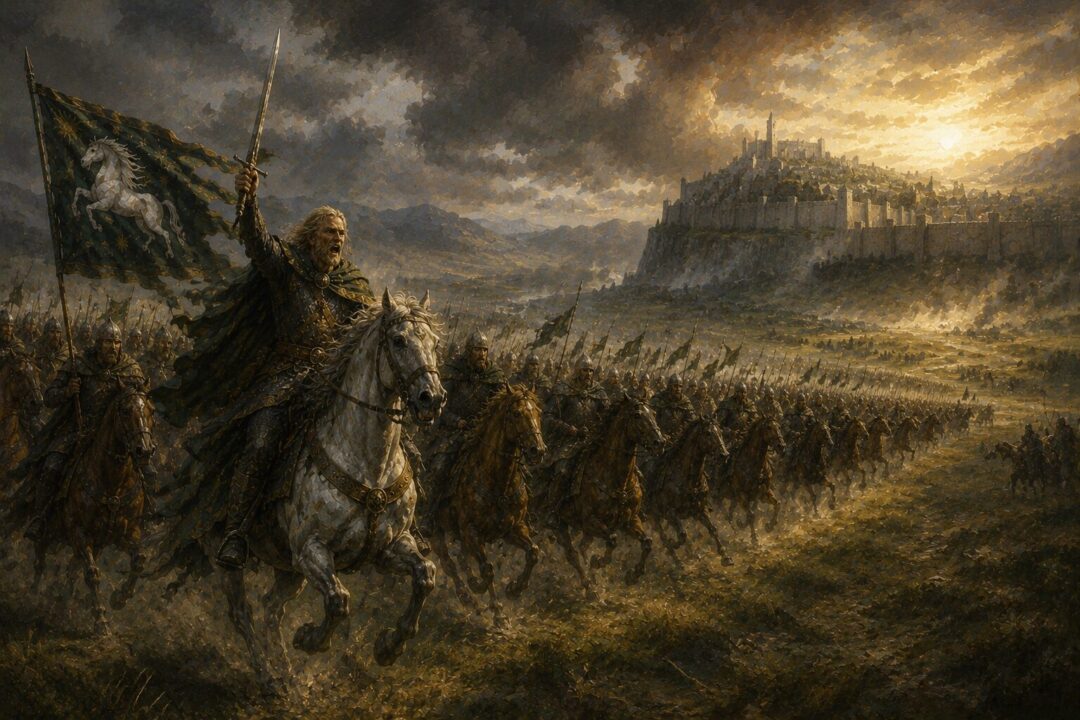
The charge led by Théoden was one of the greatest moments in the history of the Third Age, but its emotional power comes partly from everything that preceded it.
The Riders were not strangers intervening in another nation's war.
They were heirs honoring a promise.
The courage displayed on the Pelennor Fields was connected directly to the decisions made long before by Cirion and Eorl.
The story forms a remarkable historical circle.
Gondor had once faced destruction and been saved by northern horsemen.
Centuries later, Gondor again stood on the edge of catastrophe, and once again riders from the north came thundering to its aid.
The Real Meaning of Rohan's Arrival
The arrival of Rohan is often remembered as a dramatic rescue.
It certainly was that.
Yet reducing it to a last-minute intervention misses what makes the moment so powerful.
The Rohirrim did not ride because fate happened to place them nearby. They did not come because Théoden sought glory. Nor did they appear merely because the plot required reinforcement for Gondor.
They rode because history demanded an answer.
Their kingdom had been born from alliance, gratitude, and oath. The foundations of Rohan were inseparable from the friendship of Gondor.
When the beacons flared and the summons came, the Riders were responding to a debt that stretched back to the Field of Celebrant and the Oath of Cirion and Eorl.
The charge of the Rohirrim therefore represents something deeper than rescue.
It is one of Middle-earth's clearest examples of how promises endure across centuries, how gratitude can outlive generations, and how the choices of ancestors continue to shape the fate of their descendants long after those ancestors are gone.
Sources & Notes
- J.R.R. Tolkien, Unfinished Tales, ‘Cirion and Eorl and the Friendship of Gondor and Rohan’ — the Balchoth invasion, Eorl’s ride to the Field of Celebrant, the grant of Calenardhon, and the oath at Halifirien.
- J.R.R. Tolkien, The Lord of the Rings, Appendix A, ‘The House of Eorl’ — concise account of the Éothéod, Eorl the Young, and the founding of Rohan from Gondor’s former province.
- J.R.R. Tolkien, The Return of the King, Book V, Chapter 3, ‘The Muster of Rohan’ — the Red Arrow, the beacons, and Théoden’s decision to ride to Gondor despite Rohan’s own losses.
- J.R.R. Tolkien, The Return of the King, Book V, Chapter 5, ‘The Ride of the Rohirrim’ — the Rohirrim’s arrival before Minas Tirith and the charge on the Pelennor Fields.