The Orc Problem Hidden Inside Middle-earth’s Moral Universe
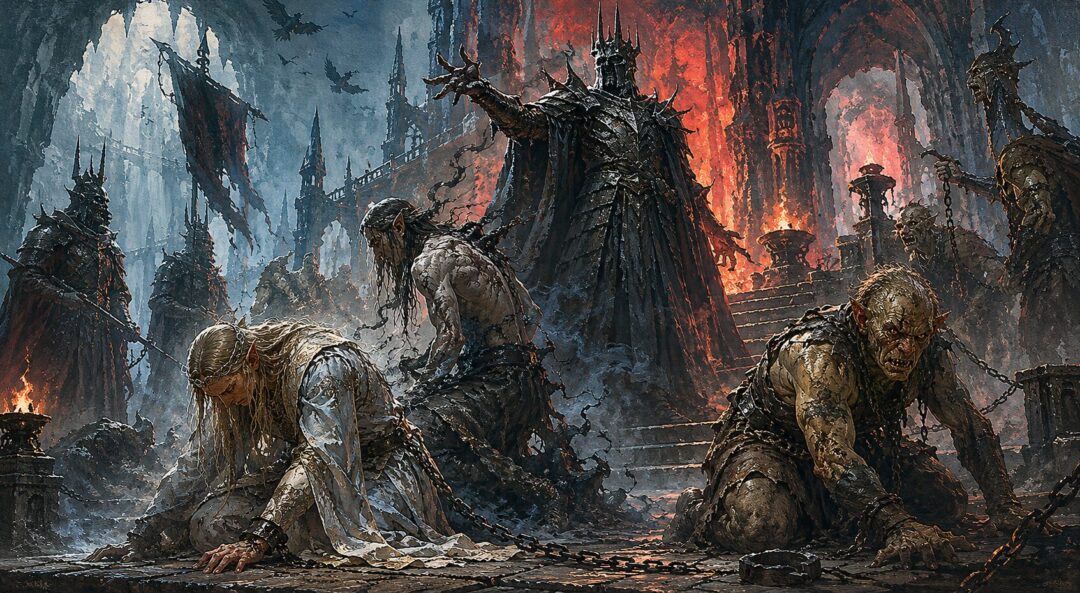
Orcs march beneath black banners, burn cities, torture captives, and laugh at cruelty. In The Lord of the Rings, few creatures seem more clearly aligned with evil. Aragorn kills them without moral hesitation. The Rohirrim hunt them as enemies. Sam and Frodo overhear them speaking in Mordor and hear cynicism, fear, and brutality.
And yet buried beneath the war-story clarity lies one of the most difficult moral problems in all of Tolkien’s legendarium:
What exactly are Orcs?
Not merely what they look like, or how they fight — but what they are in moral and metaphysical terms.
If Orcs are rational beings with speech, memory, humor, loyalty, fear, and recognizable personalities, can they be born irredeemably evil? If they are not rational persons, why do they behave so unmistakably like fallen people?
This was not a minor background detail. It became a problem serious enough that Tolkien repeatedly revisited it in later writings, struggling to reconcile Orcs with the deeper moral architecture of Middle-earth.
Orcs Could Not Simply Be “Made Evil”
One foundational rule governs Tolkien’s world: evil cannot create life independently.
This principle appears repeatedly across the legendarium. Morgoth and Sauron corrupt, dominate, twist, imitate, or enslave. They do not possess the divine creative power that belongs properly to Eru alone.
That rule creates immediate tension around Orc origins.
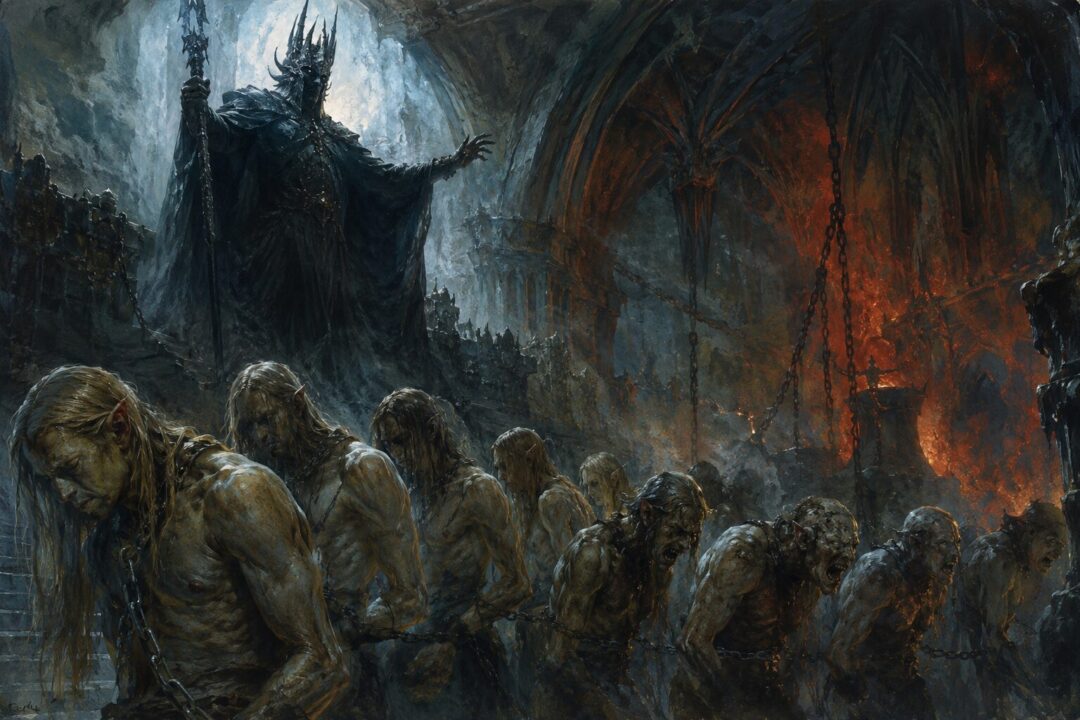
In The Silmarillion, the published account states that Morgoth bred Orcs from captured Elves, corrupted “in mockery” of the Children of Ilúvatar. This became the best-known explanation.
It solves one theological problem: Morgoth did not create a new species from nothing.
But it opens a larger one.
If Orcs descend from Elves — beings with souls, moral agency, and ultimate destiny — then Orcs are not merely monsters. They belong, somehow, within the same moral order as Elves and Men.
And that raises a disturbing implication: could Orcs possess the capacity for repentance?
The texts never show an Orc sincerely turning toward good. Yet the deeper logic of the world makes absolute inherited damnation profoundly difficult.
Tolkien became increasingly aware of this tension.
Tolkien’s Later Writings Show Growing Unease
The familiar Silmarillion explanation was not the end of the matter.
In later notes published in Morgoth’s Ring, Tolkien revisited Orc origins repeatedly, considering multiple possibilities.
At different times he explored whether Orcs might derive from corrupted Elves, corrupted Men, mixtures involving beasts, or other complicated solutions attempting to preserve theological consistency.
The shifting theories are revealing not because they provide a single definitive answer — they do not — but because they show that Tolkien himself recognized unresolved difficulties.
One major concern centered on free will.
If Orcs were truly rational incarnates, they should possess some degree of moral freedom. But if every Orc is automatically and permanently evil, that seems to deny meaningful free choice.
In later commentary, Tolkien explicitly rejected the idea that any rational creature could be made inherently evil beyond all possibility of moral choice. The problem, however, was that the stories often function dramatically as though Orcs are exactly that.
The contradiction never fully disappeared.
Orcs Behave Like Persons, Not Like Mindless Monsters
Part of the problem comes from how Orcs actually behave on the page.
They are not presented as mindless beasts.
Orcs argue over orders. They complain about superiors. They form grudging alliances across tribal divisions. They use military jargon, slang, dark humor, and practical reasoning.
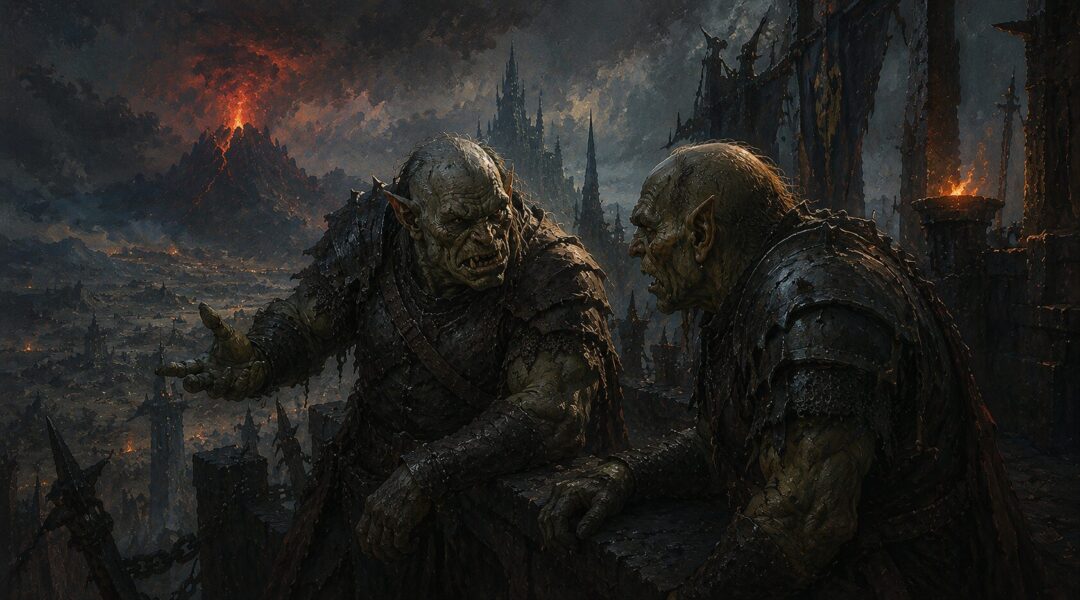
The conversation between Shagrat and Gorbag in Mordor is especially important.
These two captains discuss command structures, battlefield frustrations, and dreams of escaping the control of powerful masters. One imagines finding a safer arrangement with “a few trusty lads” away from the endless domination of greater powers.
The moment is striking because it sounds recognizably human.
Not noble — but human in emotional structure.
They resent authority. They distrust political leadership. They want survival, autonomy, and smaller loyalties.
That does not make them secretly good. The same conversation casually includes violence and cruelty.
But it complicates simplistic readings.
The texts present Orcs as morally degraded beings capable of thought, memory, social organization, and personal motives. They are not depicted as automata.
And once a creature possesses recognizable personhood, the question becomes harder to avoid: what does justice mean for such a being?
The Problem of Inherited Evil
Modern readers often frame the Orc issue through race or representation debates. Those discussions exist, but Tolkien’s own internal concern ran deeper into metaphysics and morality.
The core issue is inherited evil.
Can someone be born evil by nature?
Middle-earth’s broader moral framework generally resists that conclusion.
The corruption of Númenor unfolds through fear, pride, political manipulation, and distorted desires — not biological destiny.
Boromir falls into temptation but remains tragic rather than monstrous.
Gollum commits terrible acts, yet mercy toward him remains morally required because moral possibility still exists within him, however damaged.
Even Saruman began as a being ordered toward good purposes before falling through pride and domination.
Again and again, evil in Tolkien’s world operates through corruption.
That pattern makes the notion of an entire speaking people born permanently beyond moral recovery increasingly difficult to harmonize.
Tolkien never ignored this tension. He wrestled with it precisely because it threatened one of the deepest moral patterns running through the legendarium.
Morgoth’s Shadow and the Limits of Freedom
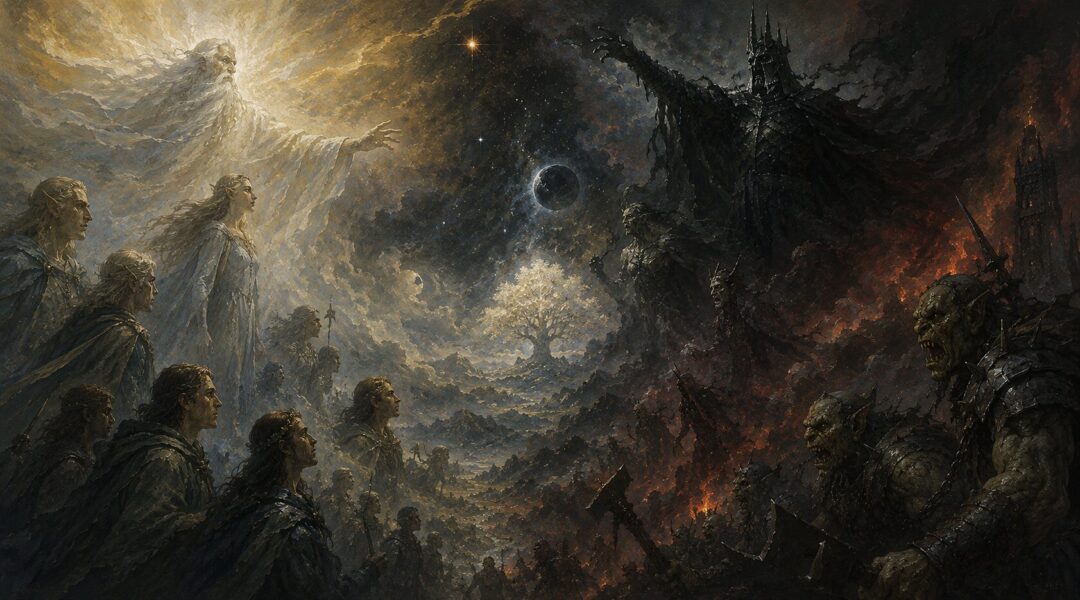
One possible reading of the later material is not that Orcs lack free will entirely, but that their freedom exists under extreme distortion.
Morgoth’s long corruption may have produced beings shaped within systems of terror, violence, breeding, domination, and inherited deformity of culture and desire.
That is different from saying they were metaphysically incapable of choice.
The distinction matters.
In The Lord of the Rings, Sauron’s armies repeatedly depend upon fear, coercion, surveillance, and domination. Loyalty is unstable. Desertion, internal conflict, and distrust are common.
Orcs obey because they fear stronger powers.
This does not prove hidden moral innocence. But it fits a model of enslaved corruption more than one of perfectly uniform evil essence.
Tolkien never offers a final settled doctrine here. The ambiguity remains.
But the ambiguity itself is important.
It suggests that even within the darkest corners of Middle-earth, moral questions resist easy simplification.
Why Tolkien Could Not Simply Ignore the Issue
From a storytelling perspective, Orcs function efficiently as enemy soldiers in an epic war.
From a philosophical perspective, they threatened to destabilize key principles of the legendarium.
The difficulty touched several foundational beliefs simultaneously:
Evil cannot create true life.
Rational beings possess moral significance.
Free will matters.
Corruption is central to how evil operates.
Absolute inherited moral condemnation sits uneasily inside that framework.
These principles work smoothly until Orcs force them into collision.
That is why Tolkien kept returning to the subject instead of quietly leaving the earlier explanation untouched.
The problem was not cosmetic worldbuilding trivia.
It concerned the moral logic of Middle-earth itself.
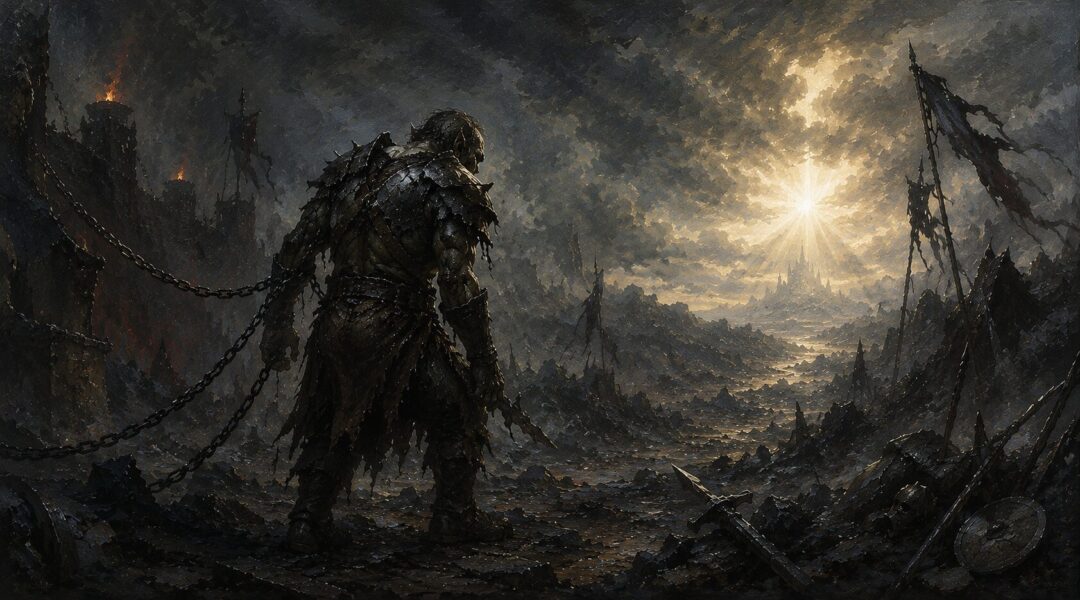
The Unresolved Tragedy of the Orcs
No definitive canonical solution completely resolves the issue.
Published texts preserve tensions rather than perfect harmony.
The Silmarillion tradition of corrupted Elvish origins remains influential. Later writings complicate or revise aspects of the problem without producing one universally accepted final answer.
Perhaps that incompleteness is fitting.
Orcs embody one of the darkest questions in the legendarium: what happens when corruption runs so deep that ordinary categories of guilt, freedom, punishment, and pity become difficult to untangle?
The stories rarely pause to examine Orc suffering directly. The great wars of Middle-earth demand immediate moral action against violent enemies.
Yet behind the battlefield necessity lies a quieter discomfort embedded within the lore itself.
Orcs are not merely monsters placed outside the moral order.
They are a problem generated by the moral order.
And that may be precisely why Tolkien could not ignore them.
Because if evil cannot truly create, then somewhere beneath the armor, hatred, fear, and long corruption of the Orcs lies a question Middle-earth never answers completely:
what becomes of a people shaped by evil, but not created by it?
Sources & Notes
- J.R.R. Tolkien, The Silmarillion, ‘Of the Coming of the Elves and the Captivity of Melkor’ — gives the classic account that Orcs were bred from captured Elves corrupted by Melkor, not independently created by him.
- J.R.R. Tolkien, Morgoth’s Ring, ‘Myths Transformed’ — shows Tolkien repeatedly revising Orc origins because evil’s inability to create life and the status of rational creatures made the problem hard to settle.
- J.R.R. Tolkien, The Letters of J.R.R. Tolkien, Letter 153 — discusses the theological difficulty of Orcs as rational, corrupted beings and rejects simple creature-making by the powers of evil.
- J.R.R. Tolkien, The Lord of the Rings, Book IV, Chapter 10, ‘The Choices of Master Samwise’ — Shagrat and Gorbag’s conversation presents Orcs with speech, motives, fear, hierarchy, and recognizable personal grievances.
- J.R.R. Tolkien, The Lord of the Rings, Book I, Chapter 2, ‘The Shadow of the Past’ — Gandalf’s teaching about pity and Gollum supports the wider moral pattern that even deeply fallen beings are not treated as mere disposable evil.