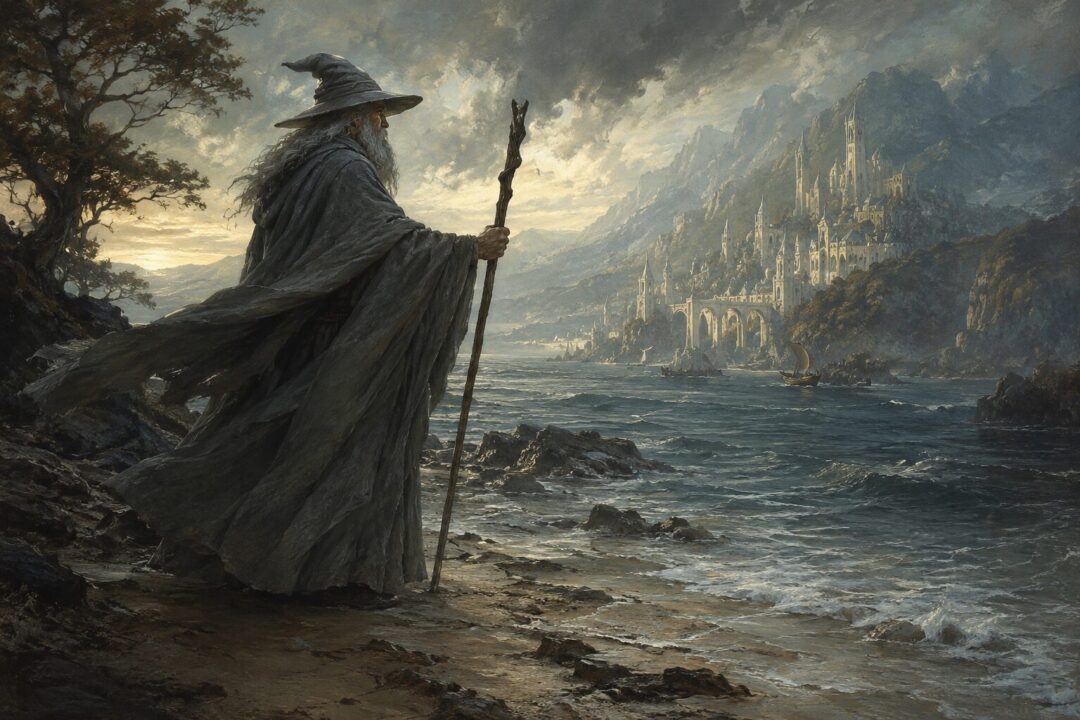
Gandalf could face a Balrog on the Bridge of Khazad-dûm, stand against the Nazgûl, and speak with a fire that seemed older than mortal courage. Yet he was not sent to Middle-earth as a conquering angel. He came as an old man in grey, weary, hungry, cold, and often dependent on doors being opened to him.
That apparent contradiction is the key to the Istari.
The Wizards were not weak because the West lacked strength. They were made limited because strength itself had become the central danger. Sauron was not merely an enemy with armies. He was the temptation to solve fear through domination, to impose order by superior will, to make others safe by making them obedient. If the Valar had answered him by sending emissaries who ruled Middle-earth in splendour, they might have defeated Sauron’s throne while repeating his method.
The Wizards were sent to resist him without becoming him.
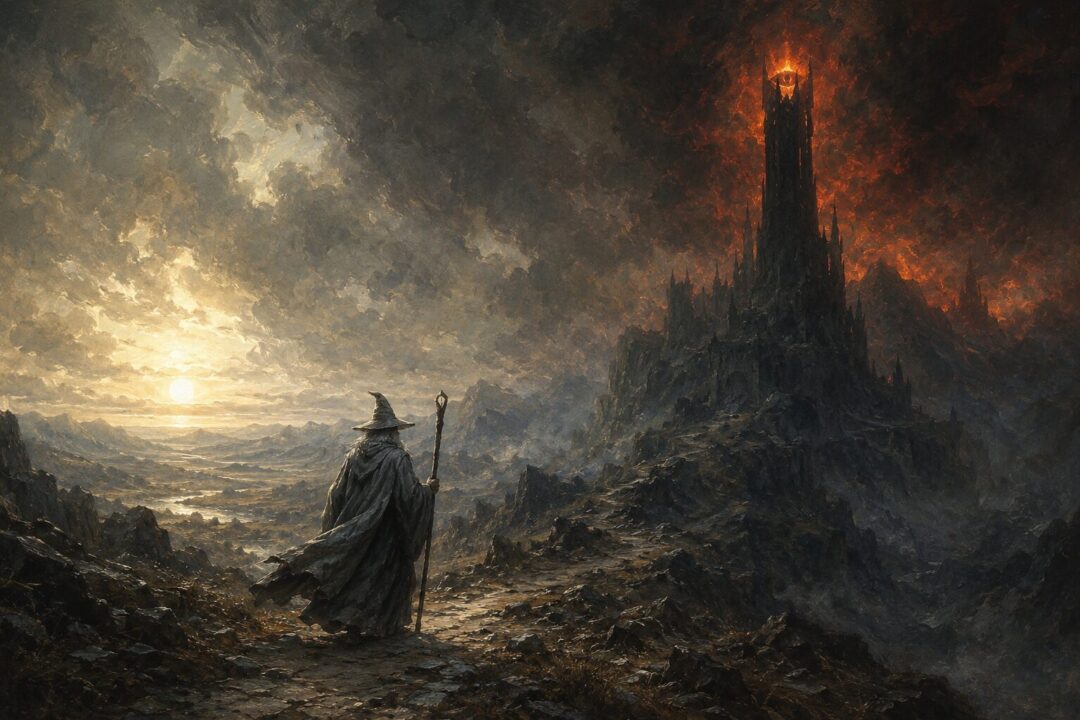
The Istari Were Maiar, But Not Sent as Unveiled Powers
The Wizards were not ordinary Men who learned magic. The tradition preserved in the lore of the Istari identifies them as Maiar: angelic spirits of the same broad order as Sauron, though not equal to him in history, power, or corruption. They came from the West as messengers, not kings.
This matters because their humble appearance was not their true origin. Gandalf, Saruman, Radagast, and the two Blue Wizards were clothed in bodies like those of Men. They experienced weariness, fear, pain, and the limits of embodied life. They could suffer. They could be delayed. They could be deceived. They could fail.
Their mission was not to overthrow Sauron by open force. They were sent to encourage, counsel, and unite the peoples who resisted him. The distinction is vital. They were not meant to replace the courage of Elves, Dwarves, Men, or Hobbits. They were meant to awaken it.
That is why Gandalf’s victories so often happen through others. He guides Thorin’s Company toward Erebor, but does not become King under the Mountain. He aids Aragorn, but does not claim the throne of Gondor. He sends Frodo forward, but does not take the Ring for himself. His power is real, but it is deliberately indirect.
Why Not Send Power Against Power?
The obvious question is simple: if Sauron was a Maia, why not send greater spirits to crush him?
Middle-earth already knew the cost of divine-scale intervention. The wars against Morgoth had broken lands and drowned regions of the world. Even when the cause was just, overwhelming power brought overwhelming ruin. By the Third Age, the struggle against Sauron was not meant to be another cataclysm of Powers.
But there is an even deeper reason. Sauron’s evil was not only destruction. It was control. He desired to order the world according to his own will. He was a maker, planner, and ruler whose gifts had turned toward mastery. The One Ring concentrated that desire: to dominate other wills, especially through the Rings of Power.
To answer that with another dominating will would have been spiritually dangerous. A mighty emissary from the West might have said, “I rule only until Sauron is gone.” But that is exactly the kind of sentence by which tyranny can disguise itself as necessity.
The Wizards were therefore limited not because power was useless, but because unchecked power was the disease.
Saruman Shows the Danger the Rule Was Meant to Prevent
Saruman is the clearest proof that the restriction was necessary.
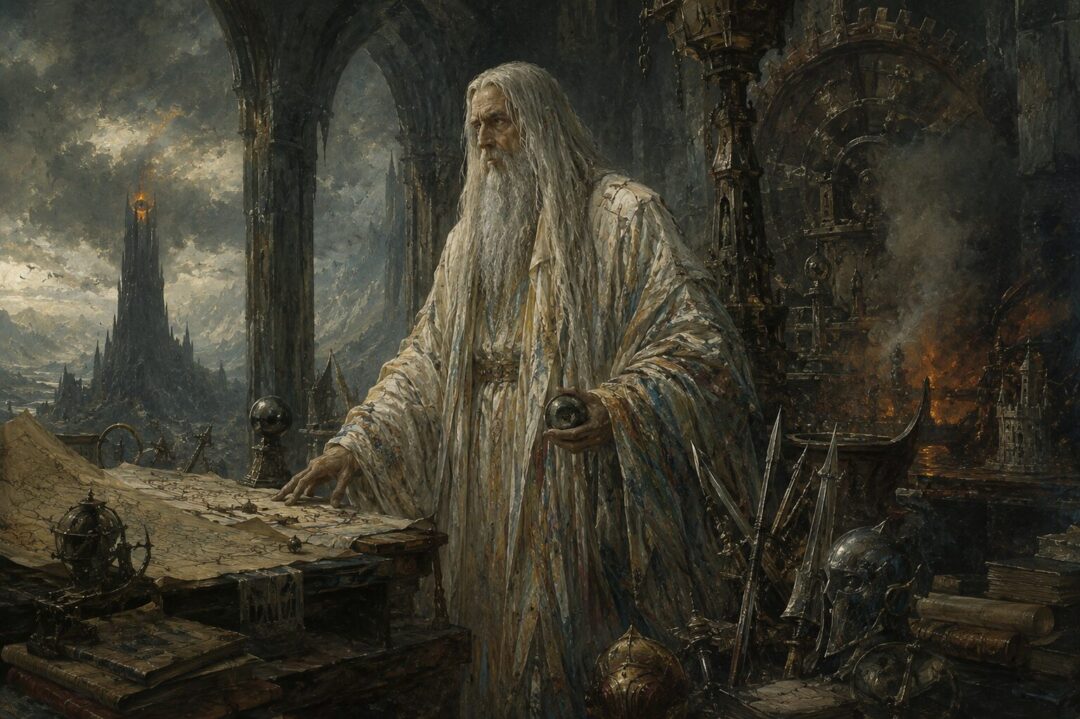
He began as the chief of the order, learned in craft, Ring-lore, and the devices of the Enemy. Yet his study of Sauron became imitation. He desired knowledge of the Ring, then possession of it, then power enough to rival or replace Sauron. In Isengard he gathered armies, bred war, cut down trees, used machinery, and bent others to his designs.
Saruman did not become Sauron in full. He lacked Sauron’s stature and ancient terror. But he became Sauronic in method. He sought order through coercion. He wanted victory by domination. He even tried to persuade Gandalf that the Wise should guide the world by controlling it.
That is the precise corruption the Istari were sent to avoid.
Saruman’s fall reveals that the Wizards’ weakness was not a flaw in the plan. It was a safeguard. Even limited, embodied, and under command, one of them still chose the path of power. Had he been sent unveiled in greater might, the disaster might have been worse.
Gandalf’s Humility Is Not Lack of Strength
Gandalf’s restraint is often mistaken for inability. He does not usually command kingdoms, seize councils, or force the Free Peoples to obey him. But this is not because he has no power. It is because his power is governed by his mission.
He counsels Théoden, but Théoden must still rise. He guides Aragorn, but Aragorn must choose the Paths of the Dead and claim his inheritance. He encourages Frodo, but Frodo must bear the Ring. Gandalf’s wisdom works by restoring freedom rather than replacing it.
Even when Gandalf returns as the White, his role remains bounded. He becomes more authoritative, and he breaks Saruman’s staff, but he still does not make himself ruler of Middle-earth. He is a steward of hope, not a lord of obedience.
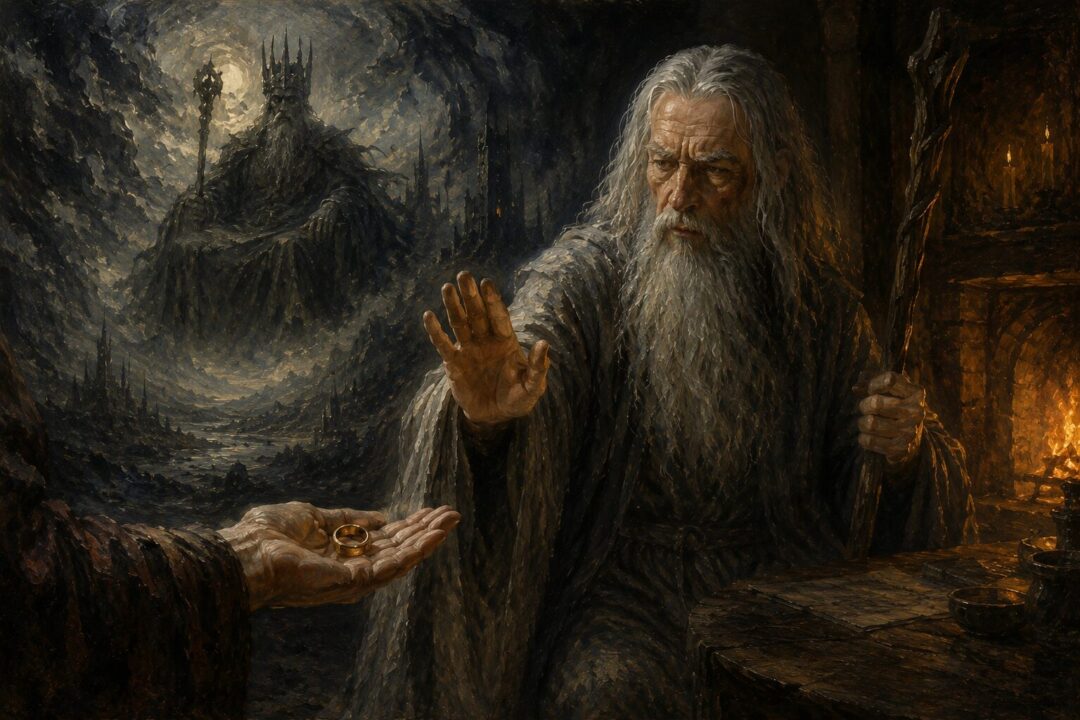
This is why his refusal of the Ring is so important. Gandalf understands that he would desire to use it for good. That is exactly why it would be deadly for him. The Ring would not need to turn him into a petty villain. It could corrupt him through pity, responsibility, and the wish to set all things right.
The danger is not that Gandalf would suddenly love evil. The danger is that he might become righteous in domination.
The Ring Exposes the Same Hidden Rule
The One Ring clarifies the whole logic of the Wizards’ mission. The Ring offers power according to the stature of the bearer. To the small and humble it may grant invisibility, preservation, or escape. To the great it offers command.
That is why the Wise refuse it. Gandalf, Elrond, Galadriel, and Aragorn each understand in different ways that using the Enemy’s ruling power cannot produce a clean victory. Galadriel’s temptation is especially revealing: she imagines herself beautiful and terrible, adored and feared. She rejects that vision and diminishes.
The same principle governs the Istari. The West does not defeat domination by sending a brighter domination. The Ring cannot be used safely to overthrow Sauron. The Wizards cannot become benevolent Saurons in order to save the world from him.
The moral structure is consistent: the means matter because the means reshape the user.
Weakness Made Room for Hobbits
The humbling of the Wizards also made room for the smallest people in the story.
If Gandalf had been sent as an irresistible power, the Quest of the Ring would hardly have required Frodo’s endurance, Sam’s loyalty, Merry’s courage, or Pippin’s growth. Middle-earth would have been rescued from above. Instead, its salvation comes through pity, friendship, endurance, and choices made by those with little worldly power.
This does not mean the humble are magically immune to corruption. Frodo is wounded by the Ring. Bilbo struggles to surrender it. Sméagol is ruined by it. But Hobbits reveal something Sauron overlooks: the strength to endure without imagining oneself fit to rule the world.
Gandalf’s mission depends on that hidden strength. He does not manufacture heroism. He notices it. He trusts it. He helps create the conditions in which it can act.
That is very different from Sauron, who understands servants, slaves, captains, and enemies, but not free persons moved by mercy.
The Blue Wizards and the Limits of What Is Known
The two Blue Wizards complicate the picture because the surviving traditions about them vary. Some accounts suggest they went into the East and may have failed or founded secret cults. Later notes offer a more hopeful possibility: that they hindered Sauron’s influence in the East and South, helping prevent his forces from becoming even greater.
What remains consistent is the nature of the Istari as emissaries sent into danger under limitation. Their story is not one of guaranteed success. They were not machines of providence. They could fail, wander, or be corrupted.
That uncertainty reinforces the point. The plan of the Wizards was risky because it respected freedom — including their own. They were sent with purpose, but not stripped of the possibility of error.

Victory Without Possession
The War of the Ring ends not with Gandalf enthroned, nor with the Wise wielding the Ring, nor with the West ruling Middle-earth directly. It ends with the Ring destroyed, Sauron’s power collapsing, Aragorn crowned, and the bearers of the Three Rings departing.
Gandalf’s task is completed precisely because he does not remain as a permanent governor. The age of Elves and Wizards passes. The Dominion of Men begins. Middle-earth is not made perfect, but it is released from the immediate tyranny of Sauron.
That ending is essential. The Wizards were not sent weak merely as a tactical disguise. Their limitation embodied the moral answer to Sauron. He sought to preserve, order, and rule by binding others to himself. Gandalf laboured, suffered, guided, and then left.
In that departure lies the final difference between the Grey Pilgrim and the Dark Lord.
Sauron wanted a world that could not escape his will. Gandalf helped save a world he would not possess.
Sources & Notes
- J.R.R. Tolkien, Unfinished Tales, "The Istari" — identifies the Wizards as Maiar sent by the Valar in limited embodied form to advise and encourage resistance, not to dominate Sauron by force.
- J.R.R. Tolkien, The Lord of the Rings, Book II, Chapter 2, "The Council of Elrond" — Gandalf refuses the Ring because he would try to use it from a desire to do good, making its temptation especially dangerous.
- J.R.R. Tolkien, The Lord of the Rings, Book II, Chapter 2, "The Council of Elrond" — Saruman's argument for rule, knowledge, and power shows how opposition to Sauron can become imitation of Sauron's method.
- J.R.R. Tolkien, The Lord of the Rings, Book III, Chapter 10, "The Voice of Saruman" — Saruman's coercive voice and shattered authority illustrate the corrupted wizard as a would-be ruler rather than a servant of freedom.
- J.R.R. Tolkien, The Silmarillion, "Of the Rings of Power and the Third Age" — describes Sauron's making of the One Ring to rule the other Rings and dominate the wills bound to them.
- J.R.R. Tolkien, The Letters of J.R.R. Tolkien, Letter 131 — frames Sauron's evil as a desire to order and control all things according to his own wisdom, supporting the article's domination-versus-freedom theme.
- J.R.R. Tolkien, The Peoples of Middle-earth, "Last Writings" — gives Tolkien's later, more hopeful note on the Blue Wizards' mission against Sauron's influence in the East and South.