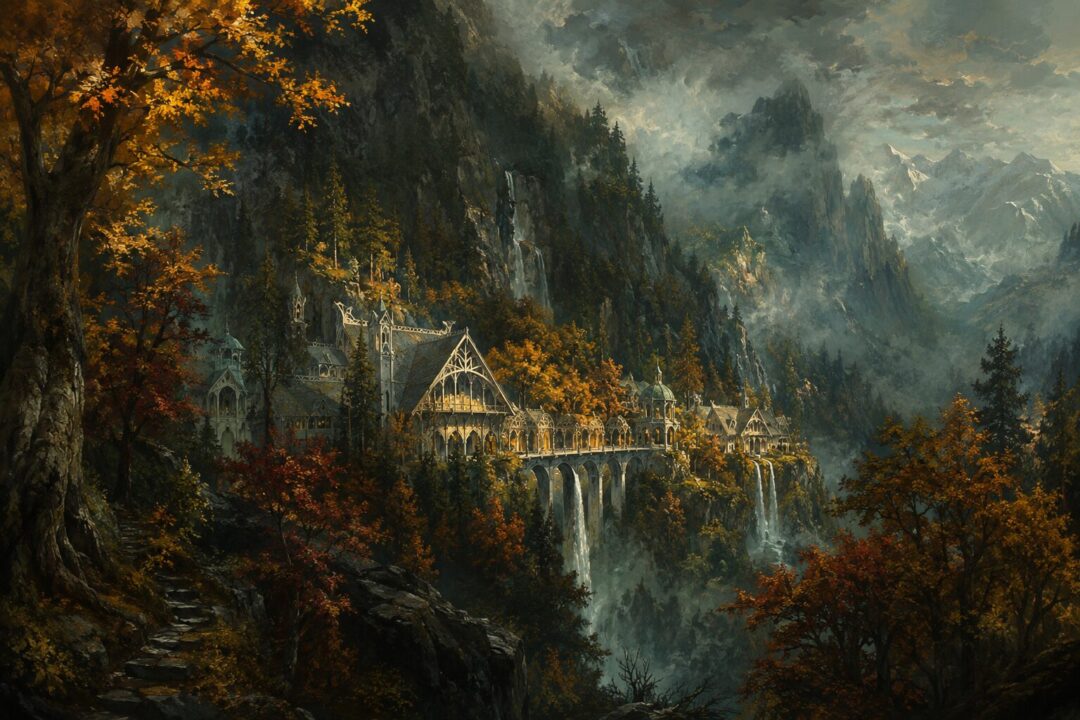
Rivendell feels, at first glance, like the answer to Middle-earth’s problems.
Hidden in a deep valley, guarded by secrecy, preserved by Elven wisdom, it appears untouched by the spreading Shadow. Heroes heal there. Songs remember forgotten ages. The Ring-bearer finds rest there. Even the fate of the world is debated beneath its roofs.
Yet Tolkien’s texts quietly reveal something more unsettling: Rivendell is not a solution to evil’s return. It is a refuge built because lasting solutions are failing.
That distinction matters.
Rivendell stands as one of Middle-earth’s most beautiful contradictions — a place of preservation in a world that cannot ultimately be preserved.
Rivendell Was Born From Defeat
To understand Rivendell, it helps to remember why it exists at all.
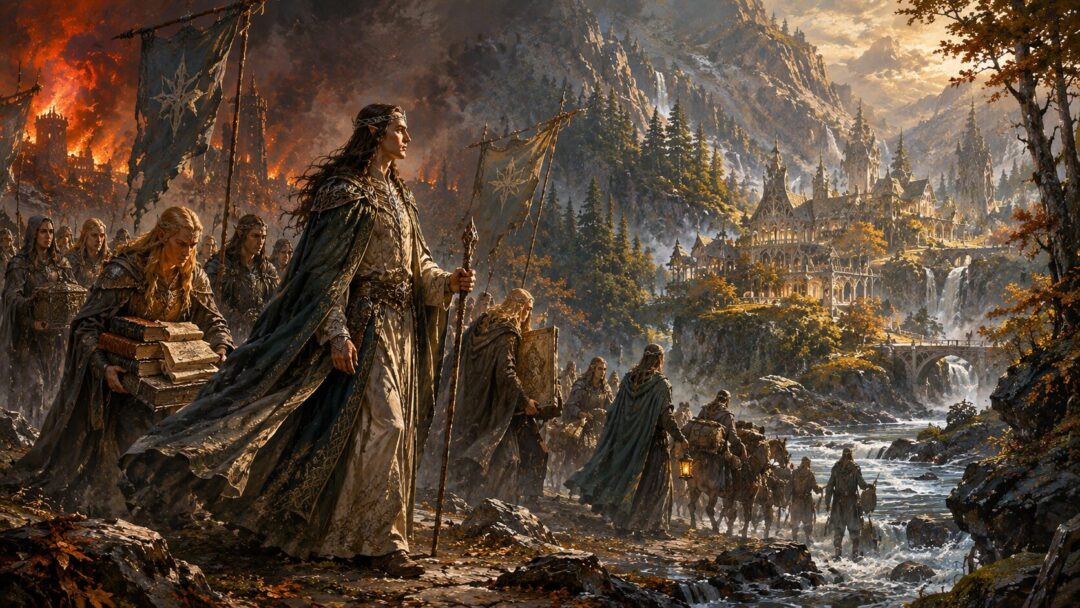
It was founded by Elrond during the wars against Sauron in the Second Age. In The Silmarillion and the appendices to The Lord of the Rings, Rivendell emerges during crisis, not triumph. When Sauron overran Eriador and destroyed much of the Elvish realm of Eregion, Elrond withdrew northward and established a hidden stronghold in the valley later called Imladris.
That origin matters.
Rivendell is not the center of a growing civilization. It is what survives after one collapses.
Eregion had been a place of immense creativity and power: the realm of the Elven-smiths, closely linked to the making of the Rings of Power. Its destruction reveals a recurring pattern in Tolkien’s world. Great achievements attract danger. Openness becomes vulnerability. Beauty survives by retreating.
Rivendell is therefore defensive from its beginning.
It preserves memory, lineage, language, healing, and wisdom — but it does so behind concealment.
The hidden valley exists because the wider political and military landscape has already failed.
A Sanctuary Sustained by Elven Power
Part of Rivendell’s extraordinary atmosphere comes from power that is real but limited.
Elrond bears Vilya, the greatest of the Three Rings entrusted to the Elves. Tolkien never gives a full technical explanation of what the Three Rings do, but the texts strongly imply that they preserve, heal, strengthen, and resist decay.
Rivendell feels different because it is different.
Time seems gentler there. Memory remains vivid. Ancient culture survives. Travelers experience rest not merely as physical shelter but as spiritual restoration.
Yet this preservation has boundaries.
The Three Rings were not weapons capable of defeating Sauron directly. Their works depended, in part, upon the larger order of power established in Middle-earth. Once the One Ring exists, the fate of Elven preservation becomes entangled with it.
This creates one of Tolkien’s quiet ironies.
The beauty of Rivendell is connected to a system that cannot endure indefinitely.
If the One Ring survives and Sauron regains mastery, the freedom of Elven realms ends. But if the One Ring is destroyed, the sustaining power of the Three Rings also diminishes.
Rivendell is therefore caught in a tragic bind.
Its continued existence in recognizable form depends upon a world order that is already passing away.
Rivendell Could Shelter Heroes — But Not Replace Their Task
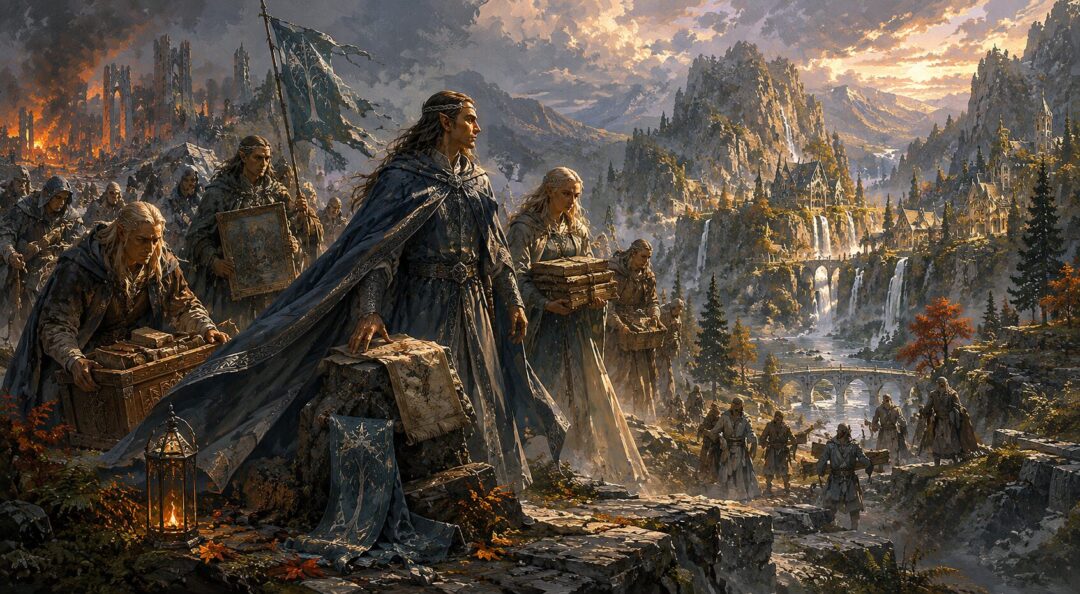
When Frodo reaches Rivendell after Weathertop and the Ford of Bruinen, it feels like salvation.
He is wounded, exhausted, hunted, and nearly overcome by the Morgul-blade’s poison. In Rivendell, he receives healing that likely could not have been achieved elsewhere.
But notice what does not happen.
The Ring is not solved.
It is not locked away permanently. It is not purified. No hidden Elvish ritual removes its danger. No wise master neutralizes its corruption.
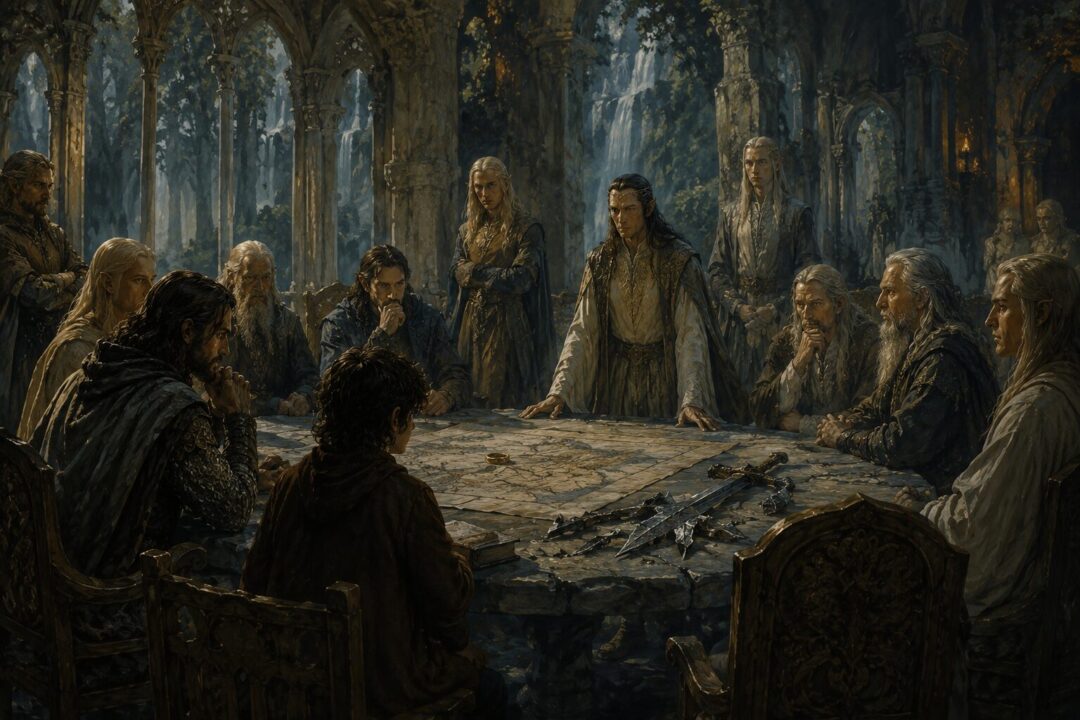
Instead, the Council of Elrond confronts a hard truth: there is no safe custodianship.
This scene is crucial because it dismantles a tempting fantasy.
If wisdom, lineage, lore, and hidden power were enough, Rivendell should be able to manage the crisis.
It cannot.
The Council considers alternatives. Send the Ring west? Impossible. Use it against Sauron? Catastrophic. Hide it? Temporary at best. Guard it indefinitely? Unrealistic.
The Ring changes the logic of refuge itself.
A hidden sanctuary can protect travelers for a time. It cannot permanently absorb the central evil of the age.
That is why the Council arrives at its terrible conclusion: the Ring must be destroyed.
Not preserved.
Not mastered.
Destroyed.
And the task requires leaving safety behind.
Why Rivendell Could Not Become a Fortress Against Sauron
A common assumption among readers is that places like Rivendell or Lórien should simply have become the core of organized resistance.
Why not gather armies there? Why not concentrate power in protected realms?
The texts suggest several answers.
First, Rivendell is hidden, not imperial.
Its strength lies in secrecy, counsel, healing, and memory — not territorial domination. It resembles an intellectual and spiritual refuge more than a conventional kingdom.
Second, the Elves are already diminishing.
Throughout The Lord of the Rings, one of the defining themes is decline. The great Elvish ages are ending. Even powerful realms exist under the shadow of departure.
Rivendell’s leaders are wise precisely because they understand this.
They do not mistake temporary endurance for permanent renewal.
Third, military victory alone cannot solve the problem of the Ring.
Even vast armies struggle against Sauron’s resources. Gondor weakens. Arnor has already fallen. The Last Alliance achieved enormous sacrifice simply to overthrow Sauron temporarily — and even then, the fundamental problem remained unfinished.
The war of the Ring is not solved by finding a better fortress.
It is solved by confronting the source of domination itself.
Rivendell supports that mission, but cannot substitute for it.
The Deep Human Truth Behind Rivendell
One reason Rivendell resonates so deeply with readers is that it embodies a profoundly human longing.
People want places where damage can stop.
Where wounds heal.
Where beauty remains intact.
Where wisdom gathers enough strength to hold back chaos.
Rivendell offers that experience — but Tolkien refuses to let refuge become escapism.
The valley gives rest, not exemption from responsibility.
Frodo must leave it.
The Fellowship must leave it.
Aragorn leaves it repeatedly throughout his life, despite personal ties, love, and memory anchored there.
Even Elrond cannot remain forever.
This pattern reveals an important moral structure within Tolkien’s world: healing matters because action still awaits.
Retreat alone cannot save Middle-earth.
Mercy, endurance, counsel, and restoration are essential — but they are preparations for costly choices in the dangerous world beyond sanctuary.
Rivendell and the Passing of the Elves
Perhaps the saddest truth about Rivendell is that its greatest success is inseparable from its eventual disappearance.
The hidden house preserves ancient memory astonishingly well.
Songs of Beren and Lúthien survive there. Genealogies, languages, histories, and wisdom from older ages endure. Rivendell becomes a living bridge between Middle-earth’s fading past and its uncertain future.
But preservation is not the same thing as permanence.
After the destruction of the One Ring, the age of the Elves wanes rapidly. Elrond eventually departs across the Sea.
Rivendell does not explode, burn, or fall in conquest.
Its fading is quieter than that.
Its purpose diminishes because the historical conditions that created it are ending.
That quietness matters.
Many fantasy stories imagine victory as the restoration of a lost golden order.
Tolkien’s world is more complicated.
The defeat of Sauron does not preserve Rivendell unchanged forever.
It allows a different age to begin — an age increasingly shaped by Men rather than Elves.
Rivendell succeeds not by becoming eternal, but by helping shepherd Middle-earth through transition.
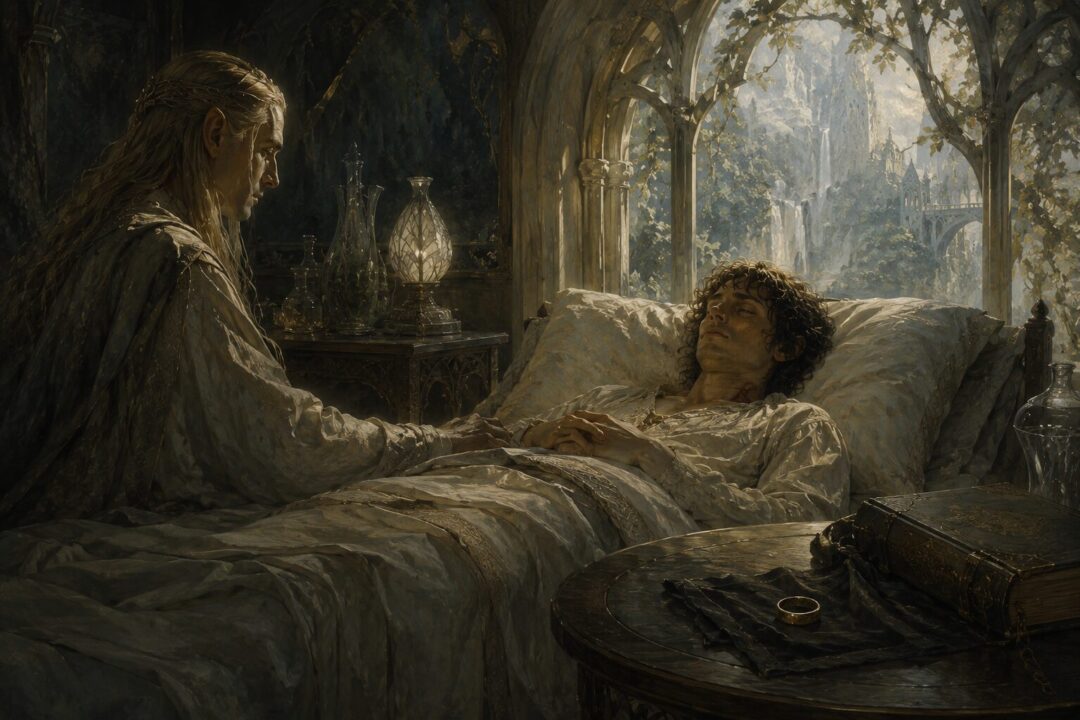
Why Rivendell Matters Precisely Because It Is Not Enough
Rivendell’s greatness lies partly in its limits.
It cannot conquer Sauron.
It cannot cleanse the Ring.
It cannot halt history.
It cannot permanently preserve the old world it loves.
And yet none of this makes it irrelevant.
Without Rivendell, Aragorn’s lineage lacks crucial shelter. The Council never gathers. Frodo may die of his wound. The Fellowship may never form.
Refuge is not failure because it falls short of solving everything.
Refuge becomes meaningful because living beings need places where memory, healing, wisdom, and courage can survive long enough to re-enter the struggle.
Rivendell embodies that difficult truth.
Not every sacred place defeats evil directly.
Some preserve what must not be lost while others bear unbearable burdens into darkness.
In Tolkien’s legendarium, that distinction is not weakness.
It is part of how hope survives at all.
Sources & Notes
- J.R.R. Tolkien, The Silmarillion, “Of the Rings of Power and the Third Age” — Sauron’s war against Eregion, Elrond’s retreat, and the founding of Imladris as a refuge.
- J.R.R. Tolkien, The Lord of the Rings, Appendix B, “The Tale of Years: The Second Age” — chronology of Eregion’s fall, Elrond’s establishment in Imladris, and the later defeat of Sauron.
- J.R.R. Tolkien, The Lord of the Rings, Book II, Chapter 1, “Many Meetings” — Frodo’s healing in Rivendell and the house as a place of memory, rest, and counsel.
- J.R.R. Tolkien, The Lord of the Rings, Book II, Chapter 2, “The Council of Elrond” — the debate showing why the Ring cannot safely be kept, hidden, sent away, or wielded, and must be destroyed.
- J.R.R. Tolkien, The Lord of the Rings, Book II, Chapter 7, “The Mirror of Galadriel” — Galadriel’s explanation that the power sustained by the Three Rings is bound to the fate of the One.
- J.R.R. Tolkien, Letter 131 — Tolkien’s account of the Three Rings as preserving and delaying decay, and of Elvish victory as inseparable from fading and departure.