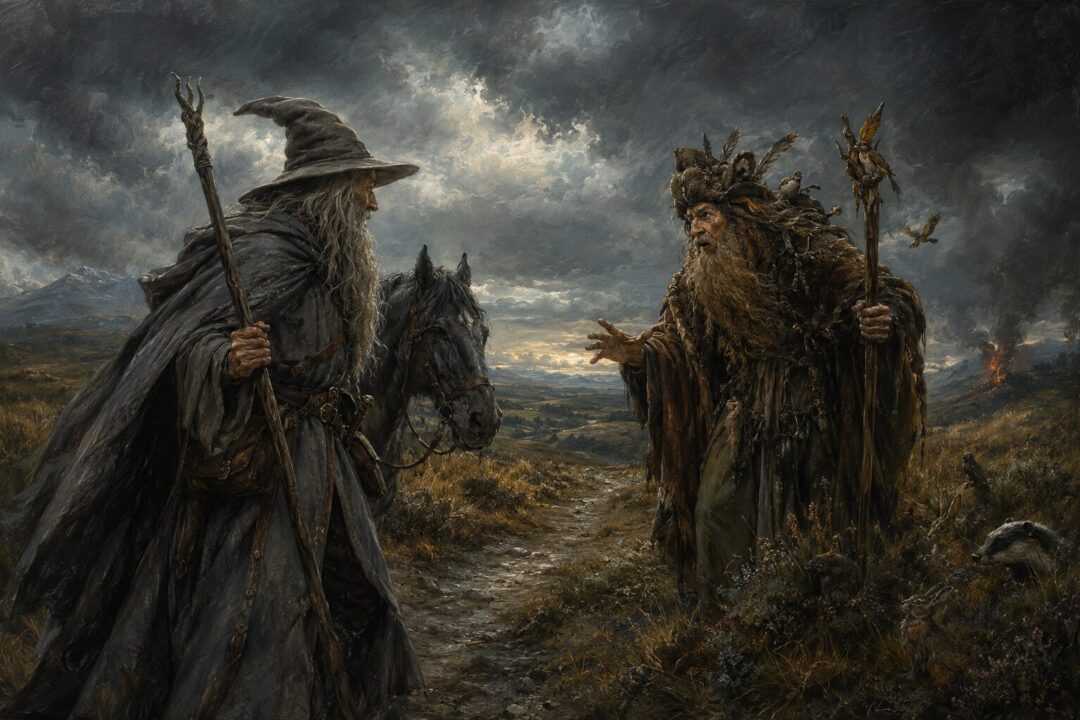
Radagast the Brown is easy to dismiss because the story gives us so little of him.
He is not present at the Council of Elrond. He does not ride to Minas Tirith. He does not challenge Saruman. He does not stand before the Balrog. By the time the War of the Ring reaches its full terror, Radagast has almost vanished from the great movements of Elves, Men, Hobbits, and Wizards.
And yet that absence is exactly what makes him interesting.
Radagast is often remembered as “the failed Wizard,” the one who cared too much for birds and beasts and too little for the struggle against Sauron. There is truth in that reading. The later traditions about the Istari do say that Radagast became absorbed in the wild creatures of Middle-earth and neglected the larger mission for which the Wizards were sent.
But his failure is not the same kind of failure as Saruman’s.
Saruman falls through pride, domination, envy, and desire for power. Radagast appears to fail through love — or at least through a love that became too narrow. That difference matters. It makes his story less simple, less contemptible, and more quietly tragic.
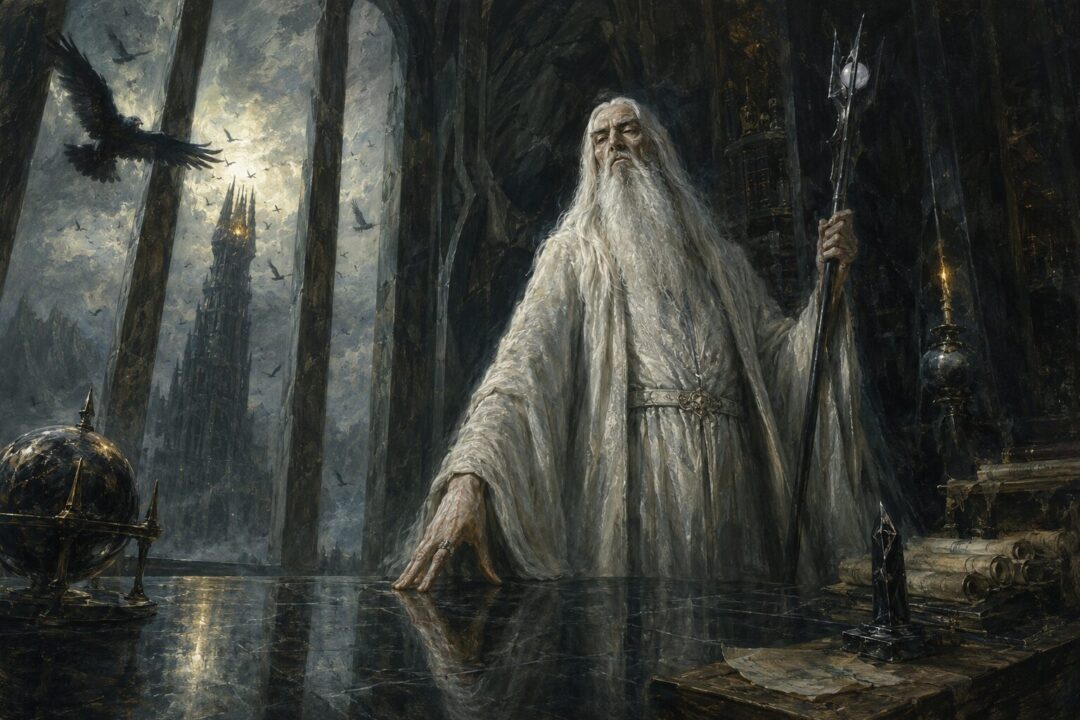
The Wizards Were Not Sent to Rule
To understand Radagast, we first have to remember what the Istari were.
The Wizards were not merely old men with staffs and strange powers. They were sent into Middle-earth in the Third Age to oppose Sauron, but they were not sent to conquer him by force or replace him with another power. Their role was to guide, counsel, encourage, and strengthen the free peoples against the Shadow.
That mission was dangerous precisely because it required restraint.
The Wizards came clothed in the forms of old men. They could feel weariness, fear, and temptation. They were powerful, but their power was veiled. Their task was not to become kings, commanders, or saviors who took the burden away from Middle-earth. They had to awaken resistance in others.
This is why Saruman’s failure is so catastrophic. He does not merely become lazy or distracted. He rejects the whole spirit of the mission. He begins to desire the Ring, to imitate Sauron, and to use knowledge as an instrument of control.
Radagast’s failure is quieter. He does not seem to seek mastery. He does not build armies. He does not make rings. He does not betray Gandalf out of malice. If he fails, it is because he withdraws from the central struggle into another part of Middle-earth’s life.
And that raises the uncomfortable question: how wrong was he?
Radagast Loved What Was Also Worth Saving
Radagast is not associated with courts, councils, towers, or wars. He is associated with the living world.
Gandalf describes him as a worthy Wizard, learned in herbs, beasts, and birds. In The Hobbit, Beorn knows of him, which places Radagast close to the world of woods, wild lands, and creatures outside the concerns of kings. His dwelling, Rhosgobel, lay near the borders of Mirkwood, a region where the corruption of the forest was not abstract. Darkness there was not only political or military. It crept among trees, spiders, shadows, and living things.
This matters because Sauron’s evil is not limited to armies and fortresses. The Shadow also poisons lands. It twists creatures. It spreads fear into forests and desolates once-living places. Mirkwood itself is one of the clearest examples of that slow corruption.
So Radagast’s concern for birds and beasts is not silly in itself. It is not a hobby. It is connected to a real part of what is at stake in Middle-earth.
The free peoples are not fighting merely to preserve thrones. They are fighting to preserve a world in which ordinary life can continue: gardens, trees, animals, songs, harvests, homes, and unnoticed living things. In that sense, Radagast’s love is not opposed to the meaning of the struggle. It belongs to it.
The problem is not that he loved the natural world.
The problem is that he seems to have loved it in a way that made him withdraw from the peoples who also needed him.

“Forsook Elves and Men” Is the Hardest Line
The sharpest judgment on Radagast comes from the tradition that says he became enamoured of the many beasts and birds of Middle-earth and forsook Elves and Men.
That word “forsook” is severe.
It does not mean he merely had a specialty. It suggests abandonment. The Istari were sent to help resist Sauron by working among the peoples of Middle-earth. If Radagast increasingly spent his days among wild creatures while neglecting Elves and Men, then he was no longer fulfilling the central purpose of his order.
But even here the failure is complicated.
Radagast does not appear to hate Elves and Men. He does not despise Hobbits. He is not shown refusing aid to Gandalf. When he meets Gandalf near Bree, he delivers Saruman’s message. He warns him that the Nazgûl are abroad. He believes the danger is real. He also agrees to send word among his friends, the birds and beasts, so that news may be carried.
That choice becomes important. Gwaihir later comes to Orthanc with news and discovers Gandalf imprisoned. Without that arrival, Gandalf’s escape from Saruman’s tower would have been far more difficult.
So Radagast is not useless in the story. He becomes, unintentionally, part of Gandalf’s rescue.
That is the strange irony of him. His network of birds and beasts, the very thing that marks his withdrawal, also helps save the one Wizard who remains faithful to the mission.
Saruman Uses Radagast Because Radagast Trusts Him
Radagast’s most visible role in The Lord of the Rings is painful because he is used.
Saruman sends him to bring Gandalf to Orthanc. Radagast appears to believe the message is urgent and genuine. He tells Gandalf that the Nine are abroad and that Saruman has knowledge they need. Gandalf trusts the warning enough to go.
Only later does Gandalf learn how thoroughly Saruman has manipulated the situation. Saruman mocks Radagast as simple and foolish, boasting that the Brown Wizard served the purpose set for him.
Saruman’s contempt has shaped how many readers remember Radagast. But Saruman is not a neutral judge. By this point he is already corrupt, proud, and treacherous. His mockery tells us a great deal about Saruman. It does not necessarily tell us the whole truth about Radagast.
Radagast is deceived because he trusts Saruman’s stated purpose. That trust may be naïve. It may show a dangerous lack of discernment. But it is not the same as betrayal.
In fact, Radagast seems to act in good faith. He thinks he is helping the effort against Sauron. He thinks Saruman, the head of the order, is still part of that effort. His failure is not that he chooses evil. It is that he cannot see how evil has entered the very hierarchy he still trusts.
That is one of the more tragic kinds of failure in Middle-earth: not the lust for power, but the inability to recognize when wisdom has rotted.

The Difference Between Humility and Evasion
Radagast’s withdrawal raises a deeper question. When does humility become evasion?
There is something admirable about a Wizard who does not seek attention. Radagast is not hungry for fame. He does not appear at councils demanding honor. He does not try to command armies. Compared with Saruman, his smallness almost looks virtuous.
But Middle-earth is full of moments where goodness must step forward. The Ring cannot be defeated by private innocence alone. Evil is not stopped merely because one has preserved a corner of tenderness. At some point, the crisis of the age demands action, risk, and contact with the wounded world of other people.
This is where Radagast’s story becomes morally uncomfortable.
A love of birds and beasts may be pure. A life among quiet creatures may seem harmless. But if that love becomes a refuge from responsibility, then even something good can become a form of failure.
That is very Tolkienian. Evil often corrupts good things by twisting their proper measure. Knowledge becomes pride in Saruman. Desire for preservation becomes possessiveness in the Elves. Love of the Shire becomes, for some Hobbits, suspicion of anything beyond its borders. Even good attachments can become dangerous when they close the heart against a larger duty.
Radagast may represent a gentler version of that pattern. He does not become wicked. He becomes insufficient.
Why Gandalf Succeeds Where Radagast Does Not
Gandalf also loves small things. He loves Hobbits, gardens, fireworks, food, laughter, and ordinary courage. He is not less humble than Radagast. In some ways, he is the Wizard most attentive to the overlooked.
The difference is that Gandalf’s love for the small never cuts him off from the great struggle. It sends him deeper into it.
He loves the Shire, so he watches over it. He loves Hobbits, so he risks everything to help them play their part. He values ordinary life, so he confronts the powers that would destroy it. Gandalf’s humility does not become retreat. It becomes service.
Radagast’s love, by contrast, seems to narrow. The texts imply that his care for beasts and birds gradually drew him away from Elves and Men. He preserved a relationship with the wild world, but lost the broader mission of the Istari.
This contrast is important because it prevents an easy answer. Radagast is not wrong because animals do not matter. He is wrong because the defense of Middle-earth required a union of many loves: love of forests, love of free peoples, love of humble homes, love of truth, and resistance to domination.
Gandalf keeps those loves connected. Radagast does not.
Was Radagast Completely Useless?
No. That would be too harsh.
Radagast helps carry warning. He sends out birds and beasts for news. His association with the Eagles indirectly contributes to Gandalf’s escape from Orthanc. He is respected enough by Gandalf to be called worthy. Beorn knows him. His knowledge of living things is real.
The texts do not give us enough to claim that Radagast did nothing good after withdrawing from the affairs of Elves and Men. They also do not tell us his final fate. After the War of the Ring, he simply falls out of the narrative.
That silence is part of the mystery.
One conservative reading is that Radagast failed the central mission of the Istari, but not because he became evil. Another reading is that his partial faithfulness still mattered in ways the larger histories barely noticed. He may have failed as a counselor of peoples while still serving, in some limited measure, the vulnerable life of Middle-earth.
But we should not soften the evidence too much. The tradition does say that only one of the Istari remained fully faithful, and that was Gandalf. Radagast, therefore, cannot be turned into a hidden equal of Gandalf without going beyond the texts.
He failed.
The question is what kind of failure it was.
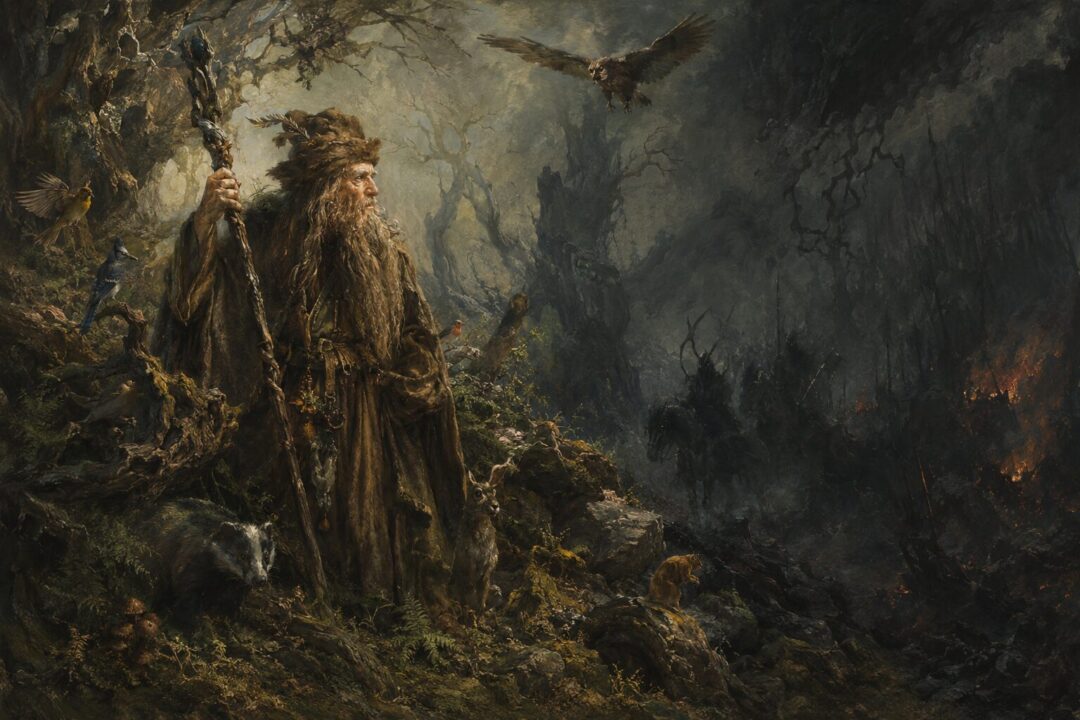
The Tragedy of a Good Love Made Too Small
Radagast’s failure is less simple than fans think because it is not a story of stupidity. It is not even clearly a story of cowardice. It is the story of a good love that became too small for the hour in which he lived.
He loved creatures that were worth loving. He cared for a part of Middle-earth that Sauron’s shadow also threatened. He did not desire the Ring. He did not build Orthanc’s engines. He did not breed armies or dream of becoming a rival Dark Lord.
But he was sent into Middle-earth for more than private tenderness.
The War of the Ring required those who loved the world to risk themselves for it. Frodo had to leave the Shire. Aragorn had to leave exile and claim the burden of kingship. Théoden had to ride out from despair. Treebeard had to awaken from long patience. Even the Ents, slow and ancient, eventually had to move.
Radagast, as far as the surviving story shows, never fully makes that turn.
That is why his failure hurts more than a simple joke about a bird-tamer. He reminds us that one can love real and beautiful things, and still fail to answer the larger call. He shows that innocence is not the same as faithfulness, and that gentleness alone is not enough when the Shadow is moving.
Radagast was not Saruman. That distinction should be preserved.
But he was not Gandalf either.
Between those two truths lies the sad, quiet complexity of the Brown Wizard: not a villain, not a hero, not a fool in the way Saruman says — but a servant of Middle-earth whose love did not widen enough when the world most needed it.
Sources & Notes
- J.R.R. Tolkien, The Lord of the Rings, Book II, Chapter 2, “The Council of Elrond” — Gandalf’s account of Radagast bringing Saruman’s summons, warning of the Nazgûl, and sending birds and beasts to gather news.
- J.R.R. Tolkien, The Lord of the Rings, Book III, Chapter 10, “The Voice of Saruman” — Saruman’s manipulative rhetoric and will to command, useful for contrasting his corruption with Radagast’s quieter failure.
- J.R.R. Tolkien, The Hobbit, Chapter 7, “Queer Lodgings” — Beorn’s reference to Radagast and Rhosgobel near Mirkwood, grounding Radagast’s association with wild lands and creatures.
- J.R.R. Tolkien, The Silmarillion, “Of the Rings of Power and the Third Age” — the coming of the Istari as emissaries from the West to oppose Sauron by counsel rather than domination.
- J.R.R. Tolkien, Unfinished Tales, “The Istari” — the fullest late account of the Wizards’ mission, including Radagast’s attachment to beasts and birds and the statement that only Gandalf remained wholly faithful.
- J.R.R. Tolkien, The Letters of J.R.R. Tolkien, Letter 131 — Tolkien’s summary of Sauron’s desire for order and domination, supporting the article’s contrast between preservation, service, and coercive power.