Frodo Baggins does not carry a sword strong enough to defeat Sauron. He does not command armies, wield great magic, or possess ancient wisdom. Yet in the deepest darkness of Mordor, when hope has almost failed, he reaches for a small crystal phial that contains the light of a star.
That light is not symbolic decoration. It has a history older than Gondor, older than the Rings of Power, older even than the Sun and Moon as Middle-earth knows them.
The light inside Galadriel’s Phial comes from Eärendil’s star.
And that means that when Frodo raises the Phial against Shelob, against terror, despair, and the crushing presence of Mordor, he is drawing on one of the oldest acts of hope in Tolkien’s legendarium.
The Gift Galadriel Actually Gives Frodo
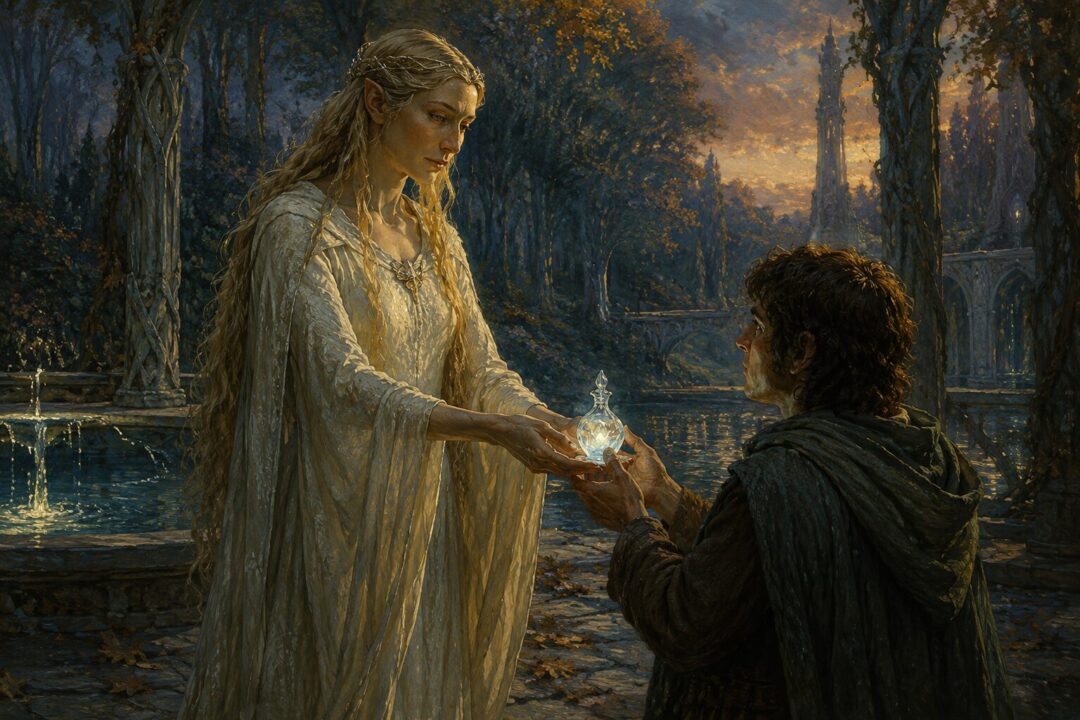
When the Fellowship departs from Lórien, Galadriel places a small crystal vessel in Frodo’s hand.
Inside burns “the light of Eärendil’s star, set amid the waters of my fountain.”
At first glance, the gift can seem almost modest beside swords, cloaks, boats, and lembas. But Galadriel herself frames it differently. She tells Frodo that it may shine for him “when all other lights go out.”
That is not poetic exaggeration.
The Phial becomes most important precisely when ordinary forms of strength no longer matter. It is useful not in victory but in endurance. Not in battlefields filled with allies, but in tunnels, wastelands, and spiritual exhaustion.
To understand why this tiny vessel carries such weight, we must go backward through thousands of years of Middle-earth’s history.
Because Eärendil’s star is not merely a star.
It is a Silmaril.
The Light Inside the Phial Begins With the Silmarils
Long before the War of the Ring, the Elven craftsman Fëanor created the Silmarils: three jewels containing the unsullied light of the Two Trees of Valinor.
These Trees, Telperion and Laurelin, illuminated the Blessed Realm before the making of the Sun and Moon. Their light represented something uniquely pure in Tolkien’s mythology: beauty untouched by the later marring of the world.
After Morgoth destroyed the Trees, their original light survived most perfectly within the Silmarils.
That inheritance matters.
Galadriel’s Phial does not contain ordinary starlight gathered from the night sky. Through Eärendil’s star, it carries a distant reflection of the ancient light of Valinor itself.
But how does a Silmaril become a star visible above Middle-earth?
That story leads to Eärendil.
Eärendil: The Mariner Who Reached the Undying Lands
Eärendil stands at one of the great turning points of the Elder Days.
Born from the union of the human Tuor and the Elf Idril, daughter of Turgon of Gondolin, Eärendil embodies one of Tolkien’s recurring themes: crossing boundaries that seem impossible to cross.
After the ruin of the great Elven realms in Beleriand, hope among Elves and Men is collapsing beneath Morgoth’s power.
Eärendil undertakes a desperate mission.
With the Silmaril brought to him by Elwing, he sails westward seeking the Blessed Realm — a place forbidden to mortal access and hidden from ordinary voyagers.
The achievement is extraordinary precisely because success is not assumed. The narratives of the Elder Days are full of failed resistance, shattered kingdoms, and catastrophic pride. Eärendil’s voyage is one of the rare moments where desperate petition reaches beyond Middle-earth’s closed circle.
He arrives in Aman and speaks on behalf of both Elves and Men.
The result is the War of Wrath: the intervention of the Valar against Morgoth, ending the First Age.
Without Eärendil’s journey, the overthrow of Morgoth as described in the texts may never have occurred.
But his story does not end with his plea.
Why Eärendil Becomes a Star
After Morgoth’s defeat, the Silmaril associated with Eärendil does not return to hidden keeping.
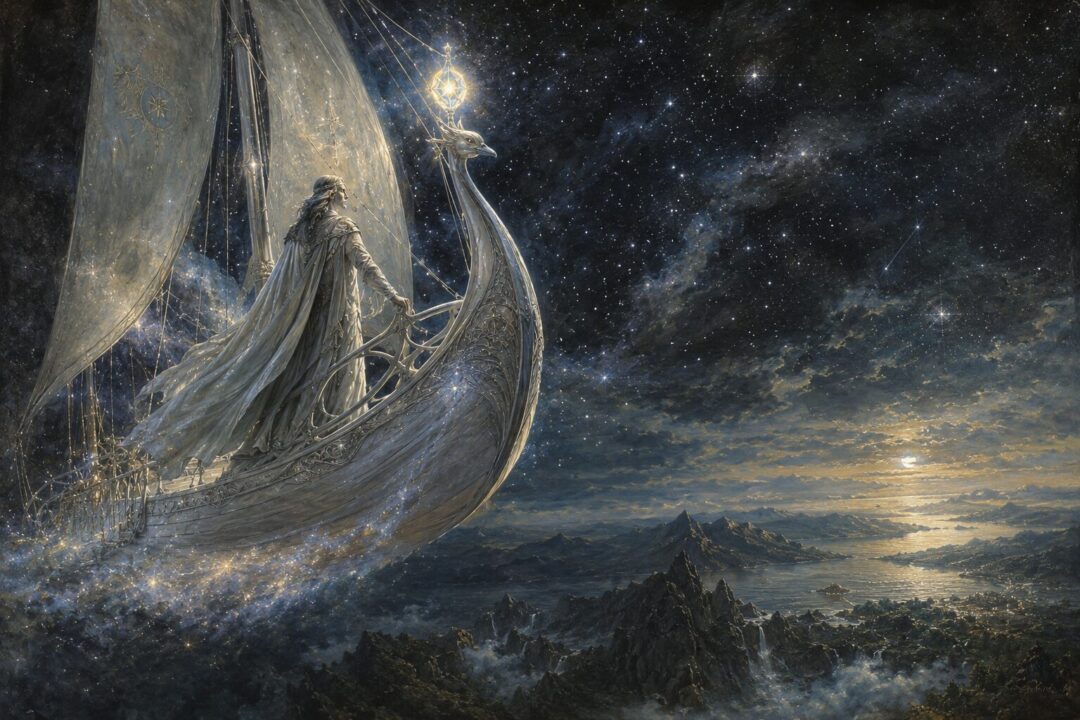
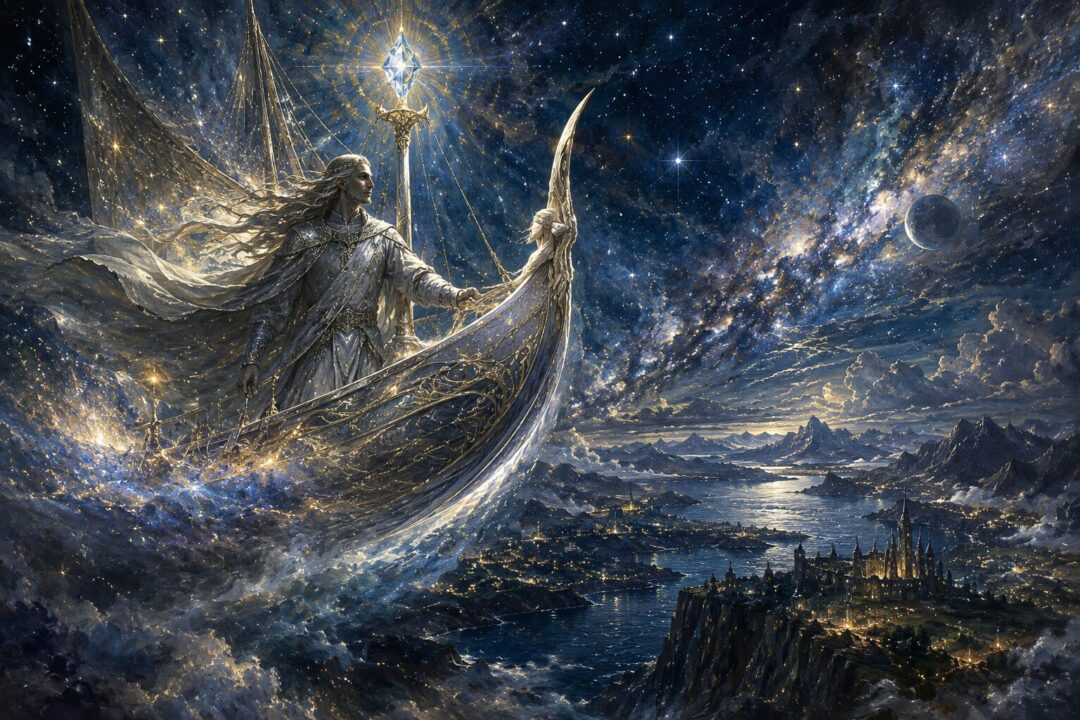
Instead, Eärendil sails the heavens bearing it.
In Tolkien’s mythology, the bright evening and morning star seen from Middle-earth becomes identified with Eärendil’s ship carrying the Silmaril across the sky.
The imagery is important because Tolkien consistently presents Eärendil’s star not merely as a celestial object but as a sign.
A sign of survival after catastrophe.
A sign that darkness, however overwhelming, is not absolute.
The peoples of Middle-earth remember it that way. Elvish hymns praise Eärendil. His name survives in songs, lore, and reverence across immense spans of time.
When Sam later sees a star shining through the clouds in Mordor, he experiences a brief but profound realization: the Shadow is only “a small and passing thing” beneath enduring beauty.
The text does not explicitly say that this particular star is Eärendil’s star. Readers often associate the moment with it, and that reading fits Tolkien’s wider symbolic pattern, but the narrative itself remains more restrained.
The connection becomes explicit, however, in the Phial.
Because Galadriel names its source directly.
Why Shelob Fears the Light
The confrontation with Shelob reveals the Phial’s deepest significance.
Shelob is not simply a giant spider. She descends from Ungoliant, the ancient being whose hunger reached even the light of the Two Trees.
That ancestry matters.
Ungoliant consumed light, devoured radiance, and participated in the destruction that darkened Valinor itself. Shelob inherits part of that monstrous relationship with light, darkness, and devouring appetite.
When Frodo and Sam face Shelob in Cirith Ungol, they are confronting a creature spiritually connected to some of the oldest darkness in the legendarium.
And what weapon burns against her?
Not steel alone.
Frodo raises Galadriel’s gift and invokes a name from ancient Elvish tradition:
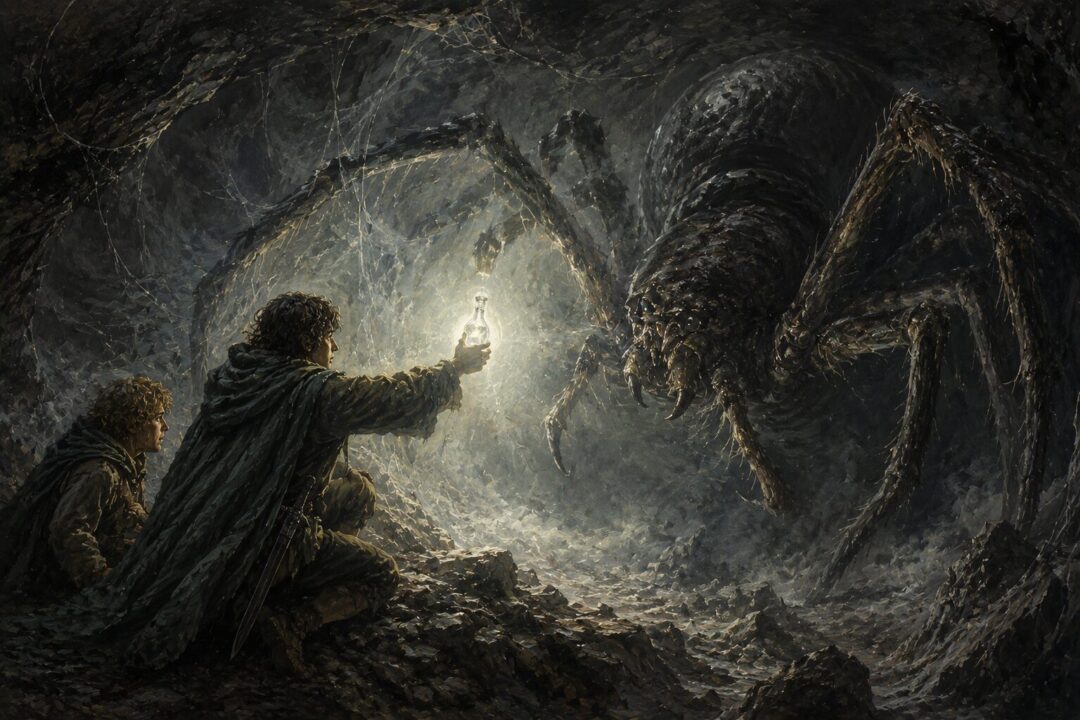
“Aiya Eärendil Elenion Ancalima!”
“Hail Eärendil, brightest of stars!”
The moment is not random ornamentation or exotic language for atmosphere.
Frodo is consciously calling upon the mariner whose star bears the light of the Silmaril.
The Phial blazes.
Shelob recoils.
The scene creates a deliberate thematic collision: inherited darkness confronted by inherited light.
Not modern technological light against monster-darkness, but one ancient mythic force answering another.
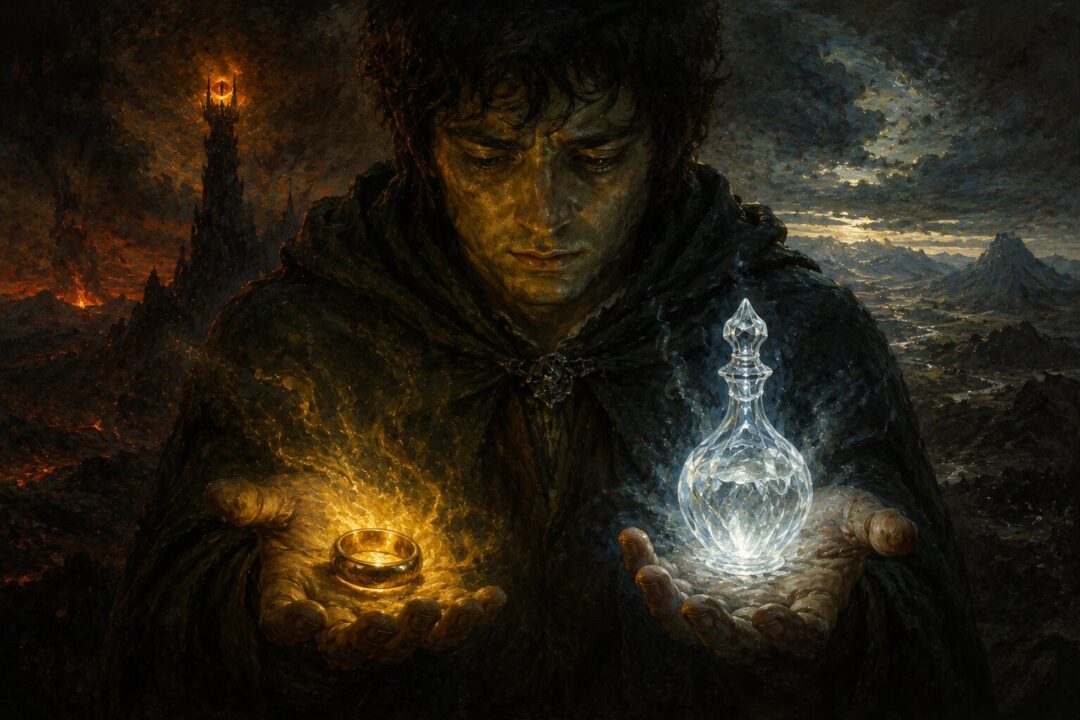
The Hidden Irony: Frodo Carries the Opposite of the Ring
The Ring and the Phial operate almost like moral inversions.
The Ring grows heavier the closer Frodo comes to its source. It isolates, dominates, and narrows perception. It promises control while consuming freedom.
The Phial does nearly the opposite.
It does not command.
It does not empower Frodo into greatness.
It gives orientation, memory, and the ability to continue.
One object contains concentrated will toward domination. The other preserves remembered light from before much of Middle-earth’s corruption.
This contrast is especially powerful because Frodo carries both at once.
The quest is not merely about transporting evil toward destruction. It is also about whether a fragile person can retain enough inner clarity to keep moving while bearing evil.
The Phial matters because Tolkien’s world does not assume courage can sustain itself indefinitely.
People need reminders.
Songs matter. Memory matters. Gifts matter. Ancient lights matter.
Why Eärendil’s Story Matters to the End of The Lord of the Rings
By the Third Age, Eärendil’s voyage belongs to unimaginably distant history.
Empires have risen and fallen. Beleriand lies drowned beneath the sea. Languages, peoples, and kingdoms have changed.
Yet the light survives.
That continuity is one of the quiet structural ideas underlying Tolkien’s mythology: small acts in one age can preserve hope for people who will never know their names.
Frodo does not meet Eärendil.
He inherits Eärendil.
He inherits a world shaped by sacrifices, voyages, defeats, remembered stories, and preserved beauty reaching backward into forgotten ages.
Galadriel’s gift becomes meaningful not because it grants invincibility, but because it links a frightened hobbit in Mordor to an older chain of resistance against darkness.
And that may be why the Phial feels so emotionally powerful to readers.
It embodies one of Middle-earth’s deepest rules.
Hope is rarely new.
Often it is ancient light carried forward by hands that did not create it.
When Frodo lifts the Phial in the blackness beneath Mordor’s shadow, the moment is not just about a glowing crystal.
It is the light of the Two Trees, preserved in a Silmaril, borne by Eärendil across the heavens, remembered by Galadriel, and entrusted at last to a hobbit who needs enough light to take one more step.
That is why Eärendil is the star behind Frodo’s light.
Sources & Notes
- J.R.R. Tolkien, The Fellowship of the Ring, Book II, Chapter 8, “Farewell to Lórien” — Galadriel gives Frodo the Phial, naming its light as “the light of Eärendil’s star” and saying it may shine when all other lights go out.
- J.R.R. Tolkien, The Two Towers, Book IV, Chapter 9, “Shelob’s Lair” — Frodo raises the Phial against Shelob and cries “Aiya Eärendil Elenion Ancalima,” directly linking the scene to Eärendil’s star.
- J.R.R. Tolkien, The Silmarillion, “Of the Voyage of Eärendil and the War of Wrath” — Eärendil reaches Aman, pleads for Elves and Men, and is set to sail the heavens bearing the Silmaril.
- J.R.R. Tolkien, The Silmarillion, “Of the Silmarils and the Unrest of the Noldor” — the Silmarils preserve the unmarred light of the Two Trees, explaining the deeper origin of the Phial’s radiance.
- J.R.R. Tolkien, The Silmarillion, “Of the Darkening of Valinor” — Ungoliant’s assault on the Two Trees provides the mythic background for Shelob’s inherited darkness and hostility to light.
- J.R.R. Tolkien, The Return of the King, Book VI, Chapter 2, “The Land of Shadow” — Sam’s vision of a star above Mordor supports the article’s theme of ancient light and hope surviving beyond the Shadow.