The name itself is almost misleading.
The Undying Lands sound like a place where death has been defeated. They lie beyond the bent seas, west of Middle-earth, where the Valar dwell, where the Eldar may return, and where Frodo, Bilbo, and later Sam are permitted to sail after the War of the Ring. To a casual reader, it can feel like a kind of heaven: a final shore where pain ends and beloved characters live forever.
But that is not what the texts say.
The Undying Lands are not called “undying” because they make visitors immortal. They are undying because the deathless dwell there. Aman is hallowed by the presence of the Valar and the Eldar, but it does not change the nature of a mortal being. A Man, Hobbit, or Dwarf who comes there does not become an Elf. He does not escape the Doom of Men. He does not step outside the design of the world simply by reaching a brighter shore.
That is the great hidden tension behind every mortal voyage into the West.
The road may lead to healing. It may lead to peace. It may even lead to a mercy unavailable anywhere else in Middle-earth. But it does not lead to endless bodily life.
The Undying Lands Were Never a Cure for Mortality
The strongest lore-grounded answer comes from the Númenórean tragedy.
In the Akallabêth, the Men of Númenor begin with a special grace. They are given a great island, long life, wisdom, and friendship with the Eldar. But they are also given a boundary: they must not sail so far west that Númenor can no longer be seen. The Ban of the Valar is not simply a territorial rule. It is meant to protect them from a desire that will destroy them.
Over time, the Númenóreans begin to resent death. Their long lives become not enough. Their greatness makes the end feel more bitter, not less. The Eldar seem to them untouched by the fear that torments Men. Aman becomes, in their imagination, not a holy land but a prize: the place where immortality must be hidden.
The answer given to them is severe and clear. It is not the land of Aman that makes its people deathless. Rather, the deathless dwell there and have hallowed the land. If mortals entered that realm, they would not gain immortality. The texts imply they would find their own mortality more painful, not less, like moths drawn into a light too strong for them.
This distinction matters. Aman is not a machine that alters the soul. It is not a fountain of eternal life. It is a realm fitted to beings whose lives are bound to Arda until the end of the world.
Mortals are different.
The Gift of Men Could Not Be Taken Away
The deepest reason mortals remain mortal is that death, in this legendarium, is not merely a biological accident. For Men, it is part of their nature.
The Eldar are bound to the world. Even when their bodies are slain, their spirits remain within Arda, and their fate is tied to the world’s story until its end. Their immortality is not simple happiness. It is also a kind of confinement. They endure the long grief of memory. They watch beauty decline. They cannot leave the circles of the world.
Men are given another destiny. Their lives are shorter, and their spirits depart beyond the known world after death. The Wise do not fully know where they go. That mystery becomes frightening, especially after the corruption of Morgoth has darkened human thought. But the texts repeatedly frame mortality, at least in its original meaning, as a gift, not as a punishment.
That is why the Valar cannot simply make Men immortal.
The Valar are powerful, but they are not the authors of the ultimate destiny of Elves and Men. They can guide, guard, govern, and hallow. They can summon, warn, and restrain. But they cannot rewrite the fundamental nature given to a race. Mortality is not a curse the Valar can remove by invitation. Nor is immortality a blessing they can hand out as a reward for reaching their shore.
This is why the Númenórean desire becomes so tragic. They are not asking merely for longer life. They are asking to become something other than what they are.
And that request cannot be granted.
Why Aman Would Not Help a Mortal Cling to Life
There is another sharp irony in the lore: Aman may actually be the wrong place for a mortal who wants to escape death.
The Númenóreans imagine the Undying Lands as a solution to the fear of death. But the warning given to them suggests the opposite. In a realm unmarred, or less marred, than Middle-earth, among beings who do not age as Men do, a mortal would feel the wound of passing time more intensely.
In Middle-earth, everyone lives amid change. Seasons turn, kingdoms rise and fall, flowers bloom and wither, and even great works are worn by years. But in Aman, the contrast would be unbearable. The land is not subject to the same visible decay. The Elves do not age toward death in the manner of Men. The Valar are beyond mortal measure.
A mortal standing there would not become deathless. He would become more aware that he is not deathless.
That is the image behind the moths and the light. The brightness is real. The holiness is real. But the mortal body is not made to abide there forever. The problem is not that Aman is evil for Men. The problem is that Men are not meant to possess it as a permanent home.
This is one reason the Ban of the Valar should not be read only as jealousy or punishment. It is also protection. The forbidden shore is dangerous because it tempts Men to misunderstand both Aman and themselves.
Sauron’s Lie Worked Because It Twisted a Real Longing
Sauron’s corruption of Númenor succeeds because he does not invent the fear of death. He exploits it.
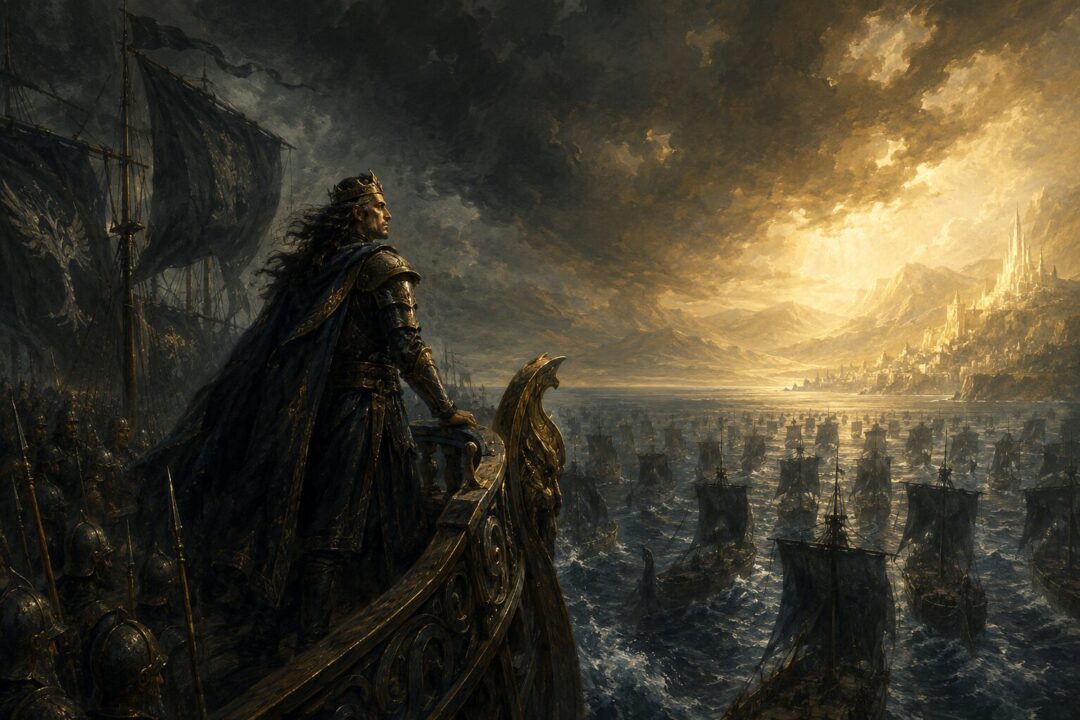
By the time Ar-Pharazôn takes Sauron captive, Númenor is already spiritually weakened. The King’s Men have grown proud, possessive, and resentful of the Valar and the Eldar. They look west and see exclusion. They look at death and see humiliation. Sauron gives their resentment a doctrine: the Valar are withholding immortality, and the deathless realm can be seized.
The lie is powerful because it turns a boundary into an insult.
But the invasion of Aman is based on a false premise. Ar-Pharazôn’s armada does not sail west to claim something that could have saved him. He sails toward a land that cannot give what he wants. Even if he had been allowed to dwell there, he would still have remained mortal. The tragedy is not simply that he fails to win immortality. It is that the thing he seeks was never available in the way he imagined.
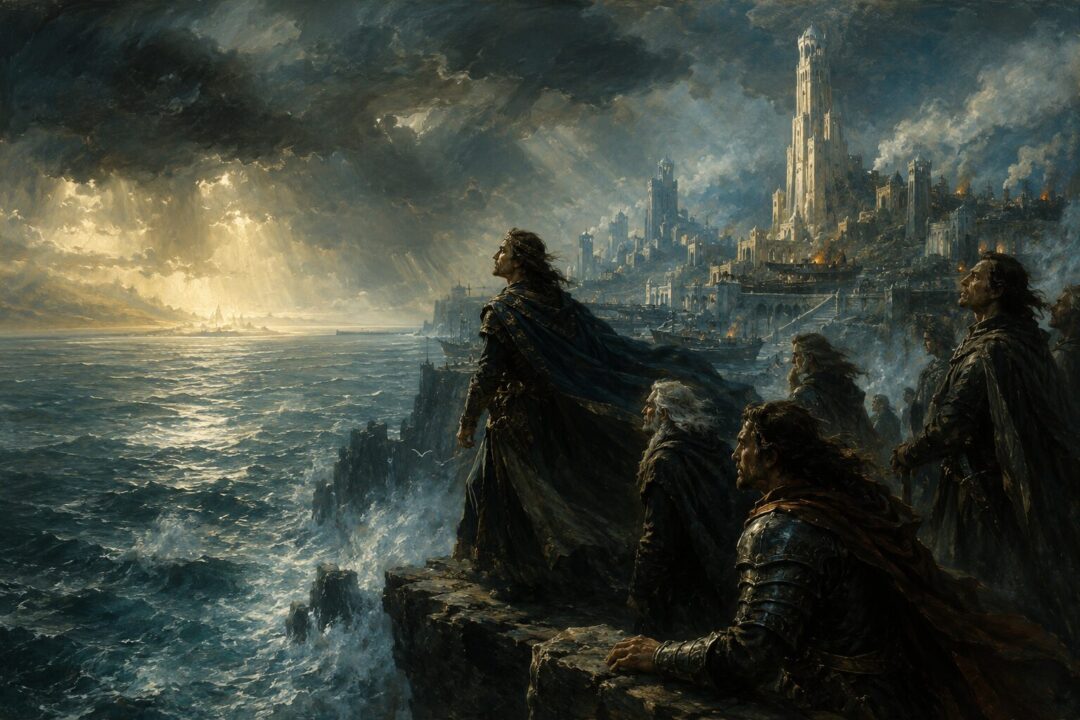
The Downfall of Númenor is therefore not only a punishment for pride. It is the collapse of a civilization that could no longer accept the shape of human life.
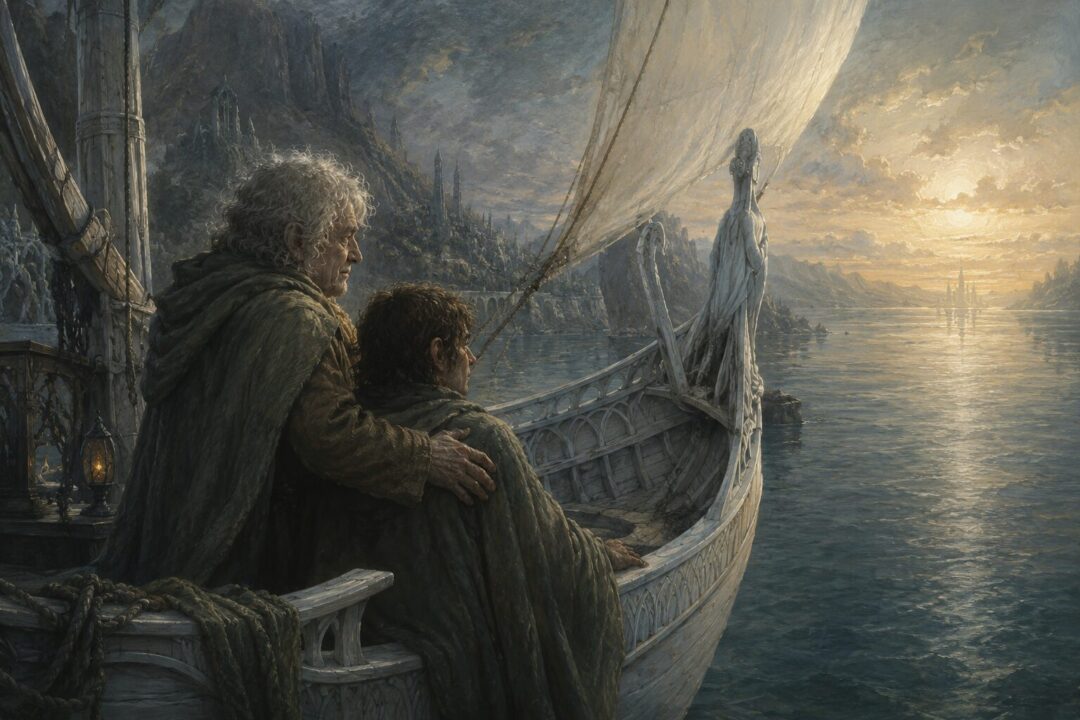
Frodo’s Voyage Was Healing, Not Immortality
This makes Frodo’s departure at the end of The Lord of the Rings much more poignant.
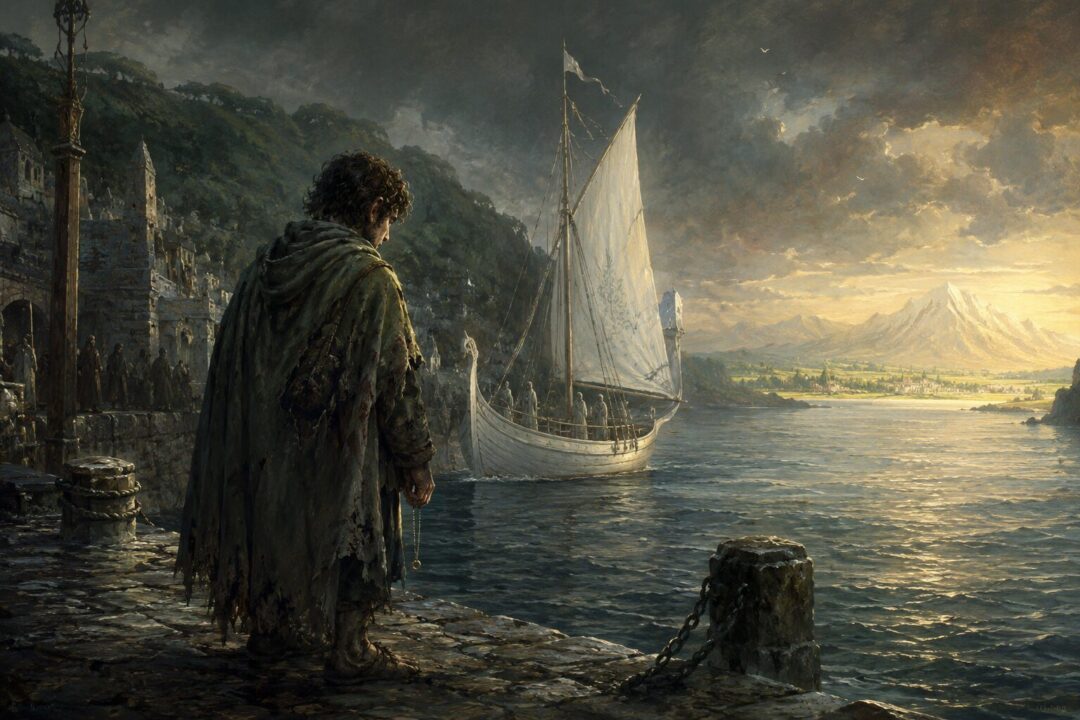
Frodo does not sail west because he has become too noble to die. He sails because Middle-earth can no longer heal him. The wound from Weathertop, the torment of the Ring, the memory of Shelob, the burden of Mount Doom, and the spiritual cost of his long resistance remain with him. The Shire is saved, but he cannot fully return to it.
The grace given to Frodo is not endless life. It is rest.
Bilbo, too, is mortal. Sam, when he later sails after Rosie’s death according to the appendices, remains mortal. Gimli’s case is exceptional in permission, but not in nature; the tradition that he went over Sea with Legolas does not mean he became an immortal being. These departures are best understood as special mercies granted to those deeply marked by the great events of the Third Age.
They are not loopholes in the fate of mortals.
This actually makes the ending more moving. Frodo is not rewarded with an escape from death. He is given a place where his wounds may be eased before death. His story does not end by overturning mortality, but by finding mercy within it.
The Difference Between Elvish Immortality and Mortal Hope
A common misunderstanding is to treat immortality as the highest possible reward in Middle-earth. The texts are more complicated.
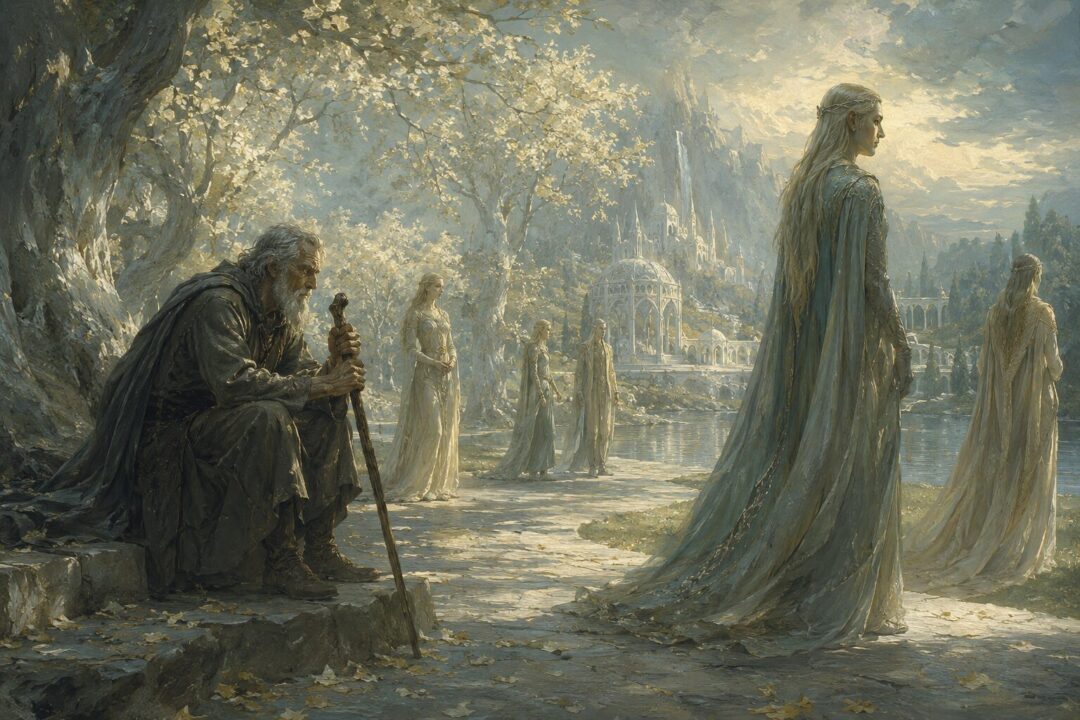
Elves do not die of age, but their immortality binds them to the slow sorrow of the world. Their memory is long, and therefore their grief is long. Their works fade. Their realms diminish. Their loves and losses remain present to them in a way mortals might barely be able to endure.
Mortals suffer because life is short. Elves suffer because life in Arda is long.
This contrast is essential to understanding Aman. For the Elves, the Undying Lands are a fitting refuge because their lives are already tied to the world. Aman does not make them immortal; it receives them as immortals. It is a place where their mode of existence belongs.
For Men, Hobbits, and Dwarves, the question is different. Their hope is not to remain forever inside Arda. Their destiny points beyond it, even if that destiny is mysterious. In that sense, asking for Elvish immortality may actually be asking for a lesser thing than the hidden gift already given to them.
That does not make death easy. The legendarium never pretends that mortality feels simple or painless. But it does suggest that the fear of death becomes destructive when it turns into envy, possession, and rebellion against the limits of created nature.
Why the Undying Lands Still Matter for Mortals
If mortals remain mortal in Aman, why allow any of them to go?
Because not every gift is immortality.
For Frodo, Bilbo, Sam, and perhaps Gimli, the West represents healing, honor, and release from burdens that Middle-earth cannot mend. They are not ordinary immigrants to a deathless paradise. They are wounded participants in a history shaped by the Ring, by loss, by loyalty, and by sacrifice.
Their permission to sail is extraordinary, but it is not a transformation of race or fate. It is more like being allowed, for a little while, to breathe air unpoisoned by the Shadow.
That is why the idea is so powerful. The Undying Lands do not erase mortality. They reveal what mortality means when fear is quieted. A mortal may go there and still die, but death no longer has to be approached under the same weight of torment, corruption, or unfinished pain.
The West is not a denial of the ending. It is a gentler road toward it.
The Real Meaning of the Forbidden Shore
The great mistake of Númenor was to believe that deathlessness could be taken by force.
The quiet mercy given to Frodo shows the opposite. The West cannot be conquered, bought, or used as a weapon against mortality. It can only be received, and only according to a wisdom larger than the desire to go on living.
Mortals in the Undying Lands remain mortal because place does not overrule nature. Aman is holy, but holiness is not the same as immortality. The Valar are mighty, but they cannot unmake the destiny of Men. The Elves are deathless, but their deathlessness is not a prize stolen from others. And death itself, however darkened by fear, is not merely an enemy to be defeated by sailing west.
That is the hidden sadness and beauty of the Undying Lands.
They are not heaven. They are not a cure for being human. They are not the end of death.
For a few wounded mortals, they are something more subtle: a place where the last part of life may be healed before the final mystery comes.
And in Middle-earth, that may be the deeper mercy.
Sources & Notes
- J.R.R. Tolkien, The Silmarillion, “Akallabêth” — the Ban of the Valar and the warning that Aman does not confer deathlessness on mortals.
- J.R.R. Tolkien, The Silmarillion, “Akallabêth” — Sauron’s exploitation of Númenórean fear of death and Ar-Pharazôn’s assault on Aman.
- J.R.R. Tolkien, The Silmarillion, “Of the Beginning of Days” — the Gift of Men and their fate beyond the circles of the world.
- J.R.R. Tolkien, The Lord of the Rings, Book VI, Chapter 9, “The Grey Havens” — Frodo and Bilbo’s departure as healing and mercy after the Ring, not a grant of immortality.
- J.R.R. Tolkien, The Lord of the Rings, Appendix B, “The Tale of Years” — later traditions of Sam’s westward sailing and Legolas bringing Gimli over Sea.
- J.R.R. Tolkien, The Letters of J.R.R. Tolkien, Letter 131 — Tolkien’s overview of Númenor, death as the Gift of God, and the temptation to seek bodily immortality.