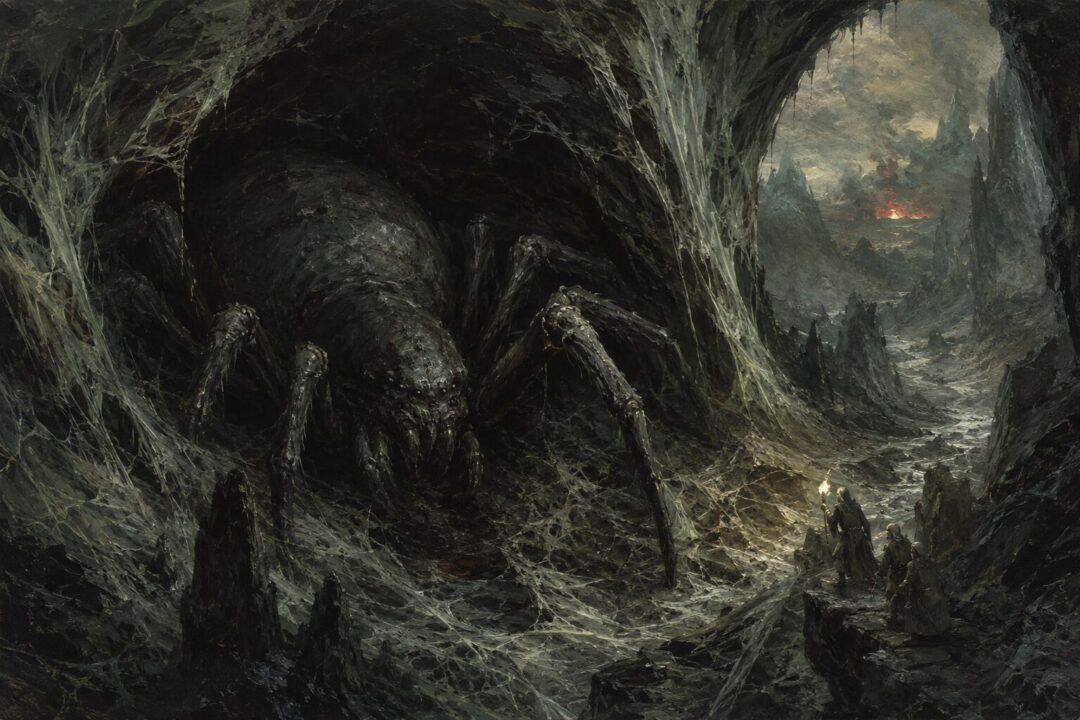
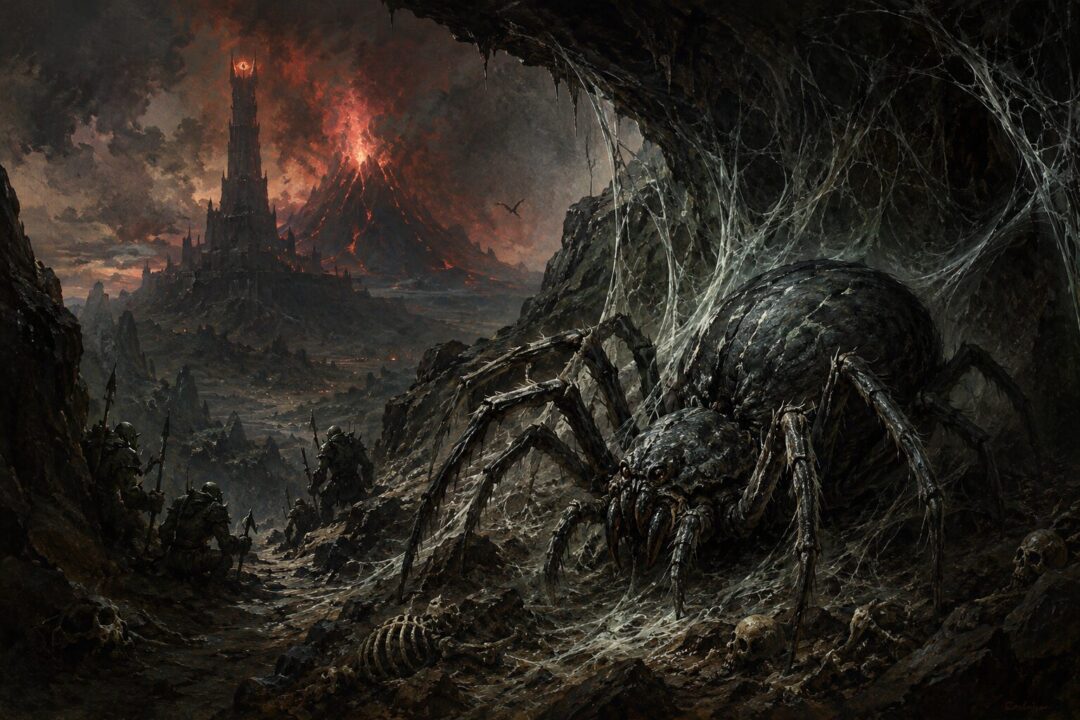
Shelob is easy to mistake for a monster placed in the story simply to frighten Frodo and Sam before Mordor.
She waits in the dark. She poisons. She devours. She turns a secret pass into a place of web, stench, and dread. On the surface, she looks like one more horror in Sauron’s land, another weapon of the Enemy guarding the road to Mount Doom.
But the deeper terror of Shelob is that she does not really belong to Sauron’s war at all.
She is older than Barad-dûr. Older than Sauron’s rule over Mordor. Older than the final military machine of the Third Age. She is not an Orc, not a Ringwraith, not a servant bred for the Dark Lord’s purpose. She is a survival from a deeper darkness: the last known child of Ungoliant, the great devourer associated with the ruin of the Two Trees in the Elder Days.
That makes Shelob more than an obstacle in Frodo’s path. She is a reminder that Middle-earth contains evils older, stranger, and less political than Sauron’s empire. Sauron wants dominion. Shelob wants consumption. And that difference matters.
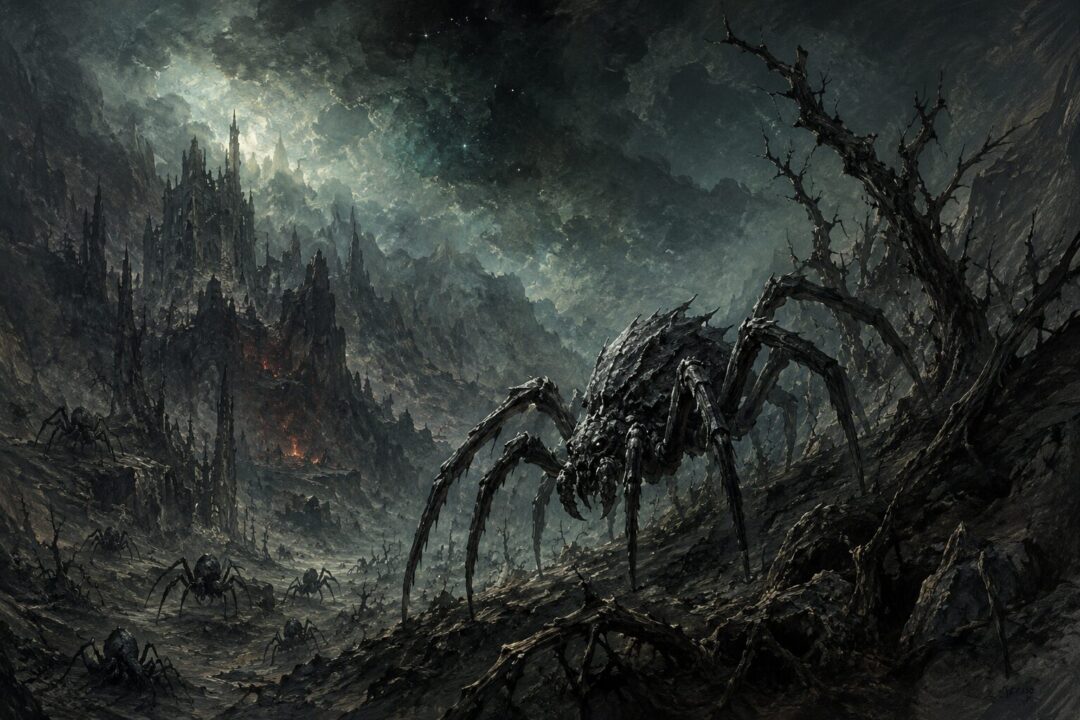
Shelob Was Not Sauron’s Creature
The most important correction is simple: Shelob was not created by Sauron.
The text presents her as already dwelling in her lair before Sauron’s fortress of Barad-dûr was built. That detail places her presence in the Ephel Dúath far earlier than many casual readers assume. Sauron may rule Mordor in the Third Age, but Shelob’s darkness is not merely an extension of his government.
She occupies Torech Ungol, the tunnel near Cirith Ungol, as a power in her own right. Orcs fear her. Gollum reveres and bargains with her in his own twisted way. Sauron knows of her and benefits from her presence, but the relationship is not one of ordinary command.
The texts imply a dark convenience rather than obedience. Shelob guards a dangerous pass because she is there, because she is hungry, and because anything trying to enter that way risks becoming her prey. Sauron can make use of that. But using a horror is not the same as owning it.
This is one of the most unsettling things about Mordor. Even at the edge of Sauron’s ordered tyranny, there remains something older and more animal, something that does not care about armies, strategy, thrones, or Rings.
Shelob is not a soldier. She is an appetite.
The Shadow Behind Shelob: Ungoliant
Shelob’s ancestry reaches back to Ungoliant, one of the most mysterious and terrible beings in the legendarium.
Ungoliant appears in the Elder Days as a monstrous spider-like being associated with darkness, hunger, and the destruction of light. She joins Melkor in the assault on the Two Trees of Valinor, drinking their light and helping bring about one of the great catastrophes of the ancient world.
Her exact origin is not fully explained in a clean, mechanical way. That uncertainty is part of the horror. She is connected with darkness beyond ordinary understanding, and she grows through devouring. She does not merely kill. She consumes light, beauty, and power.
Shelob is not Ungoliant herself. That distinction matters. Shelob is described as the last child of Ungoliant to trouble the unhappy world. She is lesser than that primeval terror, but she carries its inheritance: secrecy, webs, hunger, darkness, and a hostility to living light.
This means Shelob is a surviving fragment of a much older disaster. When Frodo and Sam enter her tunnel, they are not simply walking into a monster’s cave. They are entering a remnant of the Elder Days, a piece of ancient nightmare preserved on the border of Mordor.
Older Than Barad-dûr, Older Than the War
Sauron’s war in The Lord of the Rings is vast. It involves kingdoms, alliances, sieges, ancient claims, and the fate of the One Ring. It feels like the central darkness of the world.
Yet Shelob’s presence reminds us that Sauron’s war is not the beginning of evil.
Before the War of the Ring, before the long preparations in Mordor, before the Dark Tower became the central symbol of the Enemy, Shelob was already in the mountains. She had come out of older ruin and made her lair in a place that would later become strategically important.
This gives the Cirith Ungol episode a strange depth. Frodo and Sam are not only approaching the newest crisis of the Third Age. They are passing through an older layer of evil beneath it.
Mordor is Sauron’s realm, but not every evil thing inside or beside it originates with him. Some darkness he commands. Some he corrupts. Some he merely tolerates. Some he cannot fully master but can still exploit.
Shelob belongs to that last category.
Sauron’s Dominion Versus Shelob’s Hunger
Sauron’s evil is organized. It builds towers, roads, armies, fortresses, engines, and systems of surveillance. He wants to control wills. His great Ring is not merely a weapon but a mechanism of domination.
Shelob’s evil is different.
She does not want to rule Gondor. She does not want the Ring. She does not seek tribute, worship, or political victory. The texts present her as concerned with her own feeding, her own darkness, and her own brooding independence.
That makes her terrifying in another way. Sauron’s evil is imperial. Shelob’s evil is devouring.
One seeks to possess the world. The other seeks to consume whatever comes near.
This contrast is easy to overlook because both are dark. But Tolkien’s moral landscape often distinguishes between different kinds of evil. There is pride, domination, greed, despair, possessiveness, cowardice, and appetite. Shelob represents a form of evil that is almost anti-civilizational. She does not build a kingdom. She makes a lair.
She is not tempted by the Ring because the Ring’s central promise is power over others. Shelob’s world is narrower and more primitive. She wants prey. She wants darkness. She wants to continue.
Why Sauron Let Her Remain
If Sauron knew Shelob lived there, why did he not destroy her?
The most conservative answer is that she was useful. Her lair made Cirith Ungol more dangerous. Anyone trying to enter Mordor that way faced a horror even Orcs dreaded. From Sauron’s perspective, such a creature could function as a natural guardian, even if she was not formally under his command.
There is also a deeper irony here. Sauron’s pride makes him think in terms of control and usefulness. If something serves his purposes, even indirectly, he can allow it space. Shelob’s hunger strengthens the defenses of Mordor without needing orders, wages, or loyalty.
But this arrangement also shows the limits of Sauron’s order. Mordor is not a perfectly clean machine. It is full of fear, rivalries, decay, and parasitic evils. Orcs quarrel. captains mistrust one another. Ancient horrors occupy forgotten passages. Sauron’s power is immense, but his realm is still morally rotten from within.
Shelob is useful to him, but she is not loyal to him.
That distinction becomes important because the Ring does not pass through Mordor by the road Sauron expects. It passes through weakness, pity, hidden ways, and overlooked things. Sauron’s great strategic vision fails partly because he cannot imagine the humble purpose of Frodo’s mission. Shelob, too, becomes part of that blind spot: a danger he can use, but not truly control.
Gollum and the Worship of Hunger
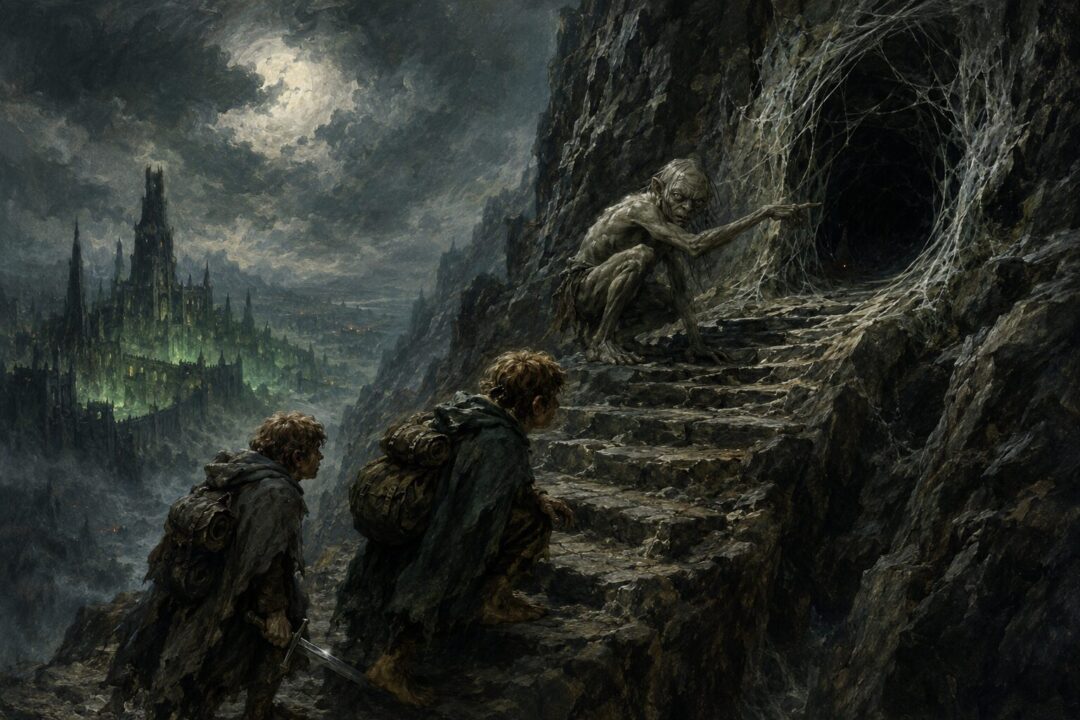
Gollum’s relationship with Shelob is one of the darkest parts of the journey.
He does not command her. He does not tame her. He serves her through cunning, fear, and the hope of using her against Frodo and Sam. His plan is not heroic strategy but a betrayal built around appetite: Shelob will take the hobbits, and Gollum hopes to recover the Ring.
This is fitting because Gollum himself has been consumed by desire. He is not like Shelob in body or origin, but he has become spiritually spider-like in one sense: secretive, lurking, patient, and predatory.
Shelob’s tunnel externalizes what the Ring has done inside him. It is dark, airless, webbed, and filled with old hunger.
Gollum leads Frodo and Sam there because he has chosen appetite over mercy. Earlier, there are moments when pity might still reach him. But by the time he brings them to Shelob, he is trying to feed them into darkness for the sake of the thing he calls precious.
That makes Shelob’s age even more meaningful. Gollum’s corruption is recent compared with hers, but it bends toward the same end: the shrinking of the soul until everything becomes hunger.
The Phial Against Ancient Darkness
Shelob is not defeated by military strength.
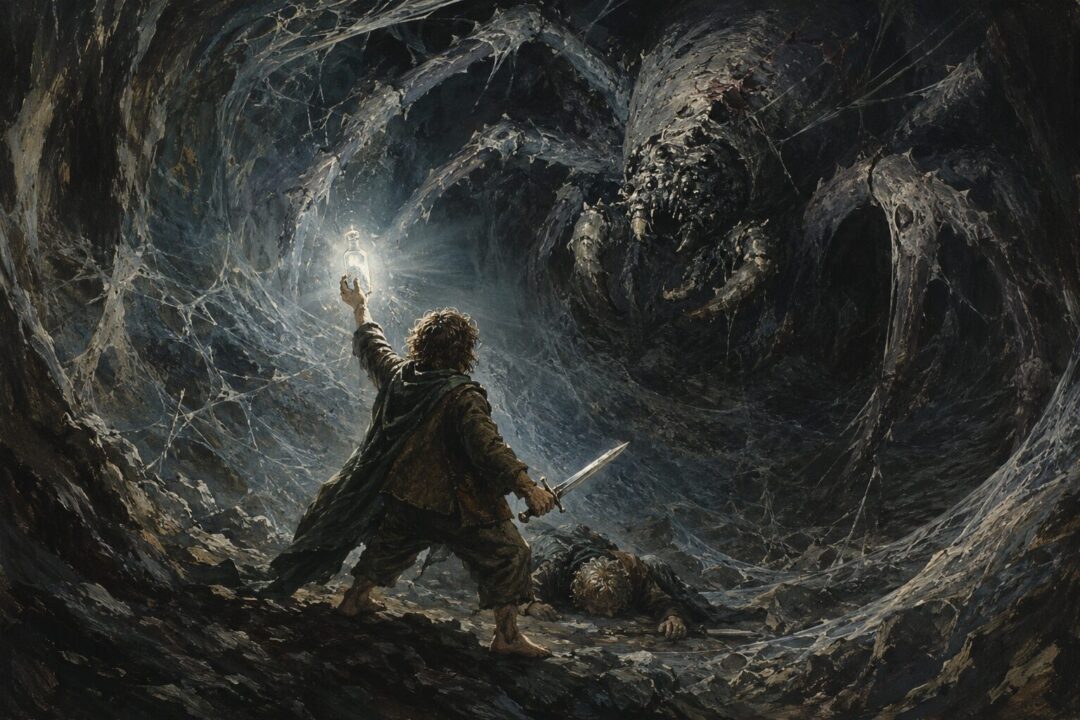
Frodo has courage, but he is overwhelmed. Sam has loyalty, and that loyalty becomes decisive. Sting wounds Shelob, but the deeper symbolic confrontation comes through the Phial of Galadriel.
The light in the Phial is associated with the star of Eärendil, and through that with the preserved light of the Silmaril. That matters because Shelob’s ancestry goes back to Ungoliant, who was bound up with the devouring of light in the Elder Days. In Shelob’s tunnel, ancient darkness meets ancient light.
The scene is not just a monster fight. It is a collision between two inheritances.
On one side is the line of Ungoliant: hunger, darkness, webs, and the desire to consume. On the other is a small vessel of light given in Lórien, carried by a hobbit who does not fully understand its power until the moment of need.
Sam’s use of the Phial is especially important. He is not a prince, wizard, or warrior of legend. Yet he becomes the bearer of a light older and greater than himself. The ancient horror recoils not because Sam is mighty in worldly terms, but because he holds and invokes something Shelob cannot endure.
In that moment, the great old darkness is resisted by humility, loyalty, and remembered light.
Shelob’s Defeat Is Not a Clean Ending
Shelob is wounded and driven back, but the text does not give a simple confirmation that she dies.
That uncertainty suits her. She is a remnant, a survivor, a thing that withdraws into darkness. The story’s attention moves on because the Quest must move on. Sam must rescue Frodo. The Ring must reach Mount Doom. The war must come to its crisis.
But Shelob’s ambiguous end leaves the sense that some evils are not neatly erased by one heroic moment. They are checked. They are wounded. They are forced back. Their power is broken for the immediate purpose of the story, but the world remains old and deep.
This is part of what makes Middle-earth feel so real. Not every darkness exists for the plot alone. Some things have histories older than the heroes. Some terrors are encountered briefly, yet imply whole ages of hidden ruin behind them.
Shelob is one of those terrors.
The Real Meaning of Her Age
So why does it matter that Shelob was older than Sauron’s war?
Because it changes what Frodo and Sam are facing.
They are not merely slipping past an enemy checkpoint. They are crossing through the accumulated darkness of the world. Sauron’s war is the immediate threat, but Shelob reveals that evil has deep roots. It survives in caves, bloodlines, memories, and appetites. It outlasts kingdoms. It adapts. It waits.
Sauron represents the will to dominate history. Shelob represents something more ancient and less rational: the urge to devour life itself.
And yet she is resisted.
Not by a king. Not by an army. Not by a great lord of the West. She is resisted by Samwise Gamgee, carrying a small blade, a gift of light, and love for his master.
That is the hidden power of the episode. The darkness in Shelob’s lair is older than Sauron’s fortress and deeper than the politics of the War of the Ring. But it is still not ultimate. It can still recoil. It can still be wounded. It can still fail to consume what love refuses to surrender.
Shelob was older than Sauron’s war because she belonged to a more ancient layer of evil.
But Sam’s stand shows that even ancient evil is not beyond defiance.
Sources & Notes
- J.R.R. Tolkien, The Lord of the Rings, Book IV, Chapter 9, “Shelob’s Lair” — for Shelob as the last child of Ungoliant, dwelling in the Ephel Dúath before Sauron’s later occupation and serving his purposes without being his servant.
- J.R.R. Tolkien, The Lord of the Rings, Book IV, Chapter 10, “The Choices of Master Samwise” — for Sam’s confrontation with Shelob, the use of Sting and Galadriel’s Phial, and Shelob’s wounded retreat rather than a cleanly confirmed death.
- J.R.R. Tolkien, The Silmarillion, “Of the Darkening of Valinor” — for Ungoliant’s alliance with Melkor, the destruction of the Two Trees, and her association with devouring light and increasing darkness.
- J.R.R. Tolkien, The Lord of the Rings, Book II, Chapter 8, “Farewell to Lórien” — for Galadriel’s gift of the Phial, containing the light of Eärendil’s star, later set against Shelob’s darkness.
- J.R.R. Tolkien, The Silmarillion, “Of the Rings of Power and the Third Age” — for Sauron’s rule from Mordor, the making of the One Ring, and the larger pattern of domination contrasted with Shelob’s independent hunger.
- J.R.R. Tolkien, The Letters of J.R.R. Tolkien, Letter 131 — for Tolkien’s own account of Sauron’s desire for order, control, and domination, useful as storycraft context rather than an in-world event source.