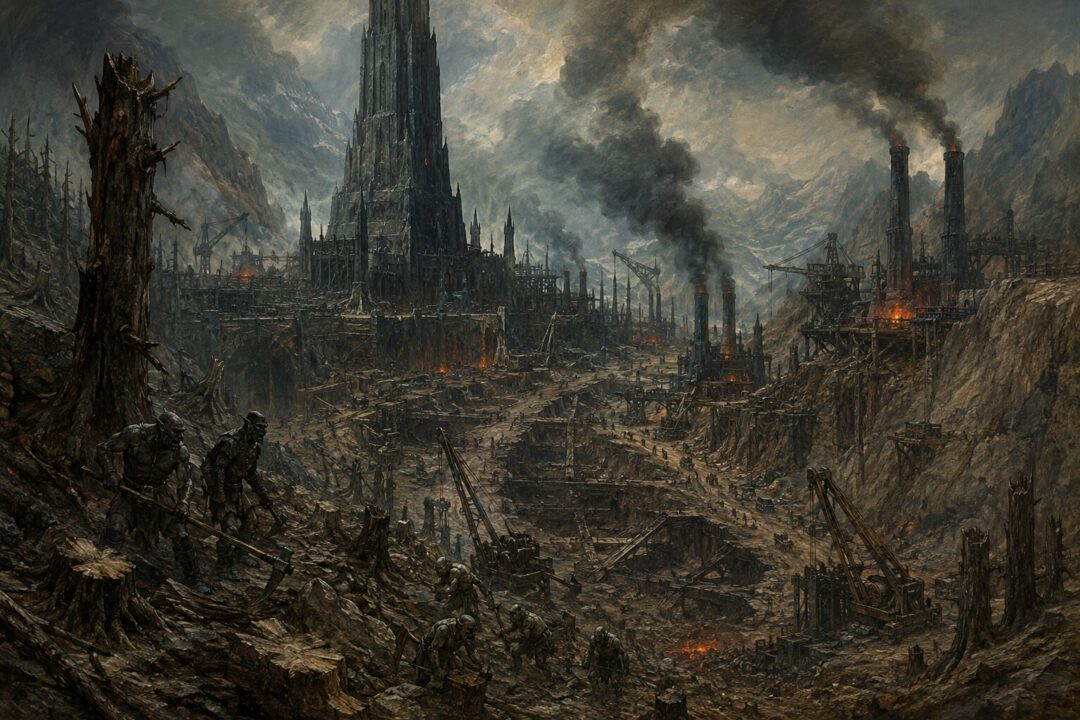
Saruman began as a guardian of Middle-earth. By the end, he had turned trees into fuel, valleys into furnaces, and living creatures into raw material for war.
That transformation matters because Saruman’s war was not only military. It was philosophical. In Middle-earth, evil often seeks domination through fear, lies, or magical power. Saruman added something else: systematic industrial destruction. His campaign against Rohan and the lands around Isengard was not simply an attempt to defeat enemies faster. It represented a deeper assault on the created order itself — on growing things, limits, stewardship, and the relationship between power and life.
The tragedy is that Saruman did not reject intelligence or craft. He corrupted them.
Isengard’s Transformation: From Stronghold to Machine-State
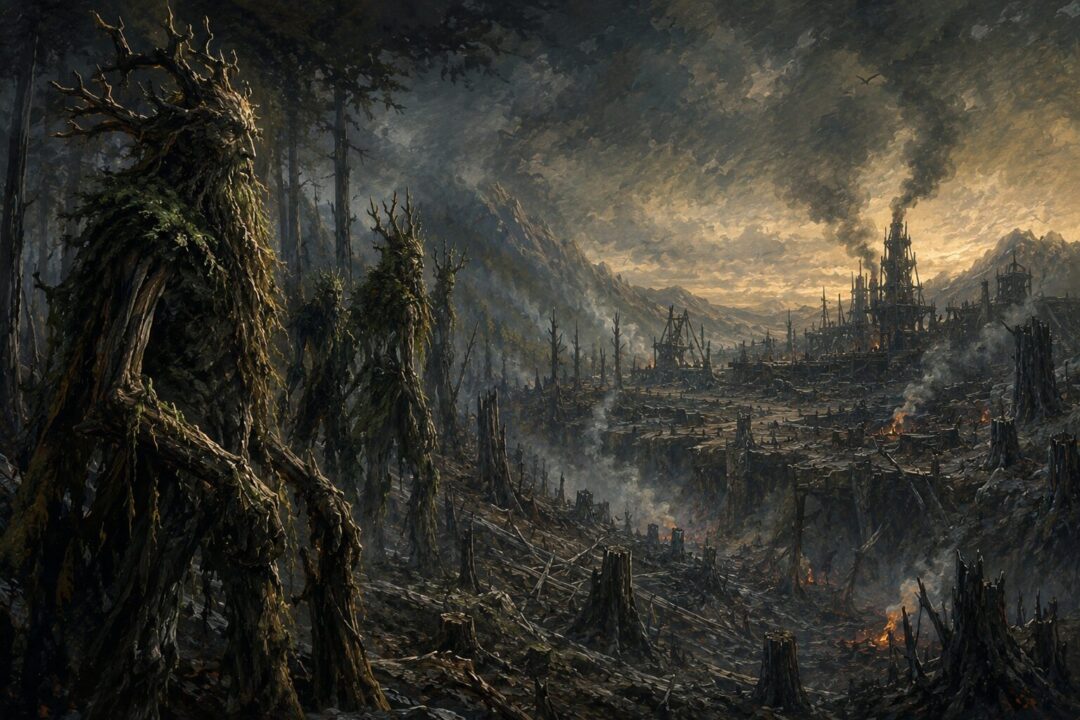
When readers first encounter Isengard in its fallen condition, the landscape itself tells the story.
Treebeard describes how Saruman once behaved differently. He had “a mind of metal and wheels,” and cared for things “as they are made by hands rather than things that live and grow.” That distinction is crucial. Craftsmanship is not condemned in Tolkien’s world. Elves forge, Dwarves build, Men create cities and towers. The problem begins when making becomes severed from reverence for life.
Under Saruman, Isengard changes from a guarded stronghold into an industrial war complex.
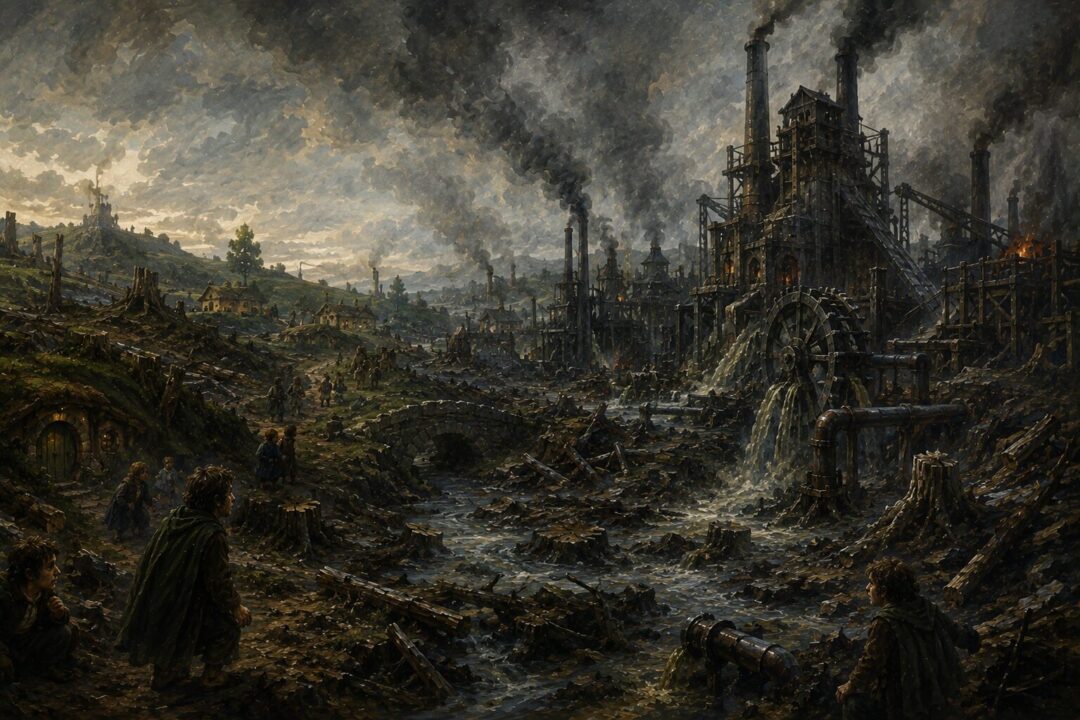
Pits are dug. Trees are felled without restraint. Smoke pours into the air. Furnaces and underground works reshape the land. Merry and Pippin witness an environment altered by extraction and mass production rather than habitation. The valley beneath Orthanc becomes a place where natural forms are broken down into inputs for military power.
The texts never present this as morally neutral technological development. The environmental devastation is tied directly to Saruman’s moral decline.
This is important because Middle-earth repeatedly associates rightful authority with care for living realms. Aragorn heals. Galadriel preserves. Even Faramir speaks of loving only that which they defend, not the sword for its sharpness or war for its glory.
Saruman reverses the pattern.
He no longer governs a place. He consumes it.
The Destruction of Trees Is Not Background Detail
One of the most overlooked aspects of Saruman’s war is the deliberate emphasis placed on trees.
The attack on Fangorn Forest is not incidental scenery surrounding the war against Rohan. It is central to understanding what Saruman has become.
Treebeard’s anger does not arise from abstract politics. He recounts Saruman’s growing appetite for wood, describing how trees were cut down recklessly, often not even used fully. Some were burned simply because they stood in the way.
That detail matters.
Wasteful destruction appears repeatedly as a mark of corruption in Middle-earth. Evil powers exploit without gratitude, measure, or restraint. Saruman does not behave like a careful steward managing necessary resources during desperate war. He behaves like a force incapable of recognizing intrinsic value in living things.
Fangorn itself embodies deep time, memory, and endurance. The Ents are shepherds of trees — ancient caretakers connected to creation’s slower rhythms. Their confrontation with Isengard therefore becomes more than a tactical counterattack.
It is creation answering mechanized domination.
The Ents do not march because they prefer one kingdom’s foreign policy over another’s. They march because Saruman has crossed a boundary.
He has made war on growing life.
Saruman’s Industrial Logic Mirrors His Moral Logic
Saruman’s physical destruction of the environment reflects the deeper structure of his thinking.
He increasingly speaks in terms of power, necessity, efficiency, and control.
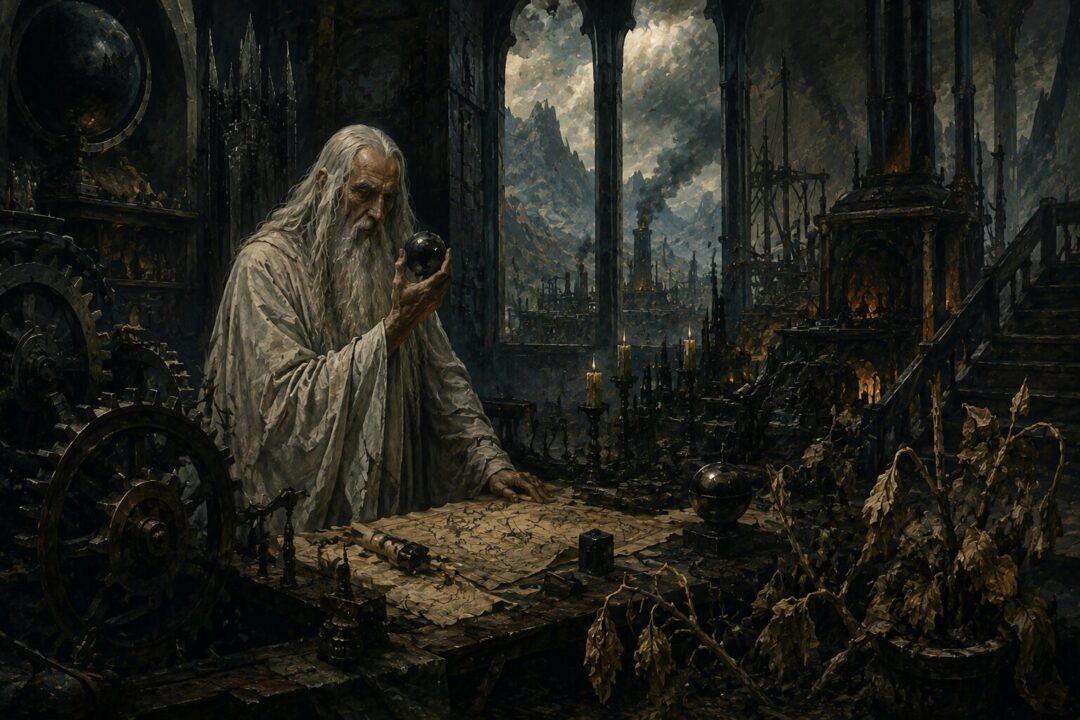
By the time of his confrontation with Gandalf, Saruman argues from political realism. The old order is ending. Power must be managed. Strong rulers must adapt to circumstances. One might work with Sauron temporarily, or seek power independently, because resistance appears impractical.
This mentality closely matches his treatment of the natural world.
Living systems are slow, resistant, and independent. Forests grow according to their own rhythms. Free peoples make unpredictable moral choices. Traditional loyalties complicate centralized control.
Saruman’s solution is simplification.
Standardized armies. Engineered violence. Rapid production. Instrumental thinking.
Even his breeding of Orcs and Men into new soldier populations reflects this logic of manipulation. The texts leave some ambiguity about exact biological methods involved, and readers should be cautious about overclaiming details. Yet what is unmistakable is Saruman’s desire to reshape living beings into more efficient tools of domination.
Creation becomes material.
Difference becomes utility.
Life becomes production.
That is why his industrial war feels spiritually distinct from ordinary conflict in Middle-earth.
Saruman Misunderstands What Power Is For
Saruman’s fall is not caused by ignorance. He is exceptionally knowledgeable.
That makes his corruption more revealing.
As one of the Istari, his original purpose was not conquest but guidance. The Wizards were sent to encourage resistance against Sauron, not to dominate the peoples of Middle-earth through displays of overwhelming authority.
Saruman abandons that mission gradually.
He studies Ring-lore obsessively. He desires command. He begins to believe that wisdom grants entitlement to rule.
His industrial project grows from the same mistaken assumption.
If one possesses intelligence, why submit to natural limits?
If one understands mechanisms, why tolerate unpredictability?
If one can organize production, why not reorganize the world?
But Middle-earth repeatedly challenges this mentality. Wisdom does not justify domination. Knowledge without humility becomes dangerous. Great power divorced from moral restraint becomes self-consuming.
Saruman mistakes mastery for legitimacy.
His machines are therefore not merely practical tools of war. They symbolize a false understanding of authority itself.
Why the Ents’ Victory Matters So Much
The destruction of Isengard by the Ents is one of the most symbolically rich reversals in The Lord of the Rings.
Saruman believes in walls, industry, calculation, and controlled force.
He underestimates ancient life.
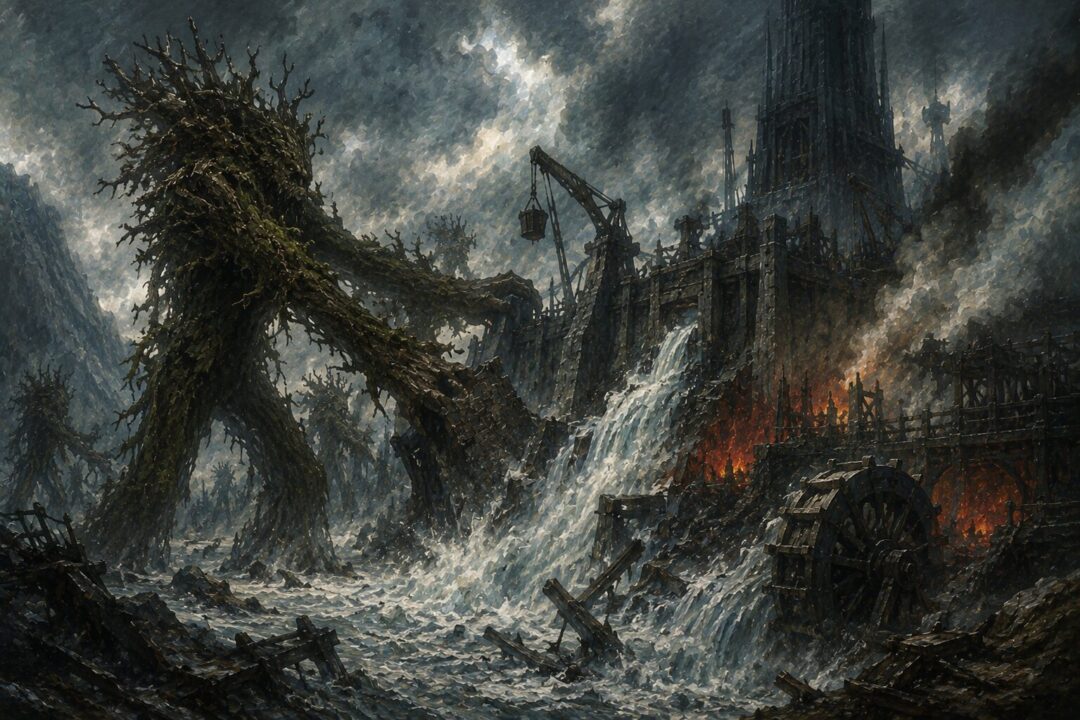
The assault on Isengard is remarkable because it is not achieved through superior machinery or clever political maneuvering. Water, trees, stone, and patient living beings overwhelm industrial power.
The imagery is deliberate.
Floodwaters crash through engineered systems. Fires are quenched. Furnaces fail. The machine-state loses control of the natural forces it presumed subordinate.
This does not mean Middle-earth advocates passivity or rejects all making, technology, or organized defense. Gondor possesses architecture, engineering, archives, and military systems. The Dwarves are master craftsmen. The issue is not invention itself.
The issue is orientation.
Does craft cooperate with creation, or seek to dominate it?
The fall of Isengard dramatizes the answer.
Saruman’s system appears powerful because it accelerates extraction and concentrates control. But it is fundamentally parasitic. It destroys the very conditions that sustain life.
Once creation rises against it, its apparent permanence collapses rapidly.
The Shire Reveals Saruman’s Final Pattern
Saruman’s industrial mindset does not end with Isengard.
After his military defeat, he brings a diminished version of the same logic into the Shire.
The “Scouring of the Shire” shows readers what Saruman’s values look like when imposed on ordinary civilian life.
Trees are cut down.
Ugly mills appear.
Pollution spreads.
Local customs are displaced by bureaucratic coercion and petty authoritarianism.
The damage feels intensely personal because the Shire represents home, continuity, agriculture, community, and modest prosperity. Saruman’s alterations are not random vandalism. They reproduce, at smaller scale, the same principles visible at Isengard.
Control without stewardship.
Production without beauty.
Power without belonging.
The Hobbits’ return becomes necessary not only to expel tyrants but to restore right relationship between people and place.
That restoration matters because Middle-earth’s moral vision is never purely abstract. Evil leaves scars on landscapes, homes, forests, and daily life.
Healing requires rebuilding those bonds.
Why Saruman’s War Was an Attack on Creation Itself
Calling Saruman’s industrial war an “attack on creation” is strong language. Yet the texts support that interpretation when used carefully.
His campaign consistently opposes living growth with extraction, stewardship with exploitation, and moral limits with manipulative control.
He attacks forests.
He reshapes landscapes into production zones.
He treats living beings instrumentally.
He pursues power through systems that consume rather than nurture.
Most importantly, he rejects the posture that rightful authority requires in Middle-earth: humility before a world one did not make.
That is the deepest irony of Saruman’s fall.
He began as a servant sent to help preserve Middle-earth against domination.
He ended by imitating, in his own style, the very impulse he was meant to resist.
His war was not only against Rohan, Fangorn, or the Free Peoples.
It was against the idea that creation possesses value beyond usefulness — and against the dangerous truth that some things are meant to live, grow, and remain beyond the machinery of power.
Sources & Notes
- J.R.R. Tolkien, The Lord of the Rings, Book III, Chapter 4, “Treebeard” — Treebeard says Saruman has a “mind of metal and wheels” and describes the reckless felling and burning of Fangorn’s trees.
- J.R.R. Tolkien, The Lord of the Rings, Book III, Chapter 8, “The Road to Isengard” — the ruined ring of Isengard, its pits, machinery, smoke, and the Ents’ flooding show Saruman’s war works being overthrown by living and natural forces.
- J.R.R. Tolkien, The Lord of the Rings, Book III, Chapter 10, “The Voice of Saruman” — Saruman’s rhetoric of order, power, and political necessity reveals the controlling logic behind his industrial program.
- J.R.R. Tolkien, The Lord of the Rings, Book VI, Chapter 8, “The Scouring of the Shire” — Saruman’s later rule in the Shire repeats the same pattern on a smaller scale: felled trees, ugly mills, pollution, and coercive control.
- J.R.R. Tolkien, Unfinished Tales, “The Istari” — the Wizards are sent to counsel and encourage resistance to Sauron, not to dominate Middle-earth by force, clarifying how Saruman betrays his office.
- J.R.R. Tolkien, Letter 131 — Tolkien describes Sauron’s core impulse as domination of other wills, a storycraft context that helps frame Saruman’s industrialism as a derivative form of the same desire for control.