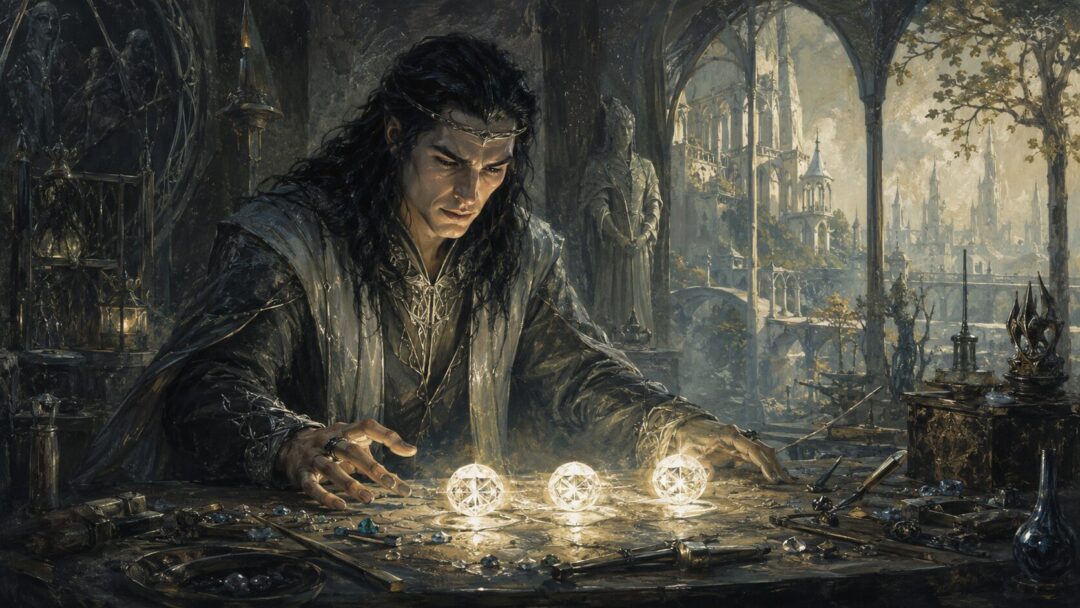
The Silmarils are usually remembered as jewels: three radiant treasures, hallowed by Varda, filled with the last living light of the Two Trees. But they are also a warning. In Fëanor’s hands, beauty became proof of ownership, genius became isolation, and grief became a political force strong enough to divide an immortal people.
Fëanor was not dangerous because he was foolish. He was dangerous because he was almost never merely foolish. His mind was sharp, his hands unmatched, his speech commanding, his courage real, and his injuries not imaginary. That is what makes him one of the most frightening figures in the history of the Eldar. A lesser Elf might have raged and been ignored. Fëanor raged, and kingdoms moved.
The Brilliance That Made Him Exceptional
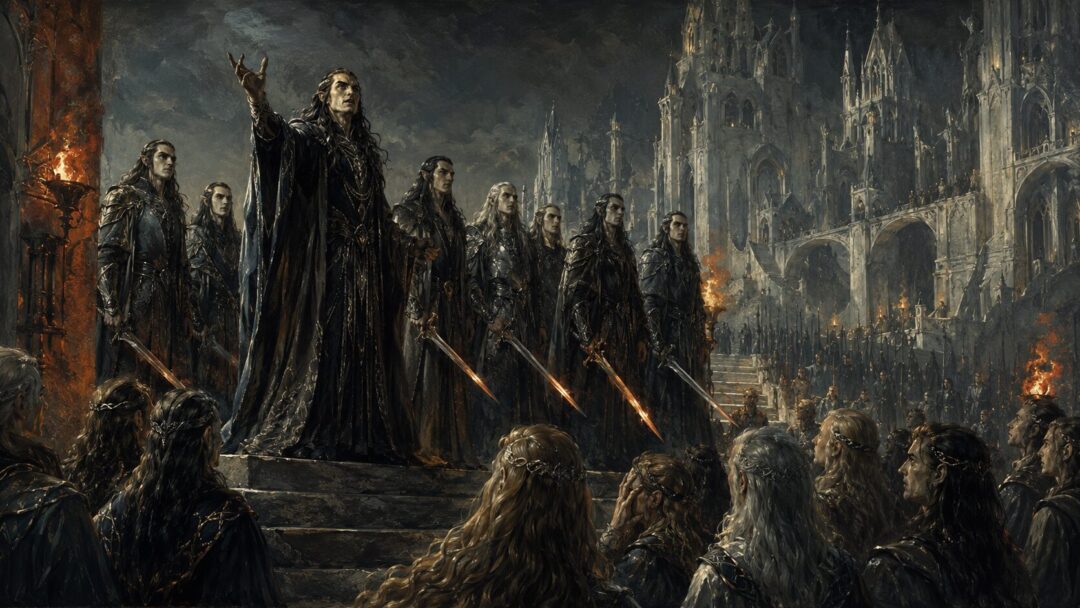
Fëanor’s greatness is not a later legend invented to excuse him. The texts present him as extraordinary from the beginning. He was the eldest son of Finwë, born of Míriel, and his very name, Fëanáro, means “Spirit of Fire.” His mother was so spent after his birth that she withdrew from bodily life, a sorrow that shaped the house of Finwë long before Melkor began poisoning the Noldor with lies. Fëanor later became renowned as a craftsman, gem-smith, loremaster, speaker, and maker of things that outlasted ages.
His brilliance was not limited to one art. He devised the Tengwar, improving upon the earlier work of Rúmil, and traditions also credit him with the palantíri and the Fëanorian lamps. His greatest work, however, was the making of the Silmarils: three jewels in which the light of the Two Trees lived in a form even the Valar could not reproduce by ordinary means.
That matters because Fëanor’s danger begins with a truth. He really had made something beyond the reach of nearly everyone else. His pride was not empty. His self-regard had evidence behind it.
Creation Became Possession
The Silmarils were beautiful, but they also changed the moral weight of Fëanor’s life. They were his work, yet they contained light that he did not create from nothing. The light came from the Trees of Valinor, themselves the work of Yavanna. The jewels were hallowed by Varda so that no mortal flesh, nor any evil or unclean hand, could touch them without being burned. They were personal craft and sacred light at once.
That tension is the heart of Fëanor’s tragedy. He looked at the Silmarils and saw the deepest proof of himself. Others could look at them and see something larger: preserved light, a blessing, a beauty that did not belong only to the maker.
When Yavanna asked whether the Silmarils might be broken to restore the Trees after their destruction, Fëanor’s refusal was not presented as simple greed. He said, in effect, that such a work could be achieved only once, and that breaking it would break his heart. The texts allow the reader to understand the pain of that answer. But they do not let that pain remain innocent. Fëanor’s inability to surrender his masterpiece revealed that his greatest creation had begun to master him.
Melkor Could Not Teach Him Genius, But He Could Bend It
Melkor did not make Fëanor brilliant. That is important. The Enemy’s most effective corruption often works by twisting what is already strong. Fëanor mistrusted Melkor personally, and in that sense he was not merely a gullible victim. Yet Melkor’s lies still found fertile ground among the Noldor: rumors of captivity in Valinor, suspicion among the princes, fear that the Valar were restraining them, and distrust between Fëanor and his half-brothers.
This is where Fëanor’s intelligence became dangerous. He could interpret events quickly, but quick interpretation is not the same as wisdom. He could detect insult, danger, and constraint with terrifying sensitivity, but he was far less able to test his own conclusions. His mind was powerful enough to build systems; his pride was powerful enough to trap him inside them.
The most dangerous lie is often the one that fits a wound. Fëanor had real losses: his mother’s death-like withdrawal, his father’s divided household, the shadow of rivalry with Fingolfin, and finally Finwë’s murder. Melkor exploited a house already full of pressure. But Fëanor supplied the flame.
His Words Were as Dangerous as His Hands
Fëanor was not only a maker of objects. He was a maker of movement. After the death of the Trees, the murder of Finwë, and the theft of the Silmarils, he addressed the Noldor in Tirion. His speech turned grief into revolt. He named Melkor “Morgoth,” the Black Foe of the World, and urged the Noldor to leave Aman for Middle-earth.
Here again, his danger lay in the mixture of truth and distortion. Morgoth really was the enemy. Finwë really had been murdered. The Silmarils really had been stolen. The Noldor really did have courage, skill, and a desire for wider lands and deeds. Fëanor’s speech did not need to be pure falsehood. It only needed to arrange true things around the throne of his own will.
That is why his rhetoric was so potent. He did not tell the Noldor to become cowards or servants of evil. He called them to vengeance, freedom, memory, and greatness. Those are powerful words in any age. In the mouth of Fëanor, they became a road out of paradise and into bloodshed.
The Oath Turned Genius Into a Machine
The Oath of Fëanor is the moment when passion hardens into structure. Fëanor and his seven sons swore to pursue anyone in Arda who withheld a Silmaril from them. The oath was not aimed only at Morgoth. It extended against any being, even if that being was Elf, Man, Maia, or Vala.
Encyclopedia of Arda
This is the terrible brilliance of the Oath: it removed future mercy in advance. It gave the sons of Fëanor a rule to obey even when their father was dead, even when circumstances changed, even when the Silmaril was held by people who were not servants of Morgoth. A normal vow can be reconsidered in light of justice. Fëanor’s Oath became a trap dressed as loyalty.
It also shows the dark side of his creative mind. Fëanor did not merely feel rage; he gave rage a form. He made it memorable, communal, binding, and hereditary. His sons did not simply inherit jewels. They inherited compulsion.
Alqualondë: When Vision Needed Ships
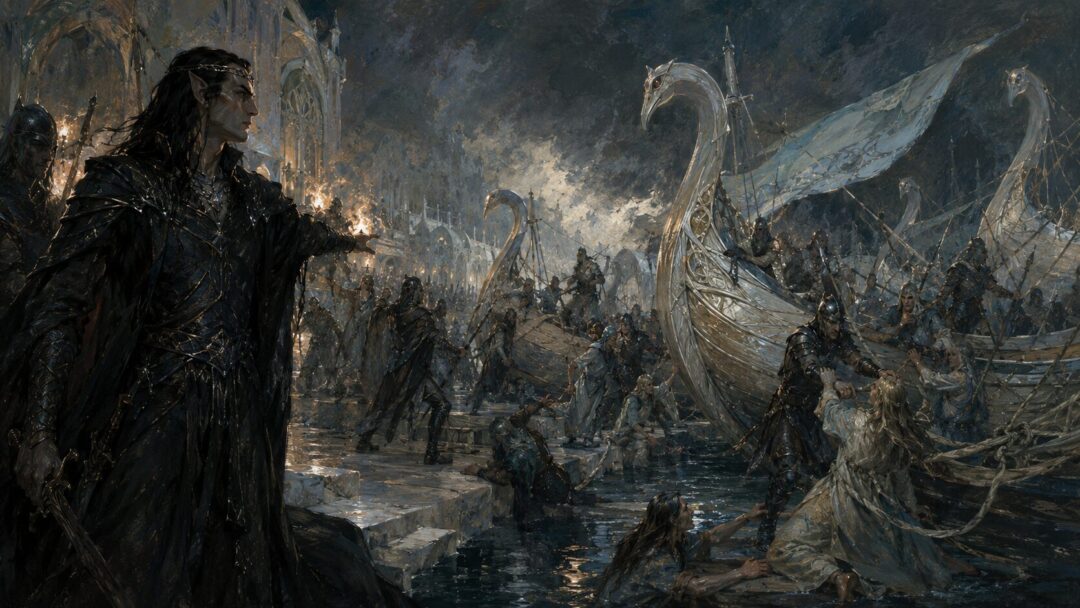
The first great proof of Fëanor’s fall came at Alqualondë. The Noldor needed ships to cross the sea. The Teleri would not give them. Their ships were not tools lying idle; they were the beloved works of their own people. Fëanor, who should have understood better than anyone what it meant to love the work of one’s hands, chose seizure over reverence.
The result was the First Kinslaying: Elves killing Elves in Aman. This is not a minor stain on an otherwise heroic rebellion. It is the moment when Fëanor’s cause reveals what it is willing to consume. The maker of incomparable jewels became the destroyer of another people’s treasures and lives.
The irony is devastating. Fëanor would not break his own work even to restore the light of the Trees. Yet he could break the peace of the Eldar and take the ships of the Teleri when his own purpose demanded it.
The Burning of the Ships and the Logic of Control
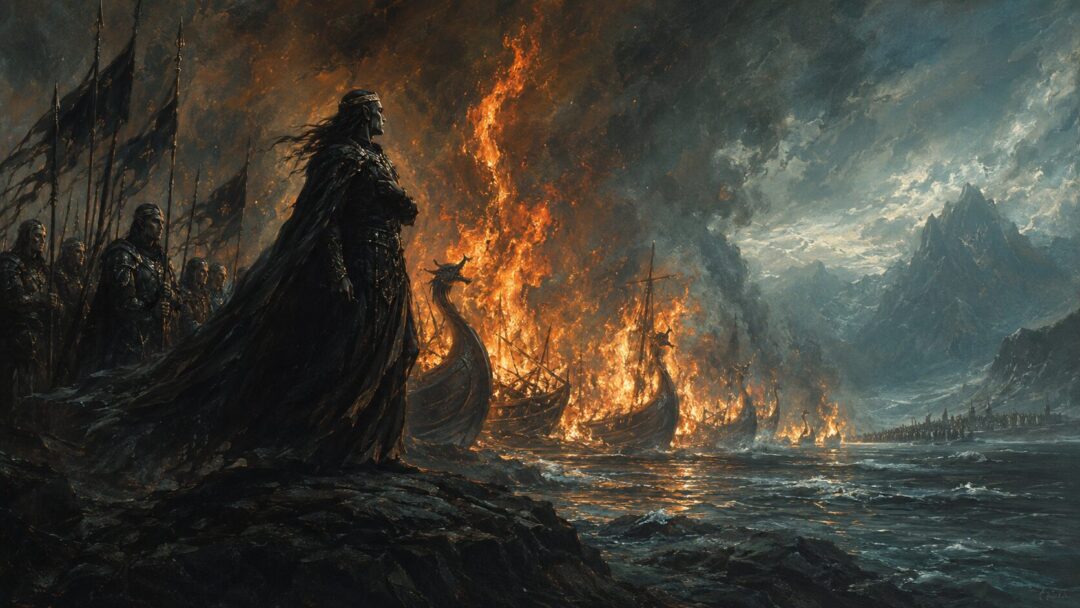
After the crossing, Fëanor abandoned Fingolfin’s people and burned the captured ships at Losgar, preventing their return and leaving the others to face the deadly passage of the Helcaraxë. This was not only cruelty; it was strategy without mercy. He chose to control the future by destroying alternatives.
That is another reason brilliance can become dangerous. Fëanor could see decisive action where others might hesitate. But decisiveness without humility becomes tyranny of will. He did not merely lead; he narrowed the world until only his path remained.
In that moment, the rebellion ceased to be a shared movement of the Noldor and became something more fractured: a history of divided houses, betrayal remembered, and wounds carried into Beleriand before the war against Morgoth had even truly begun.
His Death Did Not End His Power
Fëanor died early in the wars of Beleriand, wounded by Balrogs after pursuing Morgoth’s forces too fiercely. But his danger outlived him. His sons remained bound by the Oath, and that oath continued to shape the First Age: the ruinous attacks connected to the Silmarils, the alienation of potential allies, and the repeated spectacle of Elves turning violence against Elves while Morgoth remained the great enemy in the North.
This is one of the clearest measures of Fëanor’s brilliance. His works endured. His letters endured. His jewels endured. His words endured too, and not all enduring things are blessings.
A lesser villain might die and leave only memory. Fëanor left mechanisms: an oath, a grievance, a claim of ownership, a family identity built around recovery at any cost. His sons were not identical to him, and some moments in their stories show pity, regret, or restraint. But the structure he gave them kept pulling them back toward catastrophe.
The Tragedy of Being Almost Right
Fëanor is compelling because he is not simply wrong about everything. Morgoth is evil. The Silmarils are precious. The Valar are not always easy for the Elves to understand. The Noldor do have gifts that can flower in Middle-earth. Grief over Finwë is not petty. Desire for justice is not wicked.
But Fëanor turns each truth into something possessive. Justice becomes vengeance. Freedom becomes rejection of counsel. Craft becomes ownership without stewardship. Love of father becomes a fire that consumes other families’ sons. Courage becomes refusal to turn back.
That is why he is so dangerous. He shows how brilliance can make corruption more persuasive, not less. The greater the mind, the more beautiful the justifications can become. The stronger the will, the easier it is to mistake resistance for cowardice. The deeper the wound, the more righteous revenge can feel.
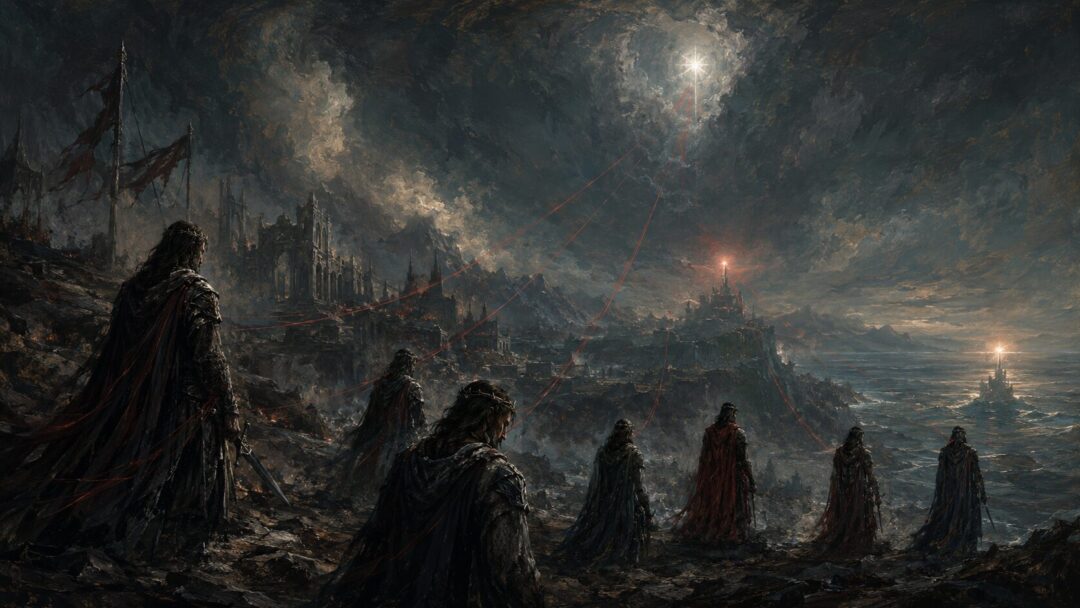
The Fire That Gave Light and Burned the House Down
Fëanor’s story is not an argument against genius, craft, or fierce love. Middle-earth is full of makers, singers, healers, warriors, and rulers whose gifts are necessary against darkness. The tragedy is not that Fëanor was brilliant. The tragedy is that his brilliance refused limits.
He could make beauty, but not surrender it. He could name evil, but not master the evil that entered his own motives. He could inspire a people, but not protect them from the cost of his inspiration. He could create objects of holy radiance, yet lead his followers into deeds that darkened the history of the Elves.
Fëanor was dangerous because he was brilliant enough to make his pride look like destiny. And once enough people believed him, even his death could not put out the fire.
Sources & Notes
- J.R.R. Tolkien, The Silmarillion, “Of Fëanor and the Unchaining of Melkor” — Fëanor’s birth, Míriel’s weariness, his gifts, character, and growing conflict within Finwë’s house.
- J.R.R. Tolkien, The Silmarillion, “Of the Silmarils and the Unrest of the Noldor” — the making and hallowing of the Silmarils, Melkor’s rumors, Fëanor’s possessiveness, and the tensions his genius intensifies.
- J.R.R. Tolkien, The Silmarillion, “Of the Darkening of Valinor” — the death of the Trees, Yavanna’s request, Fëanor’s refusal, Morgoth’s theft of the Silmarils, and Finwë’s murder.
- J.R.R. Tolkien, The Silmarillion, “Of the Flight of the Noldor” — Fëanor’s speech in Tirion, the Oath, the Kinslaying at Alqualondë, and the burning of the ships at Losgar.
- J.R.R. Tolkien, The Silmarillion, “Of the Return of the Noldor” — Fëanor’s arrival in Middle-earth, rash pursuit of Morgoth’s forces, death by Balrogs, and the continuing force of his oath.