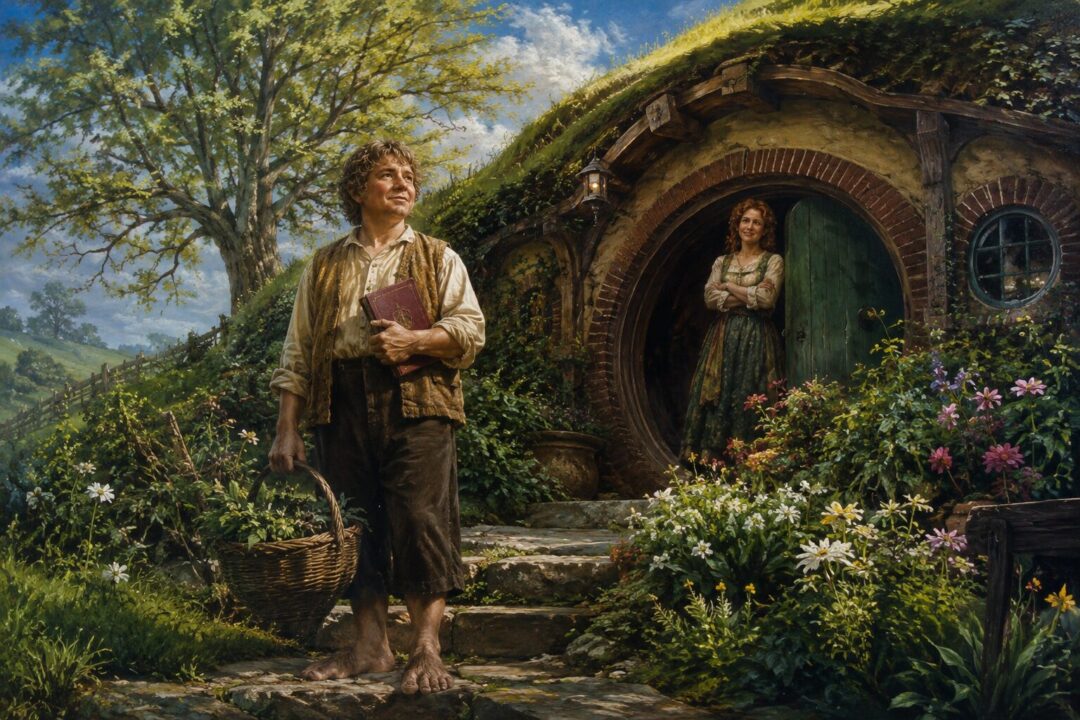
Samwise Gamgee carried the One Ring into the heart of Mordor. He gave it back willingly. He returned to the Shire. He married, raised a family, restored his homeland, and lived a long and fruitful life before eventually sailing West.
At first glance, that sounds almost ordinary compared to the grand tragedies surrounding the Ring. Yet the more closely the story is examined, the more remarkable Sam's journey becomes. Every other known Ring-bearer is permanently separated from ordinary life. Some fall into corruption. Some are consumed by obsession. Some depart Middle-earth because the wounds they carry cannot fully heal.
Sam alone comes home almost whole.
That word matters. Not completely whole, because Tolkien's text never suggests that bearing the One Ring leaves no mark. But among all Ring-bearers, Sam is unique in how fully he is able to return to ordinary life while still carrying the memory of extraordinary suffering.
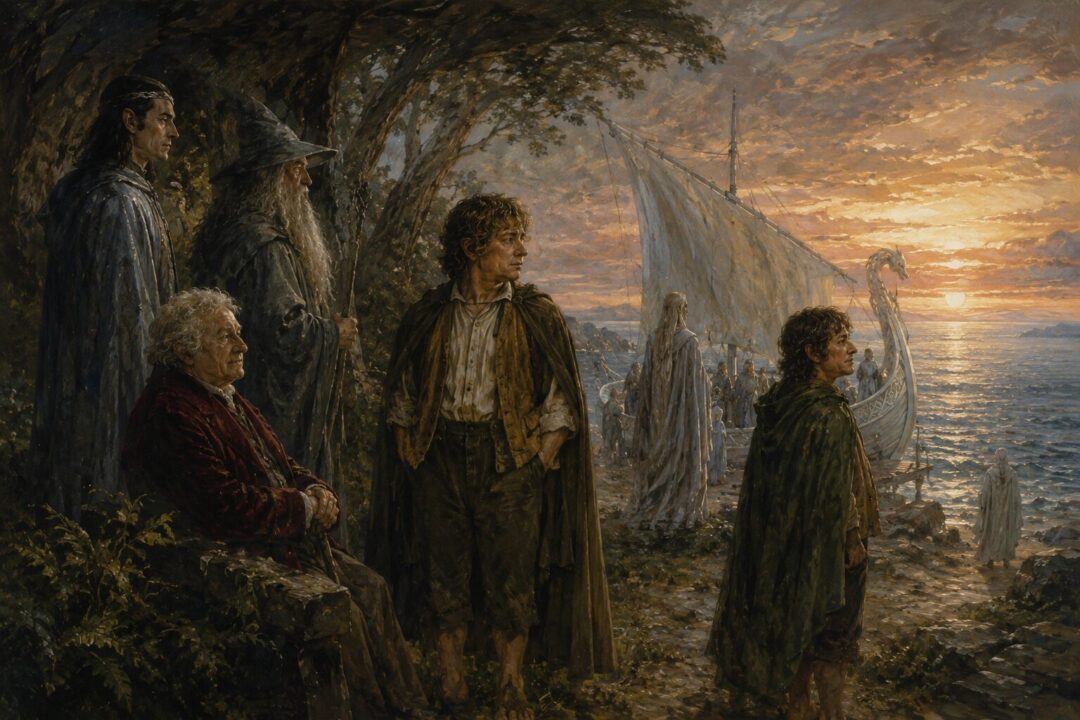
Every Ring-Bearer Pays a Price
The One Ring is never portrayed as a harmless burden. Even brief possession begins a relationship between the Ring and its bearer.
Bilbo possesses it for decades. Although he resists its greatest temptations better than might be expected, giving it up requires enormous effort. Gandalf openly fears asking him to surrender it because of what the Ring has already done to his heart. Even after leaving the Shire, Bilbo never entirely escapes its influence, and by the time Frodo sees him again in Rivendell, the longing briefly returns when the Ring is mentioned.
Frodo bears the Ring for a far shorter period, yet under vastly harsher circumstances. He carries it while pursued by the Nazgûl, wounded by the Morgul blade, enduring the growing pressure of Sauron's will, and finally walking into Mordor itself. By the Quest's end, he cannot claim the Ring at Mount Doom through his own strength. Afterwards, he repeatedly admits that the deepest wounds cannot be healed in Middle-earth.
Gollum represents the opposite extreme. Centuries of possession destroy nearly every aspect of his former identity until his entire existence revolves around recovering "his precious."
Even Isildur, who keeps the Ring only briefly, refuses to destroy it when given the opportunity. The Ring immediately begins influencing its fate and ultimately contributes to his death at the Gladden Fields.
Against that background, Sam's experience appears almost impossible.
Sam Bears the Ring at the Worst Possible Moment
Sam does not inherit the Ring peacefully. He receives it under the worst imaginable circumstances.
Believing Frodo to be dead after Shelob's attack, Sam takes the Ring because the Quest must continue. He does not seize it out of ambition or desire. Instead, he accepts what appears to be an unbearable responsibility.
This distinction matters.
Throughout The Lord of the Rings, intention never makes someone immune to the Ring's influence, but it does shape how the temptation initially appears. The Ring works by magnifying desires already present within its bearer.
For Sam, those desires are astonishingly modest.
The Ring Offers Sam a Kingdom
One of the clearest windows into the Ring's method comes during Sam's brief possession.
As he approaches Mordor, the Ring presents him with visions of greatness. Instead of merely being Sam Gamgee the gardener, he imagines becoming "Samwise the Strong," a mighty hero commanding armies and transforming the world into an immense garden under his rule.
The temptation is revealing.
The Ring does not invent an entirely foreign ambition. It twists something genuinely good—Sam's love of growing things—into a fantasy of domination. Beauty would no longer arise through patient care but through absolute control.
Yet the vision collapses almost as quickly as it appears.
Sam realizes that one small garden is enough for him. He understands that he does not truly desire to rule the world. His ordinary loves become his greatest protection.
This is one of the most profound moments in the entire legendarium. The Ring offers limitless power, and Sam rejects it because the life he already values is richer than anything domination could provide.
Giving the Ring Back
Perhaps the greatest evidence of Sam's character comes not when he carries the Ring, but when he returns it.
When Sam rescues Frodo from the Tower of Cirith Ungol, he immediately offers the Ring back.
There is no struggle comparable to Bilbo's farewell in Bag End. There is no attempt to negotiate. There is no claim that he deserves to keep it because of what he has endured.
For a brief instant, Sam hesitates, acknowledging the pain of surrendering it. But he freely returns it to Frodo.
The moment should not be exaggerated into meaning the Ring had no effect on him. Tolkien's text does not support that conclusion. Rather, it demonstrates that the Ring had not yet gained deep mastery over Sam's will.
Why Sam's Humility Matters
Throughout the story, Sam consistently measures success differently from almost every powerful figure in Middle-earth.
He wants Frodo to live.
He wants the Shire to survive.
He wants gardens to grow again.
He never seeks glory for himself.
That humility repeatedly limits the Ring's opportunities. The Ring works most effectively by convincing its bearer that power is necessary for some noble purpose. Sam briefly experiences exactly that temptation, yet he recognizes its falsehood.
His understanding of himself becomes a form of defense.
The texts never suggest that humility makes someone immune to the Ring. Frodo himself is humble, and he still falls at the Cracks of Doom. But Sam's brief possession, combined with his lack of grand ambition, appears to reduce the Ring's hold before it can become deeply rooted.
Returning to an Ordinary Life
After the War, Sam does something almost no legendary hero accomplishes.
He goes home.
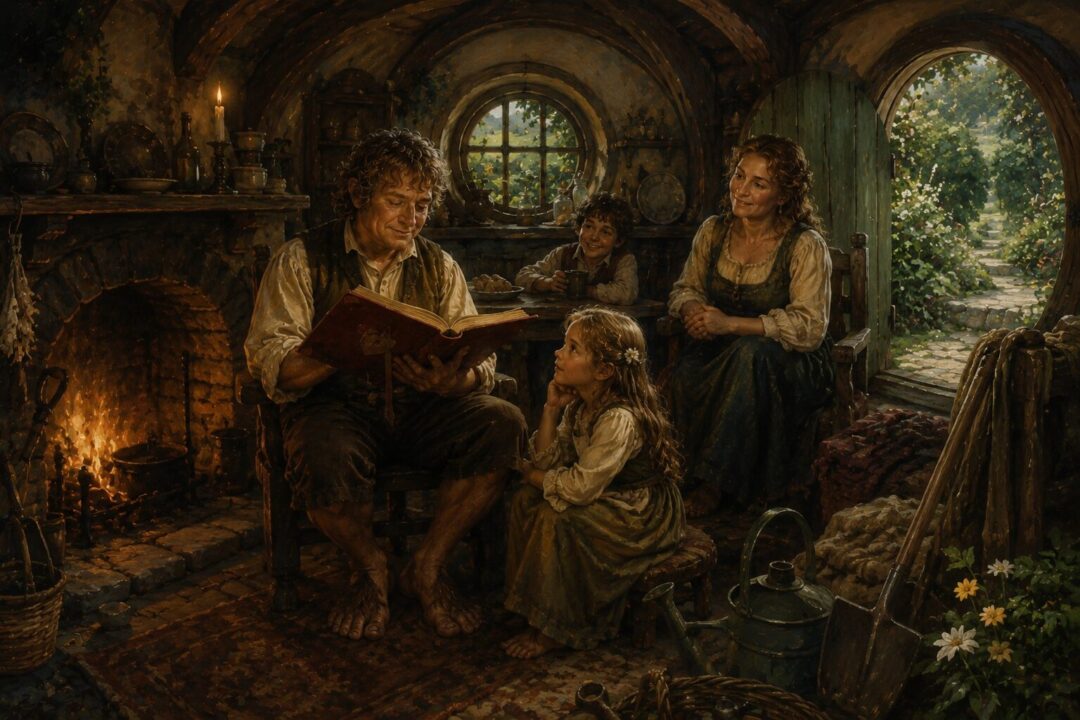
He marries Rosie Cotton. They build a family together. Sam becomes deeply involved in restoring the Shire after its devastation. Using the gift of earth from Galadriel, he helps renew fields, gardens, and trees throughout the land. The mallorn that grows in the Party Field becomes one lasting symbol of that renewal.
Eventually, Sam serves for many years as Mayor of the Shire.
These achievements are remarkable because they show genuine reintegration into ordinary life. The Quest does not remain the only defining event of his existence.
His greatest victories come through planting rather than conquering.
The Wound That Never Fully Vanished
Yet saying Sam returns "whole" would go beyond what the text supports.
Appendix B records that Sam later departs over Sea after the death of Rosie. The tradition preserved there states that, as a Ring-bearer, he was allowed to pass into the West, though only for a limited time appropriate to mortals.
This detail suggests that even Sam's burden left a permanent mark.
The text never explicitly explains how deeply the Ring continued to affect him during the intervening decades. Unlike Frodo, Sam does not speak openly of wounds that cannot heal. Nevertheless, his eventual passage West implies that his experience as a Ring-bearer remained spiritually significant.
For that reason, "almost whole" is a more accurate description than "completely healed."
Why Frodo Could Not Stay
Sam's return becomes even more meaningful when contrasted with Frodo's.
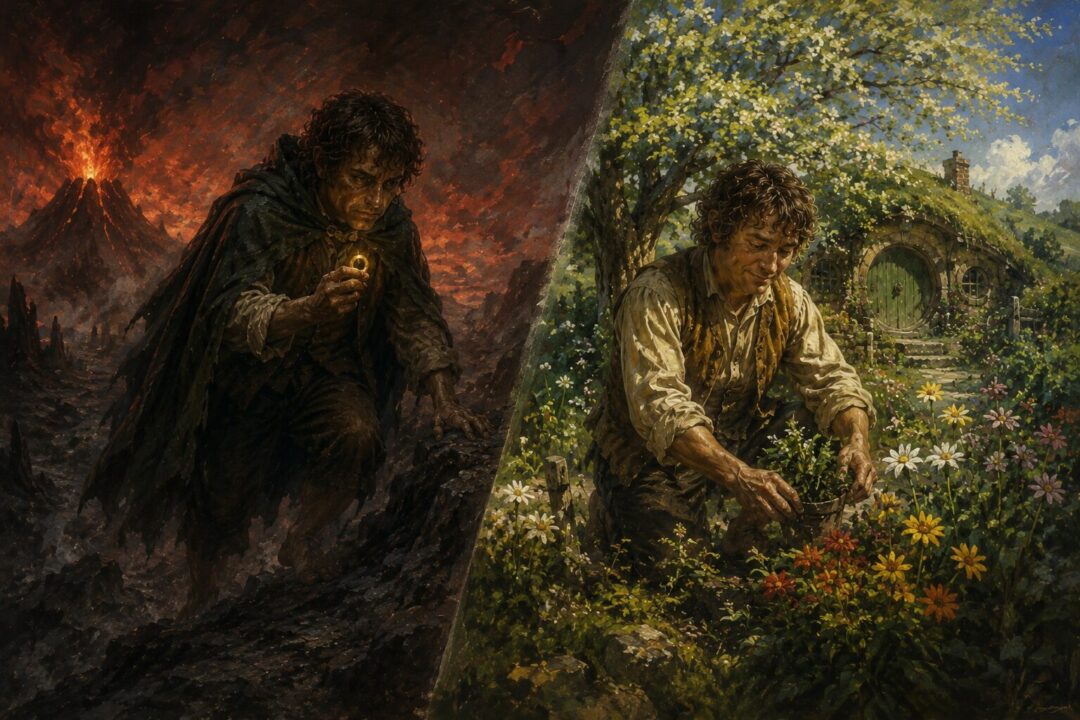
Frodo's wounds accumulate throughout the Quest. The Morgul knife, the sting of Shelob, the crushing burden of carrying the Ring, and his failure at the Crack of Doom all leave scars that ordinary peace cannot erase.
He openly tells Sam that some wounds are too deep.
His departure is not portrayed as failure but as mercy.
Meanwhile, Sam remains behind because he still has work that belongs to Middle-earth. His story continues where Frodo's cannot.
Together, their endings reveal two different forms of heroism: one sacrifices the possibility of an ordinary future, while the other receives the grace to rebuild one.
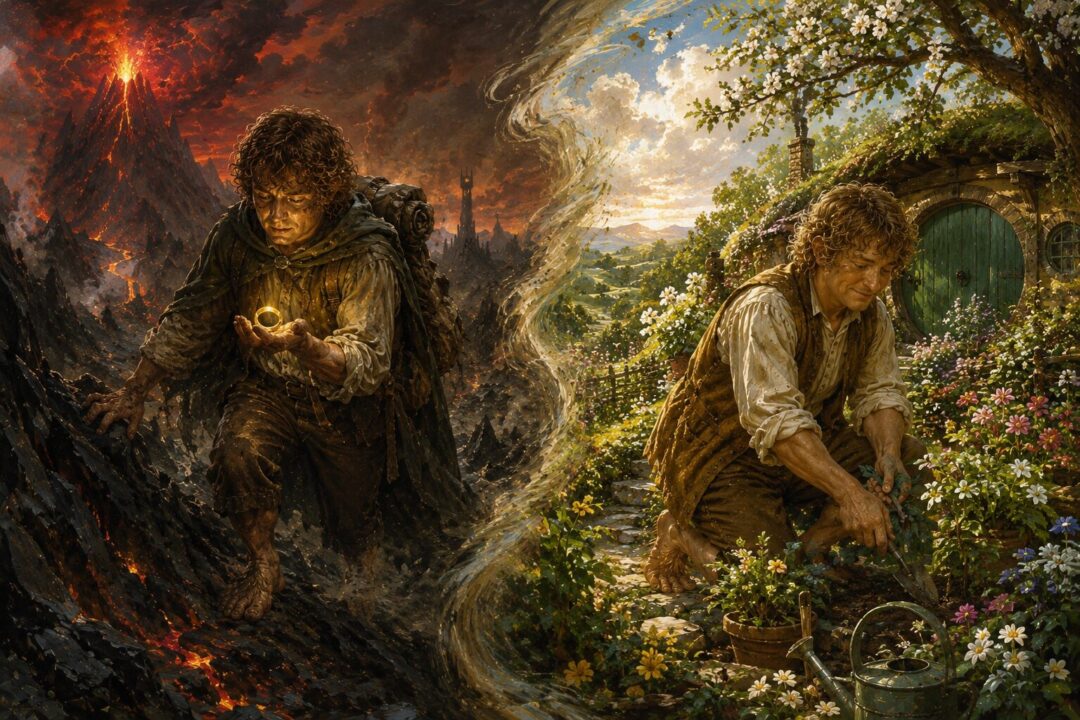
The Quiet Miracle of Samwise Gamgee
The greatest miracle of Sam's story is not that he carried the Ring.
It is that he remembered what life was for after carrying it.
The Ring promised greatness through power. Sam discovered greatness through service.
The Ring imagined a world ruled by one perfect will. Sam restored one small corner of the world by planting trees, raising children, keeping promises, and preserving friendship.
His journey does not erase the Ring's cost. The texts give every indication that bearing it mattered for the rest of his life. Yet unlike every other Ring-bearer whose story ends in isolation, obsession, or departure before ordinary life can truly resume, Sam spends decades living the very life he had fought to protect.
That is why he stands apart.
Not because the Ring failed to touch him.
But because, by grace, humility, and steadfast love, he was able to come home almost whole.
Sources & Notes
- Tolkien Gateway, “Samwise Gamgee” — summarizes Sam’s brief bearing of the Ring, his return to the Shire, and his later life. https://tolkiengateway.net/wiki/Samwise_Gamgee
- Tolkien Gateway, “Ring-bearers” — lists the Ring-bearers and distinguishes Sam’s brief stewardship from longer, more damaging possession. https://tolkiengateway.net/wiki/Ring-bearers
- Tolkien Gateway, “One Ring” — explains the Ring’s corrupting pressure and why different bearers suffer differently under its influence. https://tolkiengateway.net/wiki/One_Ring
Sources added for Sam as Ring-bearer and the Ring’s effects.