The White Tree of Gondor looks, at first, like a symbol of survival. It stands in Minas Tirith as a memory of something older than the city itself: Númenor, the island kingdom that once rose out of the sea as the greatest realm of Men. Yet the Tree is also a warning. Its line passed through fire, rebellion, exile, and ruin before it ever became the emblem of Gondor.
That is the hidden tension inside Gondor’s pride. Gondor is not merely proud because it is strong, ancient, or beautiful. It is proud because it is the heir of a civilization that had already proved how dangerous greatness could become.
The Downfall of Númenor does not simply explain where Gondor came from. It explains why Gondor’s nobility is always shadowed by fear, why its rulers cling so fiercely to memory, and why the return of the King matters as more than a political event. Gondor inherits Númenor’s glory, but also its temptation.
Númenor Was Blessed Before It Was Ruined
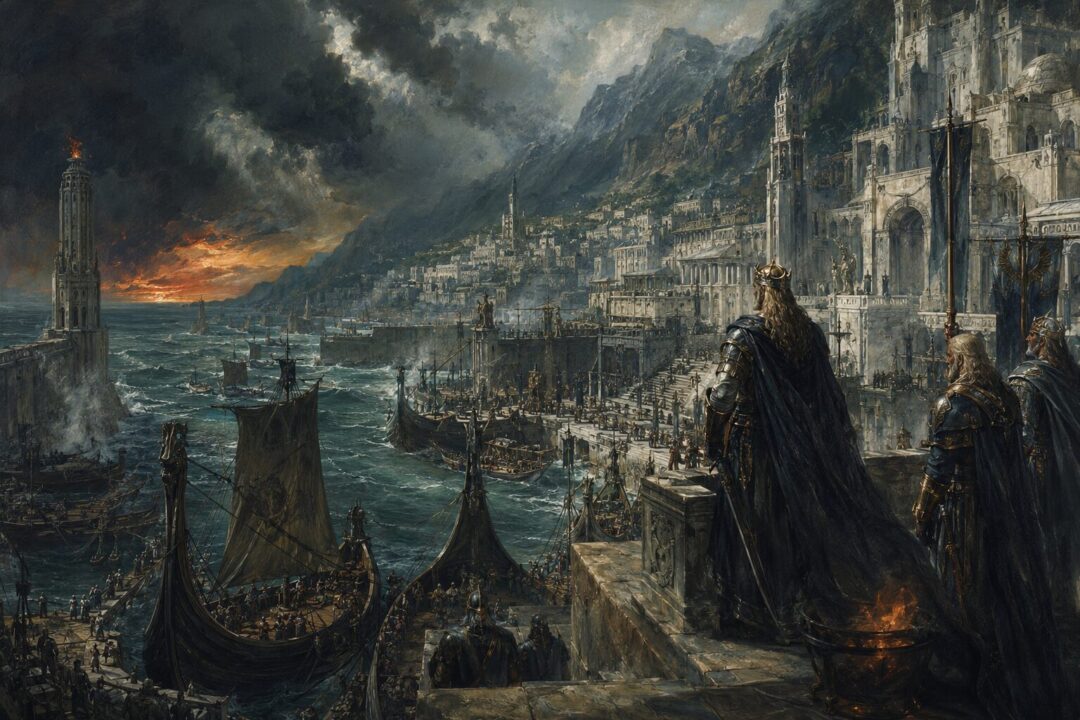
Númenor began as a gift. The Edain, those Men who aided the Elves against Morgoth, were granted an island far west of Middle-earth. Their lives were lengthened, their wisdom increased, and their kingdom became mighty beyond the ordinary measure of Men. The tragedy of Númenor is that it did not fall because it was weak. It fell because its gifts became unbearable to its own pride.
The Númenóreans were placed between two limits: they were greater than other Men, but still mortal; they could sail far across the sea, but not to the Undying Lands; they could grow in craft, knowledge, and dominion, but not escape death. The Ban of the Valar was not simply a travel rule. It marked the boundary between gift and grasping.
Over time, many Númenóreans came to resent that boundary. Their long lives made death more visible, not less. Their power over Middle-earth made humility harder, not easier. They began to look westward not with gratitude, but with envy. The texts describe Númenor turning by degrees against the Valar, with Sauron later corrupting that already-dangerous desire into open rebellion.
That matters for Gondor because Gondor is founded by survivors of that catastrophe. Its ruling houses are not descended from a simple golden age. They descend from a people who saw paradise become a warning.
Sauron Did Not Create Númenórean Pride — He Weaponized It
One of the most important details about the Downfall is that Sauron does not corrupt Númenor from nothing. Ar-Pharazôn already desires mastery. He comes against Sauron with such force that Sauron’s servants flee, and Sauron allows himself to be taken to Númenor as a captive. That apparent triumph becomes the trap.
Sauron understands what the proud king wants to hear. He does not need to tell Númenor it is small. He tells Númenor it is not great enough. He feeds the fear beneath its grandeur: the fear of death, limitation, and being denied the immortality of the Elves. In the end, Ar-Pharazôn sails against Aman itself, attempting to seize what cannot be seized. His pride turns kingship into sacrilege.
This is the pattern Gondor later repeats in smaller, more human forms. Gondor never launches an armada against the Undying Lands. It does not rebuild Sauron’s temple. It does not become Númenor again. But it inherits the same inner danger: the belief that greatness gives one the right to possess, command, preserve, and judge beyond rightful bounds.
That is why Gondor’s pride is so compelling. It is not cartoon arrogance. It grows out of real greatness. Minas Tirith is beautiful. Its soldiers are brave. Its lore is deep. Its lineages matter. Its long resistance against Mordor is heroic. But in Tolkien’s moral world, even real greatness becomes perilous when it forgets that it is stewardship, not ownership.
Gondor Was Founded by the Faithful, Not by Númenor’s Rebels
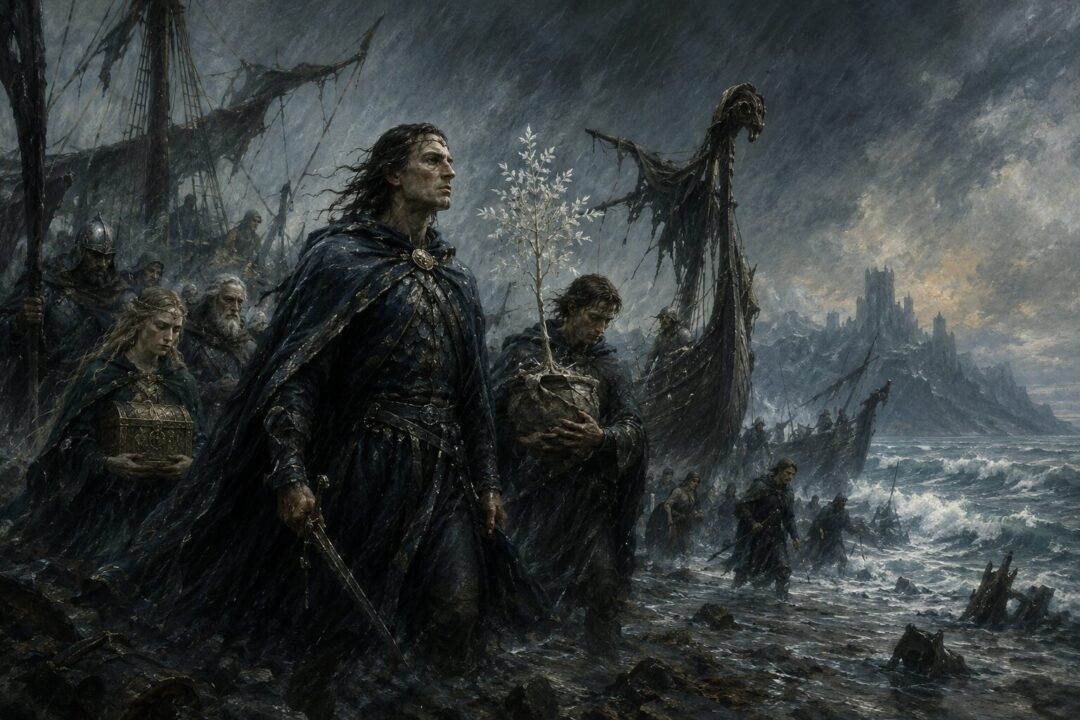
Gondor’s origin also protects it from a simplistic reading. The kingdom is not founded by Ar-Pharazôn’s faction. It is founded by the Faithful, led by Elendil and his sons, who escape the Downfall and establish the Realms in Exile. Gondor and Arnor are therefore not continuations of Númenor at its worst, but attempts to preserve what Númenor had been before its rebellion.
This makes Gondor’s pride more tragic. Its nobility is rooted in faithfulness, memory, and endurance. The White Tree recalls Nimloth, which itself was tied to ancient friendship with the Eldar and the West. The city’s very identity is built around remembrance: old names, old bloodlines, old alliances, old wounds.
But memory can become a form of pride. A people can preserve the relics of a lost world while slowly losing the humility that gave those relics meaning. Gondor’s greatness is not false; the danger is that it may begin to treat greatness as proof of entitlement.
The Faithful survived Númenor because they did not worship power. But their descendants still had to live with the burden of being the heirs of power.
The Stewards Reveal the Strain of Inherited Greatness
By the late Third Age, Gondor is ruled not by kings but by Stewards. The kingship has failed in practice after Eärnur rides to Minas Morgul and does not return, leaving the Stewards to govern in the king’s name. This arrangement is noble in theory: the Steward preserves the realm until the king returns. Yet the longer it lasts, the more psychologically difficult it becomes.
A Steward must rule like a king while insisting he is not one. He must defend a realm ancient enough to remember Elendil, but broken enough to watch Mordor rise again across the river. He must carry authority without final legitimacy. Over generations, this can become a dangerous burden.
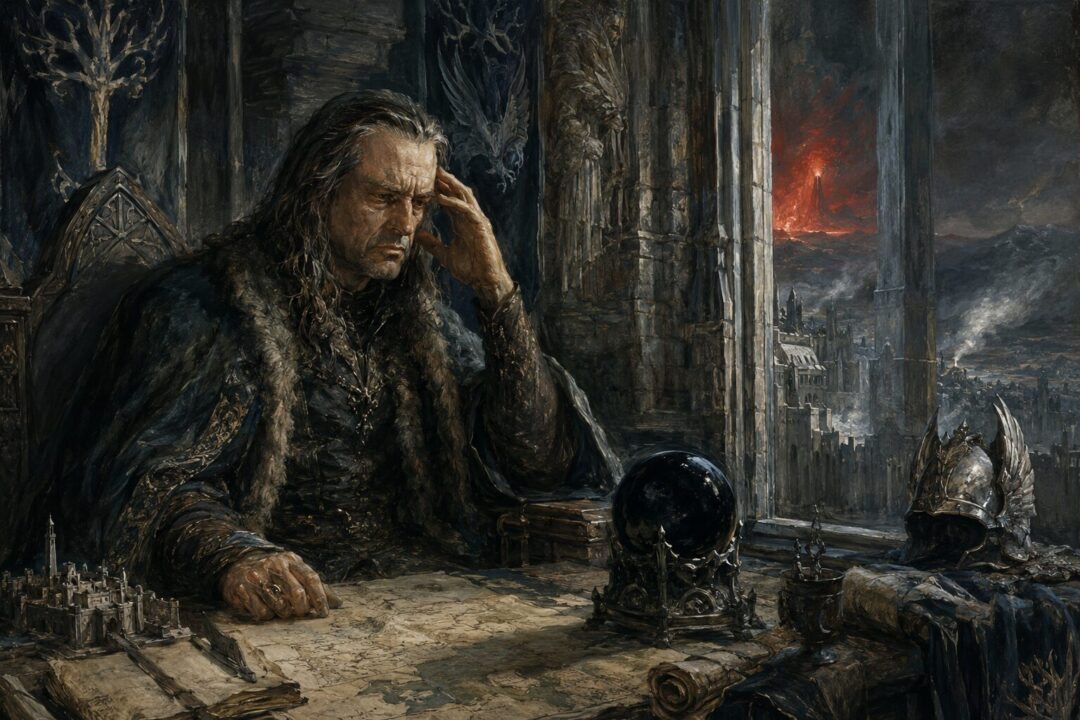
Denethor II embodies that burden most sharply. He is not a weak ruler. The texts present him as intelligent, strong-willed, perceptive, and deeply committed to Gondor. That is what makes his fall so painful. His pride is bound to responsibility. He does not merely want honor for himself; he believes Gondor is the last wall against the Shadow. Yet his use of the palantír, his grief for Boromir, his fear of Aragorn’s claim, and his despair over Mordor all converge until pride and hopelessness become almost indistinguishable.
Denethor’s tragedy resembles Númenor’s in miniature. He sees much, but not enough. He believes he understands the true scale of the war, but his sight is manipulated by Sauron. He loves Gondor, but his love becomes possessive. He would rather choose the manner of his end than surrender control to events beyond him.
That is very Númenórean.
Boromir Shows the Same Temptation in Heroic Form
Boromir is another key to Gondor’s pride. He is brave, patriotic, and deeply human. His desire to use the Ring is not born from a simple lust for evil. It comes from the desperation of a man whose city has stood for generations against the darkness while others seem distant from its cost.
From Boromir’s point of view, Gondor has paid in blood. Why should such a weapon be thrown away? Why should power be refused when the Enemy is at the gate?
That question echoes Númenor’s old error. The Númenóreans wanted to conquer death by reaching beyond the boundary set for them. Boromir wants to conquer Sauron by taking up the Enemy’s own power. In both cases, the motive can be made to sound reasonable: survival, victory, protection, justice. But the deeper mistake is the same. Some powers cannot be purified by noble intention.
Boromir’s repentance matters because it shows that Gondor’s pride is not beyond healing. He falls, but he does not become a servant of the Ring. He confesses, defends Merry and Pippin, and dies with honor. His story is not the Downfall repeated completely; it is the temptation interrupted by grace.
Faramir Understands What Númenor Forgot
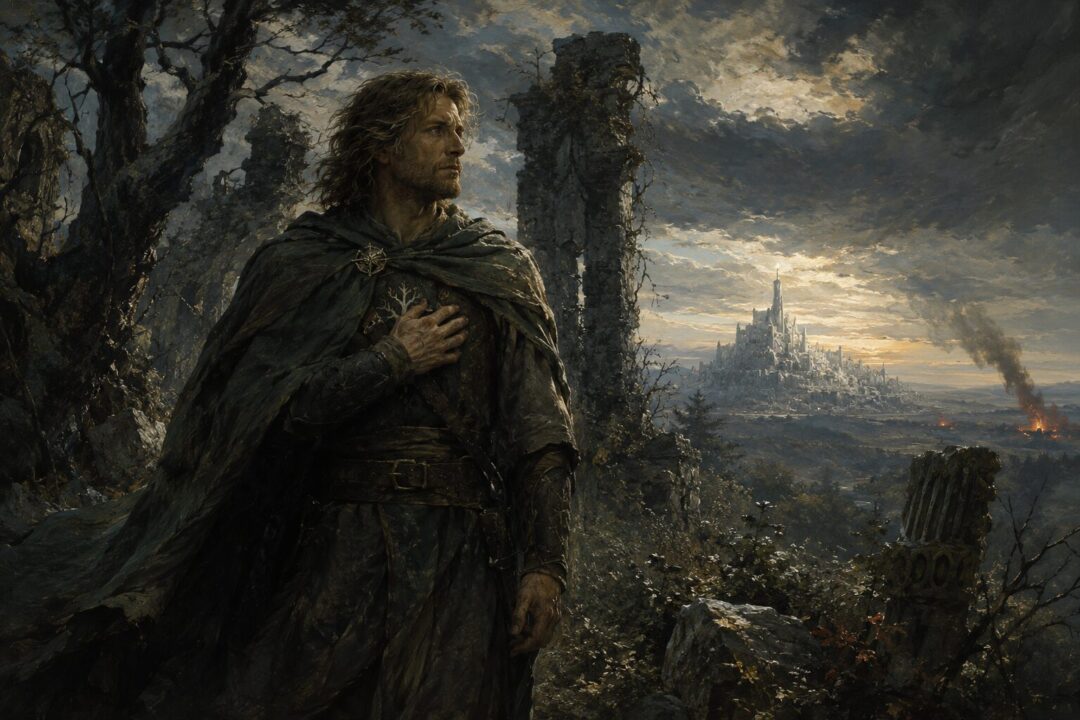
Faramir offers the clearest contrast. He has the learning and lineage of Gondor, but less of its possessive pride. He understands that some victories are not worth the cost. When he says he would not take the Ring even if he found it by the highway, he is not rejecting Gondor. He is preserving the part of Gondor that descends from the Faithful.
Faramir does not despise strength. He is a captain of war. He does not pretend Mordor can be defeated by gentleness alone. But he knows that the weapon of the Enemy cannot become the salvation of the West. In that sense, Faramir is one of the most anti-Númenórean figures in Gondor: a man of Númenórean inheritance who refuses the Númenórean temptation to grasp at forbidden power.
His humility is not weakness. It is historical wisdom.
Aragorn Restores Kingship by Refusing Domination
The return of Aragorn resolves Gondor’s pride only because Aragorn does not return as a conqueror of his own people. He comes through hardship, patience, service, and healing. He does not seize Minas Tirith in the hour of Denethor’s collapse. He waits. He heals. He enters the city in a manner that proves kingship is more than bloodline.
This is crucial. If Númenor fell because kingship became an instrument of self-exaltation, Aragorn restores kingship by making authority serve life. The hands of the king are the hands of a healer. That old saying is not just a proof of identity; it is a moral definition of rightful rule.
Gondor’s pride is not destroyed at the end of The Lord of the Rings. It is purified. The city does not stop remembering Númenor. It learns how to remember rightly. The White Tree blooms again not as a trophy of superiority, but as a sign that the old inheritance can live without repeating the old rebellion.
Gondor’s Pride Is the Shadow of a Great Memory
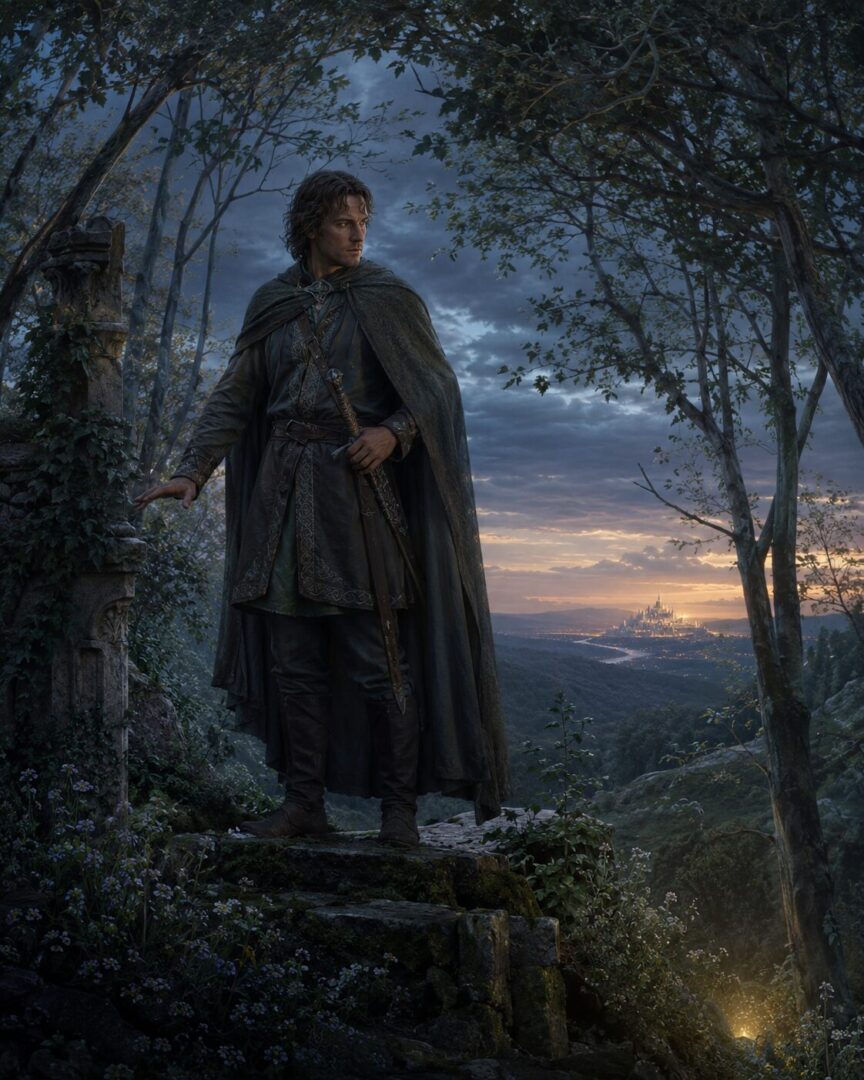
The Downfall of Númenor explains Gondor because it reveals the double nature of inheritance. To inherit glory is also to inherit danger. Gondor’s people carry the memory of a blessed island, a drowned kingdom, faithful exiles, lost kings, and a war that never fully ended. Their pride is not random arrogance; it is the emotional armor of a civilization that knows it has already lost paradise once.
That is why Minas Tirith feels both majestic and brittle. Its beauty is real, but its stones are full of grief. Its captains are heroic, but some are tempted by control. Its rulers defend the West, but they must constantly resist the old Númenórean lie: that the great may save themselves by taking what was never given.
Númenor fell when gratitude became envy, and kingship became grasping. Gondor endures when memory becomes humility, and power becomes stewardship.
That is the deeper meaning of Gondor’s pride. It is not simply the pride of a great kingdom. It is the pride of Númenor after the drowning: wounded, magnificent, dangerous, and still capable of redemption.
Sources & Notes
- Tolkien Gateway, "Númenor" — https://tolkiengateway.net/wiki/N%C3%BAmenor
- Tolkien Gateway, "Downfall of Númenor" — https://tolkiengateway.net/wiki/Downfall_of_N%C3%BAmenor
- Tolkien Gateway, "Gondor" — https://tolkiengateway.net/wiki/Gondor
Sources added for article-specific Tolkien reference context.