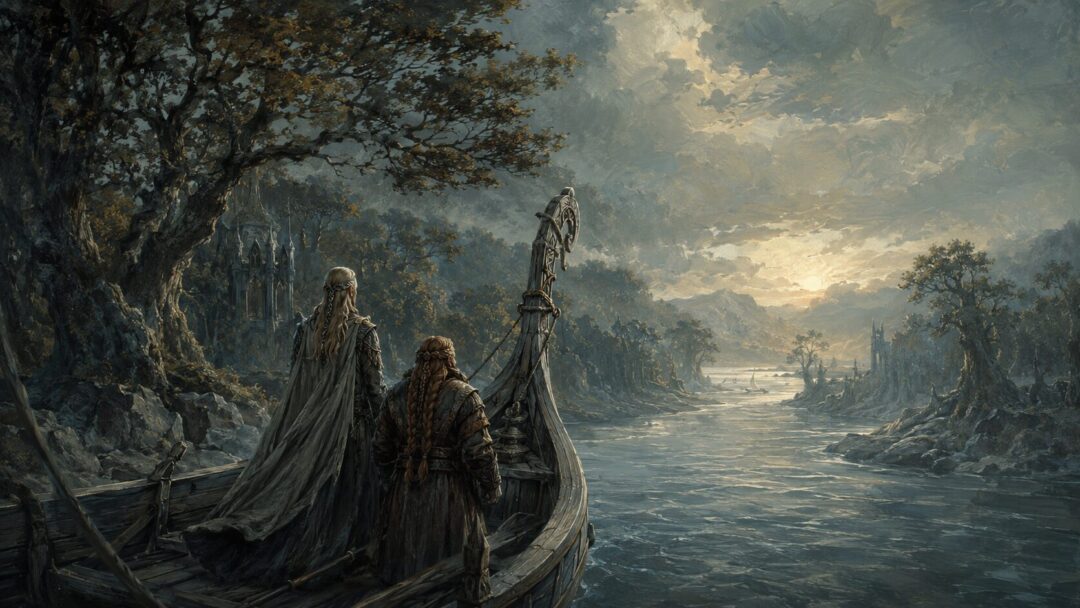
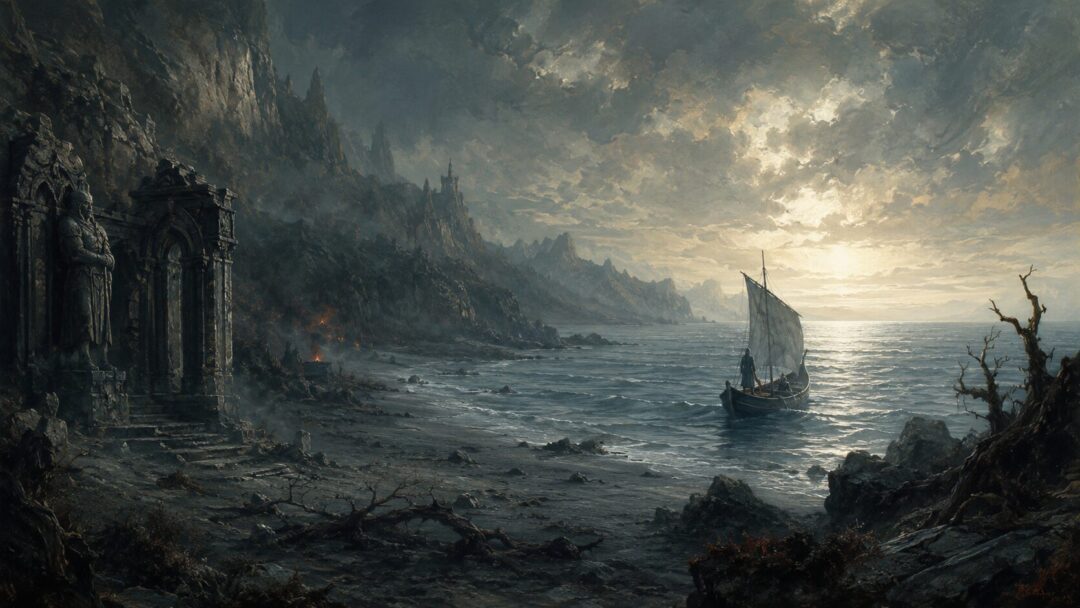
A grey ship slips down the Anduin after the death of King Elessar, and at first it looks like one more beautiful departure in a story full of farewells. Elves have been sailing West for a long time. The Sea has called to them since before the War of the Ring ended. Legolas, who heard the gulls at Pelargir and felt his heart unsettled, was always likely to leave Middle-earth in the end.
But Gimli is the impossible passenger.
A Dwarf on an Elven ship is not a small detail. It is one of the strangest and most quietly powerful endings in The Lord of the Rings. The appendices do not linger over it. They do not give us a farewell speech, a last exchange, or a description of the ship vanishing into the light. They simply say that Legolas built a grey ship in Ithilien and sailed down Anduin and over Sea; and with him, “it is said,” went Gimli the Dwarf. When that ship passed, an end came in Middle-earth of the Fellowship of the Ring.
That sentence does more than close a friendship. It ends an age of shared burden, ends the last living fellowship of the Quest in Middle-earth, and perhaps ends the old certainty that Elves and Dwarves could only remember each other through grievance.
The Last Departure of the Fellowship
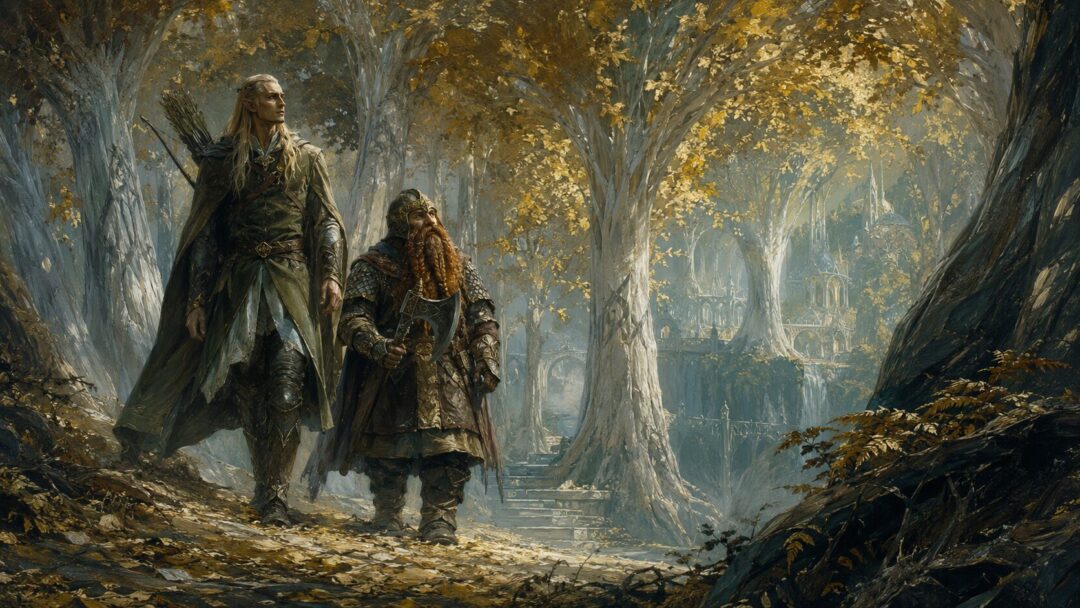
The Fellowship of the Ring was broken almost as soon as it was made. Gandalf fell in Moria. Boromir died defending Merry and Pippin. Frodo and Sam went alone toward Mordor. Aragorn, Legolas, and Gimli turned aside to rescue the captives. From that point forward, the Fellowship survived less as a company than as a promise.
Yet the story never treats that promise as meaningless. The members are scattered, wounded, tempted, crowned, diminished, and changed, but they remain bound by what they carried together. The Ring was destroyed by Frodo’s endurance, Sam’s faithfulness, Gollum’s final intervention, and a mercy that reached farther than strategy. But the victory belonged to a fellowship of many peoples: Hobbit, Man, Elf, Dwarf, and Wizard.
By the Fourth Age, that fellowship is not destroyed by betrayal. It is ended by time.
Boromir is long dead. Frodo has sailed West. Sam later follows, according to the tradition preserved in the appendices. Merry and Pippin eventually die in Gondor, and their beds are said to be placed beside Aragorn’s. Aragorn himself gives up his life after a reign that restores the kingship of Men and marks the new age. Only then does Legolas depart, and Gimli with him.
So their sailing is not merely personal. It is the final closing of the Fellowship’s earthly presence. The Quest has already succeeded. The kingdoms have already been renewed. The old companions have already passed into memory. When Legolas and Gimli leave, no member of the Fellowship remains in Middle-earth as a living witness of the road from Rivendell to Mordor.
The end is peaceful, but it is still an end.
Why Gimli’s Presence Changes Everything
Legolas sailing West is moving, but not surprising. He is an Elf, and once the Sea-longing awakens in him, the texts imply that Middle-earth can no longer fully satisfy his heart. This does not mean he despises Middle-earth. Quite the opposite: he helps renew Ithilien after the War, bringing Elves there and dwelling for a time in a land healed under Aragorn’s reign. His departure comes after service, friendship, and patience.
Gimli’s departure is different.
Dwarves are not counted among the Eldar. Their destiny is distinct, and the Blessed Realm is not presented as their natural destination. The appendices themselves treat Gimli’s going as extraordinary. The phrasing is cautious: “it is said” that he went. The text also offers a possible explanation, not a firm public record: he desired to see again the beauty of Galadriel, and it may be that Galadriel obtained this grace for him.
That caution matters. The story does not turn Gimli into an Elf. It does not say he becomes immortal. It does not explain what his life was like beyond the Sea, or how long he remained there, or what exactly was permitted to him. The point is not that all boundaries vanish. The point is that, for Gimli, an exception may have been granted because of love, reverence, and friendship.
And that makes the moment astonishing. Gimli does not leave Middle-earth because he has no place in it. He has every reason to remain. He becomes Lord of the Glittering Caves, a realm of beauty he loves deeply. He is honored among his own people. He has seen Minas Tirith restored and has helped in the rebuilding and beautifying of Gondor. He is not fleeing failure.
He leaves at the end of a fulfilled life.
That is why the choice feels so weighty. Gimli is not carried away by Elvish enchantment in youth, nor by despair after defeat. He goes after the victory has matured into history. He goes when his great companions have mostly passed beyond reach. He goes, apparently, because the deepest wonders of his life have bound him to people and beauties beyond the borders of his own race.
The Friendship That Repaired an Ancient Wound
The friendship of Legolas and Gimli is often remembered as comic banter: bow and axe, tall Elf and sturdy Dwarf, counting enemies at Helm’s Deep. But its deeper meaning begins in distrust.
At the Council of Elrond, the old suspicion between Elves and Dwarves is not abstract. Legolas is the son of Thranduil, the Elvenking who imprisoned Thorin Oakenshield and his companions in The Hobbit. Gimli is the son of Glóin, one of those very Dwarves. Their fathers’ histories stand behind them before they ever become friends.
Beyond that personal connection lies a much older wound. The histories of the Elder Days preserve terrible memories between Elves and Dwarves, especially the ruin surrounding the Nauglamír and the death of Thingol. Not every Elf and Dwarf in later ages is personally guilty of those ancient crimes, but inherited grief has a long life in Middle-earth. Peoples remember. Songs remember. Pride remembers.
Legolas and Gimli do not erase that history. They overcome it in themselves.
Lothlórien is the turning point. Gimli enters under suspicion, and the question of blindfolding nearly breaks the Company’s fragile unity. But Galadriel receives him with courtesy and insight. Gimli, in turn, responds not with possessiveness or crude desire, but with reverent wonder. His request for a single strand of her hair is shocking precisely because it could have been an echo of old possessive pride; instead, it becomes an act of humility. Galadriel gives him three.
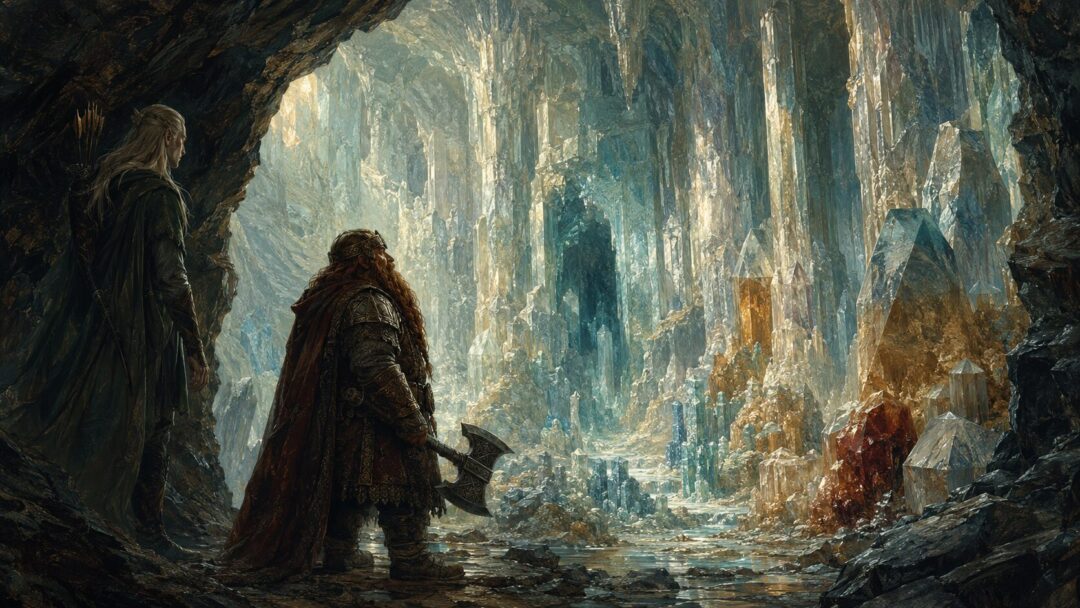
From there, something changes. Legolas and Gimli begin walking together in Lórien. Their companionship grows quietly, almost offstage. Later they make a promise to visit Fangorn and the Glittering Caves together, each agreeing to behold what the other loves. That promise is important because it is not about usefulness in war. It is about trust. The Elf agrees to enter the Dwarf’s wonder; the Dwarf agrees to enter the Elf’s.
Their final voyage is the last and greatest version of that pattern.
The Sea, the Caves, and the Exchange of Wonder
Legolas and Gimli’s friendship is built around learning to see.
Legolas hears the trees, loves green leaves, and belongs to a people whose sorrow is tied to fading and departure. Gimli loves stone, craft, hidden splendor, and the deep places of the earth. At first, these loves seem opposed. Fangorn is living, ancient, and perilous. The Glittering Caves are subterranean, mineral, and silent with crafted beauty. Each place might have seemed alien to the other.
Yet after Helm’s Deep, Gimli speaks of the caves with such awe that Legolas is moved. He admits he will visit them if Gimli will come with him to Fangorn. This is one of the most generous forms of friendship in the book: not merely defending someone, not merely fighting beside him, but consenting to be changed by what he loves.
The final sailing extends that generosity beyond Middle-earth itself. Legolas takes the road of the Elves. Gimli, if the tradition is true, goes with him. But Gimli’s motive is not only Legolas. The appendices connect his going also to Galadriel. That matters because Galadriel represents another impossible bridge. She is one of the greatest of the Eldar remaining in Middle-earth, and Gimli’s reverence for her is one of the clearest signs that old categories have failed to contain his heart.
He has not stopped being a Dwarf. He has become more fully himself by loving beyond the walls of inherited suspicion.
What Their Sailing Really Ends
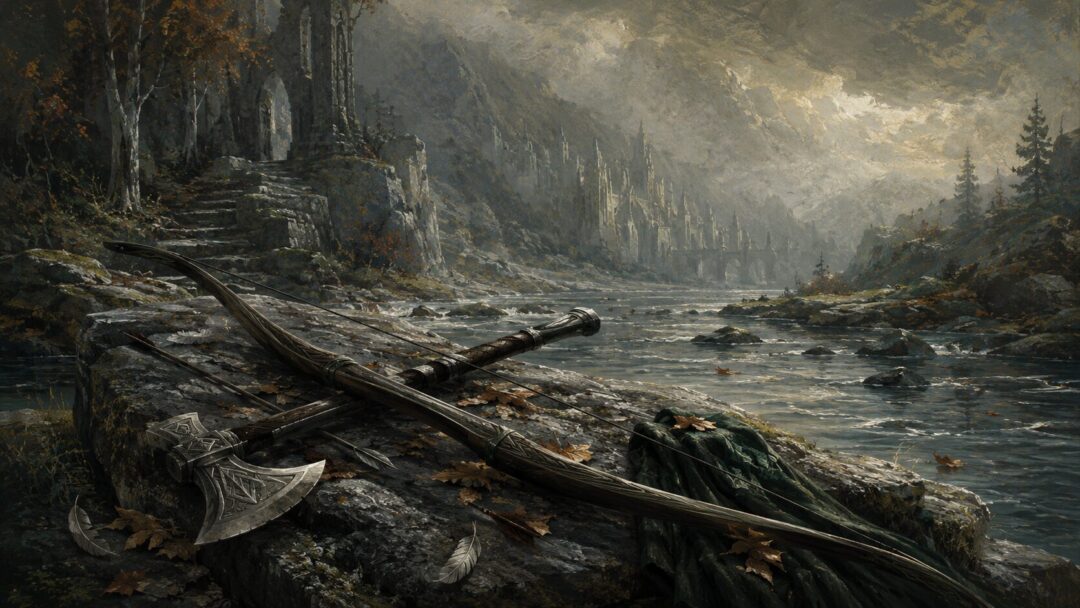
The text says that when their ship passed, “an end was come in Middle-earth of the Fellowship of the Ring.” On the surface, this means the last members of the Fellowship had left, died, or passed beyond the ordinary world. But the sentence carries a wider resonance.
It ends the age when the Free Peoples were held together by immediate necessity against Sauron. During the War, Elves, Dwarves, Men, Hobbits, and Ents all had reasons to resist the Shadow. Fear can create alliances. Survival can create temporary unity. But Legolas and Gimli prove something rarer: unity that survives victory.
After Sauron’s fall, they do not simply return to old separations. They travel together. They labor in the renewed world. They keep faith with one another after the great emergency has passed. Their friendship is not a wartime accident. It becomes part of the moral repair of Middle-earth.
Yet their departure also shows that repair is not the same as permanence. The Fourth Age belongs increasingly to Men. The Elves fade from the central story. The great wonders of the Elder Days withdraw. Dwarves continue, but their own long history also moves toward mystery and decline. The Fellowship’s end is therefore bittersweet: what was healed does not remain visible forever.
Legolas and Gimli do not found a new eternal order between Elves and Dwarves. Tolkien’s texts do not say that their friendship transforms all relations between their peoples. What it does show is smaller and perhaps more moving: two persons can answer ancient hatred with chosen loyalty. They can become evidence that the old wounds were not absolute.
A Mercy Beyond the Map
There is a temptation to ask too many practical questions about Gimli’s arrival in the West. Was he allowed into Aman itself? Did he see Galadriel again? How long did he live? What did the Valar permit? The texts do not fully answer. Their restraint is part of the power.
What we are given is enough: Gimli’s going was strange, exceptional, and associated with grace. Not entitlement. Not conquest. Grace.
That word fits the moral atmosphere of the ending. The Ring is destroyed not by strength alone. Frodo is saved, and the world with him, through pity shown earlier to Gollum. The Shire is scoured not by great lords, but by small people who have grown in courage. Aragorn’s kingship is not merely a reward, but a restoration after long patience and hidden service. Again and again, the story’s deepest turns come through mercy, humility, endurance, and gifts no one can demand.
Gimli’s passage belongs to that pattern. A Dwarf who once stood amid old suspicion becomes the companion of an Elf on the last road. A lover of caves and stone sails into the uttermost West because beauty has enlarged his world. A member of a race often remembered for guardedness and possessive craft is honored through a friendship marked by trust.
It is not a loophole in the lore. It is a grace-note at the end of it.
The Last Fellowship
Legolas and Gimli sailing together ends the Fellowship not as a failure, but as a completed promise. The Company formed in Rivendell was never meant to last forever in bodily form. It was meant to bear the Ring as far as faith, courage, and providence allowed. It was meant to bring divided peoples into one perilous hope.
By the time the grey ship passes out of Middle-earth, that hope has already borne fruit. Sauron is gone. Aragorn has reigned. The Shire has been healed. The old companions have taken their appointed roads. What remains is one final image: an Elf and a Dwarf together, leaving behind the lands where their peoples once mistrusted each other so deeply.
The ship ends the visible Fellowship. It ends the last living chapter of the Quest in Middle-earth. It ends, at least for these two, the ancient argument that blood and history must decide the limits of love.
And because the text says so little, the silence around the ship becomes luminous. We are not told everything. We are only shown enough to understand that some friendships become stronger than the griefs that preceded them, and that at the edge of the world, even an old wound may be answered by a final act of trust.
Sources & Notes
- Tolkien Gateway, "Legolas" — https://tolkiengateway.net/wiki/Legolas
- Tolkien Gateway, "Gimli" — https://tolkiengateway.net/wiki/Gimli
- Tolkien Gateway, "Undying Lands" — https://tolkiengateway.net/wiki/Undying_Lands
Sources added for article-specific Tolkien reference context.