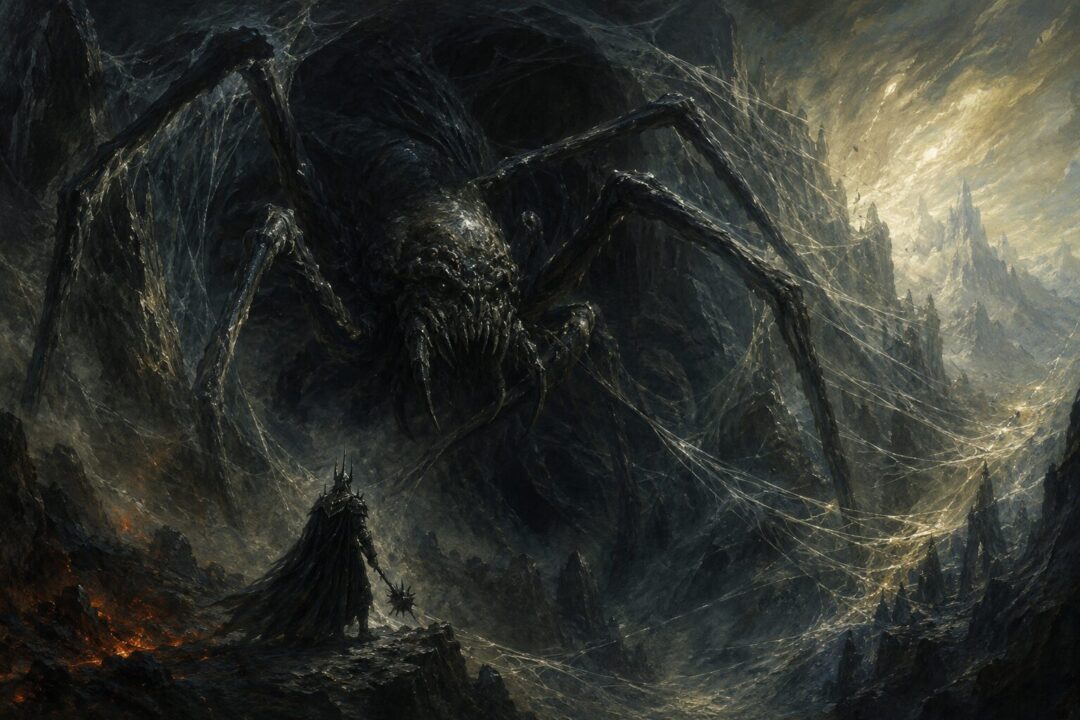
Bilbo’s first great private victory in The Hobbit is not against a dragon, a goblin-king, or a warrior. It is against spiders in the dark of Mirkwood. He is alone, invisible, terrified, and armed with a short Elvish blade that has not yet earned its name. The scene can look, at first, like a fairy-tale monster episode: travelers stray from the path, giant spiders catch them, and the clever small hero rescues his friends.
But in Middle-earth, spiders are almost never “just big spiders.”
They belong to one of the oldest patterns of evil in the legendarium: hunger that cannot be satisfied, darkness that does not merely hide light but consumes it, and webs that turn living beings into food, prisoners, and objects. From Ungoliant before the First Age, to Shelob on the borders of Mordor, to the speaking spiders of Mirkwood, Tolkien’s spider-creatures carry a spiritual and moral weight far beyond animal danger.
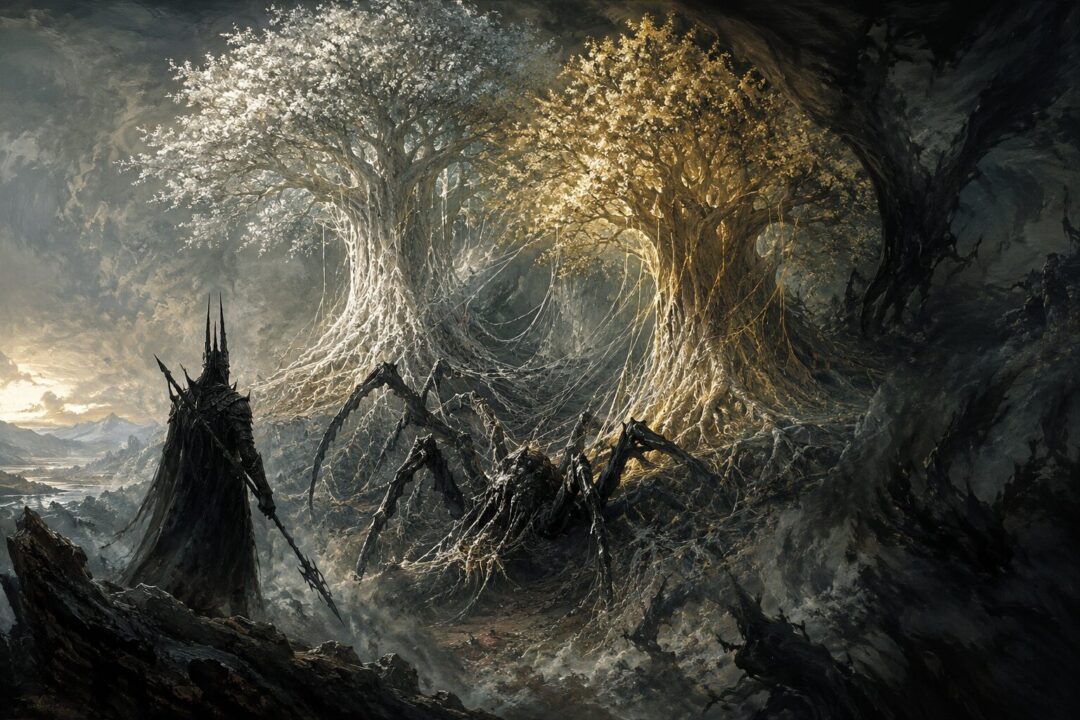
The First Spider Is Not an Animal
The deepest root of this horror is Ungoliant. The texts do not present her as a natural beast that happened to grow enormous. Her origin is deliberately obscure. She is associated with a monstrous spider-form, but her nature is mysterious: some traditions suggest she may have been among the corrupted Ainur, while other passages leave her as something stranger and less classifiable. Tolkien never gives a clean biological answer, and that uncertainty matters. Ungoliant is not frightening because she is zoologically large. She is frightening because she is a living appetite in a shape the world can barely explain.
Her power is also not merely physical. In Avathar, she spins darkness into webs and drinks in light until her dwelling becomes a place where light cannot enter. This is why she should not be read as only the first giant spider. She is a corruption of perception itself. Where she dwells, the world becomes less visible, less knowable, less alive. Her “Unlight” is one of the most disturbing ideas in Tolkien’s mythology because it is not ordinary shadow. It is darkness with appetite.
Hunger That Even Melkor Cannot Control
Ungoliant’s alliance with Melkor is one of the great warnings in the legendarium: evil can cooperate, but it does not truly unite. Melkor uses Ungoliant for revenge against Valinor. Ungoliant accepts because he promises to satisfy her hunger. The bargain is already unstable because neither party is capable of true loyalty.
After the poisoning of the Two Trees, Ungoliant drinks their light and then drains the Wells of Varda. Rather than being satisfied, she grows more terrible. Her hunger expands with every act of consumption. This is one of the central rules of Tolkien’s spiders: feeding does not end desire. It enlarges it.
That is why Ungoliant turns on Melkor after the theft of the Silmarils. When he withholds the jewels in his right hand, she demands them too, overpowers him, and entangles him until the Balrogs come to his rescue. The image is astonishing: Melkor, later Morgoth, the greatest tyrant of Arda, is nearly strangled by the very hunger he tried to weaponize.
This is not a random monster attack. It is a moral pattern. Ungoliant shows what happens when evil becomes pure consumption. It no longer serves strategy, empire, revenge, or even self-preservation. It wants more because “more” is its only law.
Nan Dungortheb: Where Horror Breeds
After fleeing from Lammoth, Ungoliant comes into Beleriand and eventually dwells near the mountains south of Dorthonion. There she mates with other foul creatures of spider-form and devours them, producing offspring before vanishing from known history. The region becomes associated with dread, and her brood helps give Nan Dungortheb its nightmarish reputation.
This genealogy is important because it means later spiders are not isolated fantasy pests. They are descendants of an ancient spiritual disaster. The spider-horror that Bilbo meets in Mirkwood and that Frodo meets near Mordor is not merely local wildlife. It is the long after-effect of Ungoliant’s presence in the world.
Tolkien’s evil often leaves residue. Morgoth’s power enters matter. Sauron’s malice lingers in places and devices. The spiders follow a similar pattern. Ungoliant disappears, but the shape of her hunger remains. Her descendants are smaller, lesser, and more killable, but they still carry something of that original darkness.
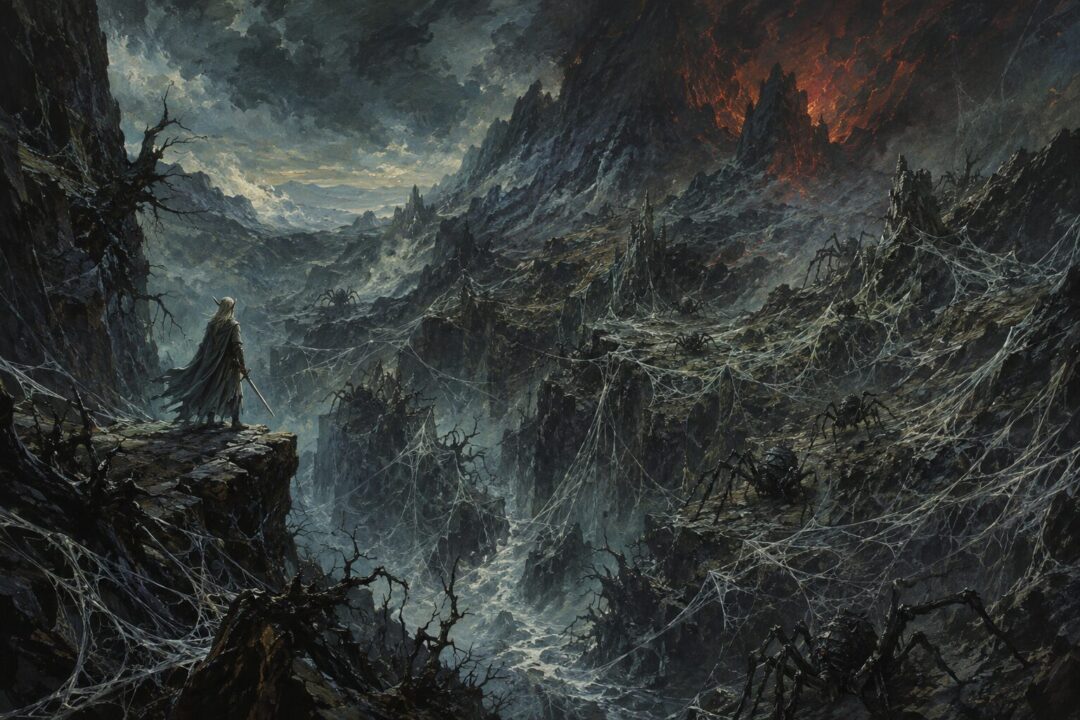
Shelob Serves No Master
Shelob is the clearest heir of Ungoliant’s meaning. The Lord of the Rings presents her as the last child of Ungoliant to trouble the world, dwelling in the pass above Minas Morgul long before Sauron’s later power in Mordor reached its height. She is ancient, independent, and uninterested in the political aims of the Dark Lord.
That independence is crucial. Shelob lives on the border of Sauron’s land, and Sauron knows she is there. He allows her to remain because she is useful as a living guard for Cirith Ungol. But she is not one of his soldiers in the ordinary sense. She does not obey the chain of command. She is not moved by the Ring, by conquest, or by any ideology of dominion. She wants prey.
This makes Shelob frightening in a different way from Sauron. Sauron is order corrupted into tyranny. He wants rule, surveillance, obedience, and possession. Shelob is older and more primitive. She wants the living body reduced to meat. The two evils can coexist because Sauron is willing to exploit her appetite, and Shelob is willing to feed in the shadow of his realm. But the texts imply a boundary between them: she is not Sauron’s servant in her own mind.
That distinction makes Cirith Ungol feel like one of the most spiritually dangerous places in the story. Frodo and Sam are not simply sneaking through the back door of Mordor. They pass through a place where two kinds of evil overlap: Sauron’s strategic darkness and Shelob’s devouring darkness.
The Body Itself Is Wrong
Tolkien’s spider-creatures are also strange because their bodies are not always described like normal spiders. Shelob has many-windowed eyes, a venomous beak, a sting, claws, and a hide thickened by layers of evil growth. The Mirkwood spiders are associated with insect-like eyes, and Tolkien Gateway notes that these details do not match ordinary spider biology.
That does not mean we should over-systematize them as some separate scientific species. A safer reading is that Tolkien uses “spider” as the nearest recognizable shape for something morally and mythically distorted. Shelob is “most like” a spider, but she is not merely an enlarged specimen from a naturalist’s book.
Her body expresses her inner reality. The bloated shape, the venom, the layered hide, the many eyes, the tunnel, the webs — all of it makes her a visible form of predatory selfishness. She is swollen with ages of feeding. She is hard to wound because evil has grown around her like armor. Her softest weakness is associated with sight and light, which is why the Phial of Galadriel becomes so important in her defeat.
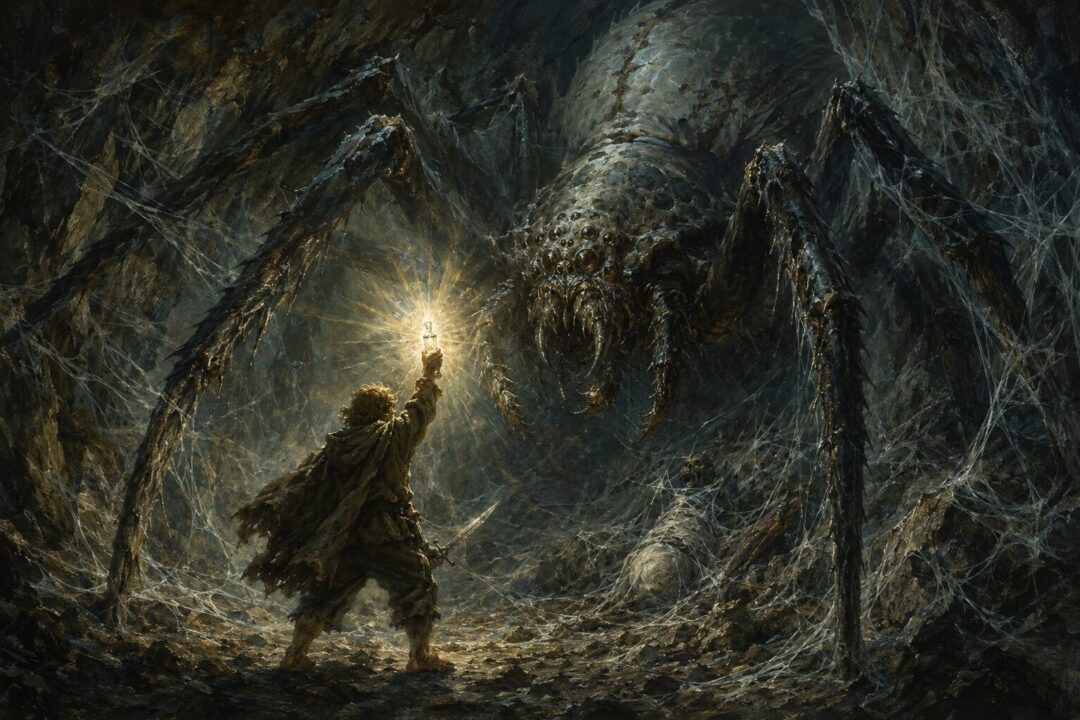
Mirkwood Spiders Are Smaller, But Not Innocent
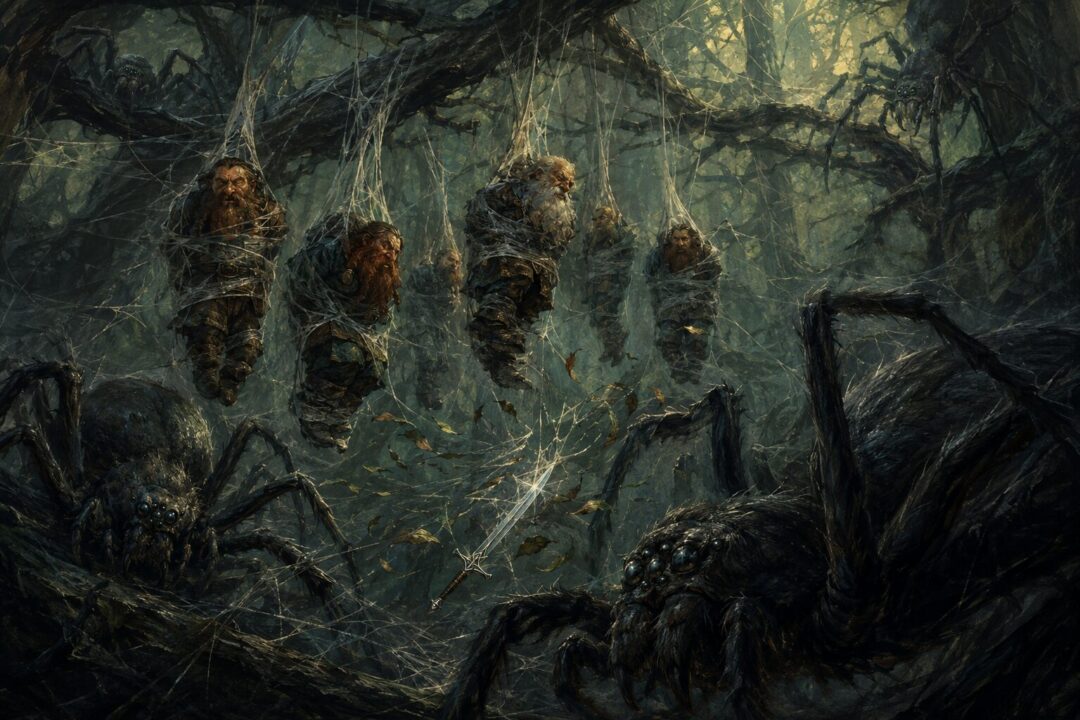
The spiders of Mirkwood are not described with the same mythic weight as Ungoliant or Shelob, but they are still more than animals. They speak, plot, mock, and show cruel intelligence. Their presence is tied to the darkening of Greenwood into Mirkwood, a change associated with Sauron’s return as the Necromancer in Dol Guldur. The children of Shelob are said to have spread as far north as Dol Guldur and Mirkwood, and by the time of Bilbo’s journey the forest is thick with webs and fear.
This changes how we read Bilbo’s fight. He is not merely killing oversized forest vermin. He is confronting one of the small, lingering outgrowths of ancient darkness. His sword receives the name Sting because, in that moment, Bilbo becomes more than a burglar surviving by luck. He becomes someone capable of resisting the shadow directly, even when no wizard, warrior, or king is there to help.
The victory is modest compared with the War of the Ring. Yet thematically, it belongs to the same world. A small person, armed with courage and a blade from older wars, strikes back against a descendant of old evil in a place where light has almost failed.
Webs, Paths, and the Loss of Freedom
Spiders in Middle-earth also attack one of Tolkien’s recurring moral images: the path. Roads, paths, and ways matter deeply in The Hobbit and The Lord of the Rings. Characters are tested by whether they stay on the path, lose it, choose a harder road, or are led into a trap.
Spiders turn paths into snares. In Mirkwood, leaving the path exposes Thorin’s company to capture. At Cirith Ungol, Gollum guides Frodo and Sam along a way that is technically a path into Mordor, but morally a betrayal into Shelob’s lair. In both cases, the spider is waiting where guidance has failed or trust has been corrupted.
The web is the opposite of the true road. A road exists so that a traveler may move toward a destination. A web exists so that movement ends. The victim is not simply killed; he is immobilized, wrapped, stored, and consumed at leisure. That is why spider-scenes feel so claustrophobic. The danger is not only death. It is the loss of agency.
Why Light Matters Against Them
Against Ungoliant and Shelob, light is never decorative. Ungoliant devours light; Shelob recoils from the Phial of Galadriel; the Mirkwood spiders belong to a forest where sunlight has become thin, obstructed, and strange. Light in these episodes is not just illumination. It is truth, memory, and resistance.
The Phial works against Shelob because it carries a light connected, through Eärendil’s star, to the unmarred light preserved from the Elder Days. The texts do not turn this into a simple magical weapon with rules like a game item. Its power is moral and symbolic as much as physical. Sam holds up a light that Shelob’s darkness cannot digest.
That is the great reversal. The line of Ungoliant began by consuming the light of the Trees. But in Shelob’s tunnel, her descendant is driven back by a remnant of holy light carried by a gardener from the Shire. The ancient hunger that once terrified Melkor is resisted not by a greater tyrant, but by humility, loyalty, and courage.
The Real Horror Is Appetite Without Limit
Tolkien’s spiders are terrifying because they show appetite cut loose from gratitude, pity, and purpose. Ungoliant consumes light itself. Shelob consumes whatever living things come within reach. The Mirkwood spiders joke and scheme around bound captives. Each version reduces other beings to food.
That is why they are never just giant animals. Animals in Tolkien’s world can be noble, ordinary, dangerous, or mysterious. But these spiders belong to the moral geography of the Shadow. They are what hunger looks like when it becomes a worldview.
And yet their defeats are equally revealing. Bilbo survives by wit and courage. Sam survives by love and stubbornness. The light that Ungoliant tried to devour returns in a form her heir cannot master. Middle-earth remembers its wounds, but it also preserves answers to them.
The spiders are ancient, monstrous, and deeply rooted in darkness. But they are not ultimate. Their webs can be cut. Their tunnels can be passed through. Their hunger can be refused.
Sources & Notes
- J.R.R. Tolkien, The Silmarillion, “Of the Darkening of Valinor” — Ungoliant establishes Tolkien’s spider imagery as ancient, demonic hunger rather than ordinary animal menace. https://tolkiengateway.net/wiki/Ungoliant
- Tolkien Gateway, “Ungoliant” — summarizes the primordial spider-spirit, her devouring darkness, and her connection to later monstrous spiders. https://tolkiengateway.net/wiki/Ungoliant
- Tolkien Gateway, “Shelob” — covers Shelob’s ancestry from Ungoliant, her malice, and her role as a spiritual as well as physical threat in Mordor’s borderlands. https://tolkiengateway.net/wiki/Shelob
- The Encyclopedia of Arda, “Shelob” — independent reference on Shelob as a monstrous offspring of Ungoliant, reinforcing the lineage from ancient darkness to later spider-horror. https://www.glyphweb.com/arda/s/shelob.html
Sources cover Ungoliant, Shelob, and Tolkien’s great-spider lineage as a dark/hungry power rather than ordinary animal gigantism.