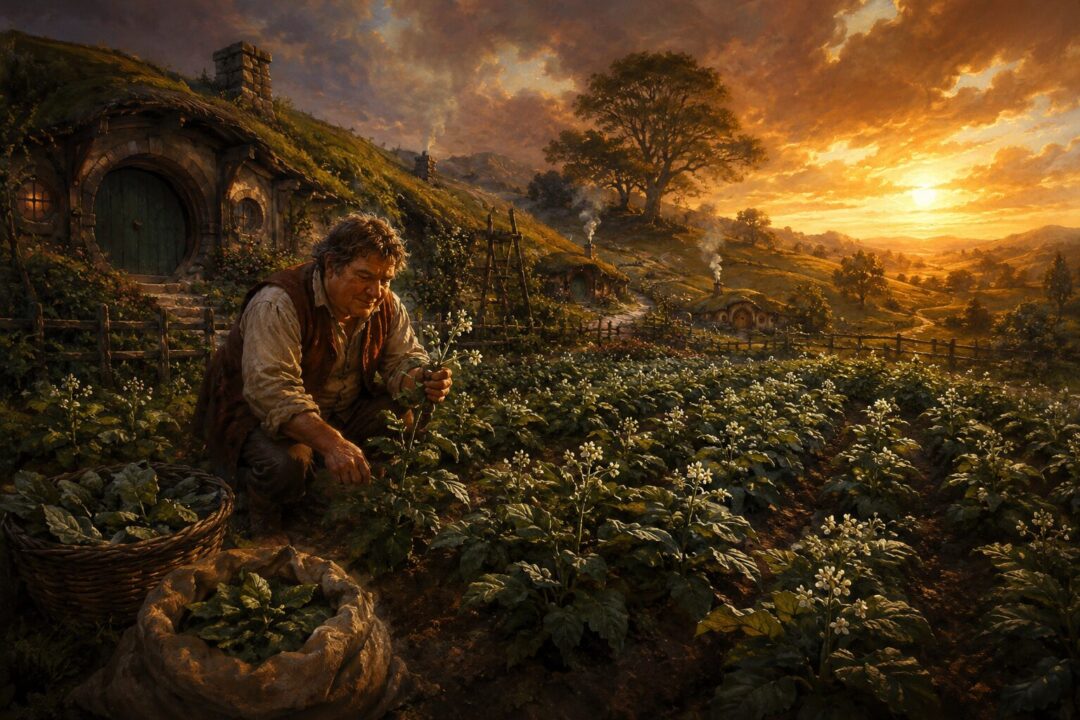
Few things seem more unmistakably "Shire" than a Hobbit quietly filling a pipe after supper. Pipe-weed appears so ordinary that it is easy to treat it as little more than a charming habit, a symbol of comfort before adventures begin or after dangers end.
Yet the history of pipe-weed tells a very different story.
Rather than representing isolation, it reveals that the Shire was quietly connected to the wider world long before Frodo ever left Bag End. The story of a simple leaf traces forgotten trade routes, cultural exchanges, wandering travelers, ancient kingdoms, and even the hidden ambitions of Saruman himself. One of the most peaceful customs in Middle-earth turns out to be evidence that the Shire was never as detached from history as it appeared.
The remarkable irony is that Hobbits became famous for something they almost certainly did not invent.
A Mystery Even Hobbits Could Not Fully Explain
The Prologue to The Lord of the Rings openly admits that the origins of smoking pipe-weed were already uncertain by the end of the Third Age. Meriadoc Brandybuck collected everything that could still be learned in his Herblore of the Shire, but even his careful research could only reconstruct part of the story.
According to those traditions, pipe-weed was first grown in the Shire around the year S.R. 1070 (T.A. 2670) by Tobold Hornblower of Longbottom in the Southfarthing. Tobold became so closely associated with the crop that one of the finest later varieties bore his nickname: Old Toby.
But the texts immediately raise an intriguing possibility.
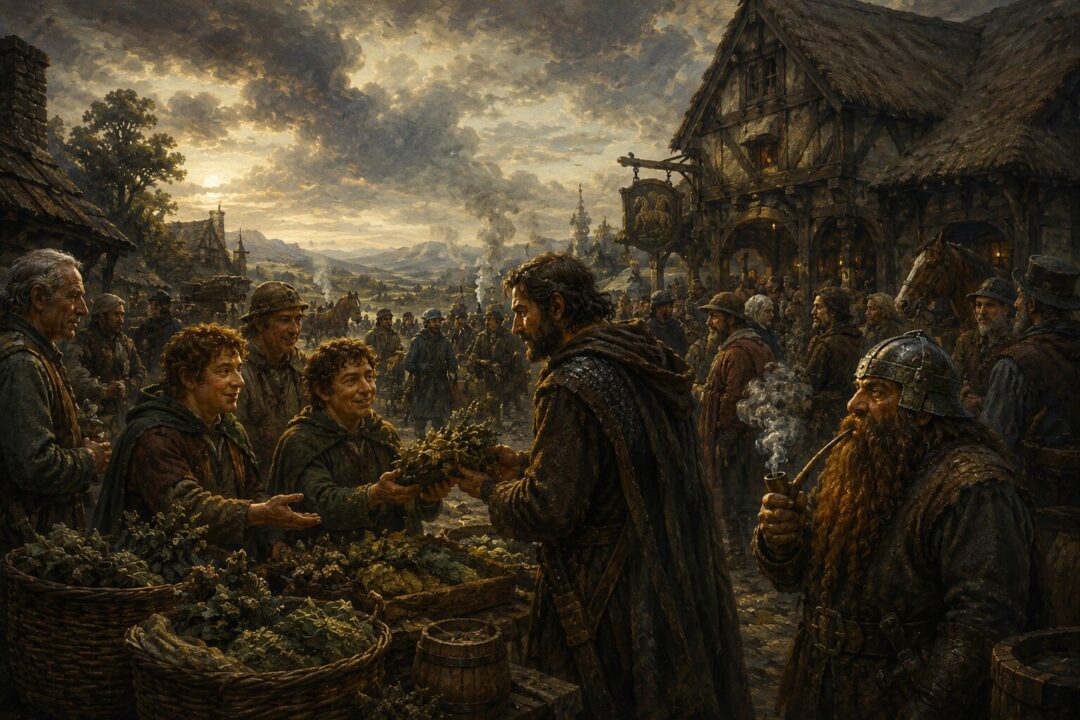
Tobold never explained exactly where he obtained the plant, and Merry notes that many believed he discovered it during travels to Bree in his youth. The evidence is circumstantial rather than conclusive, yet it is presented as the strongest surviving explanation.
Instead of beginning inside the Shire, the story appears to begin somewhere beyond its borders.
Bree Was More Than a Village on the Road
Bree occupies a unique place in northwestern Middle-earth.
Unlike the Shire, it was inhabited by both Men and Hobbits. Travelers from every direction passed through its crossroads. Rangers watched nearby lands. Dwarves used its roads. Merchants and wanderers regularly stopped at the Prancing Pony before continuing east or west.
If pipe-smoking truly developed there before reaching the Shire—as Merry cautiously suggests—then the custom itself emerged in one of Middle-earth's great meeting places rather than inside an isolated Hobbit community.
This matters because it changes how we understand Hobbit culture.
Many readers imagine Hobbits creating their traditions entirely independently. Pipe-weed instead illustrates that at least some beloved Shire customs were adopted, refined, and ultimately perfected after contact with neighboring peoples.
The Hobbits did not merely copy the practice.
They transformed it.
The finest pipe-weed soon came from the Southfarthing, and Shire growers became renowned throughout the North for producing varieties whose quality surpassed those grown elsewhere.
The Leaf Carried an Even Older History
The story stretches back still further.
In The Return of the King, Aragorn explains that the herb is known in Gondor as westmansweed, while its more learned name is sweet galenas. There it grows naturally and is appreciated mainly for its fragrant flowers rather than for smoking. The name westmansweed preserves the tradition that it came with the Númenóreans from over the Sea during the Second Age.
The texts stop short of describing every stage of its journey north.
What they do imply is a remarkable chain of transmission.
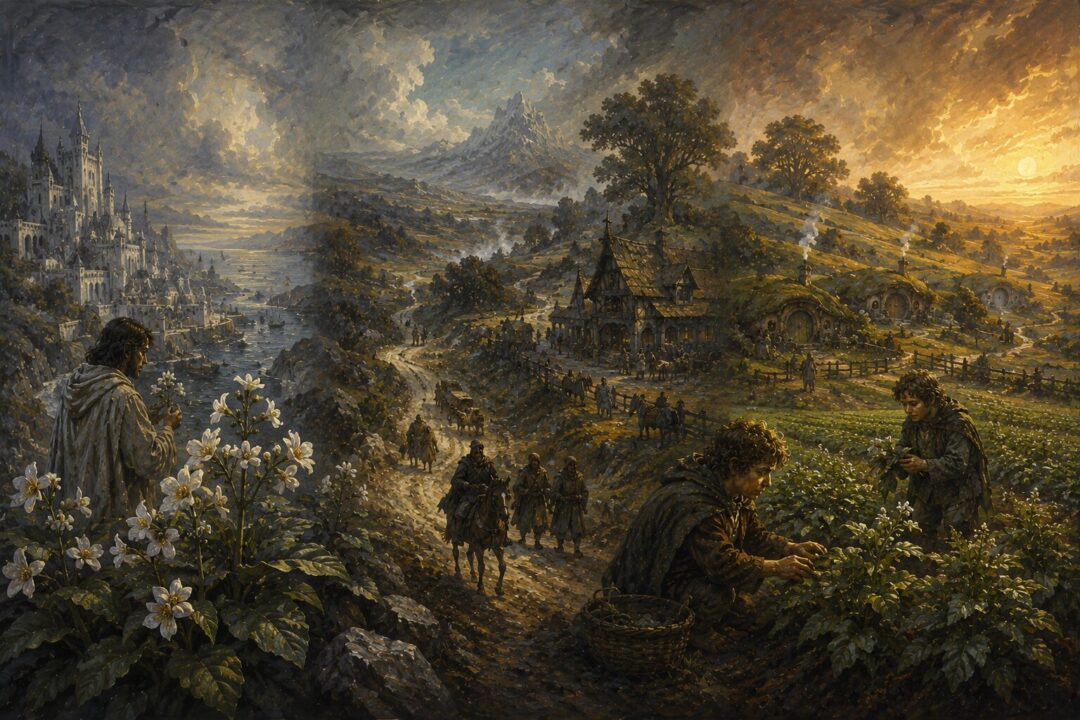
A plant associated with Númenórean settlement appears in Gondor, reaches Eriador, is likely cultivated around Bree, and finally becomes the defining crop of the Shire.
One humble herb quietly records centuries of movement across Middle-earth.
Long after kingdoms declined and borders shifted, the leaf continued traveling where armies and kings no longer did.

The Shire Was More Connected Than It Looked
The Shire often feels detached from the rest of Middle-earth because Hobbits deliberately preferred peace, routine, and local concerns.
Yet pipe-weed hints at a different reality.
Growing it successfully required agricultural knowledge suited to the Southfarthing's favorable climate. Producing famous varieties such as Longbottom Leaf and Old Toby required generations of cultivation rather than accidental success. Exporting them required merchants, buyers, and dependable routes.
The Shire therefore participated in regional trade far more actively than many readers assume.
Its economy included products valued well beyond Hobbit borders.
Visitors knew where the finest leaf could be found.
The Rangers knew it.
The people of Bree knew it.
Gandalf certainly knew it.
Even Saruman knew it.
Pipe-weed reminds us that peaceful societies are rarely isolated ones.
Gandalf Understood Hobbits Better Than Most
Gandalf's enjoyment of pipe-weed often appears humorous.
He sits comfortably with Hobbits, blows elaborate smoke-rings, and seems entirely at home among them.
Yet this habit reflects something deeper.
Unlike many powerful figures, Gandalf took genuine interest in ordinary people and their customs. Learning the art of smoking from Hobbits was entirely consistent with his character. Rather than dismissing small pleasures as beneath him, he appreciated them.
That attitude mirrors his larger understanding of Middle-earth.
Great wisdom often begins with paying attention to ordinary lives.
The same people who cultivated remarkable pipe-weed also possessed resilience, generosity, and unexpected courage that others repeatedly overlooked.
The leaf therefore becomes another example of Gandalf recognizing value where others saw only simplicity.

Saruman Saw Something Entirely Different
Saruman initially mocked Gandalf's fondness for pipe-weed.
Later, however, he secretly adopted the habit himself.
After Isengard fell, Merry and Pippin discovered stores of Southfarthing pipe-weed among Saruman's possessions. At first they delighted in the unexpected find without fully considering what it revealed. Only later did the broader implications become apparent.
The discovery suggests commercial connections between Saruman and the Shire before his open assault upon it.
The texts do not describe every detail of these dealings, but the presence of Shire pipe-weed in Isengard shows that Saruman had access to goods from a land he would later seek to dominate.
This is one of Tolkien's quiet ironies.
The same trade networks that carried comfort across Middle-earth could also be exploited by those seeking power.
Pipe-weed itself remained innocent.
The ambitions surrounding it did not.
A Crop That Carried Reputation
Pipe-weed also reveals something about Hobbit craftsmanship.
The names Longbottom Leaf, Old Toby, and Southern Star are not simply different plants but celebrated cultivated varieties. They suggest careful breeding, agricultural experimentation, and pride in local production.
This fits a broader pattern within the Shire.
Hobbits excelled at quiet skills rather than spectacular achievements.
Their gardens flourished.
Their food was famous.
Their inns welcomed travelers.
Their fields were carefully tended.
Pipe-weed belongs naturally beside these accomplishments.
Its reputation spread not because Hobbits sought glory but because they consistently produced something exceptional.
The Contrast Between War and Ordinary Life
Some of the most memorable pipe-smoking scenes occur during moments of uncertainty.
After great battles, friends share a pipe.
Following terrible hardship, familiar smoke restores a sense of home.
These moments are not celebrations of the leaf itself so much as reminders of the ordinary world worth defending.
Pipe-weed therefore functions almost as a literary anchor.
Whenever it appears, readers are reminded of kitchens, gardens, inns, laughter, and peaceful evenings that exist beyond wars and Dark Lords.
Its significance lies precisely in its normality.
Middle-earth is not saved merely so kingdoms can survive.
It is saved so ordinary lives may continue.
The Hidden Lesson of Pipe-weed
Pipe-weed begins as a plant.
It becomes a trade good.
It becomes a cultural tradition.
It becomes evidence of forgotten journeys stretching across centuries.
Its history reveals that the Shire never existed entirely apart from the wider world. Ideas, crops, travelers, and customs crossed its borders long before the War of the Ring. Hobbits absorbed outside influences without losing their own identity, refining what they received into something uniquely theirs.
That quiet confidence may be the most revealing lesson of all.
The strongest cultures are not always the most isolated.
Sometimes they are the ones able to welcome good things from beyond their borders while preserving everything that makes home worth returning to.
In the end, a single pipe filled with Southfarthing leaf contains far more than fragrant smoke. It carries echoes of Númenor, Bree, wandering merchants, careful gardeners, wise friendships, hidden ambitions, and the enduring connections that quietly linked Middle-earth together long before most people noticed them.
Sources & Notes
- https://tolkiengateway.net/wiki/Pipe-weed — overview of pipe-weed, its first cultivation by Tobold Hornblower, Longbottom Leaf/Old Toby, Bree traditions, and Gondor’s name sweet galenas/westmansweed.
- https://tolkiengateway.net/wiki/Tobold_Hornblower — background on Tobold Hornblower of Longbottom and the Shire tradition that he introduced pipe-weed cultivation around S.R. 1070.
- https://tolkiengateway.net/wiki/Bree — context for Bree as a mixed settlement of Men and Hobbits at the crossroads of the East Road and Greenway, supporting the article’s point about cultural exchange beyond the Shire.
- https://tolkiengateway.net/wiki/Saruman — summary of Saruman’s interest in the Shire and pipe-weed, including the trade connections and stores of Longbottom Leaf found at Isengard.
Sources document Tolkien-lore details about pipe-weed, Tobold Hornblower, Bree as a crossroads settlement, and Saruman’s Shire leaf connections.