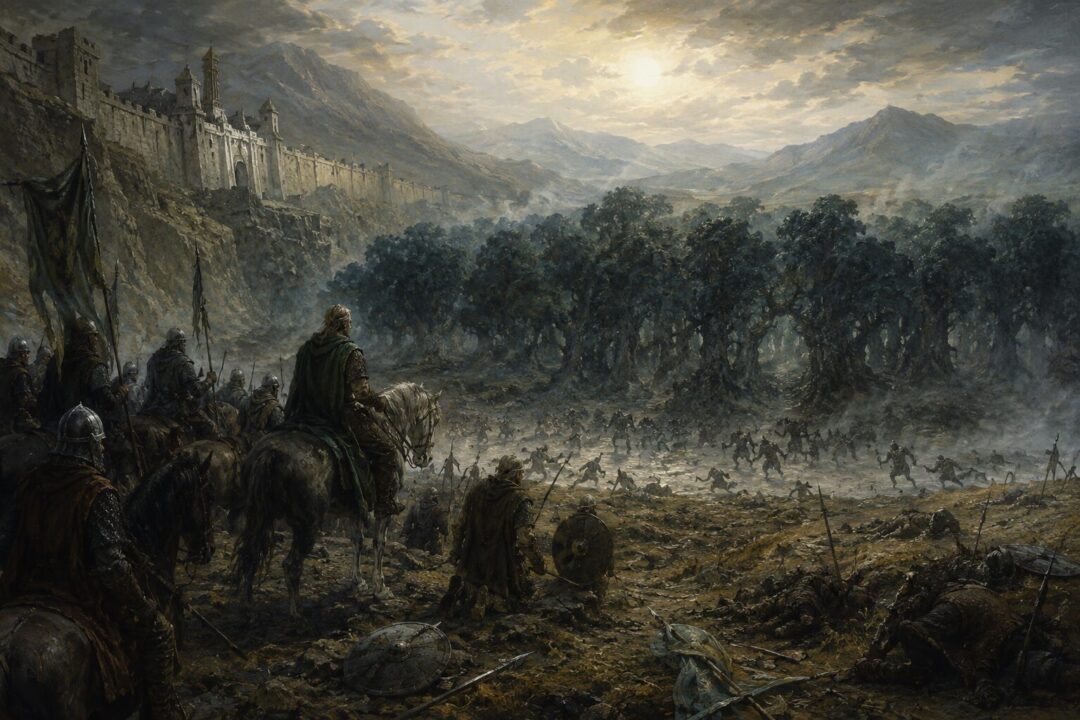
At Helm’s Deep, the defenders of Rohan expected death to come from the front: ladders against the wall, fire in the culvert, Orcs pouring through the breach, and the horn of Helm Hammerhand sounding as a last act of defiance. But the strangest doom of that night did not come from steel.
It came from behind the enemy.
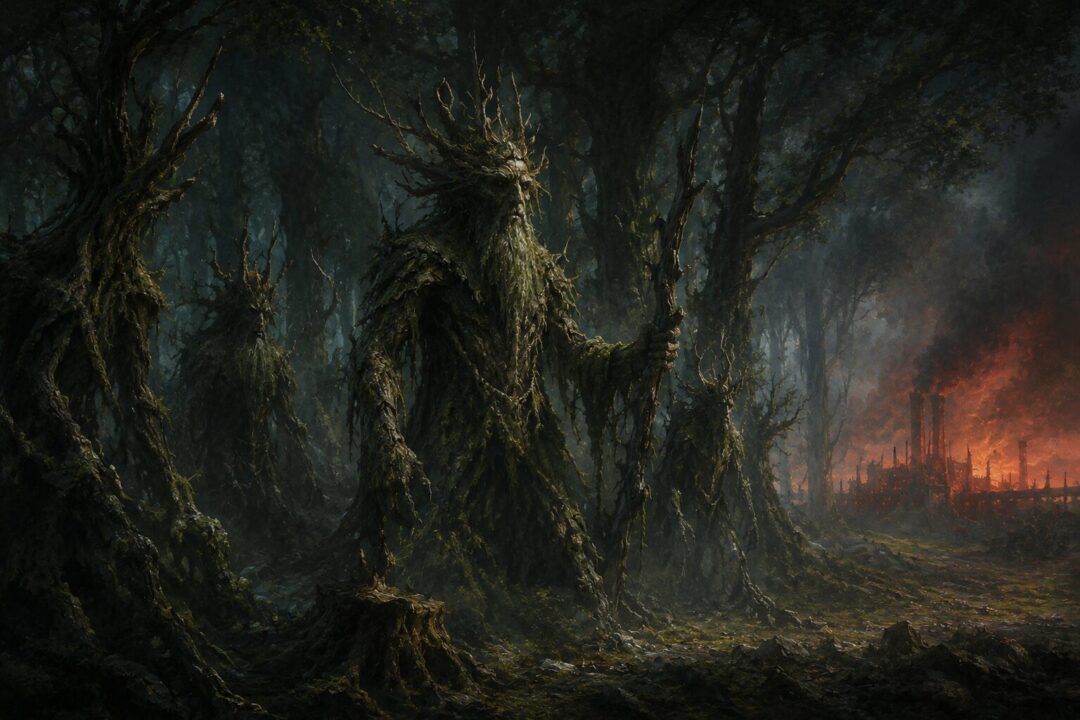
Where the armies of Isengard expected an open valley, they found a forest that had not been there before. Not a line of soldiers. Not a cavalry reserve. A dark, silent wood, stretching across the Deeping-coomb, blocking the way of escape. The Orcs had come to destroy Rohan with axes, fire, and Saruman’s machinery. By dawn, they were trapped between Men and trees.
The texts do not show the Huorns tearing Orcs apart in explicit detail. That is part of the horror. The account is more restrained, and therefore more unsettling. The Orcs fled into the darkness beneath the boughs, and none came out.
The Forest That Was Not There the Night Before
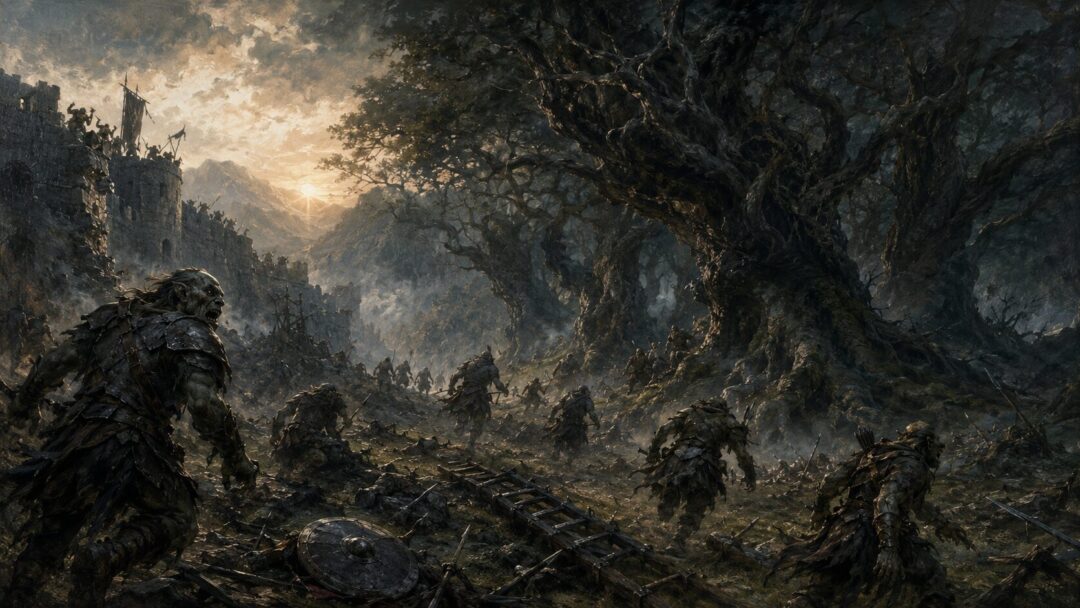
The Battle of the Hornburg turns on a sudden reversal. Théoden and Aragorn ride out from the Hornburg at dawn, while Gandalf and Erkenbrand arrive with men of the Westfold. Saruman’s army, already shaken, is driven backward. But the retreat is no retreat at all.
Behind them stands a new forest.
The valley below Helm’s Dike had been open before. By morning it was filled from side to side with strange trees. The Orcs, pressed by the defenders and Gandalf’s arriving force, broke and ran into that wood. Tolkien Gateway’s summary of the chapter notes that the enemy found itself in fear and confusion because the green dale had become a great dark forest, and that those who disappeared into it were never seen again.
That detail matters. The Huorns were not merely reinforcements. They were a closing gate. Saruman’s army was defeated not just by courage from the Hornburg, but by a living landscape that refused to remain passive.
Who Were the Huorns?
The Huorns were not simply ordinary trees. They were connected to Fangorn and the Ents, but their exact nature is deliberately left uncertain. Merry’s explanation in “Flotsam and Jetsam” suggests that some Ents had grown more tree-like, while some trees had become more Entish. The safest reading is that Huorns exist somewhere between trees and Ents: aware, powerful, dangerous, and capable of movement, but not described with the same clear personhood as Treebeard and the Ents.
Reputable lore summaries preserve this uncertainty: the origin of the Huorns is unknown, and it is unclear whether they were Ents becoming tree-like, trees becoming Entish, or both. They could wrap themselves in shadow, move with frightening speed when angered, and speak with the Ents. Without Entish care, they could become “queer and wild,” a danger even to the Free Peoples.
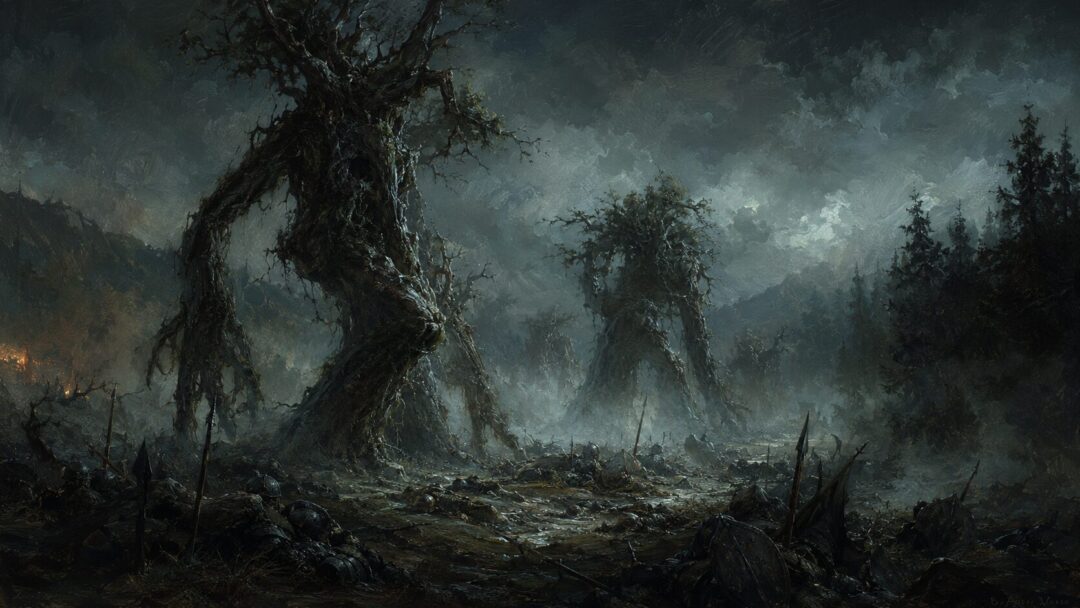
This is why their role at Helm’s Deep feels so different from a normal battlefield maneuver. The Rohirrim fight with sword, spear, wall, and horn. Gandalf arrives with timing and authority. The Huorns bring something older and less human: the wrath of the forest itself.
Why They Came to Helm’s Deep
The Huorns did not appear randomly. They came because Fangorn had been roused.
Saruman had not merely made war on Rohan. He had made war on trees. His Orcs cut, burned, and abused the forest around Isengard for fuel, fortification, and machinery. Treebeard’s anger is not abstract environmental grief; it is personal, ancient, and accumulated over long years. Fangorn had endured Saruman’s listening, his learning, and finally his betrayal.
During the War of the Ring, Gandalf spoke with Treebeard at Isengard, and the Huorns were sent to Helm’s Deep to aid the Rohirrim. Tolkien Gateway’s Fangorn Forest entry summarizes that the Huorns went to Helm’s Deep after Gandalf talked with Treebeard at Isengard, and it also notes Saruman’s Orcs abusing the forest as one reason the Ents attacked Isengard.
This gives the scene a moral shape. The Orcs at Helm’s Deep are not only enemies of Rohan. They are also servants of the power that had mutilated Fangorn. When they run into the trees, they are running into the consequences of Saruman’s own violence.
What Happened Inside the Wood?
The most honest answer is: the text does not describe the killing directly.
It tells us the Orcs fled into the forest. It tells us none returned. It tells us later that the Orc bodies were piled in heaps near the eaves of the trees, too many for burial or burning. It tells us the Huorns departed during the next night, and that a great pit and stone-covered mound appeared afterward. The implication is clear enough: the Huorns destroyed the Orcs, and then dealt with the bodies. But the exact method is left in shadow.
That restraint is important. Tolkien often gives terror more force by refusing to over-explain it. The Huorns are not treated like monsters in a bestiary with a list of attacks. They are heard, seen, feared, and then understood by what remains after they have gone.
The Orcs vanish beneath branches. The next morning, there is no army.
The Death Down
After the battle, the Men of Rohan had a terrible practical problem. The dead Orcs were too many. Their bodies were piled away from the mounds of Men, near the eaves of the strange trees. The Rohirrim lacked enough wood for burning, and even if they had possessed it, Gandalf warned them not to harm the trees.
Then night came.
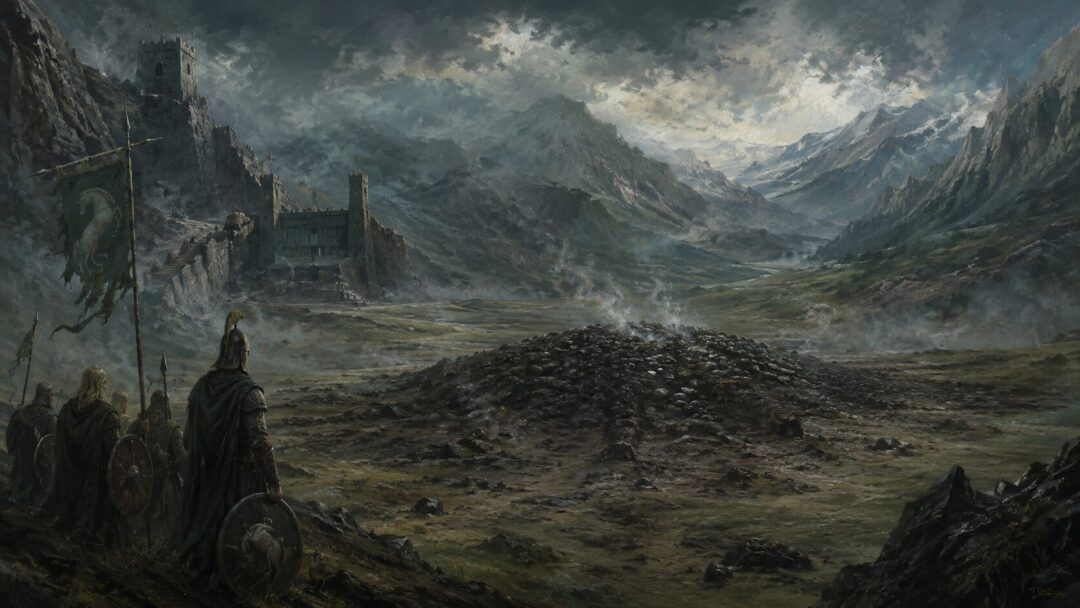
By morning, the Huorns were gone. The Orc bodies were gone too. In the Deeping-coomb, about a mile below the Dike, a huge pit had been delved and stones piled over it into a mound. Men believed the slain Orcs were buried there, but no one set foot on it. It became known as the Death Down, and no grass grew there. Tolkien Gateway’s Death Down entry summarizes this sequence: the dead Orcs were piled near the trees, the forest departed in the night, the Orcs were gone, and a new stone-covered hill had been raised.
This is one of the bleakest small afterimages in the War of the Ring. The battle is won. Rohan survives. The horn has sounded, Théoden has ridden out, and Saruman’s great assault has failed. Yet the land itself keeps a scar.
The Death Down is not a heroic mound like the graves of Men. It is a place of avoidance. No song grows there. No grass covers it. The Orcs are not honored, but neither are they simply forgotten. Their end becomes part of the geography.
Why the Dunlendings Were Treated Differently
The fate of the Orcs becomes sharper when set beside the fate of the Dunlendings.
Saruman’s army included Men from Dunland as well as Orcs and Uruk-hai. The Dunlendings had their own long bitterness against Rohan, and Saruman manipulated that hostility for his war. But after Helm’s Deep, those who surrendered were not exterminated. Théoden showed mercy: they were allowed to return home after swearing to end hostilities and withdraw beyond the Isen. The slain Dunlendings were buried separately from the Orcs.
That contrast is not accidental. The Orcs are treated as the carrion of Saruman’s machine-war, a horror too foul and numerous for ordinary rites. The Dunlendings, though enemies, remain Men capable of surrender, shame, and future peace.
This distinction keeps the aftermath from becoming simple revenge fantasy. Rohan does not answer all enemies with the same doom. Men who were deceived and inflamed by Saruman can be spared. Orcs who came as the cutting edge of Isengard’s destruction vanish into the vengeance of Fangorn.
The Revenge of the Trees
The phrase “revenge of the trees” can sound almost playful until one looks at the scene carefully. At Helm’s Deep, the Huorns are terrifying because they reveal that Middle-earth is not a dead stage on which only kings and armies act. The old world still has memory. Forests can be wronged. Trees can be angered. Things overlooked by the proud can become instruments of judgment.
Saruman’s mistake was not only strategic. It was spiritual. He saw forests as material: timber for fires, engines, pits, wheels, and war. He treated living things as fuel for domination. The Huorns answer that vision in the language Saruman understands least. They do not debate. They do not negotiate. They arrive as a wall of darkness, and his Orcs disappear inside it.
The justice is severe, but not tidy. The Huorns are not gentle woodland guardians. They are dangerous, shadowed, and only partly understood. Even the Free Peoples are warned not to harm them. Their help saves Rohan, but it also reminds the reader that not every force opposed to evil is comfortable, tame, or safe.
A Victory With a Shadow
Helm’s Deep is often remembered as a moment of hope: the king restored, the horn sounding, dawn breaking, Gandalf arriving, and the enemy broken. That is all true. But the Huorns add another layer.
They make the victory older, darker, and stranger.
The Orcs did not merely lose a battle. They were swallowed by the consequence of serving a master who had violated the living world around him. Their bodies vanished into a mound where no grass would grow. The trees returned to Fangorn, and the people of Rohan were left with a place they would not touch.
That is what the Huorns did after Helm’s Deep. They destroyed the Orcs who fled into their shadow. They removed the dead that Men could not bury or burn. They raised, or at least left behind, the Death Down. And then they departed.
No proclamation. No trophy. No explanation.
Only crushed grass, a stone mound, and the memory that for one night in Rohan, the forest went to war.
Sources & Notes
- https://tolkiengateway.net/wiki/Huorns — explains the uncertain nature of the Huorns, their movement, shadow, relation to Ents, and their role in destroying Saruman’s fleeing Orcs after Helm’s Deep.
- https://tolkiengateway.net/wiki/Battle_of_the_Hornburg — summarizes the Battle of Helm’s Deep/Hornburg, including the sudden forest in the Deeping-coomb and the Orcs vanishing into it.
- https://tolkiengateway.net/wiki/Fangorn_Forest — background on Fangorn, Saruman’s damage to the forest, and the movement of Huorns connected with the Entish response to Isengard.
- https://tolkiengateway.net/wiki/Treebeard — provides context for the Ents’ anger at Saruman, Treebeard’s leadership, and the living forest’s involvement in the war.
Sources cover the Huorns, the Battle of the Hornburg, Fangorn, and Treebeard’s part in the living forest’s response.