The Ring should have made the answer simple.
Gollum had murdered for it. He had hidden with it. He had followed Bilbo out of the dark in hatred, and by the time Frodo heard the full story in Bag End, Gollum had already been caught by Sauron and forced to give up two dangerous words: “Shire” and “Baggins.” From a purely practical point of view, Frodo’s reaction seems reasonable. If Bilbo had killed Gollum in the tunnels under the Misty Mountains, perhaps none of this would have happened.
Gandalf does not deny that Gollum has done evil. He does not pretend the creature is harmless. He does something more difficult: he refuses to let fear dress itself up as wisdom.
Again and again, the great hidden rule of the Ring-quest is not that the Wise know exactly what must happen. It is that they know they do not. Gandalf’s trust in pity is not sentimental softness. It is a disciplined refusal to make death the answer simply because the future feels frightening.
The Moment Bilbo Did Not Understand
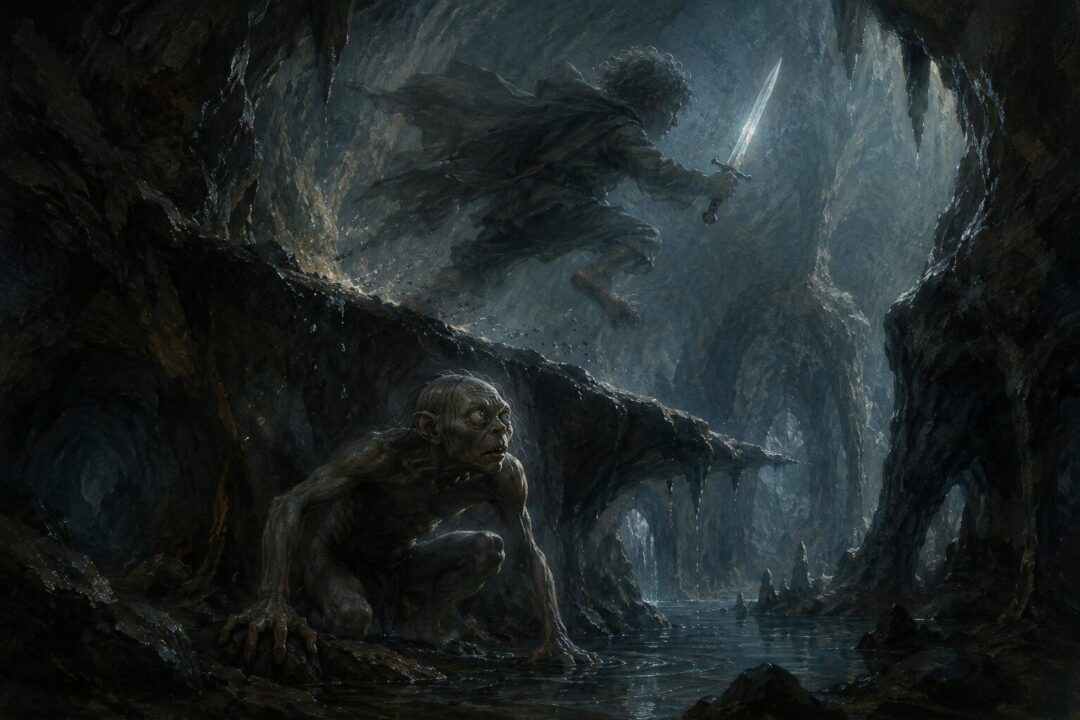
In The Hobbit, Bilbo’s mercy is not presented as a grand philosophy. He is lost, terrified, invisible, and armed. Gollum is blocking the way out. Bilbo has a sword, the Ring, and a chance to escape by killing the creature who would gladly have eaten him.
But Bilbo sees Gollum’s misery.
That detail matters. Gollum is not spared because he is innocent. He is spared because Bilbo recognizes something pitiable in him. In the dark, Bilbo does not yet understand the Ring’s history, Sauron’s return, or the scale of what he carries in his pocket. He only understands that striking Gollum from invisibility would be crueler than necessary.
So he leaps over him instead.
This is one of the smallest physical actions in the story, and one of the largest moral ones. Bilbo does not win by mastering the Ring. He wins, in that moment, by resisting the kind of advantage the Ring offers: unseen power over a weaker enemy. The texts later imply that this act of pity helps preserve Bilbo from deeper corruption. He possesses the Ring for many years, and though it affects him, he is still capable of surrendering it. That is extraordinary in the history of Ring-bearers.
Gandalf sees more in that mercy than Bilbo himself could have seen.
Gandalf’s Rebuke Is Not a Prediction
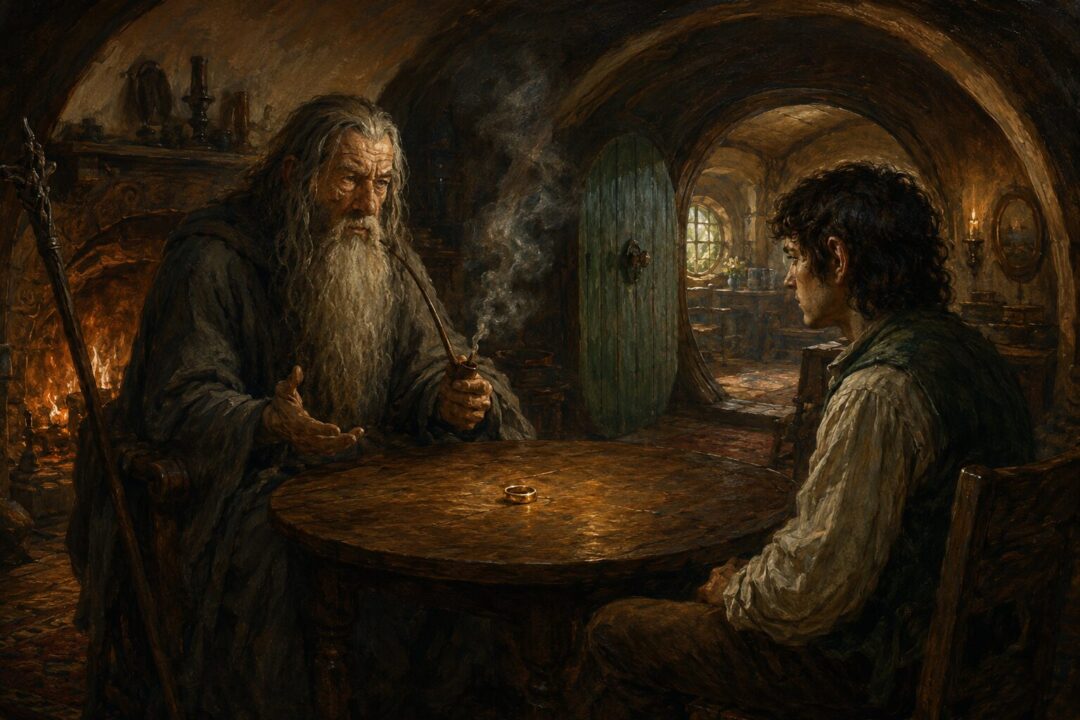
When Frodo says it is a pity Bilbo did not kill Gollum, Gandalf’s reply is often remembered as one of the moral centers of The Lord of the Rings. But the force of it is sometimes softened in memory.
Gandalf is not saying evil should be ignored. He is not saying judgment is impossible. He is warning Frodo against eagerness.
His point is severe: many who live deserve death, and some who die deserve life, but no one in that room can restore life to the dead. That is why death, even deserved death, cannot be treated as a convenient solution. Gandalf’s wisdom is rooted not in certainty, but in humility. Even the Wise cannot see every ending.
That last idea is crucial. Gandalf does not know exactly how Gollum will matter. He says his heart tells him Gollum still has some part to play, for good or ill. This is not a strategic forecast. It is not a guarantee that Gollum will repent, or that pity will produce an obvious reward. Gandalf is admitting that the moral shape of events may be larger than calculation.
In other words, Gandalf trusts pity more than certainty because certainty is precisely what no one possesses.
The Ring Makes Certainty Feel Righteous
The One Ring does not only tempt people with armies, thrones, or domination. It tempts them with simplified answers.
Boromir imagines using it as a weapon. Saruman imagines mastering the logic of power. Even Frodo, early in his journey, can imagine that killing Gollum would have prevented danger. These are different forms of the same seduction: the belief that one decisive act of force can solve the problem cleanly.
Gandalf’s pity cuts across that temptation.
The Ring belongs to a world where power feeds on the desire to control outcomes. Sauron’s will is certainty sharpened into tyranny. He seeks to order everything around himself. Against that, Gandalf offers a stranger kind of wisdom: act rightly without possessing the whole pattern.
This is why pity is not weakness in Middle-earth. It is a resistance to the Enemy’s deepest logic. Sauron cannot imagine pity as a power. He can understand fear, bargaining, pride, domination, secrecy, and betrayal. But mercy given to a useless, treacherous, ruined creature is outside the machinery of his thought.
That does not make Gollum good. It makes pity unpredictable to evil.
Frodo Learns the Lesson Slowly
Frodo does not accept Gandalf’s lesson all at once. His first instinct is horror and revulsion. Gollum has brought danger toward the Shire. He has suffered, but he has also betrayed.
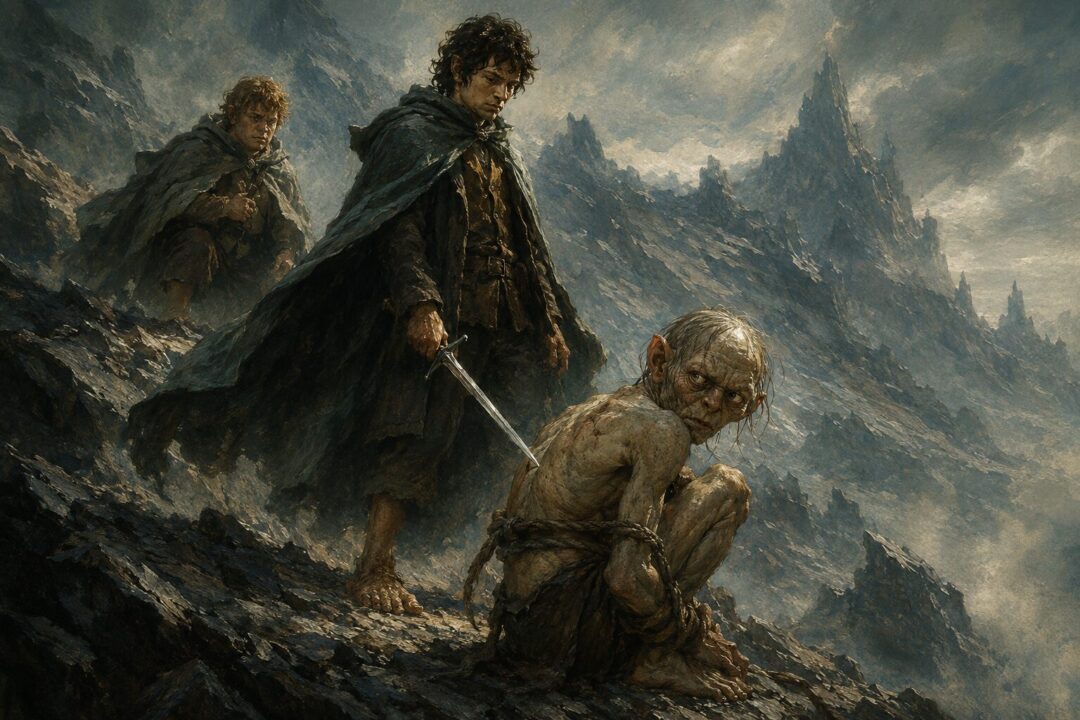
Yet by the time Frodo meets Gollum in the Emyn Muil, something has changed. Frodo has carried the Ring long enough to understand pity from within. He can see Gollum not only as a threat, but as a warning. Gollum is what a Ring-bearer can become.
This makes Frodo’s mercy different from Bilbo’s. Bilbo pitied Gollum before he understood the full danger of the Ring. Frodo pities him after he begins to understand it.
When Gollum is captured, Frodo does not simply release him out of naive kindness. He binds him by an oath and uses him as a guide. This is mercy with caution, pity without blindness. Frodo knows Gollum may betray them. He also knows that killing him would be a moral surrender of another kind.
The relationship between Frodo and Gollum remains unstable, and the texts never ask us to pretend otherwise. Gollum is divided, cunning, miserable, and dangerous. But Frodo’s pity creates a narrow space in which Sméagol can still be addressed as Sméagol. Whether that possibility could ever have lasted is uncertain. Tolkien’s story does not make redemption automatic.
It makes mercy possible.
Sam Sees the Danger, but Not the Whole Sorrow
Sam is not wrong about Gollum’s danger. In many practical ways, Sam sees clearly. He notices Gollum’s plotting, his malice, his slipperiness. Sam’s suspicion protects Frodo more than once.
But Sam often struggles to see Gollum’s misery as Frodo sees it.
That does not make Sam cruel. It makes him limited in a way that is deeply human. Sam loves Frodo, and love can make danger look unforgivable. To Sam, Gollum is the thing that threatens his master. To Frodo, Gollum is also the thing that reveals what the Ring does to a soul.
This difference comes to a painful point when Gollum shows signs of inner conflict on the stairs near Cirith Ungol. The text gives readers a brief, fragile glimpse of a creature almost softened by the sight of Frodo sleeping. Sam wakes and speaks harshly. It would be too much to say Sam alone destroys Gollum’s chance; Gollum has already chosen evil many times. But the moment suggests that pity is delicate. It can open a door, and contempt can close it.
The tragedy is not that Sam is foolish. The tragedy is that he is understandable.
Faramir and the Forbidden Pool
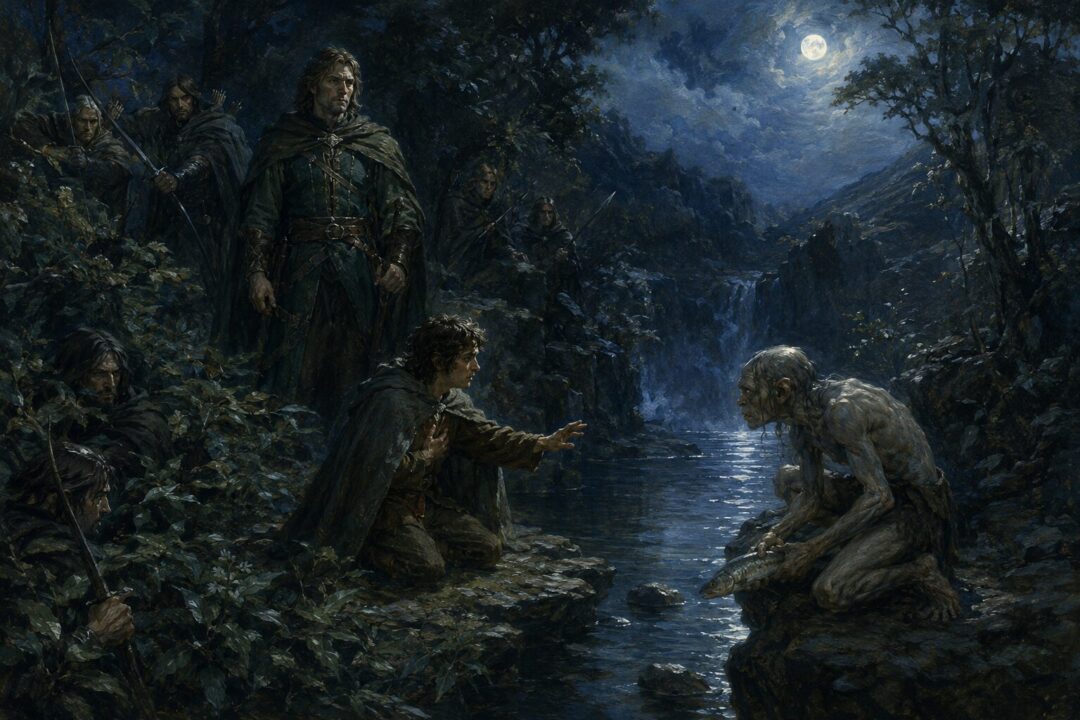
The same hidden rule appears again in Ithilien. Gollum trespasses at the Forbidden Pool, where Faramir’s law allows death for such an intrusion. In military terms, the creature is dangerous. In legal terms, he may be condemned. In strategic terms, sparing him risks the secrecy of Faramir’s refuge and the mission itself.
Frodo pleads for him.
This is not because Frodo trusts Gollum completely. He does not. Frodo’s mercy is burdened by knowledge. He understands that Gollum is both guide and threat, both victim and betrayer. Yet he also understands that the Quest has already become bound up with Gandalf’s old warning. Gollum still has a part to play, though no one can safely name it.
Faramir’s response matters because he is a captain in wartime, not a sheltered innocent. He is capable of severity, but he is not governed by appetite for death. In sparing Gollum for Frodo’s sake, Faramir participates in the same pattern: lawful power restrains itself because the full end of the matter is unknown.
Mercy does not erase danger. It carries danger forward without becoming evil to defeat it.
At Mount Doom, Certainty Fails
The final irony is that certainty fails at the Crack of Doom.
The Quest is built around one clear task: bring the Ring to the fire and destroy it. Yet at the very end, Frodo cannot do it. This should not be read as simple weakness. The Ring is at the place of its making, at the height of its power, pressing on a bearer who has endured beyond ordinary strength. The text presents Frodo’s failure as terrible, but also as something no one should judge lightly.
If the success of the Quest depended only on flawless willpower, it would fail.
What remains is the chain of pity.
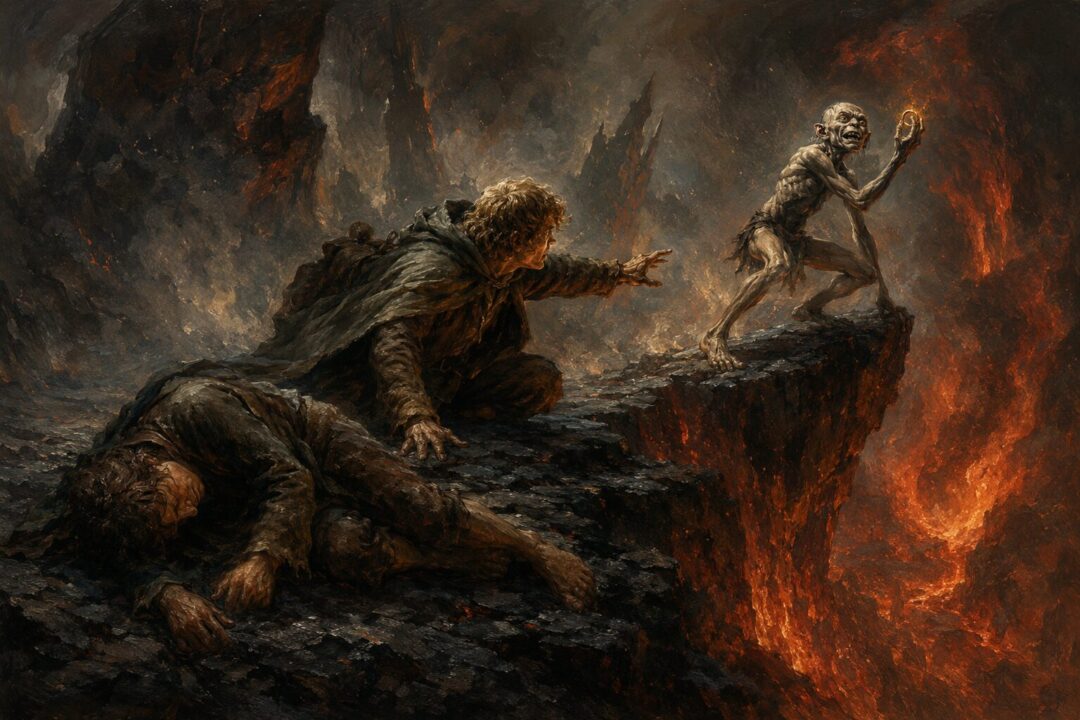
Bilbo spared Gollum in the dark. Frodo spared and protected him across the long road. Sam, at the last, did not kill him on the slopes of Orodruin. Gollum then reaches the Sammath Naur, seizes the Ring, and falls with it into the fire. He does not destroy the Ring out of virtue. He acts out of craving. Yet because mercy kept him alive, even his corruption is drawn into the undoing of Sauron’s power.
This is not a neat moral equation. Pity does not turn Gollum into a hero. It does not remove the damage he has done. It does not make Frodo’s suffering vanish. But it allows an ending that strength, judgment, and certainty could not produce.
Gandalf’s Deepest Wisdom
Gandalf’s trust in pity is one of the clearest signs of his wisdom because it is not based on optimism. He knows Gollum is dangerous. He knows Sauron is searching. He knows the Ring corrupts. He knows the Wise are moving in partial darkness.
That is exactly why pity matters.
Certainty can become an excuse for cruelty. Strategy can become a mask for fear. Justice can become eagerness to deal out death. Gandalf resists all of these not because he lacks severity, but because he understands the moral cost of becoming too sure.
Middle-earth is saved not by innocence untouched by evil, but by mercy practiced under pressure. Bilbo’s pity in a tunnel, Frodo’s pity on a barren slope, Faramir’s restraint beside the pool, Sam’s final refusal to strike: these choices do not look powerful when they happen. They look risky, foolish, or incomplete.
Only afterward does the pattern appear.
Gandalf does not trust pity because he can prove it will work. He trusts it because without pity, victory over Sauron would begin to resemble the very logic Sauron understands. The Wise cannot see all ends. That is not a weakness in the story’s moral vision. It is the reason mercy has room to act.
Sources & Notes
- Tolkien Gateway, “Gollum” — summarizes Sméagol’s murder for the Ring, centuries of possession, capture by Sauron, and his later role in the Ring’s destruction, grounding the article’s claim that a pitiable figure can still be dangerous and consequential. https://tolkiengateway.net/wiki/Gollum
- Tolkien Gateway, “Riddles in the Dark” — covers Bilbo’s encounter with Gollum under the Misty Mountains, including Bilbo’s chance to kill him while invisible and his decision to leap over him instead. https://tolkiengateway.net/wiki/Riddles_in_the_Dark
- Tolkien Gateway, “The Shadow of the Past” — summarizes Gandalf’s conversation with Frodo about Gollum, Bilbo’s pity, and the warning that even the Wise cannot see all ends. https://tolkiengateway.net/wiki/The_Shadow_of_the_Past
- Tolkien Gateway, “Bilbo Baggins” — provides background on Bilbo as Ring-bearer, his sparing of Gollum, and his unusually successful surrender of the Ring, supporting the article’s link between mercy and resistance to corruption. https://tolkiengateway.net/wiki/Bilbo_Baggins
Sources selected for Gollum, Bilbo’s mercy in “Riddles in the Dark,” Gandalf’s warning in “The Shadow of the Past,” and Bilbo’s Ring-bearing arc.