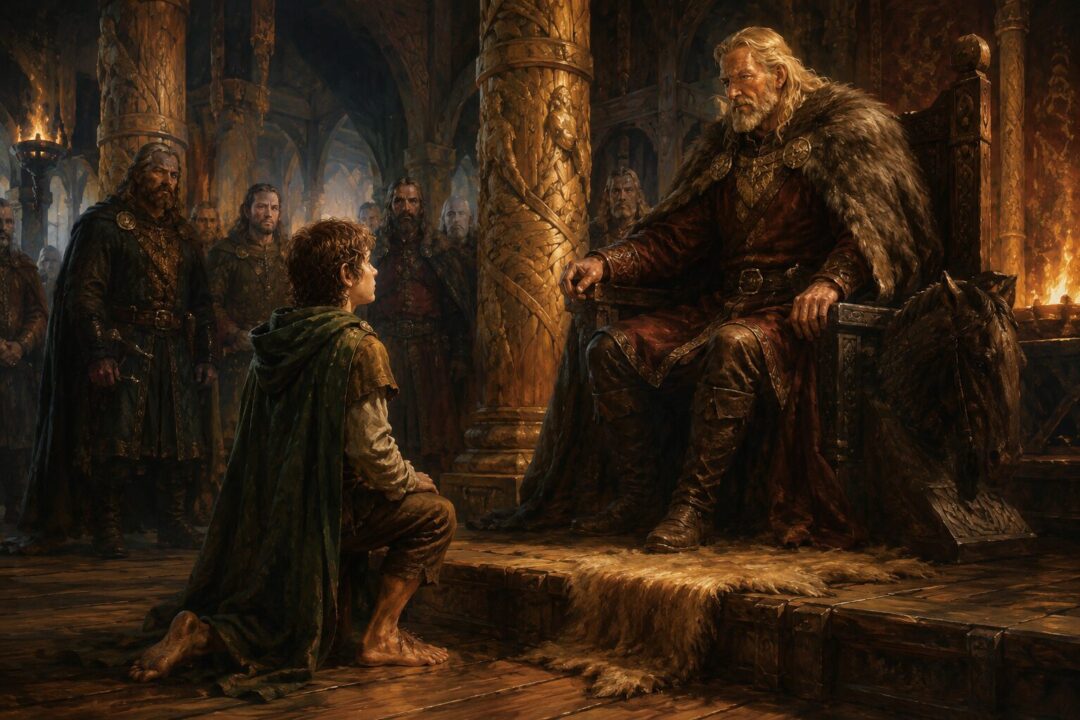
When most readers think about Meriadoc Brandybuck, they remember the cheerful Hobbit who laughed with Pippin, caused trouble in the Shire, and rode with the Rohirrim to the Battle of the Pelennor Fields. Yet one of the most interesting changes in his story happens long before he faces the Witch-king. By the time Merry leaves Rohan, he is no longer simply a courageous Hobbit caught in great events. He has become observant, disciplined, and far more dangerous than he had ever been before.
The transformation is easy to overlook because Merry never becomes a mighty warrior in the manner of Aragorn, Éomer, or Gimli. Tolkien presents something quieter. Merry learns how kingdoms function, how leaders make difficult choices, how armies prepare for war, and how courage can exist without physical strength. Most importantly, he gains the confidence to act deliberately rather than merely react to danger.
His time among the Rohirrim marks the point where he begins thinking like someone who belongs in the struggles of Middle-earth rather than someone simply trying to survive them.
Merry Arrived in Rohan as a Refugee
Before reaching Rohan, Merry spends much of the journey following stronger companions.
During the flight from the Shire, Aragorn repeatedly protects the Hobbits. At Rivendell, Merry contributes to the Council but remains one member of a much larger company. Even after the Fellowship leaves, the Hobbits depend heavily upon the wisdom and strength of others.
His captivity among the Orcs changes him by forcing him to observe carefully. Merry notices details, studies his enemies, and quietly gathers information that later helps the escape of himself and Pippin. These are important signs of growth, but they are still the skills of someone enduring events imposed upon him.
Rohan changes the pattern.
Instead of simply escaping danger, Merry enters a functioning kingdom preparing for total war. He witnesses leadership under immense pressure rather than merely hearing stories about it.
Théoden Gives Merry Purpose
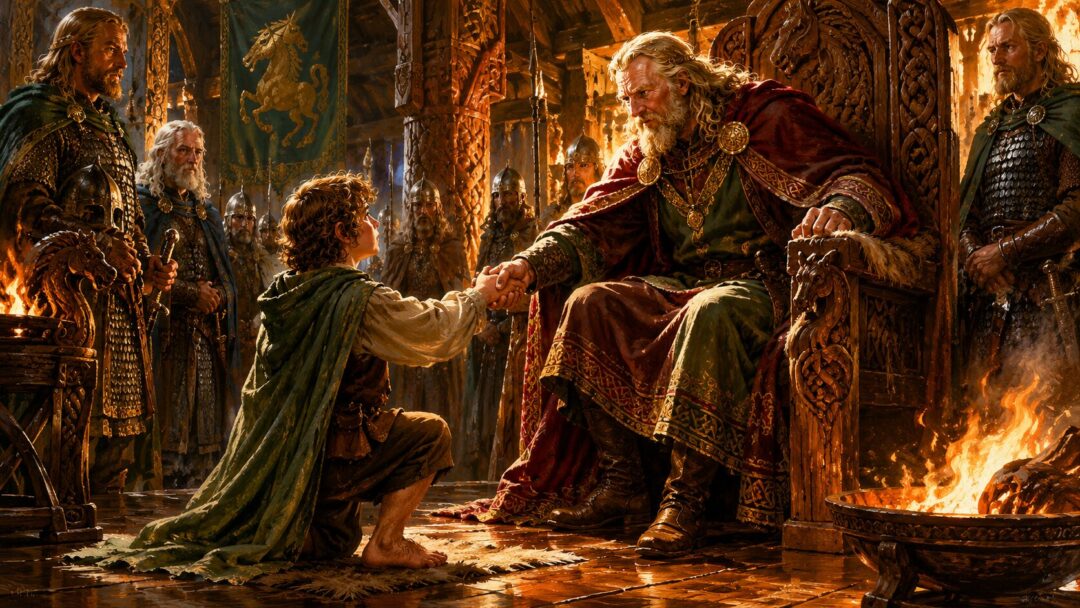
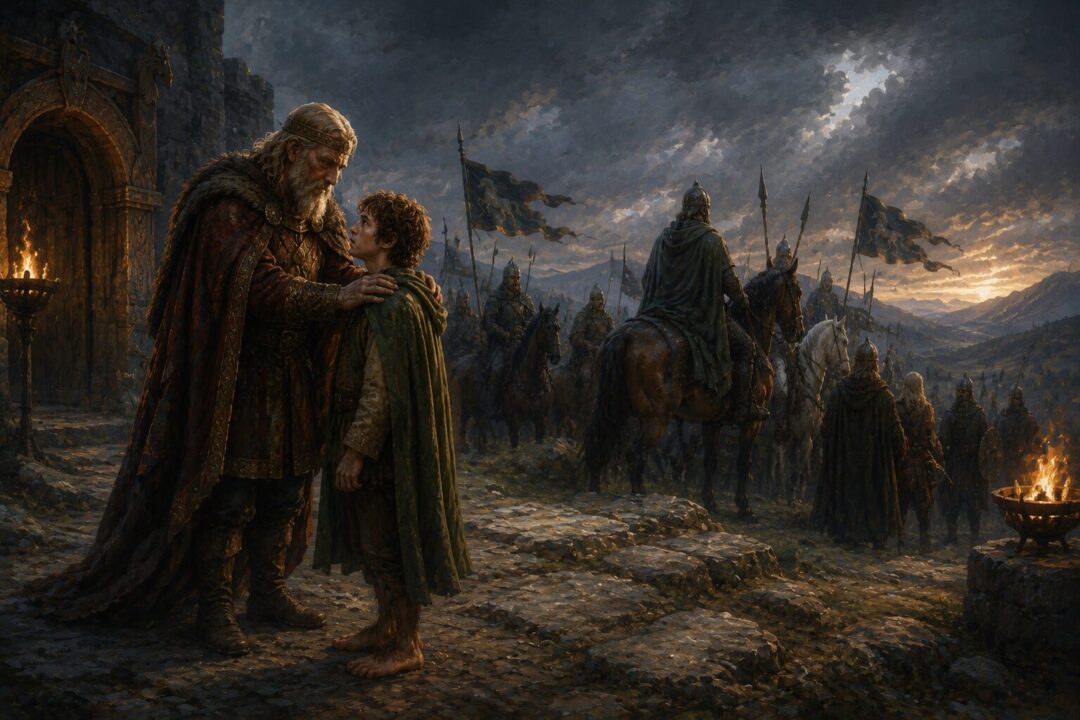
Perhaps the single most important moment comes when Merry offers his service to King Théoden.
The king formally accepts him as his esquire, creating a bond that is both symbolic and practical. Merry is no longer merely a guest or protected traveler. He now has responsibilities within the household of a king.
This matters because Tolkien consistently presents service as honorable rather than degrading. Throughout Middle-earth, trusted service builds character.
Sam serves Frodo.
Faramir serves Gondor.
The Riders serve Théoden.
Even Aragorn repeatedly places duty above personal ambition.
By accepting Merry into his household, Théoden grants him dignity despite his small stature. Rather than treating him as a curiosity, he recognizes his courage and loyalty.
For perhaps the first time, Merry occupies a defined place inside the military and political structure of one of the great kingdoms of Men.
He Learned How Great Leaders Carry Responsibility
Merry spends significant time near Théoden during one of the darkest periods in Rohan's history.
He witnesses the king recovering from despair after the influence of Wormtongue ends. He sees Théoden choose action despite knowing the odds may be poor. He observes councils, preparations, and the burdens placed upon rulers who cannot avoid difficult decisions.
Unlike readers, Merry does not see these events from a distant narrative perspective.
He lives beside them.
This exposure teaches him that courage is not recklessness. Théoden does not ride because victory is guaranteed. He rides because abandoning his duty would be worse than defeat.
That lesson becomes part of Merry's own character.
Rohan Changes His Understanding of War
The Hobbits begin their adventure knowing little of organized warfare.
The conflicts of the Shire are small by comparison, and even tales of ancient battles belong mostly to songs and family stories.
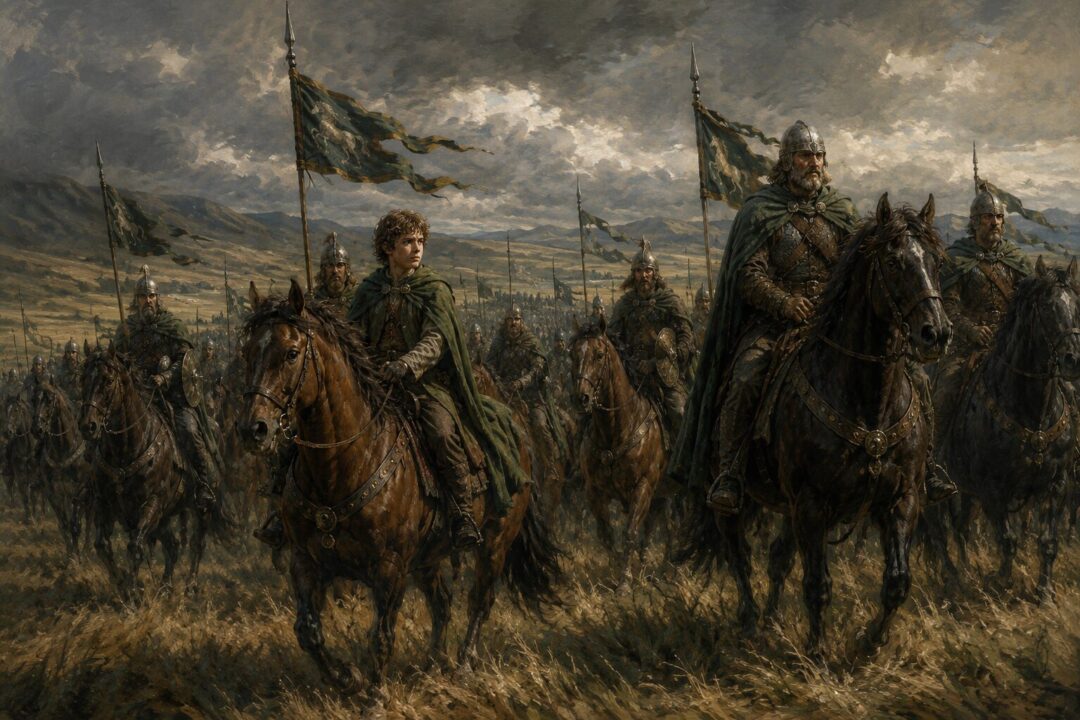
Rohan introduces Merry to the practical reality of a kingdom mobilizing for survival.
He sees horses gathered, messengers riding, weapons prepared, supplies organized, and entire communities shaped by the expectation of invasion.
The Rohirrim are not eager for battle.
They prepare because they believe there is no honorable alternative.
This distinction is central to Tolkien's portrayal of just resistance against overwhelming evil.
War is costly, frightening, and tragic, but refusing to oppose destructive tyranny carries its own moral cost.
Living among the Riders gives Merry a mature understanding of conflict that differs greatly from the adventurous excitement that might have attracted younger Hobbits.
The Oath to Stay Behind Makes Him Stronger
One of the most painful moments for Merry comes when Théoden orders that he cannot ride openly with the Muster of Rohan.
The decision is not a rejection of Merry's courage.
Instead, Théoden believes he is protecting someone physically unsuited for the coming battle.
Merry's reaction reveals how much he has changed.
Earlier in the journey, disappointment might have ended the matter.
Now, he desperately wishes to fulfill his duty.
His grief comes not from wounded pride but from being unable to serve those to whom he has pledged loyalty.
This emotional shift shows how deeply Rohan has reshaped his sense of responsibility.
Dernhelm Recognizes What Others Miss
Merry ultimately rides because Dernhelm secretly carries him.
Only later is Dernhelm revealed to be Éowyn.
This decision is significant because both characters occupy similar positions within the story.
Each has been told they should remain behind.
Each understands genuine courage as something more than obedience to expectations.
Neither seeks glory.
Both simply refuse to abandon those they love during their darkest hour.
Their shared determination ultimately places them together before the Lord of the Nazgûl.
Without Merry's experiences in Rohan, it is difficult to imagine him making this choice with the same quiet resolve.
The Barrow-blade Was Only Part of the Victory
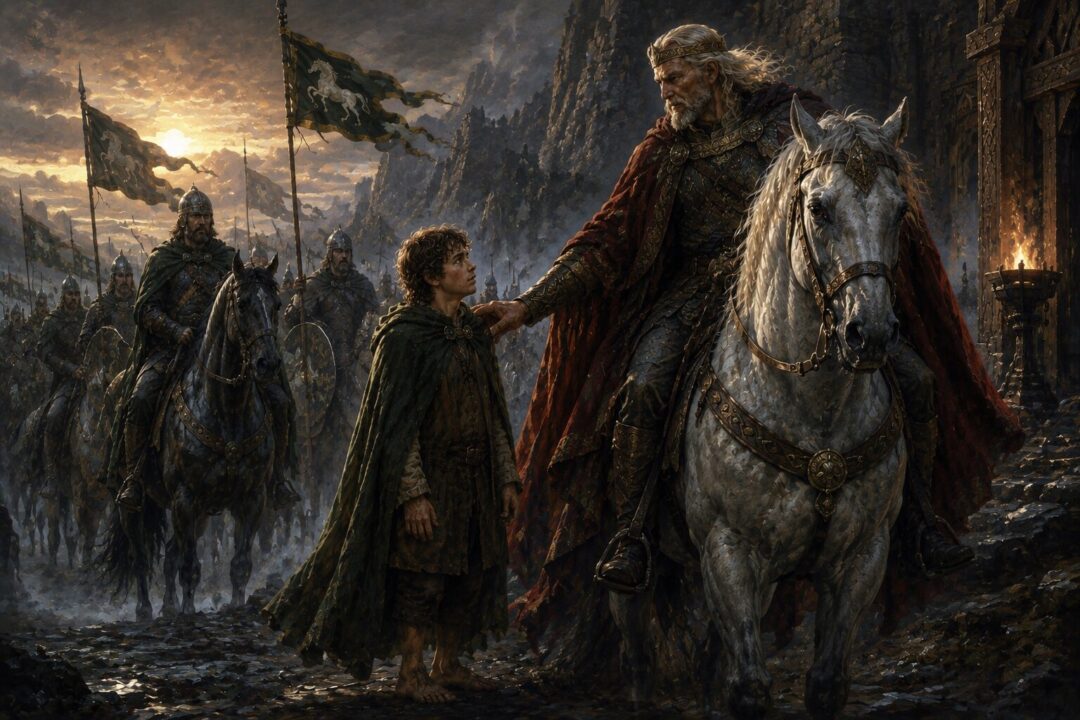
Much attention rightly falls upon Merry's Westernesse blade during the Battle of the Pelennor Fields.
The narrative indicates that this ancient weapon, recovered from the Barrow-downs, had been forged in wars against the realm of Angmar and proved especially significant against the Witch-king. The text explicitly notes that Merry's stroke broke the spell that protected the Nazgûl's unseen sinews, allowing Éowyn's final blow to succeed.
Yet possessing the correct weapon alone was never enough.
Someone still had to close with the most terrifying servant of Sauron.
Someone had to overcome overwhelming fear long enough to strike at exactly the right moment.
That person was Merry.
His courage, patience, and judgment mattered just as much as the blade itself.
Rohan had taught him to remain beside his lord even when hope seemed nearly gone.
That lesson reaches its greatest expression on the Pelennor.
Confidence Replaced Dependence
One subtle change after Rohan is the way Merry makes decisions.
Earlier in the story, he often waits for guidance from Gandalf, Aragorn, or Frodo.
Later, he increasingly evaluates situations himself.
This does not mean he becomes arrogant.
Instead, he develops confidence grounded in experience.
The same Hobbit who once relied upon stronger companions eventually helps destroy the greatest captain of the Enemy's armies.
The transformation feels believable precisely because Tolkien builds it gradually through many smaller moments rather than presenting sudden heroism.
The Same Growth Appears Back in the Shire
The effects of Rohan do not disappear after the War of the Ring.
When Merry returns home, he helps organize resistance during the Scouring of the Shire.
Unlike the carefree Hobbit who left Bag End months earlier, he understands logistics, leadership, and disciplined action.
The returning Travellers become natural leaders because they have witnessed functioning kingdoms under extraordinary pressure.
Merry's confidence during the liberation of the Shire reflects lessons learned across Middle-earth, with Rohan providing one of the most decisive stages in that education.
Strength Was Never Measured by Size
Merry never becomes physically imposing.
He does not wield legendary strength or magical power.
His importance grows because his character changes.
Rohan teaches him loyalty through service, courage through responsibility, discipline through military order, and wisdom through close observation of honorable leadership.
Those qualities ultimately make him dangerous in ways no enemy expects.
The Witch-king fears great captains and mighty warriors.
He does not anticipate a Hobbit who has quietly learned the habits of kings, accepted the burdens of duty, and discovered that true courage often belongs to those whom the world overlooks.
That is why Merry leaves Rohan as someone fundamentally different from the Hobbit who first entered its rolling plains. He remains humble, compassionate, and unmistakably Hobbit—but he has also become a person capable of changing the outcome of history at precisely the moment when Middle-earth needs him most.
Sources & Notes
- Tolkien Gateway, “Meriadoc Brandybuck” — traces Merry’s capture, service to Théoden as esquire, ride to the Pelennor, and role in helping Éowyn defeat the Witch-king, matching the article’s arc of growth after Rohan. https://tolkiengateway.net/wiki/Meriadoc_Brandybuck
- Tolkien Gateway, “Rohan” — gives background on the kingdom of the Rohirrim and its military culture, supporting the article’s focus on what Merry learns by living inside a kingdom preparing for war. https://tolkiengateway.net/wiki/Rohan
- Tolkien Gateway, “Théoden” — covers Théoden’s recovery, leadership, acceptance of Merry’s service, and final ride, grounding the article’s discussion of kingly responsibility and service. https://tolkiengateway.net/wiki/Th%C3%A9oden
- Tolkien Gateway, “The Muster of Rohan” — summarizes the chapter in which Merry is left behind by Théoden but deliberately rides with Dernhelm, showing his shift from protected observer to active participant. https://tolkiengateway.net/wiki/The_Muster_of_Rohan
- Tolkien Gateway, “The Battle of the Pelennor Fields” — covers the battle where Merry’s Rohan-shaped courage and discipline culminate in his decisive aid against the Witch-king. https://tolkiengateway.net/wiki/The_Battle_of_the_Pelennor_Fields
Sources selected for Merry, Rohan, Théoden, the Muster, and Pelennor.