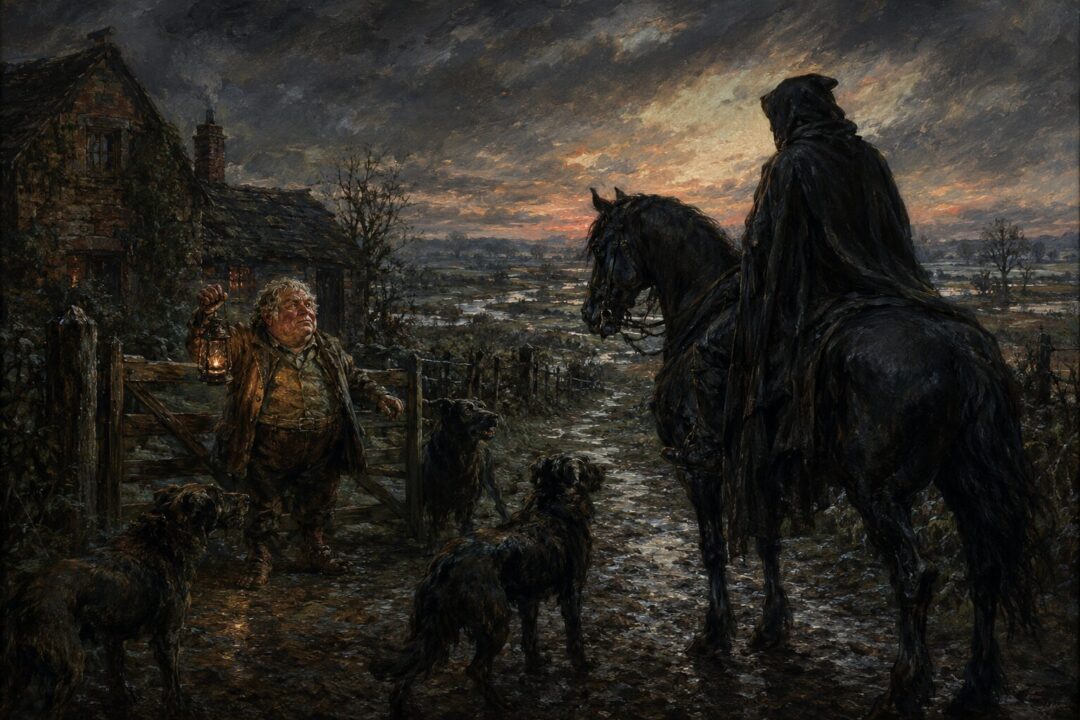
The first truly frightening figure Frodo meets after leaving Bag End is not a king, a wizard, or even the Black Rider on the road. It is Farmer Maggot.
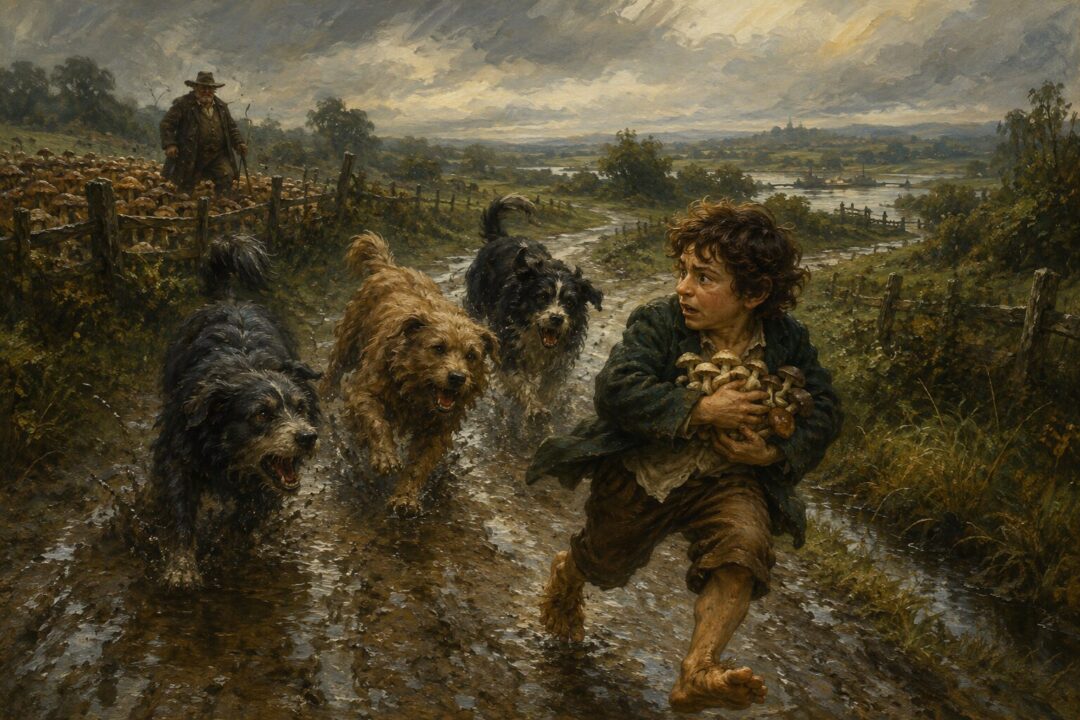
That sounds absurd until you remember how Frodo reacts when he realizes they have stumbled onto Bamfurlong. To Pippin, Maggot is simply a tough old farmer with fierce dogs and excellent mushrooms. To Frodo, he is a childhood terror: the man who once caught him trespassing after mushrooms, beat him, and set the dogs after him all the way to the Ferry. On the surface, the episode looks almost comic: a guilty hobbit, a stern farmer, and a basket of mushrooms.
But the deeper strangeness is this: Maggot is not just a rustic obstacle on the road. He knows things. He has seen things. He has already faced the darkness before Frodo arrives at his door. And when Tom Bombadil later speaks of him, the farmer suddenly appears larger than the homely scene first suggested.
Farmer Maggot is not secretly a wizard. The texts never say that. But he stands at one of the Shire’s wild edges, and that changes everything.
Bamfurlong Is Not Ordinary Shire Country
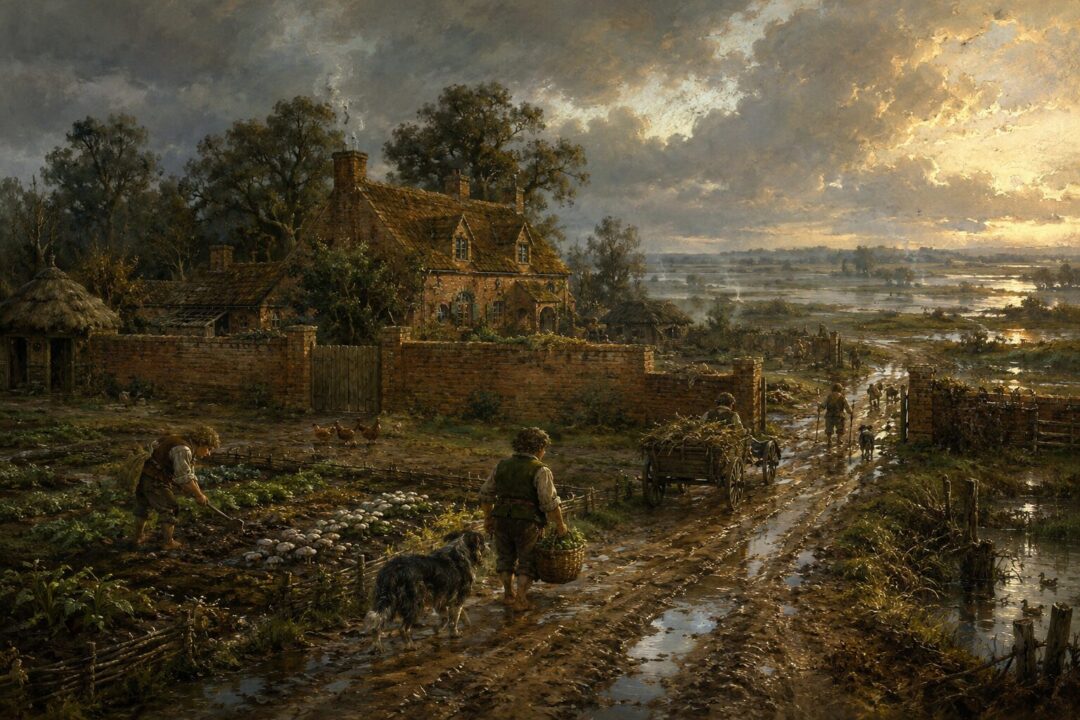
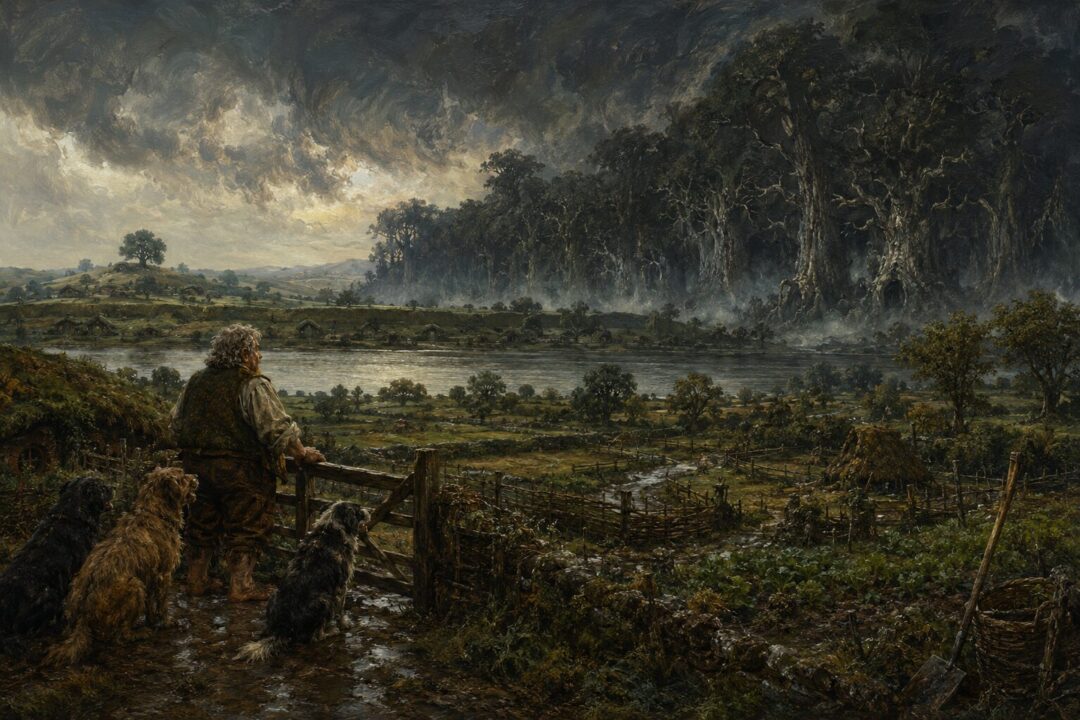
Maggot’s farm, Bamfurlong, lies in the Marish, in the Eastfarthing of the Shire. This matters. The Marish is not the comfortable, hilly, well-ordered Shire of Hobbiton. It is low, wet, fertile, and difficult country near the Brandywine. It has bogs, ditches, hedges, dikes, and fields reclaimed from marshland. Bamfurlong is not a cozy hobbit-hole but a brick farmhouse with a high wall and dogs.
That setting explains much about Maggot. He is not “wild” in the sense of being lawless. He is wild because his life is built on a border. He farms land that must be watched, drained, fenced, defended, and understood. His world is not abstract lore but practical knowledge: which path floods, which gate is safe, which stranger does not belong, which rumor has teeth.
The Marish also has its own older flavor within hobbit society. Its people are associated with Stoorish habits: flat lands, riversides, boots in muddy weather, and houses rather than holes. The Marish was also connected with the Oldbucks, the ancestors of the Brandybucks, before Gorhendad Oldbuck crossed the Brandywine and founded Buckland.
So Maggot is not merely “a farmer from the Shire.” He belongs to a region where the Shire is already less sheltered, less sleepy, and more exposed to older currents of history.
The Farmer Who Guards More Than Mushrooms
Frodo remembers Maggot as the guardian of mushrooms. That memory is funny because it is so hobbit-like: a childhood trauma caused by trespassing in a mushroom field. Yet the adult scene changes the meaning of that old fear.
Pippin explains that Maggot is a friend to the Brandybucks and a terror to trespassers, but then adds the key reason: folk near the border have to be more on their guard. That line quietly reframes the whole episode. Maggot’s dogs are not only comic farm protection. They are part of a borderland instinct.
The Shire has Shirriffs, rules, and a settled order, but Maggot lives in a place where the outside world can arrive down a lane. He has a household to protect, fields to guard, and local ties that run toward Buckland and the Ferry. He is the sort of hobbit who knows that danger does not always announce itself as a war. Sometimes it asks questions at the gate.
That is exactly what happens.
On the same day Frodo comes to Bamfurlong, Maggot has already been visited by a Black Rider. The Rider asks after Baggins, offers gold for information, and returns later if Maggot sees him. Maggot is frightened; even one of his dogs is badly unnerved. But he refuses the stranger, tells him there are no Bagginses there, sends him back toward Hobbiton, and threatens to call the dogs.
Maggot does not know the full truth of the Ring. He does not understand the cosmic danger at his gate. But he knows enough to recognize wrongness. That is the kind of knowledge the wild Shire gives him: not prophecy, but suspicion sharpened by place.
He Reads Strangers Better Than the Shire Reads Itself
Many Shire-hobbits survive by not asking questions. That habit is often charming, but it is also dangerous. The Shire’s peace depends partly on ignorance: ignore the roads, ignore the old wars, ignore the Rangers, ignore the dark powers beyond the borders.
Maggot is different. He is not worldly like Bilbo, learned like Frodo, or adventurous like Merry. But his eyes are open. He listens to rumor, notices movement, and judges strangers by conduct rather than appearance.
When the Black Rider comes, Maggot does not need to know the word Nazgûl to understand that this is not a normal traveler. The offer of gold does not tempt him into gossip. The threat does not make him obedient. He gives the Rider nothing useful, then later tells Frodo what happened.
This is one of the overlooked acts that helps Frodo survive the first stage of the journey. Maggot does not defeat the Enemy. He does something smaller and more hobbit-like: he refuses to cooperate with evil when it appears at his own gate.
That may be the central point of his character. The Shire is saved many times by great powers, but also by small refusals: a farmer not selling information, a servant not abandoning his master, a gardener carrying a burden he never asked for.
The Bombadil Connection Makes Him Stranger
The most mysterious thing about Farmer Maggot is not his courage with the Black Rider. It is his connection with Tom Bombadil.
In The Lord of the Rings, Tom speaks of Maggot with unusual respect. He appears to regard him as more important than the hobbits had imagined, praising the earth-rooted wisdom of this old farmer. That does not mean Maggot is supernatural. The text does not make him a hidden spirit, Maia, or forgotten being. But it does mean that Bombadil recognizes something in him.
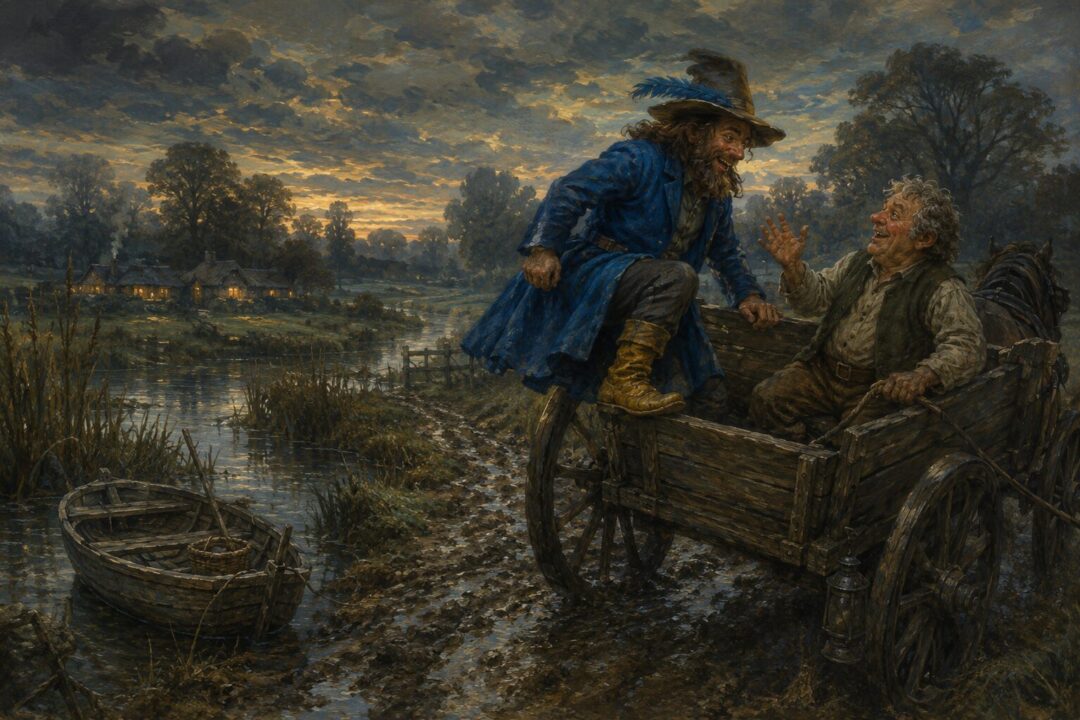
This is reinforced by “Bombadil Goes Boating,” a later poem presented as part of Shire-lore. In it, Tom travels by water toward hobbit country, meets Farmer Maggot, goes to Bamfurlong, and spends the night exchanging news with him. The poem’s range of gossip is striking: tidings from the Barrow-downs to the Tower Hills, queer tales from Bree, rumors in trees, and shadows on the marches.
That image changes Maggot completely. He is not just a farmer with dogs. He is part of an informal news-web running across the edges of the Shire: Buckland, the Marish, Bree, the Old Forest, the Barrow-downs, and beyond.
Again, the safe reading is conservative. The poem does not prove that Maggot understands Tom’s nature, nor that he has secret magical knowledge. But it does show that he is one of the rare hobbits whose world touches Bombadil’s world. And that alone places him outside the ordinary mental map of the Shire.
The Wild Shire Has Its Own Intelligence Network
The Shire often looks isolated, but its borders are porous. Buckland lies beyond the Brandywine, pressed against the Old Forest. The High Hay was planted to defend Buckland from the trees, and the Bucklanders have a long memory of the Forest’s hostility. The Marish, meanwhile, lies near river-roads, ferry crossings, and old connections with Buckland.
Maggot’s knowledge comes from this geography. He is not sitting in a library. He is standing in a lane where news passes in the bodies of travelers, animals, weather, crops, and rumors. A Black Rider appears. A Brandybuck visits. A strange old master from beyond the Forest comes boating. A frightened Baggins returns after years away. Maggot notices all of it.
That is why he knows “more than he should.” The phrase only works if we imagine the Shire as a sealed pastoral bubble. But the eastern Shire is not sealed. It is a membrane. Things press against it: old woods, old roads, old fears, and old friends.
Maggot knows because someone has to.
Why Frodo Finds Safety Where He Expected Fear
The emotional turn of the chapter is not the Black Rider. It is Frodo discovering that the terror of his childhood is actually a refuge.
Maggot welcomes the travelers, hears them out, tells them what he knows, drives them toward the Ferry, and sends Frodo away with mushrooms. The old punishment is transformed into hospitality. The farmer who once chased Frodo from his land now helps carry him toward the next stage of the Quest.
That reversal is deeply Tolkien-native. Many things in Middle-earth are not what fear first makes them seem. Strider looks dangerous but becomes a guardian. Lothlórien seems perilous but becomes sanctuary. Even Gollum, wretched and treacherous, becomes part of mercy’s hidden design. Farmer Maggot is a smaller version of that pattern: feared from a distance, trustworthy up close.
Frodo’s childhood guilt made Maggot into a monster. Reality reveals something better and more complicated: a stern, shrewd, generous hobbit of the borderlands.
The Wisdom of Earth Underfoot
Farmer Maggot matters because he represents a kind of wisdom Middle-earth repeatedly honors: not domination, not scholarship, not glamour, but grounded attention.
He knows his land. He knows his neighbors. He knows when a stranger is wrong. He knows when to be hard, when to be hospitable, and when to keep his mouth shut. His wisdom is not grand enough to be sung in Gondor, but it is exactly the kind of wisdom that lets a small country endure.
The wild Shire is not a contradiction of the peaceful Shire. It is the reason that peace can still exist. Somewhere, beyond the comfortable lanes of Hobbiton, there are hedges, ferries, marshes, dogs, and old farmers who keep watch.
That is why Farmer Maggot feels bigger than his page time. He stands at the place where the story’s cozy beginning first touches danger. And when the Shadow comes asking for Baggins, the old farmer of Bamfurlong does not understand the whole war.
He simply knows enough to say no.
Sources & Notes
- Tolkien Gateway, “Farmer Maggot” — summarizes Maggot’s role in The Fellowship of the Ring, including his earlier treatment of Frodo, his dogs, his refusal to aid a Black Rider, and Tom Bombadil’s high opinion of him. https://tolkiengateway.net/wiki/Farmer_Maggot
- Tolkien Gateway, “Bamfurlong” — identifies Maggot’s farm in the Marish and supports the article’s emphasis on Bamfurlong as a guarded, borderland household rather than a cozy hobbit-hole. https://tolkiengateway.net/wiki/Bamfurlong
- Tolkien Gateway, “Marish” — gives the Marish’s position in the Eastfarthing by the Brandywine and its Stoorish associations, grounding the article’s point that Maggot belongs to a less sheltered edge of the Shire. https://tolkiengateway.net/wiki/Marish
- Tolkien Gateway, “A Short Cut to Mushrooms” — covers the chapter in which Frodo, Sam, and Pippin reach Maggot’s farm, learn of the Black Rider’s visit, and receive Maggot’s practical help. https://tolkiengateway.net/wiki/A_Short_Cut_to_Mushrooms
- Tolkien Gateway, “Stoors” — explains the Stoorish connection with rivers, flat lands, and houses, providing background for the Marish/Buckland cultural texture discussed in the article. https://tolkiengateway.net/wiki/Stoors
Sources selected for Maggot, Bamfurlong, the Marish, the mushroom episode, and Stoorish borderland context.