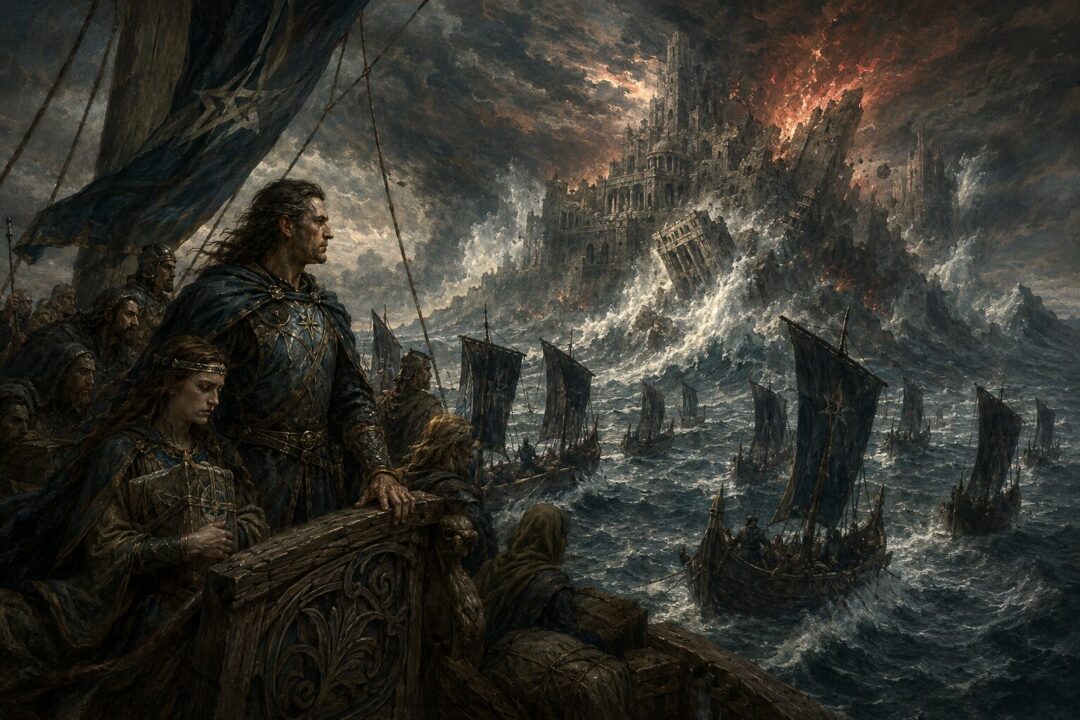
When Aragorn stands in The Lord of the Rings as the heir of Elendil, he carries more than a royal bloodline. He carries a wound. The nobility of Númenor survived in him: long memory, grave courtesy, healing hands, the high speech of the West, and a kingship that looks backward as much as forward. But the same inheritance also carries exile, loss, and the strange burden of belonging to a place that no living road can reach.
That is the overlooked tragedy of the Faithful. They did not worship Sauron. They did not join Ar-Pharazôn’s assault on Aman. They preserved friendship with the Eldar, reverence for the Valar, and belief in Ilúvatar when much of Númenor turned against those things. Yet they were not untouched by Númenor’s long decline. The island changed them before it fell, and its destruction changed them again.
The Faithful escaped the ruin of Númenor, but they did not escape Númenor itself.
The Faithful Were Not Outsiders to Númenor
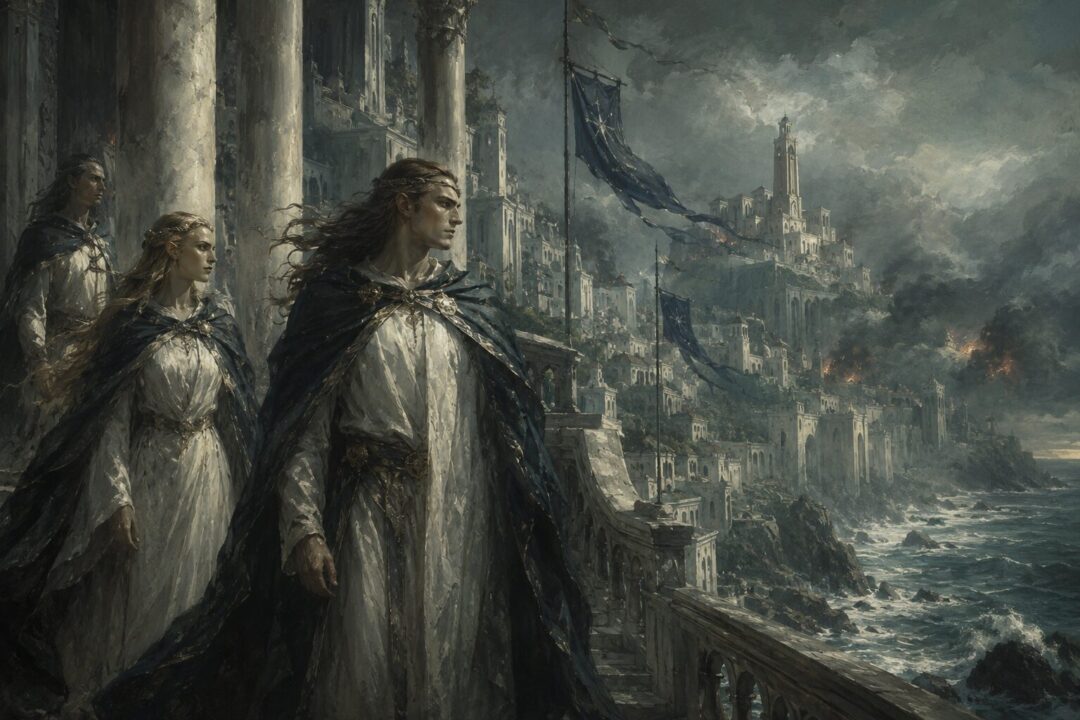
It is tempting to imagine the Faithful as a clean remnant, almost separate from the corrupted island around them. The texts do not really present them that simply. They were Númenóreans: heirs of Elros, dwellers in the Land of Gift, members of a people given long life, wisdom, strength, and a place set apart after the wars against Morgoth.
The Faithful, also called the Elendili or Elf-friends, opposed the later policies of the King’s Men and remained loyal to the Valar and Ilúvatar. They preserved friendship with the Eldar while many Númenóreans came to resent the Ban of the Valar and the death appointed to Men.
But their loyalty did not make them culturally neutral. They spoke the languages of Númenor. They lived under Númenórean kings. Their memories, ceremonies, architecture, seafaring habits, and political imagination were shaped by an island kingdom that had become the greatest realm of Men in the world. Even resistance to Númenor’s corruption was still resistance from within Númenor.
That matters because the fall of the island was not only a disaster that happened around them. It was the destruction of the world that had formed them.
They Inherited Greatness Before They Inherited Exile
Númenor began as a reward and a mercy. The Edain who had aided the Elves against Morgoth were given a land in the Great Sea, removed from the immediate darkness of Middle-earth but not permitted to sail west into the Undying Lands. This gift created a people both blessed and bounded.
That tension never disappears. The Númenóreans were greater than other Men in many ways, but still Men. They had longer lives, but not immortality. They could see, from their island, signs of a West they could not possess. The Ban was not originally a punishment; it marked the difference between the fate of Elves and the fate of Men. But over generations, the difference became a wound.
The Faithful accepted what the King’s Men increasingly rejected. Yet acceptance is not the same as never feeling the pressure. The texts do not say that every Faithful Númenórean was free from grief over death, longing for the West, or pride in Númenor’s power. Rather, they remained faithful despite living inside a civilization where those temptations became stronger and more public.
Their virtue was not innocence. It was endurance.
The Island Taught Them to Think Like Númenóreans
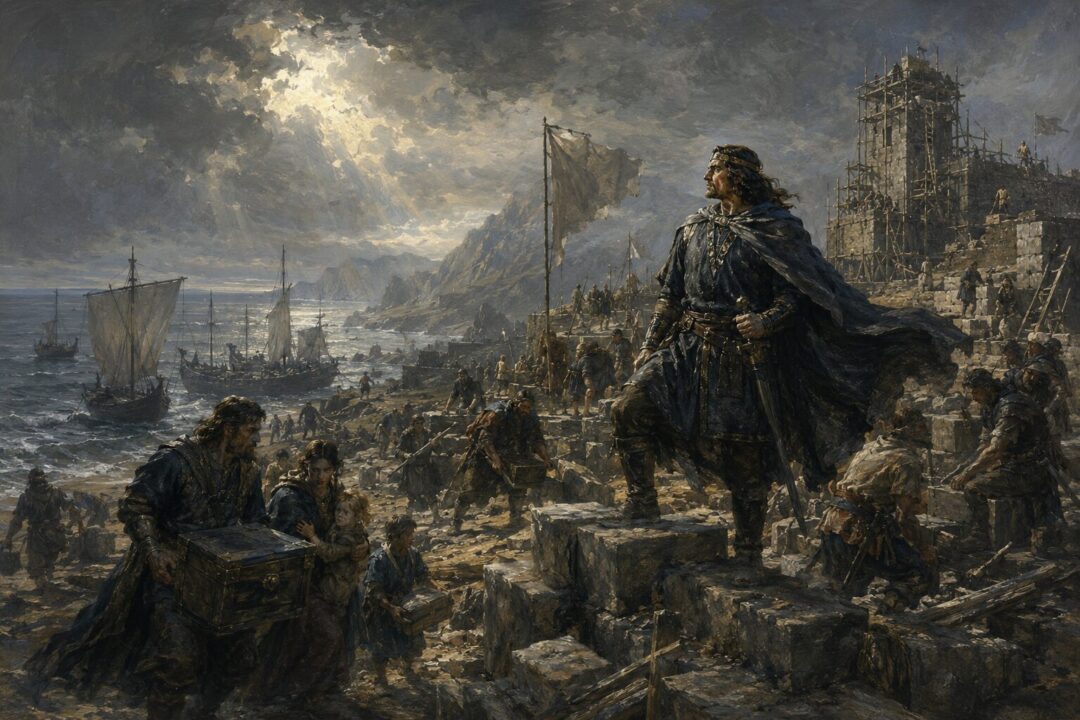
The Faithful opposed the worst of Númenor, but they still carried its scale of imagination. When they escaped to Middle-earth, they did not become wandering villagers or hidden hermits. Elendil and his sons founded kingdoms.
That is not a small detail. After the Downfall in the Second Age, Elendil and the surviving Faithful established the Realms in Exile: Arnor in the north and Gondor in the south. These kingdoms were not mere shelters. They were political continuations, attempts to preserve lawful order, memory, and Númenórean identity on new soil.
This reveals how deeply the island had shaped even the loyal remnant. The Faithful did not reject kingship, towers, cities, archives, lineage, or the grandeur of Men. They purified and redirected those things. They carried the White Tree. They preserved lore. They raised great works in stone. They kept the names of Elendil, Isildur, Anárion, and the line of the Dúnedain at the center of their history.
One reading is that the Faithful became most Númenórean after Númenor was gone. Only in exile did their identity harden into something sacred, mournful, and deliberately preserved.
Their Memory Became a Form of Power
Memory is one of the great forces in Middle-earth. The Elves remember with painful clarity because they are bound to the world. Men remember differently: through songs, houses, heirlooms, tombs, and inherited names. The Faithful became a people of memory because their homeland was not merely lost. It was removed.
The Akallabêth, the tale of the Downfall, is associated in tradition with Elendil and was preserved in Gondor. encyclopedia-of-arda.com Whether read as history, lament, warning, or all three, its existence is significant. The survivors did not treat Númenor as something to forget. They shaped their future around remembering it rightly.
This memory had moral force. It warned against pride, rebellion, and the desire to seize immortality by force. It also preserved the legitimacy of the Exiles. Gondor and Arnor were not random realms founded by shipwrecked nobles; they were the heirs of a drowned kingdom, carrying both blessing and judgment.
But memory can be dangerous even when it is faithful. The more glorious the lost world becomes in recollection, the more later generations may measure themselves against an impossible past. Gondor in the Third Age often feels like a civilization living under the shadow of its own ancestors. Its greatness is real, but so is its melancholy.
They Were Changed by Loss, Not Only by Survival
The escape of the Faithful can sound triumphant: nine ships, precious heirlooms, the seed of the White Tree, the founding of Arnor and Gondor. But the emotional truth is darker. They survived the end of their world.
Elendil did not sail from Númenor as an explorer seeking opportunity. He fled catastrophe. His father Amandil had already vanished into the West in a desperate attempt to seek mercy, and the island he left behind was swallowed. Elendil’s arrival in Middle-earth is therefore not only a founding moment. It is a bereavement.
The texts imply this in the very language of exile. The Realms in Exile are not simply new Númenor. They are realms founded after judgment, by those who escaped but could not restore what was lost. The sea becomes a barrier of grief. Númenor becomes Akallabêth, the Downfallen.
That loss shaped the Faithful into a people who looked both forward and backward. Their kingdoms were future-facing acts of courage, but they were built from ruins of memory. Their greatness was not the confidence of a young civilization. It was the discipline of survivors.
Their Faithfulness Did Not Cancel the Doom of Their People
One of the hardest truths in the Númenórean story is that righteousness does not always remove consequence. The Faithful were spared from the immediate destruction, but they still entered history as exiles. They still bore the political and spiritual aftermath of Númenor’s rebellion.
This is not because they secretly deserved the same judgment as Ar-Pharazôn. The texts do not say that. Rather, Tolkien’s world often shows that the innocent and faithful may suffer within the consequences of a larger fall. The Faithful lived in the same island kingdom, under the same shadow, during the same long decline. When the wave came, it ended the world they knew too.
Their survival was mercy, but it was not restoration.
That distinction gives the story its power. The Faithful are not rewarded with an untouched paradise somewhere else. They are given a task: carry what can be saved into Middle-earth. Preserve the true memory. Resist Sauron. Build kingdoms that remember both the glory and the warning of Númenor.
They become faithful not by being spared grief, but by bearing it without surrendering to the same pride that destroyed their homeland.
The Shadow of Númenor Followed Them into Middle-earth
The Faithful escaped Sauron’s immediate trap in Númenor, but they did not leave Sauron behind. After the Downfall, Sauron returned to Middle-earth in diminished form, and the Exiles became his chief enemies in the West. The War of the Last Alliance grew from this new age of conflict, with Elendil and Gil-galad leading the final great resistance of the Second Age.
That means the Faithful inherited not only Númenor’s memory, but Númenor’s unfinished war. Their island had fallen partly through Sauron’s corruption of its king and people. Their new kingdoms were founded in a world where Sauron still endured. Exile did not free them from the Enemy’s history; it placed them on the front line of it.
This too changed them. Arnor and Gondor were born defensive. Their geography, alliances, towers, and military identity were shaped by the knowledge that the Shadow had survived. The Faithful became guardians as much as heirs.
Even in the Third Age, the Dúnedain are marked by this burden. Aragorn’s line is hidden, diminished, and watchful. Gondor stands long against Mordor. The splendor of Númenor becomes not merely an ancestral boast, but a responsibility that grows heavier as the bloodline wanes.
The White Tree Shows What They Preserved—and What They Lost
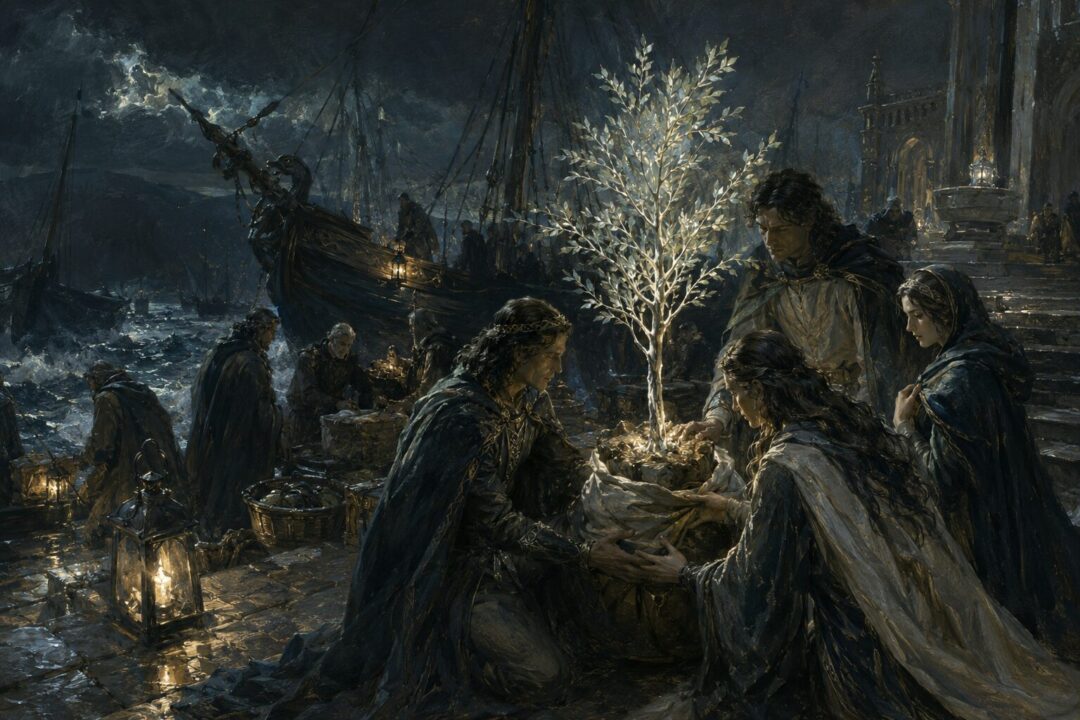
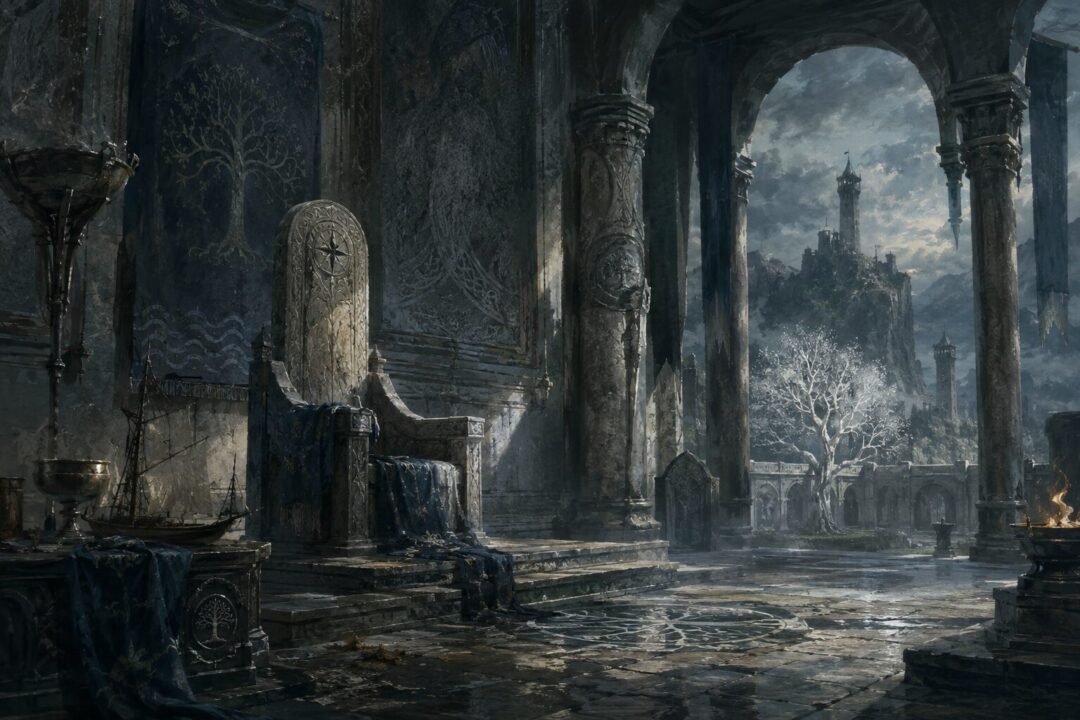
Few symbols capture the Faithful more clearly than the White Tree. It is living memory: not a weapon, not a crown, not a fortress, but a descendant of a sacred lineage tied to the friendship of Elves and the blessing of the West. Its preservation by the Faithful shows what they valued most deeply.
Yet a tree transplanted is still a sign of exile. It lives, but not in its first soil. It testifies to continuity and rupture at the same time.
That is the central contradiction of the Faithful after the Downfall. They preserved what was best in Númenor, but preservation itself proved that the original world was gone. Every seed, heirloom, name, and story carried into Middle-earth was both rescue and reminder.
The Faithful were changed because their identity became sacramental in the broad sense: outward things carried inward meaning. A sword was not only a sword. A tree was not only a tree. A name was not only a name. These things became vessels of a drowned past and promises for an uncertain future.
The Faithful Became a Warning Against Clean Escapes
The story of the Faithful matters because it resists a simple moral division. Yes, they were right to reject Sauron’s lies and the rebellion of the King’s Men. Yes, their survival made the later hope of Middle-earth possible. Without Elendil’s line, there is no Aragorn. Without Gondor, the West has no great shield against Mordor.
But the Faithful were still changed by the island that fell because no one lives inside a doomed culture without being shaped by it. They inherited its beauty and its grief, its high language and its political grandeur, its reverence and its danger. They carried away the part of Númenor that could still be redeemed, but they also carried the ache of everything that could not.
That makes them more moving than a simple remnant of “good Númenóreans.” They are survivors of a holy catastrophe, people who learned that faithfulness does not always mean remaining untouched. Sometimes it means escaping with memory, guilt, duty, and hope all bound together.
Númenor fell because Men tried to seize what was not given to them. The Faithful endured because they accepted limits, but even they had to live with the cost of a people who forgot them.
In Middle-earth, the Exiles built towers, planted trees, raised kings, and fought the Shadow. Yet beneath all that grandeur was a quieter truth: the sea had taken their home, and every act of preservation was also an act of mourning.
Sources & Notes
- Tolkien Gateway, “Faithful” — defines the Elendili as Númenóreans loyal to the Valar and Ilúvatar, opposed to the King’s Men, and survivors who founded the Realms in Exile. https://tolkiengateway.net/wiki/Faithful
- Tolkien Gateway, “Númenor” — summarizes the island’s gift to the Edain, its later division between King’s Men and Faithful, Sauron’s corruption, and the escape of Elendil’s people. https://tolkiengateway.net/wiki/N%C3%BAmenor
- Tolkien Gateway, “Downfall of Númenor” — covers Ar-Pharazôn’s assault on Aman, the drowning of Númenor, and the catastrophe from which the Faithful escaped. https://tolkiengateway.net/wiki/Downfall_of_N%C3%BAmenor
- Tolkien Gateway, “Elendil” — gives Elendil’s role as leader of the Faithful after Amandil, survivor of the Downfall, and founder of Arnor and Gondor as Realms in Exile. https://tolkiengateway.net/wiki/Elendil
- Tolkien Gateway, “Dúnedain” — traces the Númenórean exiles after the Downfall into Arnor and Gondor, supporting the article’s focus on inherited memory and identity. https://tolkiengateway.net/wiki/D%C3%BAnedain
Sources cover the Faithful/Elendili, Númenor’s decline, the Downfall, Elendil, and the Dúnedain in exile.