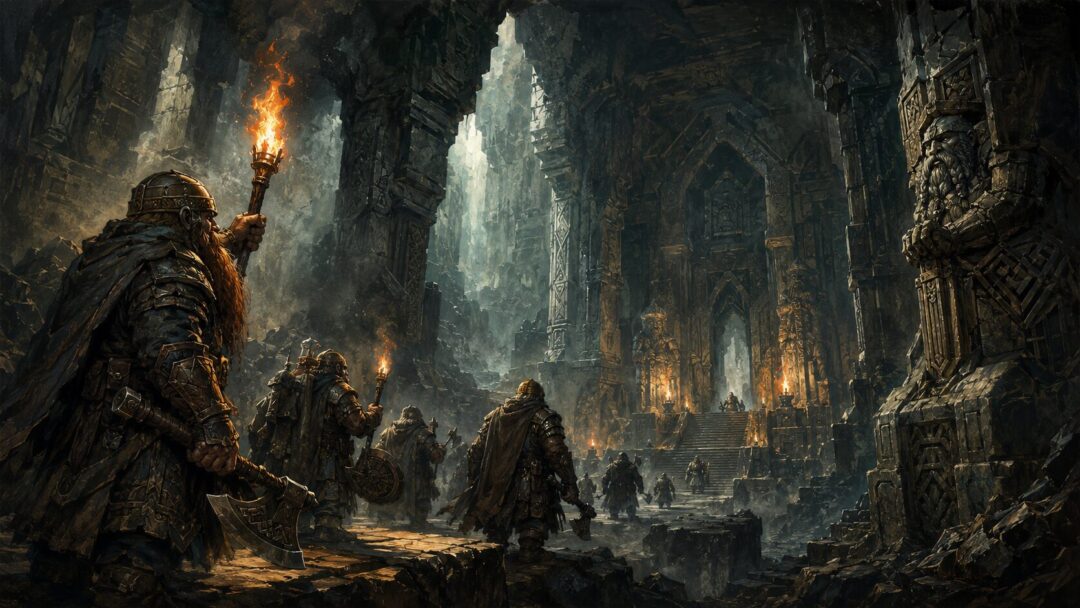
Deep within the mountain of Khazad-dûm, where even stone seems to forget the shape of light, there is a brief and haunting moment in history that lingers like an echo that never fully dies. Balin son of Fundin did what few Dwarves of the Third Age dared to attempt: he returned to Moria, the ancestral heart of his people, and for a short time, he succeeded.
But Tolkien’s legendarium is rarely concerned with simple victory or defeat. It is more interested in the fragile span between them—the moment when hope becomes structure, and structure quietly begins to fail. Balin’s colony is one of the clearest expressions of this tension: a restoration that worked just long enough to reveal why it could not last.
The Return to Khazad-dûm
In The Lord of the Rings, it is stated that Balin entered Moria with a company of Dwarves, seeking to reclaim and resettle the ancient halls of Durin’s folk. This was not an act of reckless conquest but of memory-driven ambition: Khazad-dûm had once been the greatest of all Dwarven realms, a place of unmatched craft, wealth, and depth.
By the Third Age, however, it had become something else entirely. It was abandoned after the release of a nameless terror—later understood by Gandalf to be a Balrog—and subsequently overrun by Orcs. What Balin and his followers entered was not an empty ruin, but a contested darkness layered over centuries of collapse.
Yet the early record of the expedition, preserved in the Book of Mazarbul, suggests that their arrival was not immediately doomed. On the contrary, they achieved a level of success that, for a brief period, appeared sustainable.
The First Success: A Restored Lordship in the Dark
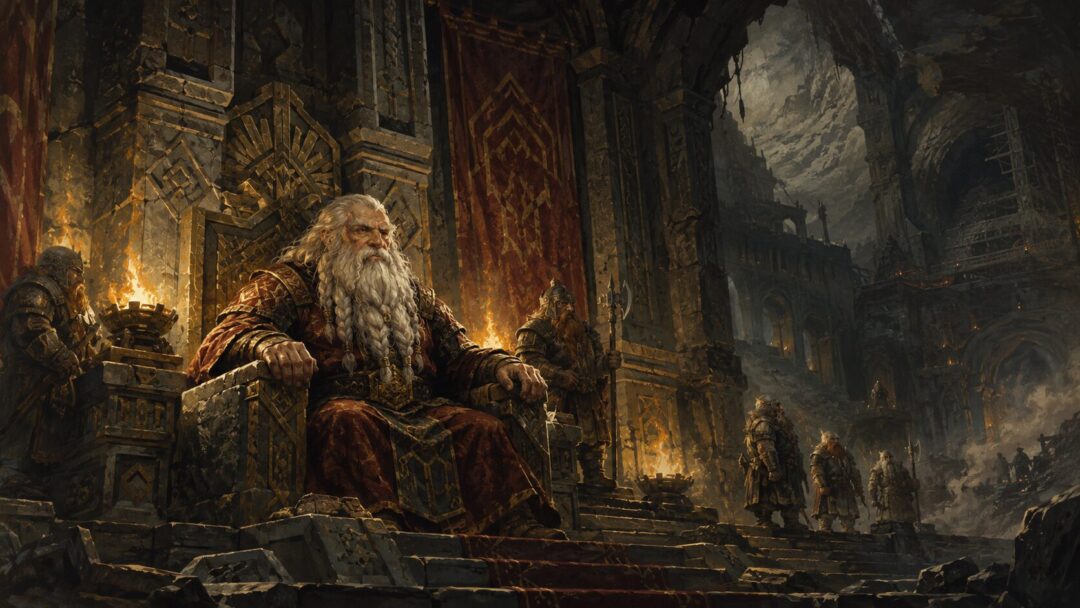
The Book of Mazarbul records Balin as “Lord of Moria,” a title that carries immense weight in Dwarven tradition. This implies more than mere survival. It suggests governance, territorial control, and the re-establishment of order within at least parts of the ancient city.
The Dwarves appear to have secured key areas, including the West Gate, and re-established communication with the outside world. For a time, Moria was not simply entered—it was held.
This is the critical point of the tragedy: Balin’s colony does not fail immediately. It succeeds first.
But success in Moria is not the same as safety. It is only the beginning of exposure.
A Kingdom That Cannot Be Fully Reclaimed
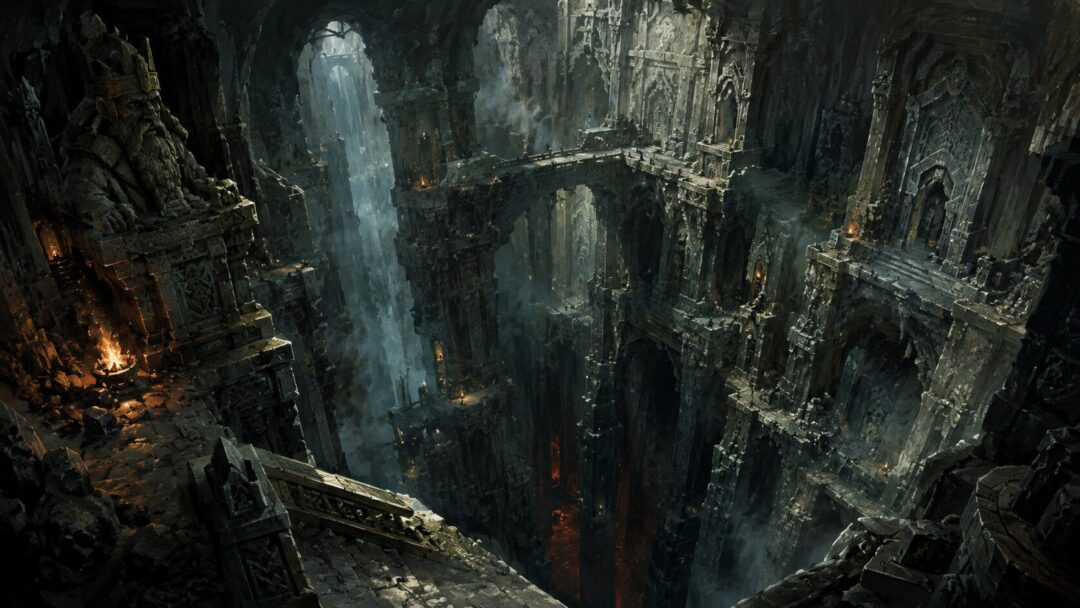
Khazad-dûm is not a static ruin. In Tolkien’s description, it is vast beyond the comprehension of most who dwell in the Third Age, with endless tunnels, deep shafts, and layered halls stretching far beyond the knowledge of any single expedition.
By the time Balin returns, those depths are no longer empty. Orcs have adapted to the darkness, establishing themselves as a persistent and organized presence. Beneath them, something far older and more dangerous is later inferred by Gandalf to dwell: a Balrog, a remnant of the ancient world.
Importantly, the colony itself does not initially operate with full knowledge of what lies below. Their success is built on partial visibility. They reclaim what they can see, while the unseen remains untouched.
This imbalance defines their fate.
Expansion as Exposure
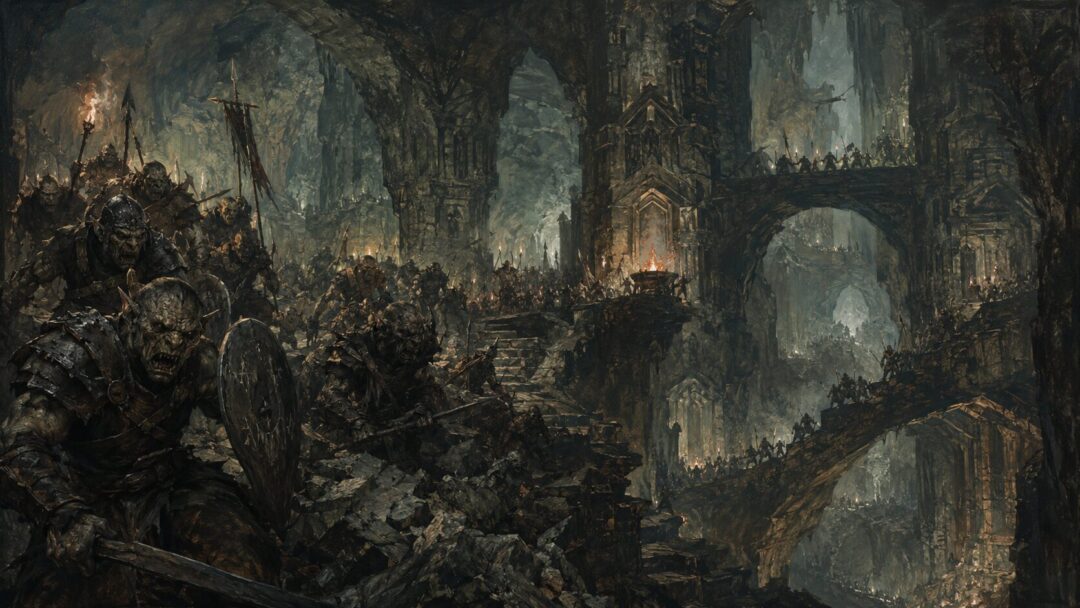
The surviving entries in the Book of Mazarbul suggest a gradual transition from expansion to defense. Early confidence gives way to increasing reports of Orc activity and sustained attacks. The colony’s presence, once a source of stability, becomes a signal that draws resistance.
This is a key structural reality in Tolkien’s portrayal of reclaimed ruins: to occupy a space is also to announce oneself to everything that still claims it.
As the Dwarves expand their control, they also expand their perimeter of vulnerability. Each reclaimed hall requires defense. Each secured passage becomes a potential breach point. What begins as restoration becomes attrition.
There is no indication that the Dwarves were failing in courage or discipline. Rather, they were attempting to maintain order in a system that had already exceeded the scale of their resources.
The Chamber of Mazarbul: Collapse of a Living Record
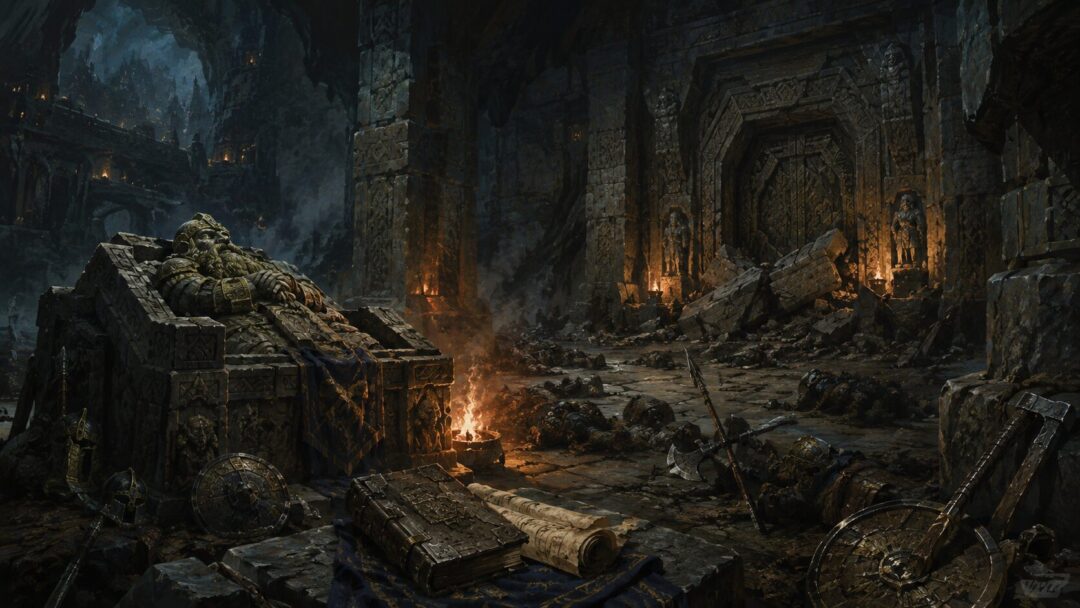
The final phase of the colony is marked by retreat and entrenchment within the Chamber of Mazarbul. This location becomes both administrative center and last refuge. It is here that Balin is buried, and here that the last entries of the chronicle are written.
The text preserved by the Fellowship is fragmentary, but its structure is unmistakable: increasing pressure, loss of contact, and final siege conditions. The Dwarves are not simply defeated in open battle—they are enclosed by the accumulation of everything they could not permanently secure.
The Chamber of Mazarbul becomes the point where history stops being expansion and becomes recording. The act of writing itself becomes a form of resistance against erasure.
Why the Colony Failed After It Succeeded
The tragedy of Balin’s expedition lies not in its failure, but in its brief success. Tolkien presents a situation where initial achievement does not prevent collapse—it accelerates it.
Several structural forces contribute to this outcome within the logic of the narrative:
First, Moria is too vast to be reclaimed in partial stages. Control of surface halls does not equate to control of its depths.
Second, hostile forces within Moria are not static. Orcs are organized, adaptive, and entrenched in ways that allow them to respond to incursion over time rather than being displaced by a single campaign.
Third, and most importantly, the colony lacks full understanding of the fundamental threat beneath them. The presence of the Balrog is not known to the colonists themselves, only inferred later. This means their strategic planning is incomplete by default.
Success, therefore, is not a guarantee of stability. It is a temporary condition that increases the stakes of everything that follows.
The Irony of Lordship in a Dying Realm
To call Balin “Lord of Moria” is to highlight the deepest irony of the expedition. The title is real within the narrative context—it reflects actual control achieved over portions of the ancient city—but it also frames the fragility of that control.
Lordship implies permanence. Moria refuses permanence.
Tolkien’s world often treats titles as reflections of tension rather than triumph. Here, lordship exists simultaneously with siege conditions. Authority is real, but incomplete. Power is exercised, but not absolute.
This duality is what makes the colony’s collapse feel inevitable in retrospect, even though it was not immediate.
The Silence After the Last Entry
When the Fellowship later discovers the remains of Balin’s colony, they encounter not just ruins but a frozen narrative. The Book of Mazarbul ends mid-collapse, interrupted by violence and abandonment. The silence that follows is not empty—it is full of implied continuation.
What happened after the last entry is not fully detailed in surviving text, but the structure of events makes the outcome clear: the colony was overwhelmed.
Yet the importance of Balin’s attempt is not diminished by this end. It remains one of the clearest examples in Tolkien’s legendarium of a restoration that briefly succeeded before collapsing under conditions it could not fundamentally change.
Conclusion: A Brief Light in an Unforgiving Depth
Balin’s colony in Moria is often remembered as a failed reclamation, but the deeper truth in Tolkien’s narrative is more precise: it was a successful reclamation that could not be sustained.
For a moment, Khazad-dûm was not merely memory or myth. It was governed, inhabited, and structured once again by its rightful heirs. That moment matters, even if it could not last.
In Tolkien’s world, where history is measured not only in victories but in endurance, Balin’s achievement stands as a reminder that success is not always the opposite of failure. Sometimes it is simply the moment that reveals how much is still missing beneath the surface.
Sources & Notes
- https://tolkiengateway.net/wiki/Balin — Tolkien Gateway, Balin: biography covering his expedition to reclaim Moria, his brief lordship, death, and tomb.
- https://tolkiengateway.net/wiki/Moria — Tolkien Gateway, Moria: history of Khazad-dûm, its abandonment, Orc occupation, and later events involving Balin’s colony.
- https://tolkiengateway.net/wiki/Book_of_Mazarbul — Tolkien Gateway, Book of Mazarbul: details the chronicle of Balin’s colony and its final written record.
- https://tolkiengateway.net/wiki/Chamber_of_Mazarbul — Tolkien Gateway, Chamber of Mazarbul: context for Balin’s tomb, the colony’s last refuge, and the Fellowship’s discovery.
Sources selected for Tolkien lore context on Balin, Moria/Khazad-dûm, the Book of Mazarbul, and the colony’s final collapse.