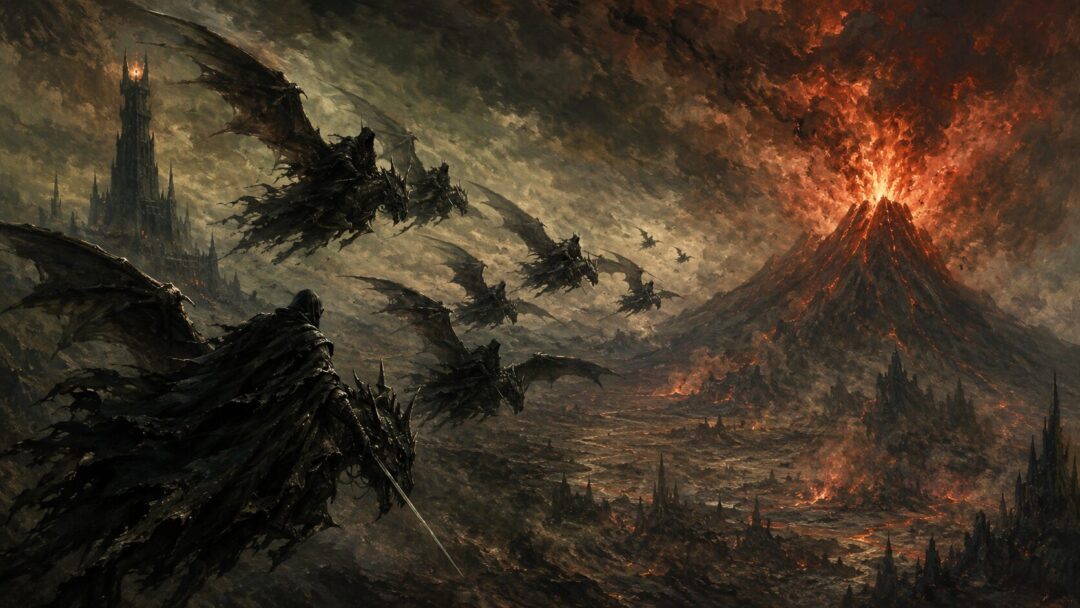
The final terror of the War of the Ring is not only the fall of Sauron. It is the last flight of the Nazgûl.
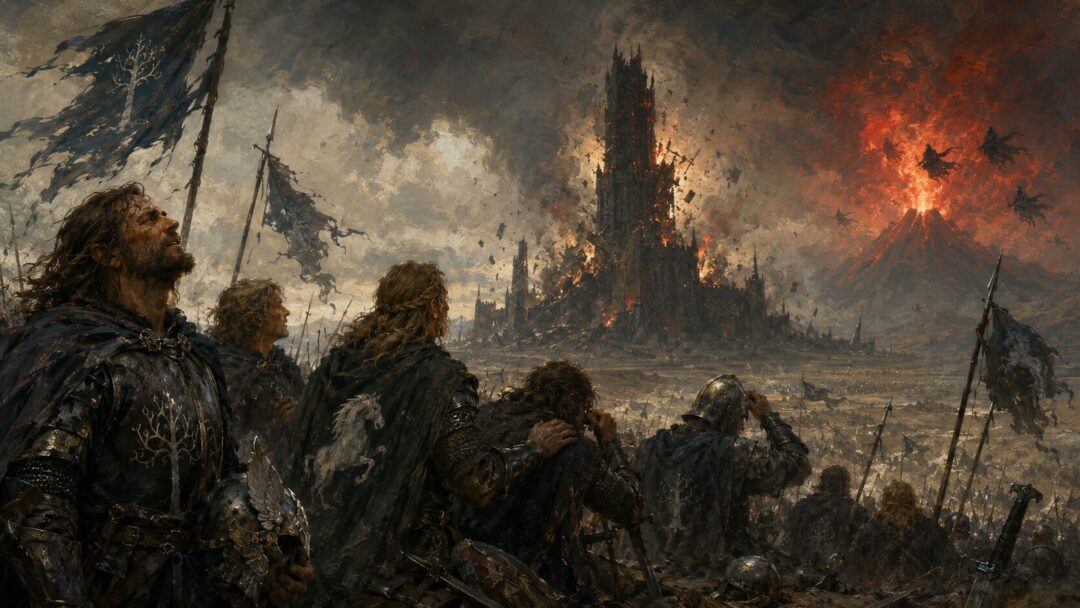
At the very moment when Frodo claims the Ring in the Sammath Naur, Sauron understands the danger too late. The remaining Ringwraiths are sent racing southward toward Mount Doom, mounted on their winged creatures, but they arrive after Gollum has fallen with the Ring into the fire. The texts give no long death-scene for them. They are overtaken by the ruin of the mountain and destroyed.
That sounds simple. But it hides a deeper question: what exactly was destroyed? Were the Nazgûl killed like warriors? Did their stolen power vanish? Were the Men inside them released? Or did their existence depend so completely on the Ring-system that when the One was unmade, there was almost nothing left to save?
The safest answer is this: their power collapsed because it was never truly independent. The Nazgûl were not free sorcerers who happened to serve Sauron. They were Men stretched beyond mortal life by the Nine Rings, enslaved through a power ultimately subject to the One, and maintained as instruments of Sauron’s will.
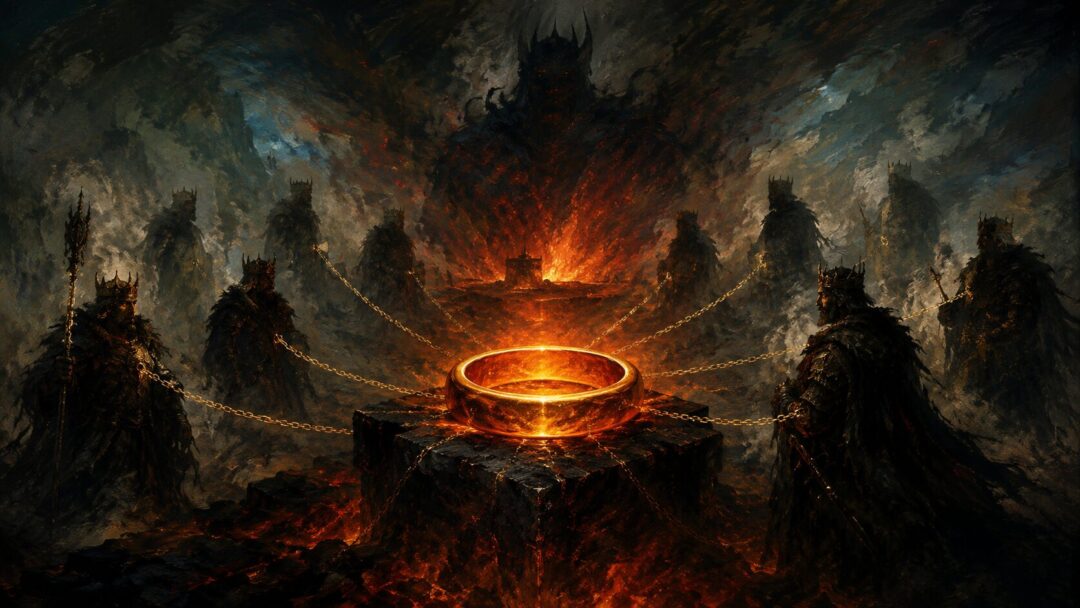
The Nazgûl Were Not Just Ghosts
The Nazgûl began as mortal Men. The Nine Rings gave them power, wealth, long life, and a terrible kind of visibility in the Unseen world. But that gift became a trap. Their lives were unnaturally extended until they faded into wraiths, permanently invisible to ordinary sight and enslaved by Sauron.
This matters because their “power” was not a single thing. It was a condition.
They had unnatural endurance. They could inspire paralyzing fear. They existed partly in the wraith-world. They could be unseen, yet present. They could ride, command, wound, and hunt. But all of this came through corruption, not through natural strength.
The Nazgûl were powerful because they had been emptied. Their humanity had not been enlarged into something noble; it had been thinned, bent, and bound. They were not immortal in the Elvish sense, nor deathless in any free sense. They were mortals whose deaths had been postponed by domination.
So when the One Ring was unmade, the question is not whether they lost a useful weapon. It is whether the whole structure holding them in that condition could still stand.
The One Ring Was the Master Key
The Ring-system was built around rule. The One Ring was made to dominate the other Rings of Power, and the power of those Rings was bound up with it, “to last only so long as it too should last,” in the wording preserved from the account of the Rings.
That line is crucial. It does not mean every lesser Ring functioned in exactly the same way. The Three, for example, were not touched by Sauron in their making, though they were still caught in the larger danger of the One. But the Nine were the most terrible example of the system working as Sauron intended: bearers corrupted, wills dominated, lives extended, identities consumed.
By the end of the Third Age, the texts also point to Sauron having gathered or held the Nine Rings himself, while the Ringwraiths remained enslaved through them. There is some tension in the wording of different passages, but the later implication is that the Nazgûl were not roaming Middle-earth with independent possession of their own Rings. Their bondage ran through Sauron.
That makes their last moment even colder. The Ringwraiths were not racing to Mount Doom as allies making a desperate choice. They were being driven there by the will that owned them.
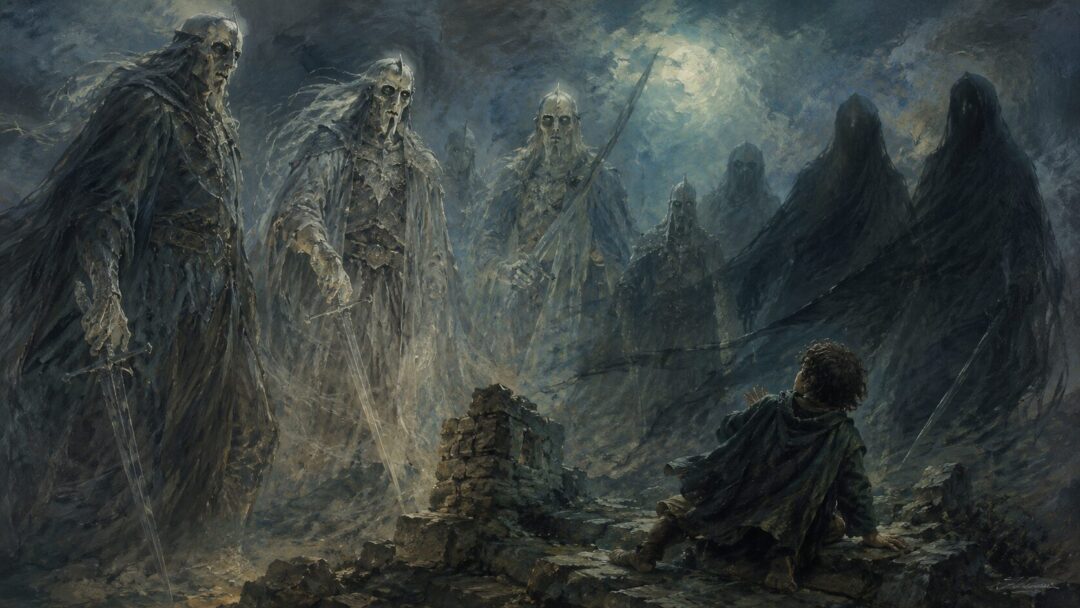
Their Terror Was Real, But Borrowed
The chief weapon of the Nazgûl was fear. Their presence unmanned soldiers, darkened courage, and brought the Black Breath. Their power was especially dreadful in darkness, and even when they were not seen, their nearness could be felt as oppression.
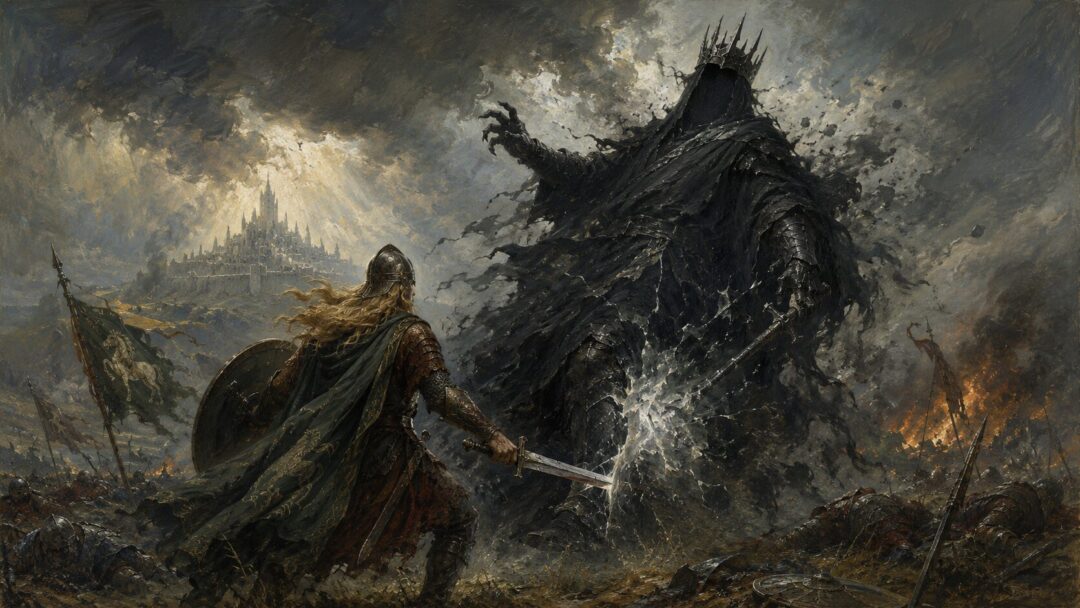
Yet the texts also suggest limits. The Ringwraiths are terrifying, but not invincible. At the Ford of Bruinen, their horses are destroyed and they are forced to return to Mordor “empty and shapeless.” On the Pelennor Fields, the Witch-king falls through the combined acts of Merry and Éowyn. The Nazgûl depend on forms, mounts, weapons, commands, and fear. Their unseen nature does not make them absolute.
That is why the destruction of the One Ring does not need to “fight” each remaining Ringwraith one by one. Their terror has a source. Their wraith-existence has a source. Their enslavement has a source. When that source is unmade, their borrowed majesty has nowhere to stand.
The image is almost architectural. Barad-dûr falls because what upheld it has failed. Sauron falls because the best part of his native strength, poured into the Ring, is lost. The Nazgûl fall because they are among the most complete works of that same system of domination.
What Happened in the Final Moment?
The direct narrative answer is that the remaining eight Nazgûl were caught in the fiery ruin of Mount Doom and destroyed. The Witch-king had already been slain earlier at the Battle of the Pelennor Fields.
But “destroyed” does not automatically answer every metaphysical question. The books do not pause to explain whether the last inner remnants of the Men they once were experienced release, annihilation, judgment, or some other fate. Tolkien’s world has deep rules about death, spirits, and embodiment, but the specific after-fate of the Nazgûl is not described in detail.
So the most lore-faithful answer is conservative: their role as Ringwraiths ended. Their power ended. Their forms, mounts, and ability to act in Middle-earth ended. Their enslavement as the Nine Servants of the Lord of the Rings could not continue once the ruling power behind that slavery had been broken.
Anything beyond that becomes interpretation.
One reading is that because they were originally mortal Men, the destruction of the sorcery sustaining their unnatural state finally forced the end that had been delayed for thousands of years. Another reading is more terrible: that they were so consumed by Sauron’s domination that there was no meaningful “return” to the persons they had been. The texts do not settle this in emotional terms. They show the consequence, not the private interior of the wraiths.
Sauron’s Fall Explains Their Fall
Gandalf’s warning about Sauron gives the clearest rule for the larger collapse. If the Ring were destroyed, Sauron would lose the best part of his original strength, and what had been made or begun with that power would crumble. Afterward he would be unable to grow or take shape again.
The Nazgûl fit that pattern. They are not exactly the same kind of “work” as a tower or a fortress, because they were once living Men. But their continued existence as Ringwraiths belongs to Sauron’s Ring-made order. They are among the clearest examples of what his power does to the living: it does not simply kill; it preserves in bondage.
That is the horror of the Nine. Sauron did not need to make them corpses. He made them useful.
When the One Ring was unmade, Sauron could no longer command the world through that invested power. His armies were thrown into confusion. His tower collapsed. His own spirit was reduced beyond recovery. In that same catastrophe, the Nazgûl’s power had no independent foundation.
They were not freed commanders looking for a new master. They were the broken instruments of a broken will.
Why They Could Not Survive as Lesser Dark Lords
A tempting idea is that the Nazgûl might have remained as independent undead beings after Sauron’s fall. But the lore gives little support for that.
Their identity is tied to the Rings. Their title means Ringwraiths. Their power comes from enslavement through the Nine, and the Nine belong to the larger domination of the One. They are repeatedly presented as Sauron’s servants, not as rival powers with separate realms of their own.
Even the Witch-king, the greatest of them, rules Angmar as Sauron’s instrument. His terror is immense, but it is still derivative. He can command armies, break courage, and threaten kingdoms, yet his fate remains bound to the dark power that made him what he is.
This is why the end of the One Ring is not merely a political defeat. It is a metaphysical disarming. The Nazgûl cannot simply keep their wraith-power and choose a new purpose, because that power was never morally or spiritually theirs. It was a chain.
The Tragic Irony of the Nine
The deepest irony is that the Nazgûl’s great power was also their helplessness.
They outlived kingdoms. They terrified warriors. They survived wounds and disasters that would have ended ordinary Men. They could pass through the world as shadows and make even the brave feel death before death came. Yet at the center of all that dread was dependence.
They had no future apart from Sauron. They had no freedom apart from the Rings. Their long lives were not victories over death, but a long postponement purchased by the loss of self.
So when the One Ring was unmade, the Nazgûl did not merely lose a magical advantage. The lie of their existence was exposed. The power that had made them seem deathless was itself mortal, because it had been placed in a thing that could be destroyed.
That is why their end feels sudden. For thousands of years they had seemed like shadows that could not be grasped. But once the Ring went into the fire, the hidden bargain failed all at once.
The Nazgûl’s power became nothing because it had always been borrowed from a doomed source. Their terror was real, their deeds were terrible, and their corruption shaped the history of Middle-earth. But in the end they were not masters of death. They were slaves of a Ring that could burn.
Sources & Notes
- https://tolkiengateway.net/wiki/Nazg%C3%BBl — Tolkien Gateway, Nazgûl: background on the Ringwraiths as mortal Men enslaved by the Nine Rings and Sauron’s will.
- https://tolkiengateway.net/wiki/One_Ring — Tolkien Gateway, One Ring: context for the Ruling Ring’s domination over the other Rings of Power and its destruction in Mount Doom.
- https://tolkiengateway.net/wiki/Rings_of_Power — Tolkien Gateway, Rings of Power: explains the Seven, Nine, Three, and the One, including how Sauron’s ring-system bound its bearers.
- https://tolkiengateway.net/wiki/Downfall_of_Barad-d%C3%BBr — Tolkien Gateway, Downfall of Barad-dûr: account of the immediate collapse of Sauron’s power and the destruction of the Ringwraiths.
Sources selected for Tolkien lore context on the Nazgûl, the Rings of Power, the One Ring, and the Ringwraiths’ destruction when Sauron’s power collapsed.