When Frodo meets Gildor Inglorion and his wandering Elves in the Shire, he greets them in Quenya: “Elen síla lúmenn’ omentielvo.” A star shines on the hour of our meeting.
The reaction is revealing. Frodo has not merely spoken an Elvish language. He has used the High-elven tongue, a speech carrying memories far older than the Shire, Gondor, or even the kingdoms whose ruins still haunt Eriador.
Yet Quenya is not the ordinary Elvish language Frodo encounters in Middle-earth.
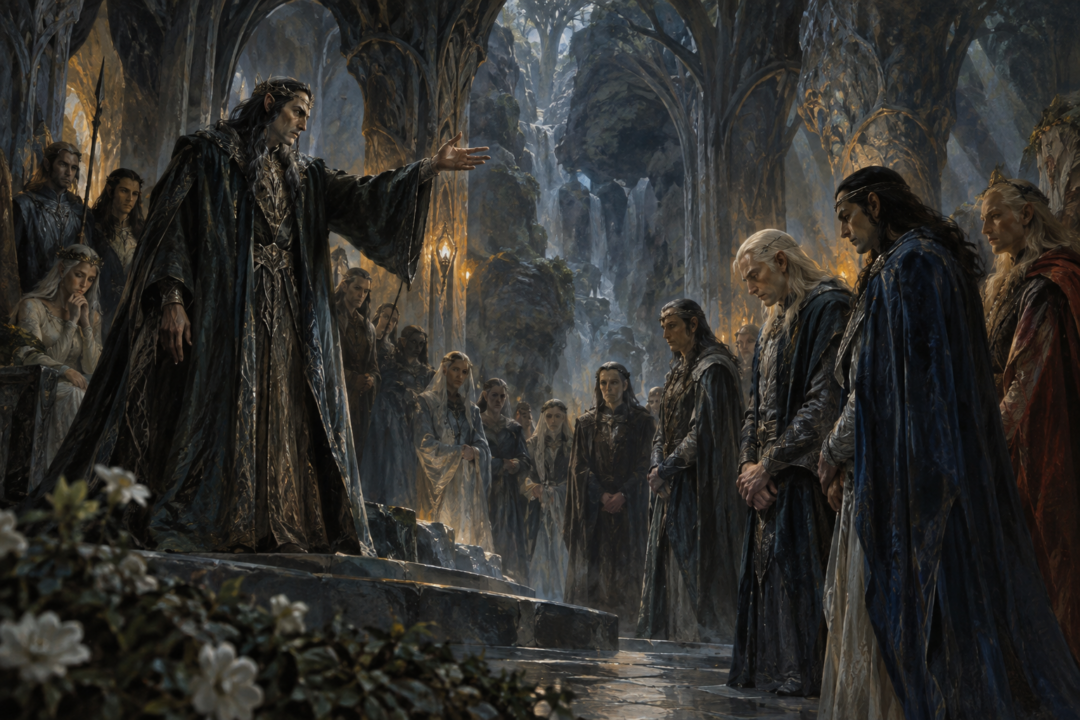
That distinction reaches back thousands of years to one of the most consequential linguistic decisions of the First Age. After learning the truth about the Kinslaying at Alqualondë, Thingol forbade the open use of the Noldorin tongue in his realm. The Sindar thereafter rejected it, while the Noldorin Exiles increasingly adopted Sindarin for ordinary speech.
Quenya did not disappear.
Instead, something stranger happened.
It retreated from everyday conversation into the places where a language can survive almost indefinitely: among rulers and the learned, inside families, in names, poetry, ceremony, historical memory, and eventually the traditions of Men.
Thingol’s Ban Was About Blood, Not Grammar
The prohibition cannot be understood apart from Alqualondë.
The Noldor had returned to Middle-earth under the shadow of rebellion and the first Kinslaying, in which Fëanor and his followers attacked the Teleri to seize their ships. The full truth was initially concealed from Thingol, whose own people were closely related to the Teleri of Aman.
When the truth emerged, his anger attached itself not merely to individuals but to the language carried by the Exiles.
In The Silmarillion, Thingol declares that the Noldorin tongue will not again be heard in his ears and forbids its open use throughout his realm. He commands the Sindar neither to speak it nor answer those who use it.
The consequences spread beyond the practical reach of Doriath. The narrative says that the Sindar throughout Beleriand refused the language and shunned those who spoke it openly.
This matters because the Noldor were newcomers surrounded by a much larger Sindarin-speaking population. They were also linguistically gifted. Rather than forcing the Sindar to adopt Quenya, the Exiles learned Sindarin.
The result was not the extinction of Quenya but a division of function.
Sindarin became the ordinary language of the Exiles in Middle-earth. Quenya became something elevated, restricted, and increasingly associated with the past.
The Ban Never Completely Silenced Quenya
The crucial detail comes immediately after the account of the prohibition.
The Exiles adopted Sindarin for their daily uses, but the High Speech of the West continued to be spoken by Noldorin lords among themselves.
That qualification changes the whole picture.
Quenya had lost the public contest without being erased from private life. It could still exist wherever the social authority of Thingol and the expectations of the Sindar mattered less: within particular households, among the Noldorin elite, and in contexts tied to learning and memory.
Gondolin provides particularly important evidence.
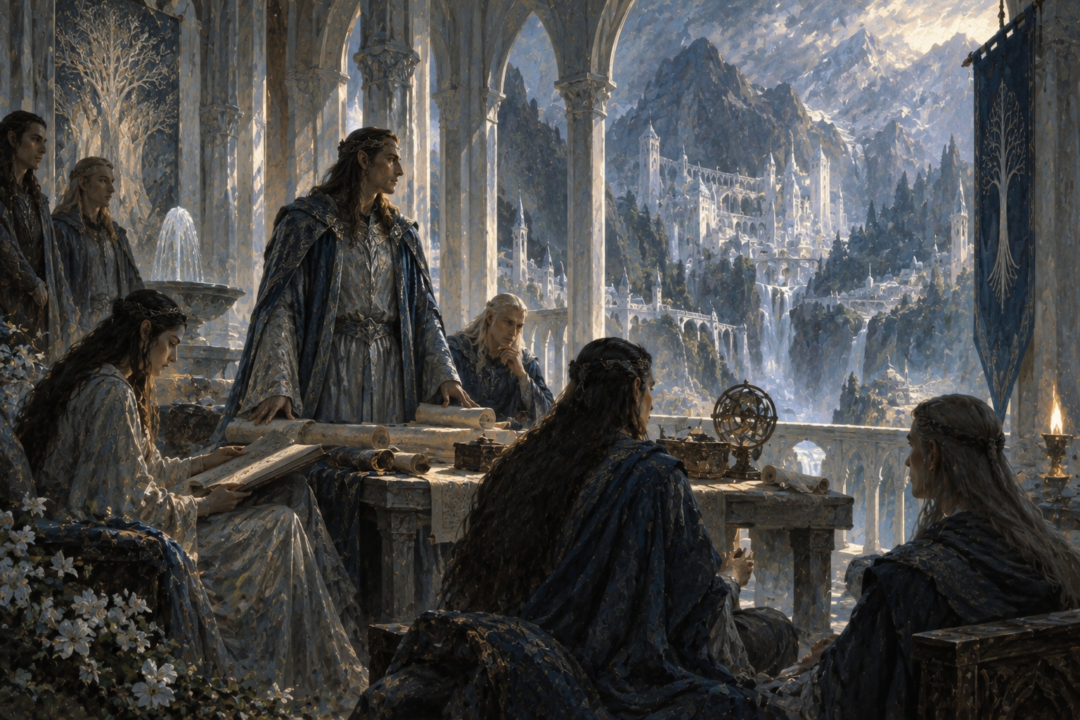
Turgon gave his hidden city the Quenya name Ondolindë, although the Sindarin form Gondolin became the name by which it was generally known. In Unfinished Tales, the guards encountered by Tuor can speak the High Speech of the Noldor. Other linguistic material concerning Gondolin indicates an especially strong survival of Quenya in Turgon’s household.
The hidden city therefore preserves something more than a population behind mountains.
It preserves pieces of the cultural world the Noldor brought from Aman.
Aredhel Shows How Language Becomes Private Memory
A smaller and more intimate example appears in the story of Aredhel and her son.
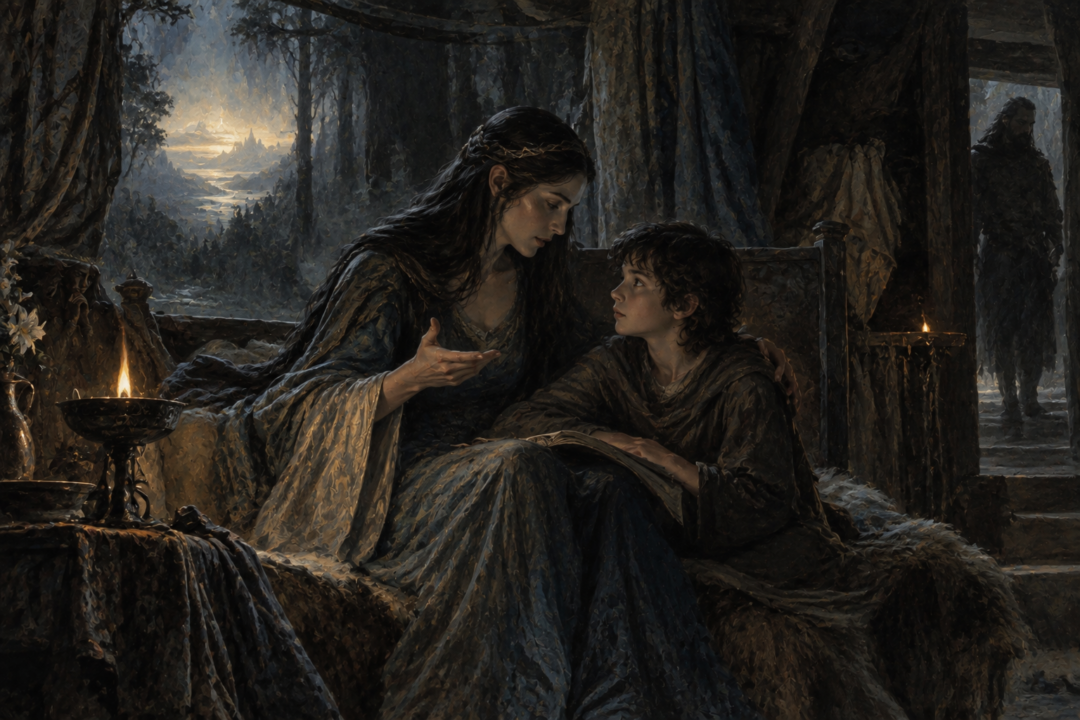
Aredhel gives Maeglin a secret Quenya name in her heart: Lómion, “Child of the Twilight.” The public world around him knows him by the Sindarin name Maeglin, given by Eöl.
The contrast is extraordinarily suggestive.
One name belongs to the visible identity of the child. The other belongs to his mother’s inward life and her Noldorin inheritance.
Related linguistic traditions also describe Aredhel teaching Quenya to her son despite Eöl’s prohibition.
Here Quenya survives not because a king issues a counter-decree, nor because an entire population rejects Thingol’s settlement. It survives through transmission between individuals.
That is one of the great patterns of its later history.
Once a language ceases to dominate marketplaces, councils, roads, and ordinary households, it can still endure wherever people believe that what it remembers cannot be adequately replaced.
Quenya Becomes the Language of What Must Be Remembered
By the Third Age, Sindarin is the principal spoken Elvish language encountered in northwestern Middle-earth. Quenya has acquired a markedly different status.
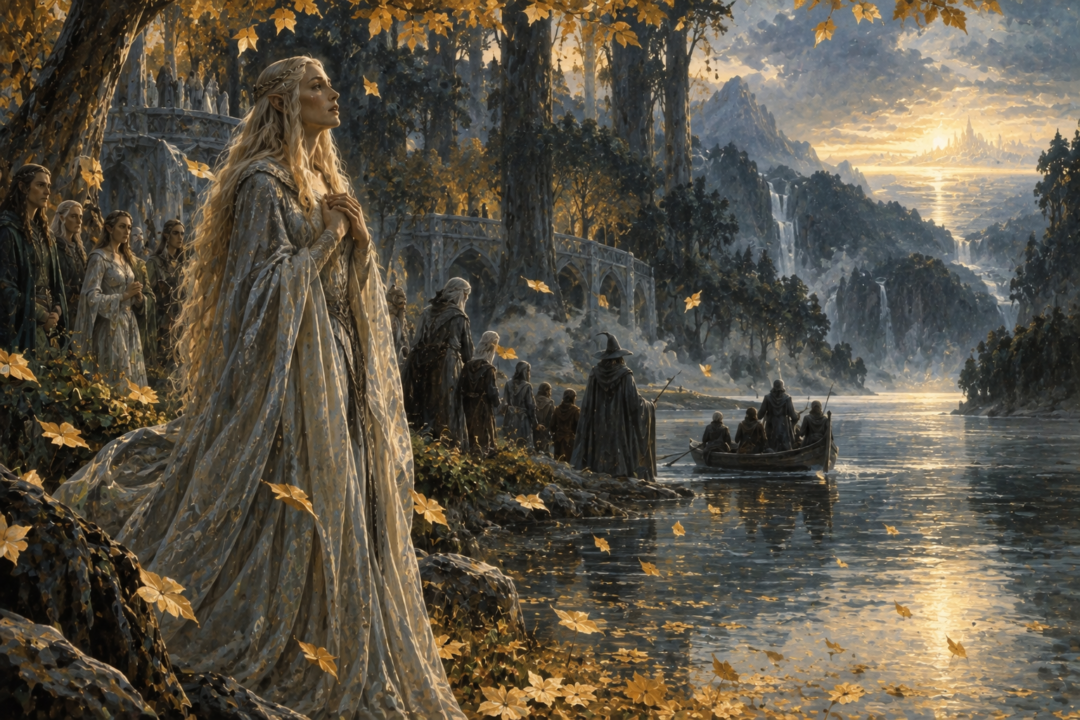
The clearest emotional example may be Galadriel’s lament in Lórien, commonly called “Namárië.”
She sings in Quenya while remembering the West.
That choice matters.
Galadriel is one of the remaining Noldor who actually came from Aman. Quenya for her is therefore not merely an ancient language reconstructed by scholars. It belongs to a world she personally knew before the long disasters of the Ages.
The lament looks westward toward Valinor and expresses separation, longing, and departure. Quenya has become almost perfectly suited to that moment because its historical position mirrors the poem’s emotional one.
It is a language present in Middle-earth that belongs, in a profound cultural sense, somewhere else.
The ban that once pushed Quenya out of ordinary public life could not erase the memories attached to it. Indeed, by the end of the Third Age, its rarity gives its appearances unusual weight.
People do not need Quenya to order dinner or conduct most diplomacy.
They use it when the past itself seems to enter the present.
Men Preserve What the Elves No Longer Use Daily
Quenya’s survival becomes even more remarkable because it crosses the boundary between Elves and Men.
The learned traditions inherited from Númenor preserve knowledge of the High-elven tongue. The Númenóreans, particularly the Elf-friends, possessed deep knowledge of Eldarin lore, and Quenya remained associated with learning and ancient prestige rather than becoming their ordinary vernacular.
This inheritance survives the Downfall.
The royal traditions of the Realms in Exile preserve High-elven naming customs. Gondor itself is overwhelmingly not a Quenya-speaking society, yet Quenya remains embedded in the language of its historical legitimacy and learned culture.
That distinction is important.
The survival of Quenya does not mean that Minas Tirith was full of people casually conversing in it. The texts instead present a world in which ancient languages can remain culturally powerful long after they cease to be normal speech.
A language can disappear from the street while remaining alive in archives, names, inherited formulas, poetry, and institutions.
Gondor becomes one of Quenya’s great repositories precisely because its civilization is deeply conscious of the past.
Aragorn Turns Memory Back Into Ceremony
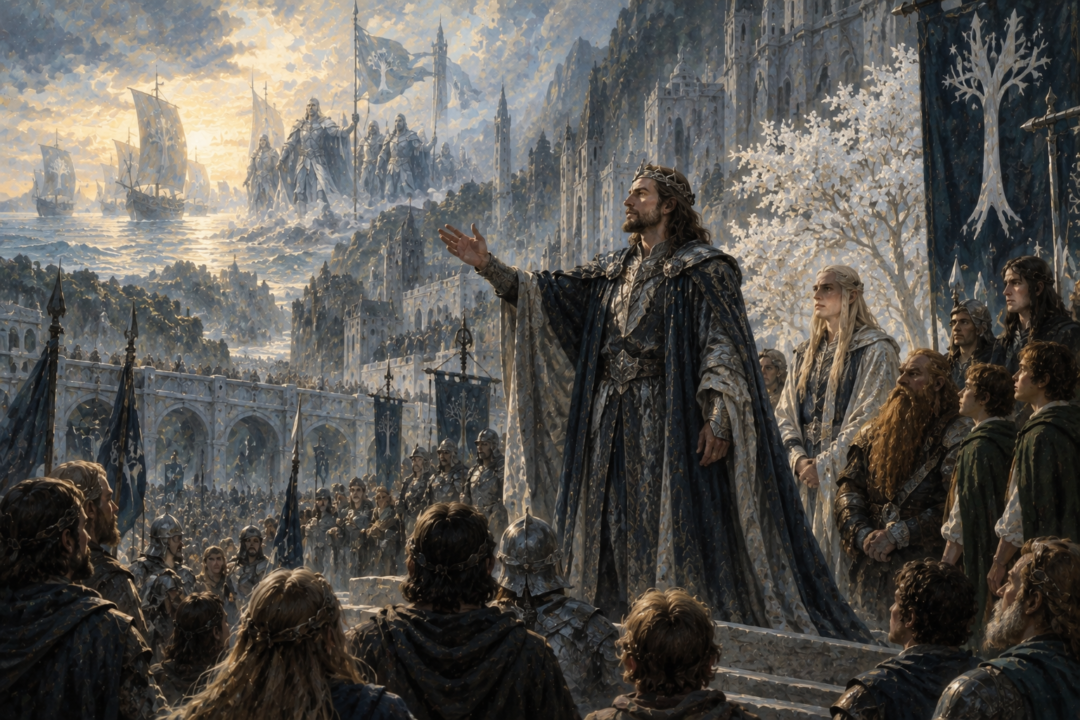
At Aragorn’s coronation, Quenya suddenly becomes public again.
After receiving the crown, Aragorn repeats the words attributed to Elendil when the Númenórean exile first came to Middle-earth after the Downfall: “Et Eärello Endorenna utúlien. Sinome maruvan ar Hildinyar tenn’ Ambar-metta!”
The significance lies not simply in the words but in their continuity.
Aragorn is restoring a kingship that has been absent from Gondor for nearly a thousand years. His use of Quenya reaches beyond the Ruling Stewards, beyond the later kings of Gondor, and back toward Elendil and the founding of the Realms in Exile.
The language functions almost like a bridge across broken history.
Thingol once tried to prevent Quenya from being openly heard because it had become inseparable, in his judgment, from the crime and rebellion of the Exiles.
Thousands of years later, a descendant of Númenórean kings openly speaks Quenya before the people of Gondor as part of an act of restoration.
This is not a reversal of Thingol’s decree in any legal sense. His kingdom and the First Age world in which he issued that command are long gone.
It is something more subtle.
The language has outlived the circumstances that drove it from common speech.
The Ban Changed Quenya More Than It Destroyed It
It would be too simple to say that Thingol banned Quenya and therefore transformed it single-handedly into a ceremonial language.
Other forces mattered. The Noldor were fewer than the Sindar, the populations of Beleriand mixed, and the Noldor were highly capable of learning the language already spoken around them. Even without Thingol’s decree, Sindarin had powerful demographic and practical advantages.
But the ban accelerated and symbolized the change.
Quenya ceased to be the ordinary public language of the Noldorin Exiles. Sindarin took that place. Quenya increasingly belonged to narrower domains: Noldorin lords, particular households, learned tradition, ancient names, poetry, and remembrance.
And that apparent retreat became a peculiar form of survival.
A common language changes because everyone needs it.
A remembered language can be guarded precisely because nobody needs it for ordinary life.
By the end of the Third Age, Quenya carries enormous historical density. Frodo can speak a greeting in it. Galadriel can sing her longing for the West in it. Gondorian tradition can preserve it. Aragorn can use it to connect his restored kingship to Elendil.
Quenya survives because Middle-earth never entirely stops remembering what the language means.
Thingol succeeded in driving the tongue of the Exiles out of ordinary Sindarin society.
He did not—and probably could not—drive it out of memory.
That became Quenya’s refuge.
And in Middle-earth, memory can sometimes endure longer than kingdoms.
Sources & Notes
- Tolkien Gateway — Quenya: its displacement as an everyday language and survival as an ‘Elven-latin’ of ceremony, lore, and song. https://tolkiengateway.net/wiki/Quenya
- Tolkien Gateway — Thingol: the Kinslaying’s effect on his relations with the Noldor and his ban on Quenya. https://tolkiengateway.net/wiki/Thingol
- Tolkien Gateway — Gondorians: the learned preservation of Quenya from Númenórean loremasters and its use in names of high significance. https://tolkiengateway.net/wiki/Gondorians
Sources on Thingol’s ban, the Noldor’s adoption of Sindarin, and Quenya’s continued use in ceremony, lore, song, names, and learned Gondorian tradition.