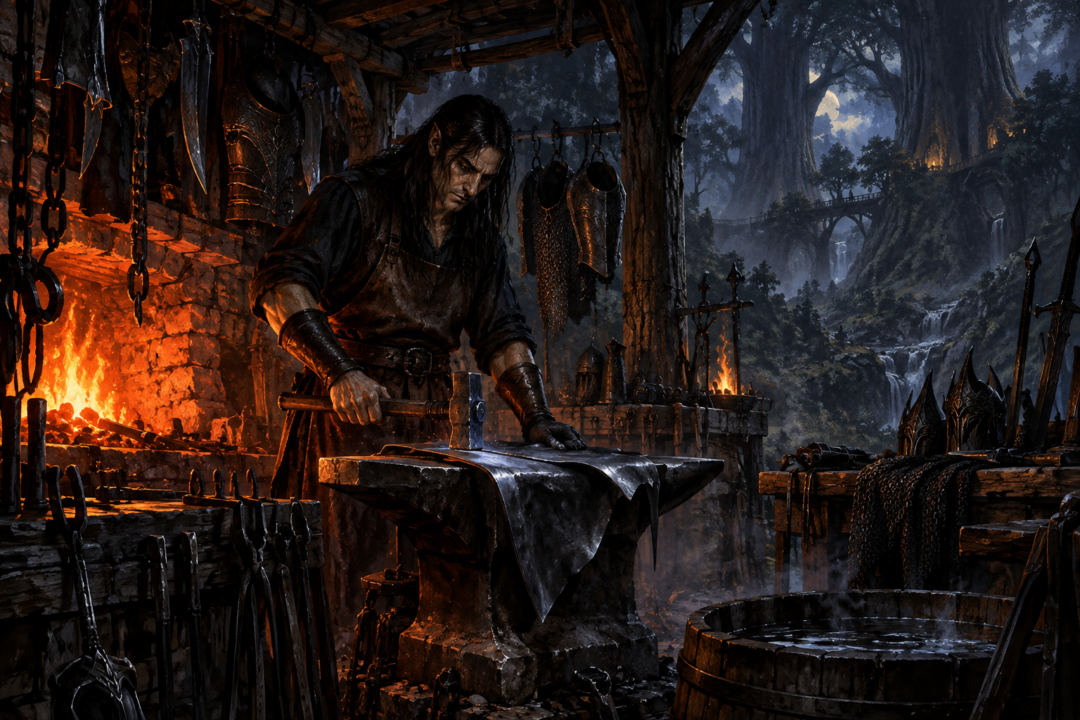
How Eöl Could Hate the Noldor Yet Be a Friend of the Dwarves
Eöl the Dark Elf presents one of the stranger cultural contradictions of the First Age. He despises the Noldor so deeply that when speaking to his son Maeglin, he describes them as slayers of his kin, invaders, and usurpers. Yet this same suspicious, fiercely independent Elf repeatedly welcomes another people into his life: the Dwarves of the Blue Mountains.
This is not a minor acquaintance. Eöl meets the Dwarves who travel through East Beleriand, converses with them, visits their underground cities of Nogrod and Belegost, and learns much of his extraordinary metalcraft from them. The relationship becomes one of the defining features of his life.
At first glance, that seems inconsistent. If Eöl distrusts outsiders and resents foreign peoples establishing themselves in Beleriand, why can he maintain close relations with the Dwarves?
The answer is that Eöl's hostility is not simple isolationism. His hatred of the Noldor is rooted in a particular historical grievance. The Dwarves, in his eyes, belong to an entirely different category.
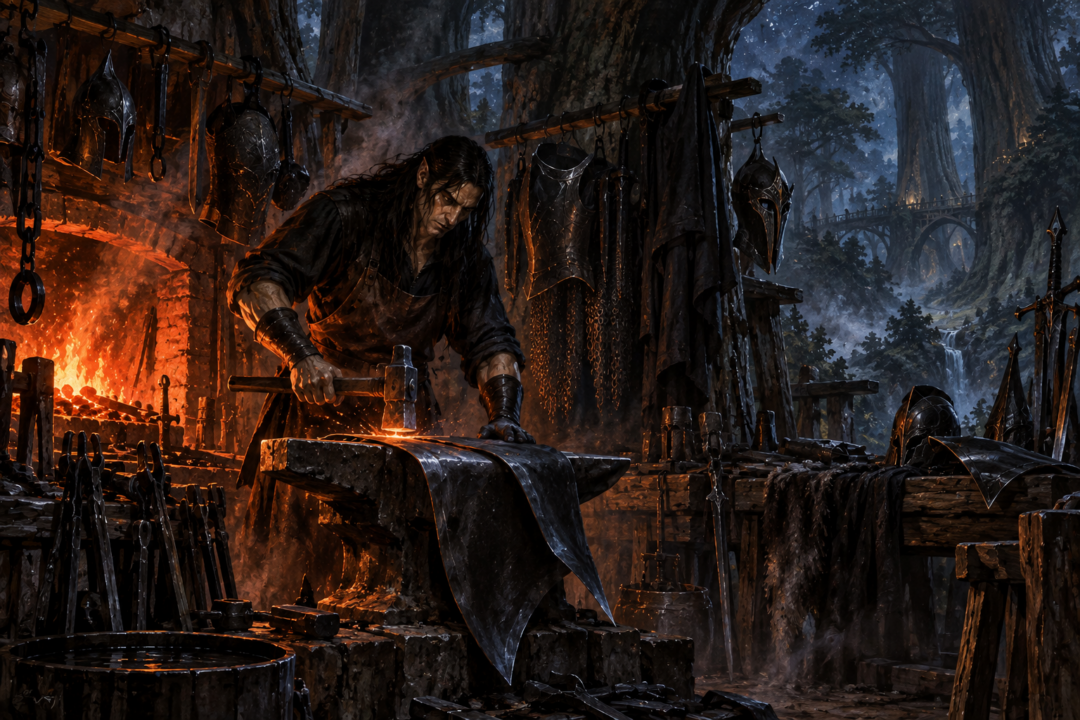
Eöl Does Not Simply Hate Everyone Outside His Own People
Eöl is introduced as an Elf profoundly uncomfortable with the political and cultural world developing around him.
He is of the kin of Thingol and leaves Doriath after the Girdle of Melian is established, settling instead in Nan Elmoth. There he prefers deep shadow, night, twilight, and the memory of Beleriand before the rising of the Sun.
His attitude toward the returning Noldor is explicitly hostile. He shuns them and holds them responsible for Morgoth's return to trouble the peace of Beleriand.
That belief is not a complete history of Morgoth's actions. Morgoth had already corrupted Middle-earth long before the Noldor returned. But Eöl's perspective reflects something psychologically important: the arrival of the exiles is associated in his mind with upheaval.
The Noldor arrive from the West bearing enormous political and military consequences. They establish realms, wage war against Morgoth, and bring with them the unresolved guilt of the Kinslaying at Alqualondë.
Eöl therefore does not merely see skilled Elves from another branch of the Eldar.
He sees newcomers whose arrival has transformed Beleriand.
The Dwarves do not carry that same meaning for him.
The Dwarves Were Already Part of Beleriand's Older World
This distinction matters enormously.
The Dwarves of Nogrod and Belegost had dealings with the Sindar long before the return of the Noldor. Their relationship with the Elves was never uniformly warm—the friendship between the Eldar and Naugrim is described as cool—but the two peoples nevertheless exchanged knowledge, goods, and services.
Dwarven craftsmen had worked for Thingol. They helped create Menegroth, and commerce ran between the Blue Mountains and the Elven lands.
Eöl's relationship with them therefore does not require him to accept the political transformation represented by the Noldorin return.
Indeed, the geography makes their friendship almost natural. One of the Dwarven roads through East Beleriand passed near Nan Elmoth. Eöl met the Naugrim there, and their conversations gradually became friendship.
The contrast is striking.
The Noldor arrive as powerful princes claiming territories and founding kingdoms.
The Dwarves encountered by Eöl are travellers, craftsmen, merchants, and inhabitants of ancient cities beyond Beleriand's eastern frontier.
Nothing in the text suggests that Eöl regarded Nogrod or Belegost as competing claims upon his own homeland.
Craft Gives Eöl and the Dwarves a Common Language
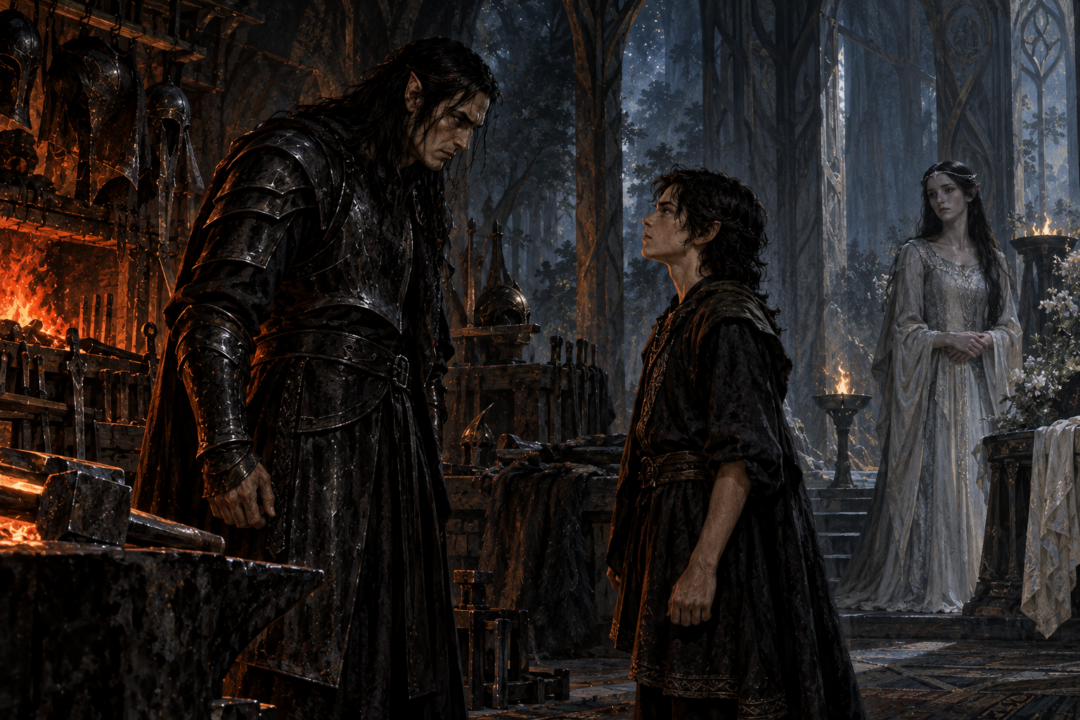
There is another reason the relationship works: Eöl and the Dwarves understand one another through making things.
Eöl is one of the great smiths of the First Age.
His visits to Nogrod and Belegost are particularly important because he learns much of metalwork there. This is an unusual degree of intimacy between an Elf and the Dwarves. Elsewhere, we are told that few of the Eldar went to Nogrod and Belegost, with Eöl and later Maeglin being notable exceptions.
The result can be seen in Eöl's own work.
He devises galvorn, a black metal described as possessing the hardness of Dwarven steel while remaining thin and supple. From it he makes armour that he wears when travelling abroad.
He also forges Anglachel and Anguirel from iron that fell from heaven. Anglachel eventually passes through Thingol's possession to Beleg and then Túrin, becoming one of the most ominous weapons in the legendarium.
The texts do not say that the Dwarves taught Eöl how to make those particular swords or invented galvorn for him. What they establish is that Eöl learned much metalcraft from them before achieving extraordinary skill of his own.
Their relationship is therefore not simply commercial.
It is intellectual and creative.
For someone as secretive and self-contained as Eöl, shared craft appears capable of crossing boundaries that politics cannot.
His Hatred of the Noldor Is Specifically Historical
Eöl's later words to Maeglin reveal the deeper structure of his prejudice.
When Maeglin becomes fascinated by stories of the Noldor and wishes to seek his mother's relatives, Eöl forbids it. He identifies himself and his son with the Teleri and condemns the Noldor as those responsible for slaying their kin and usurping their homes.
That accusation points directly toward the Kinslaying and the wider resentment surrounding the return of the exiles.
This is why describing Eöl merely as xenophobic misses something important.
He certainly possesses an intensely possessive and authoritarian personality, especially within his own household. But his hostility toward the Noldor has named causes.
The Dwarves did not kill Teleri at Alqualondë.
They did not cross the Sea as exiles.
They did not establish Noldorin kingdoms across Beleriand after arriving from Aman.
From Eöl's perspective, friendship with Dwarves therefore does not contradict hostility toward the Noldor. The two peoples occupy completely different places in his understanding of history.
Whether Eöl's judgment is fair is another question.
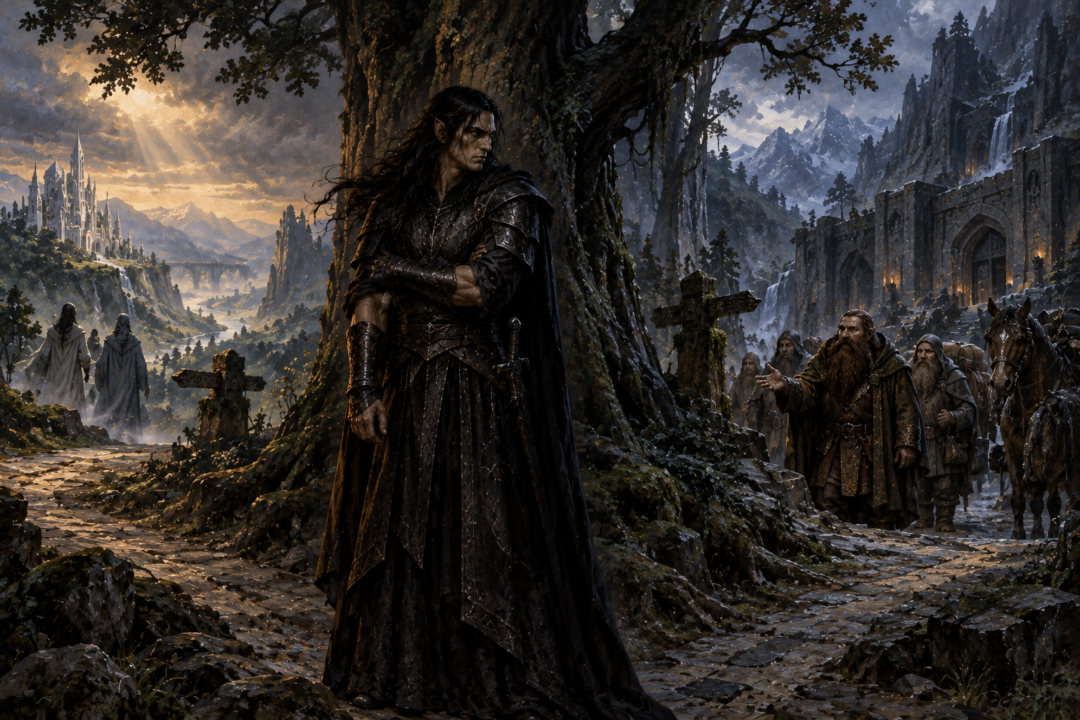
The Irony Is That the Dwarves Do Not Share His Hatred
Here the contradiction becomes more revealing.
Eöl may distinguish sharply between Dwarves and Noldor, but the Dwarves themselves are not bound by his grievance.
The Dwarves of Belegost, in particular, later form important relationships with the Noldor. Azaghâl, Lord of Belegost, is connected with Maedhros, and the Dwarves of Belegost fight in the Union of Maedhros during the Nirnaeth Arnoediad. Their resistance to Glaurung becomes one of the great feats of that disastrous battle.
So Eöl's Dwarven friendships cannot be interpreted as part of some broad Dwarf-and-Sindar political front against the Noldor.
No such alliance is described.
The Dwarves pursue their own relationships according to circumstance, trade, loyalty, and advantage.
That makes Eöl's position more personal than ideological in any organized sense. He can value Dwarven craftsmanship while the very people he respects can cooperate with Noldorin princes he despises.
Middle-earth's peoples are not political blocks.
Individual loyalties cross cultural boundaries constantly.
Maeglin Exposes the Limits of Eöl's Worldview
The greatest challenge to Eöl's carefully divided world comes from his own son.
Maeglin is the child of Eöl and Aredhel, sister of Turgon.
He therefore embodies precisely the union Eöl's rhetoric tries to deny: Telerin and Noldorin ancestry exist in the same person.
Eöl wants his son to identify exclusively with his father's house. But Maeglin becomes increasingly interested in the Noldor, particularly through Aredhel's accounts of her people and their deeds.
At the same time, Maeglin shares Eöl's connection with the Dwarves. Father and son travel together to the cities of the Blue Mountains, and Maeglin learns much from those journeys.
The son therefore inherits both sides of Eöl's life: the craft-world connected with the Dwarves and a blood relationship with the Noldor.
Eöl can maintain his distinctions only by imposing them.
Eventually Aredhel and Maeglin flee Nan Elmoth while Eöl is away visiting the Dwarves.
That detail carries a bitter irony.
The very relationship that demonstrates Eöl's capacity for friendship beyond his own people creates the absence during which his family escapes the restrictions he has placed upon them.
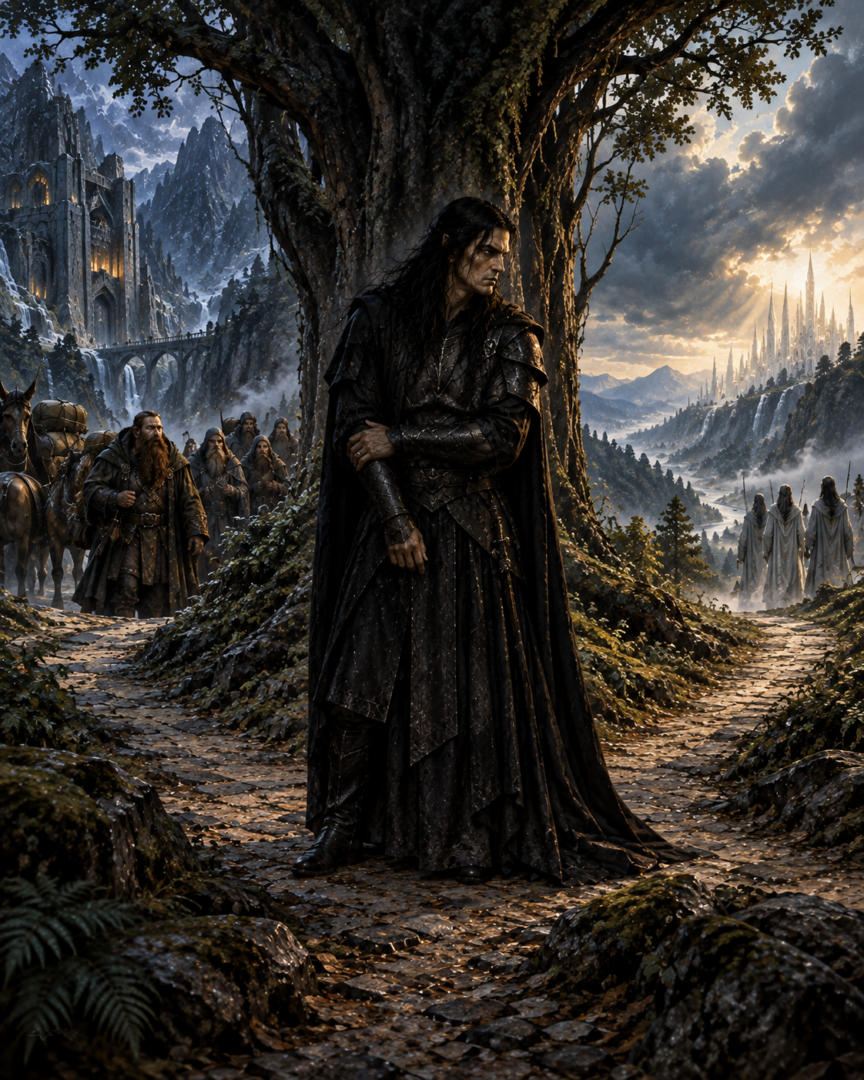
Eöl's Real Boundary Is Not Race but Grievance
Eöl's friendship with the Dwarves reveals something essential about him.
He is capable of admiration across cultural boundaries.
He can exchange knowledge. He can become a guest in foreign halls. He can learn from craftsmen who are not Elves at all.
What he cannot do is relinquish the grievances around which he has constructed his understanding of the Noldor.
That distinction makes him more complicated than a simple Elf who hates outsiders.
His world is divided according to memory.
The Dwarves belong to an older pattern of Beleriand: difficult neighbours perhaps, but useful partners, skilled craftsmen, and eventually friends. The Noldor represent disruption, remembered bloodshed, territorial change, and a history Eöl refuses to forgive.
And that refusal eventually reaches into his own family.
His son has Noldorin blood whether Eöl approves of it or not. His wife belongs to the very people he condemns. The boundaries he attempts to enforce cannot survive the reality of his household.
The tragedy is therefore not that Eöl possesses no capacity for friendship.
It is that the text proves he does.
He can cross the ancient divide between Elf and Dwarf when conversation, craftsmanship, and mutual benefit give him reason to do so. Yet toward the Noldor he allows historical hatred to harden into an absolute principle.
That is why his Dwarven friendships are not an inconsistency in his story.
They expose the selectiveness of his hatred—and show just how deliberately he chooses to preserve it.
Sources & Notes
- Tolkien Gateway — Eöl: his outlook, friendship with the Dwarves, visits to Nogrod and Belegost, and metalcraft. https://tolkiengateway.net/wiki/E%C3%B6l
- The Encyclopedia of Arda — Eöl: his smithcraft and rare friendship with the Dwarves of Nogrod and Belegost. https://www.encyclopedia-of-arda.com/e/eol.php
- Tolkien Gateway — Dwarves of the Blue Mountains: their cities, crafts, and long dealings with the Elves of Beleriand. https://tolkiengateway.net/wiki/Dwarves_of_the_Blue_Mountains
Sources on Eöl’s hostility to the Noldor, his friendship with the Dwarves of the Blue Mountains, and the craft traditions connecting him with Nogrod and Belegost.