Morgoth’s Iron Crown Became His Collar — and the Meaning Is Brutal
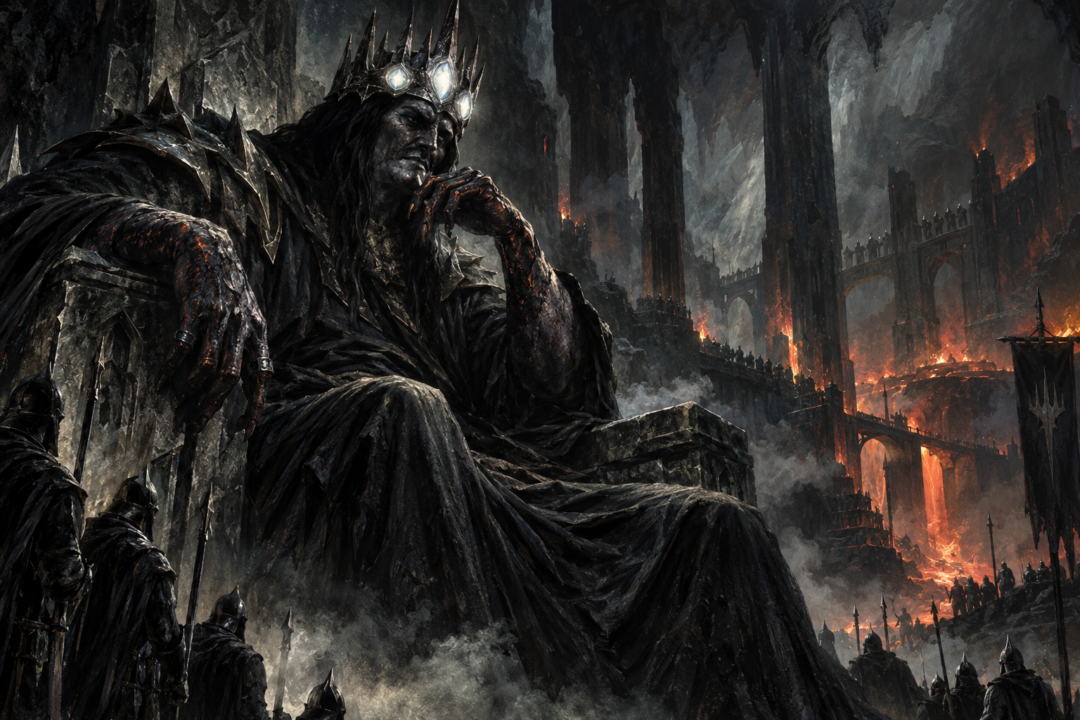
At the beginning of the wars for the Silmarils, Morgoth sat beneath Thangorodrim wearing an Iron Crown. At the end, that same iron was around his neck.
The change occupies only a brief moment in the account of the War of Wrath, yet it is one of the most striking reversals in the history of Middle-earth. Morgoth had forged the crown after stealing the Silmarils and returning to Angband. He proclaimed himself King of the World and placed the three stolen jewels in his crown as the visible sign of that claim.
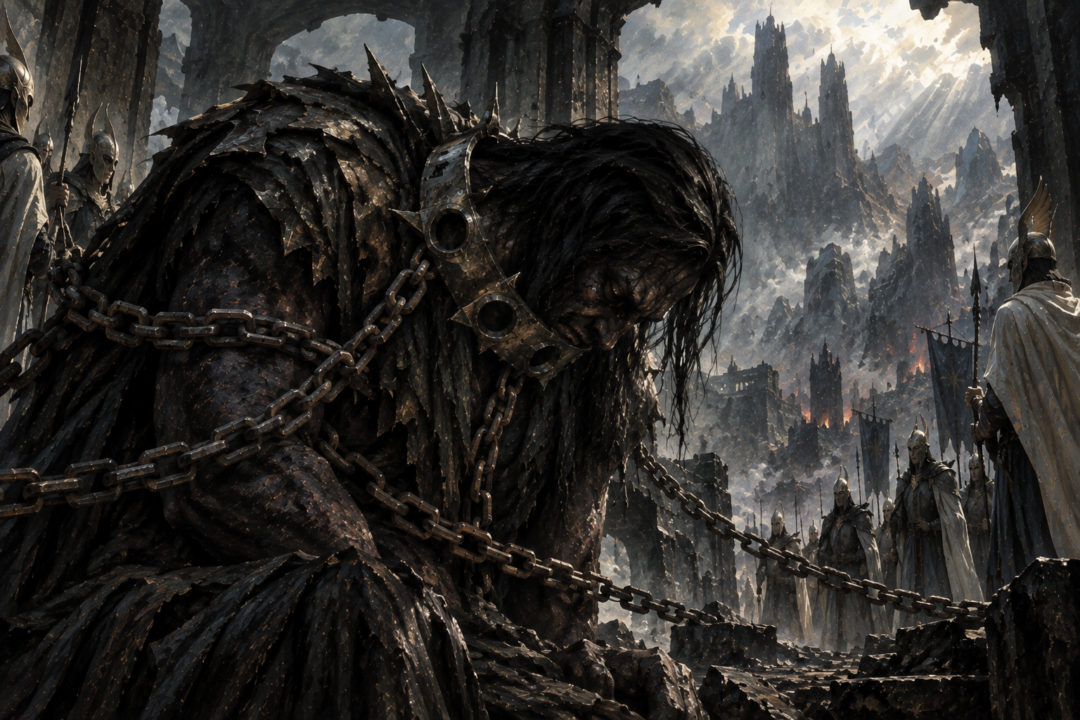
Centuries later, when Angband finally fell, the crown was taken from him. The two Silmarils still set within it were removed. Then the crown itself was beaten into a collar for Morgoth's neck.
The object that had proclaimed his kingship became an instrument of his humiliation.
That transformation matters because Morgoth's Iron Crown was never merely decoration. From the moment he forged it, it represented what he wanted the world to believe about him—and what he ultimately could never possess.
The Crown Was a Claim to the Entire World
After the destruction of the Two Trees and the theft of the Silmarils, Morgoth escaped from Aman and returned to his ancient fortress of Angband.
There he rebuilt his power.
Above Angband rose Thangorodrim, while beneath it Morgoth gathered his servants and prepared for the wars that would devastate Beleriand. In this setting he forged his great crown of iron and called himself King of the World.
The connection is explicit: the crown was a token of his claimed kingship.
But Morgoth did something even more provocative. He set the three Silmarils into it.
These were not his creations. Fëanor had made them, and Varda had hallowed them. Morgoth possessed them only because he had stolen them after the Darkening of Valinor.
His supreme emblem of sovereignty was therefore decorated with something he could seize but could neither create nor truly master.
That contradiction followed him throughout the First Age.
Morgoth’s Greatest Treasures Hurt Him
The Silmarils did not submit peacefully to Morgoth.
Because of their hallowing, his touch burned him. His hands became blackened, and the pain remained. Yet he placed the jewels in the Iron Crown anyway.
The crown itself became another burden. The text says Morgoth never removed it even though its weight became a deadly weariness.
That detail changes the image completely.
From a distance, the Dark Lord appears enthroned beneath the mountains with the greatest jewels in Arda blazing above his face. Yet the same symbols that magnify his apparent majesty also cause him pain and exhaustion.
He refuses to surrender them.
This is one of the clearest patterns surrounding Morgoth's relationship with possession. He wants things not merely to admire them but to claim them, control them, and deny them to others. The Silmarils become especially revealing because possession brings him suffering rather than peace.
Still he keeps them.
The crown therefore becomes both a symbol of domination and a burden voluntarily endured for the sake of domination.
Beren and Lúthien Already Proved the Crown Could Fall
Long before the War of Wrath, Morgoth suffered a smaller but astonishing humiliation.
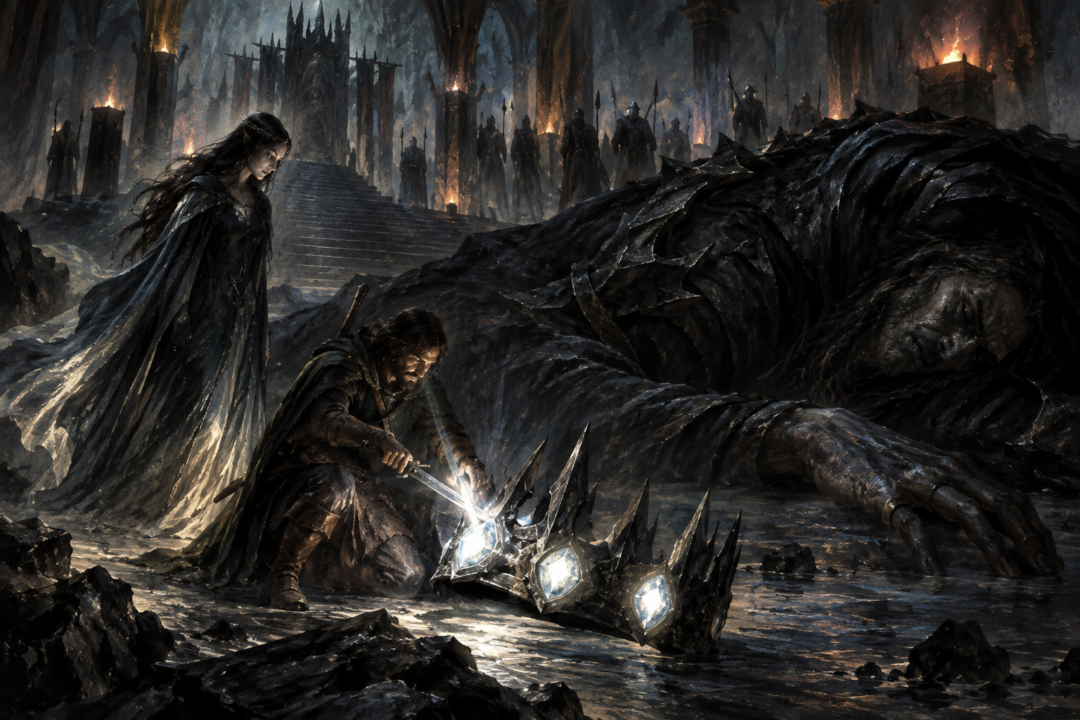
Beren and Lúthien entered Angband during their quest for a Silmaril. Before Morgoth's throne, Lúthien caused him to fall into enchanted sleep.
When Morgoth collapsed, his Iron Crown fell from his head.
For perhaps the most terrifying ruler in Middle-earth, this is an extraordinary image: the self-proclaimed King of the World lying helpless while two enemies approach the crown containing his greatest treasures.
Beren used Angrist to cut a Silmaril from it.
He then attempted to take another, but the knife broke, and the attempt ended. One jewel nevertheless escaped Morgoth's possession.
The significance is difficult to miss, although the text does not explicitly present the episode as a prophecy of Morgoth's later fate. The crown that seemed to proclaim unchallengeable dominion had already been cast to the ground once.
Its wearer could be overcome.
Its jewels could be taken.
And the authority it represented was not absolute.
The War of Wrath Destroyed More Than Morgoth’s Armies
Morgoth remained overwhelmingly powerful in Middle-earth after Beren and Lúthien escaped. Kingdom after kingdom fell during the disasters of the First Age, until the surviving enemies of Angband seemed incapable of overthrowing him.
The decisive change came through Eärendil.
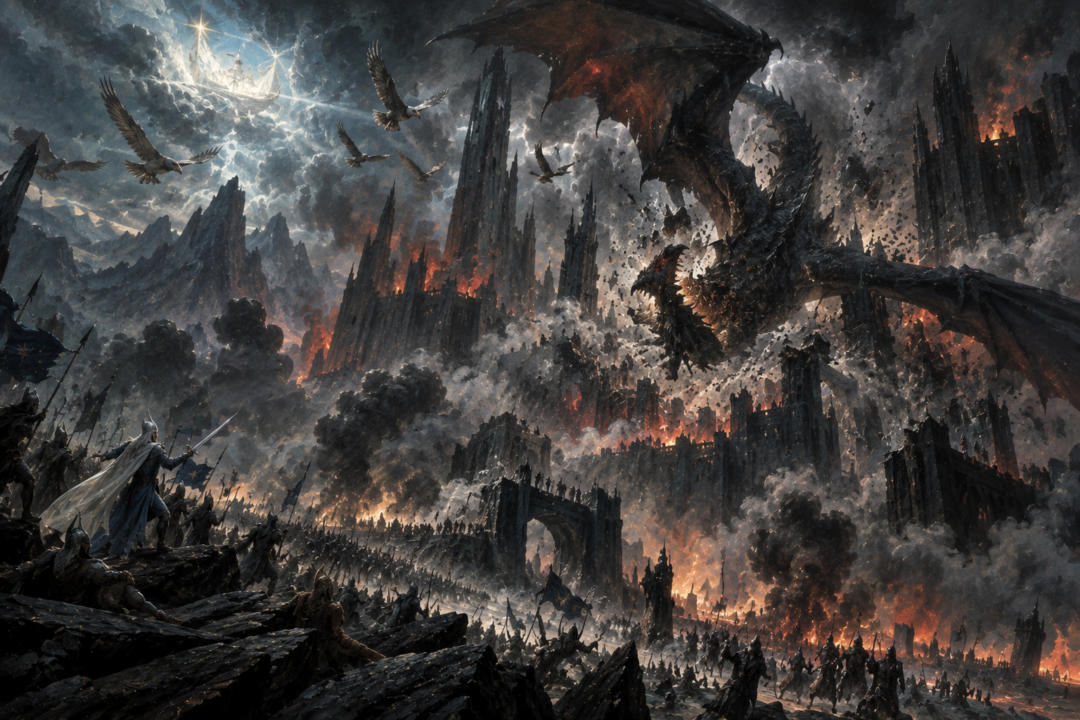
His voyage eventually brought the plea of Elves and Men before the Powers of the West, and the Host of the West came against Morgoth. The resulting War of Wrath was catastrophic on a scale unmatched by the earlier wars of Beleriand.
Morgoth unleashed his forces, and finally the winged dragons appeared. Eärendil fought among the Eagles against them and slew Ancalagon the Black, whose fall broke the towers of Thangorodrim.
Angband was overwhelmed.
But Morgoth himself did not emerge for a final heroic confrontation.
Instead, when defeat reached him, he retreated into the deepest places of his mines and sought peace and pardon.
The contrast with his title could hardly be greater.
The King of the World ended his reign hiding beneath it.
The Crown Became a Collar
When Morgoth was finally taken, the reversal became physical.
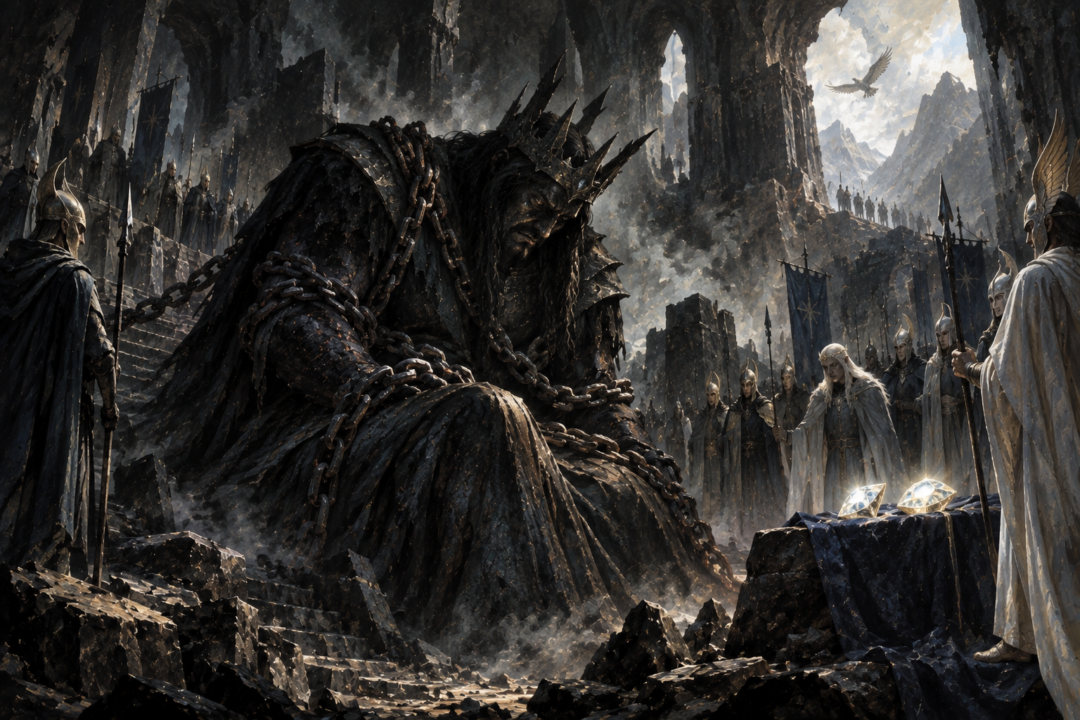
He was cast down and bound with Angainor, the chain that had restrained him in an earlier age. His Iron Crown was beaten into a collar for his neck, and his head was bowed upon his knees.
The two remaining Silmarils were removed.
It is worth keeping the details precise. The text explicitly states that the crown was beaten into a collar. It does not provide an extended explanation of the symbolism or describe the exact process by which the iron was reshaped.
But the juxtaposition is powerful enough without embellishment.
A crown is worn above the head.
A collar encloses the neck.
One signifies the wearer's claim to rule. The other, in this context, marks captivity.
Morgoth had created the object to announce that he stood above the world. His conquerors transformed that same object into part of the spectacle of his subjection.
Nothing new needed to be forged for the purpose.
His own emblem was enough.
The Silmarils Were Taken From Him at Last
There is another important part of the scene.
Before Morgoth was removed from the world, the two Silmarils remaining in his crown were taken from him and entrusted to Eönwë.
For most of the First Age, Morgoth's possession of the jewels had driven an enormous portion of the tragedy of Beleriand. Fëanor and his sons had sworn their terrible oath because of them. Beren had entered Angband for one. Kingdoms and families had been drawn into the consequences surrounding them.
Yet when Morgoth finally lost them, the jewels themselves remained unstained.
That is a striking contrast.
Morgoth could steal the Silmarils. He could lock them in iron. He could carry them through centuries of war. He could make them part of his royal image.
He could not make them his in any deeper moral sense.
Indeed, their holiness caused him continual pain.
His relationship with the Silmarils becomes a miniature version of his relationship with Arda: possession is not the same thing as rightful mastery.
Morgoth Had Been Chained Before
The use of Angainor adds another layer to his defeat.
Long before the wars of Beleriand, after the Valar assaulted Utumno, Morgoth had already been captured and bound with Angainor. He was taken to Valinor as a prisoner and remained confined for long ages before eventually being released.
At the end of the First Age, the chain returned.
The repetition matters even without assigning it an explicit symbolic meaning beyond what the narrative states. Morgoth had spent ages presenting himself as an unconquerable sovereign, yet his final capture returned him to a condition he had known before: bound and defeated by the Powers he had defied.
Only this time the ending was far more severe.
After his defeat, Morgoth was thrust through the Door of Night beyond the Walls of the World.
His kingdom in Middle-earth was finished.
The Cruel Irony of Morgoth’s Crown
The Iron Crown has one of the most complete visual arcs of any object in the First Age.
It begins as an announcement.
Morgoth forges it after his return to Angband, names himself King of the World, and fixes the stolen Silmarils upon it. He wears it even though the jewels burn him and the crown becomes an exhausting weight.
Then its apparent invincibility begins to fracture.
It falls from his head before Beren and Lúthien. One Silmaril is cut from it.
Finally Angband itself is broken. The last two Silmarils are removed, Morgoth is bound, and the crown ceases even to be a crown.
Iron remains.
Kingship does not.
The text never pauses to deliver a long explanation of what readers should make of this transformation, so interpretations should remain interpretations. Yet one reading is especially difficult to avoid: Morgoth's chosen symbol of mastery becomes evidence of the limits of that mastery.
He had declared himself King of the World.
At the end of his reign, the world was not his.
The jewels were not his.
The crown was not even a crown anymore.
And the iron he had once placed above his head was fastened around his neck.
Sources & Notes
- Tolkien Gateway — Iron Crown https://tolkiengateway.net/wiki/Iron_Crown
- Tolkien Gateway — Morgoth https://tolkiengateway.net/wiki/Morgoth
- Tolkien Gateway — War of Wrath https://tolkiengateway.net/wiki/War_of_Wrath
These references document Morgoth’s Iron Crown and Silmarils, his defeat in the War of Wrath, and the crown being beaten into a collar. The article’s reading of that reversal as symbolic humiliation is interpretation.