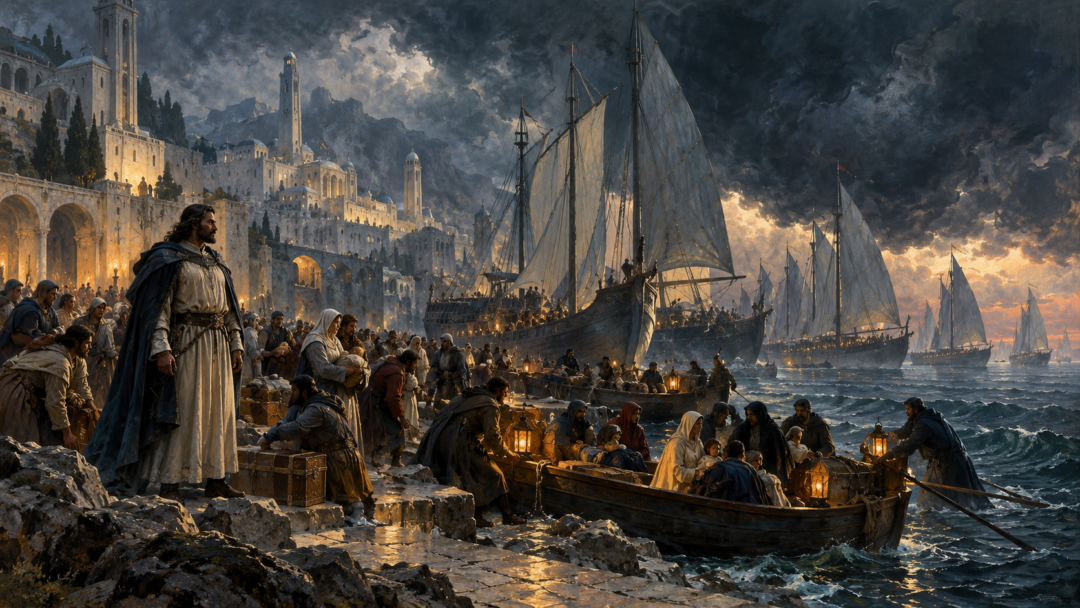
When Númenor fell, nine ships escaped the ruin. They carried Elendil, his sons Isildur and Anárion, their families and followers, the Seven Seeing-stones, precious heirlooms, stores of goods, and one living scion of the White Tree.
It is tempting to picture those vessels as a carefully designed survival fleet in which every treasure, crop seed, and bloodline was deliberately duplicated against disaster. The texts do not go that far. They never say that the Faithful created a formal system for distributing “seed-stock,” nor do they give us inventories for individual ships.
What they do describe is more interesting.
The Faithful did not merely flee with valuables. They preserved different kinds of continuity: people who could found new households, objects that carried memory and authority, lore that could be taught again, instruments that could bind distant realms together, and one extraordinary living tree whose ancestry reached back toward the light of the Elder Days.
The nine ships were therefore more than lifeboats. Without claiming a plan more detailed than the texts provide, they can be understood as vessels carrying the materials from which a broken civilization might begin again.
Amandil Prepared for an End, Not an Ordinary Migration
The evacuation began before the catastrophe.
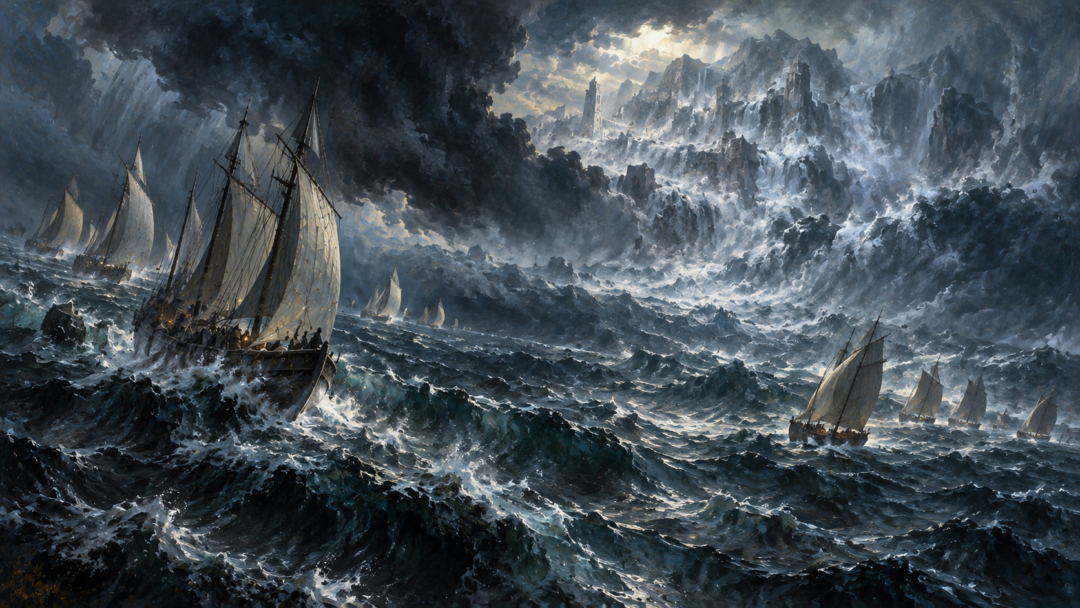
As Ar-Pharazôn prepared his great armament against Aman, Amandil recognized that Númenor had reached a point from which it might not return. Before sailing west himself in a desperate attempt to seek mercy, he warned Elendil to remain ready.
Elendil obeyed.
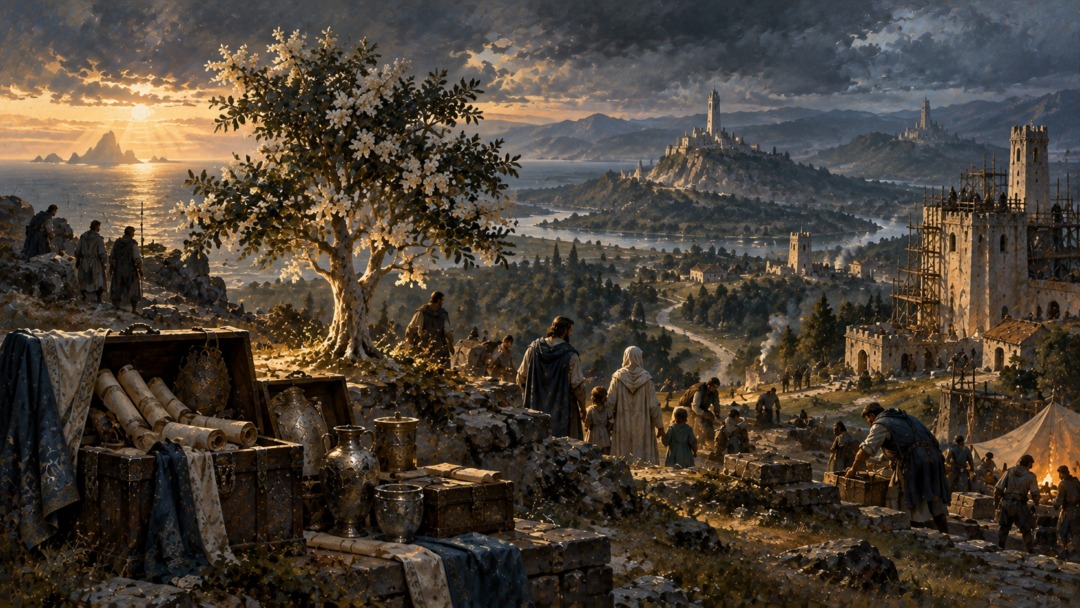
His ships waited off Númenor’s eastern coast. The Faithful placed aboard them their wives and children, heirlooms, and a great store of goods. The account in the “Akallabêth” becomes unusually specific about what some of those goods represented: vessels and jewels, works created during Númenor’s wiser days, and scrolls of lore.
That distinction matters.
A refugee carrying jewels preserves wealth. A refugee carrying written lore preserves knowledge.
The Faithful were taking pieces of a civilization with them.
Yet their preparations were limited. There were only nine ships associated with Elendil and his sons. They could not rescue Númenor. They could preserve only a remnant of it.
That constraint helps explain the character of what survived: not everything, but enough to establish continuity.
The Ships Were Already Divided by Elendil’s House
The surviving fleet did not remain together.
In the received account, Elendil reached the north with four ships. Isildur had three, while Anárion had two; the latter five were driven toward the southern coasts and eventually the region of the Anduin.
The storm of the Downfall determined their separate landfalls, so we should be careful about treating the later geography as a perfectly executed evacuation plan. The texts do not say that Elendil deliberately intended to establish one kingdom in Eriador and another beside the Anduin before Númenor sank.
Nevertheless, the fleet already possessed something essential: multiple leaders within the same dynastic house.
Elendil was not carrying the future of the Faithful alone. His adult sons commanded their own portions of the surviving people. When catastrophe separated father from sons, this did not leave leaderless survivors scattered across Middle-earth.
Instead, two political centers emerged.
Elendil established the northern realm of Arnor. Isildur and Anárion founded Gondor in the south, ruling beneath their father’s high kingship.
The physical separation of the ships thus became the foundation of the Realms in Exile.
The Palantíri Show the Principle Most Clearly
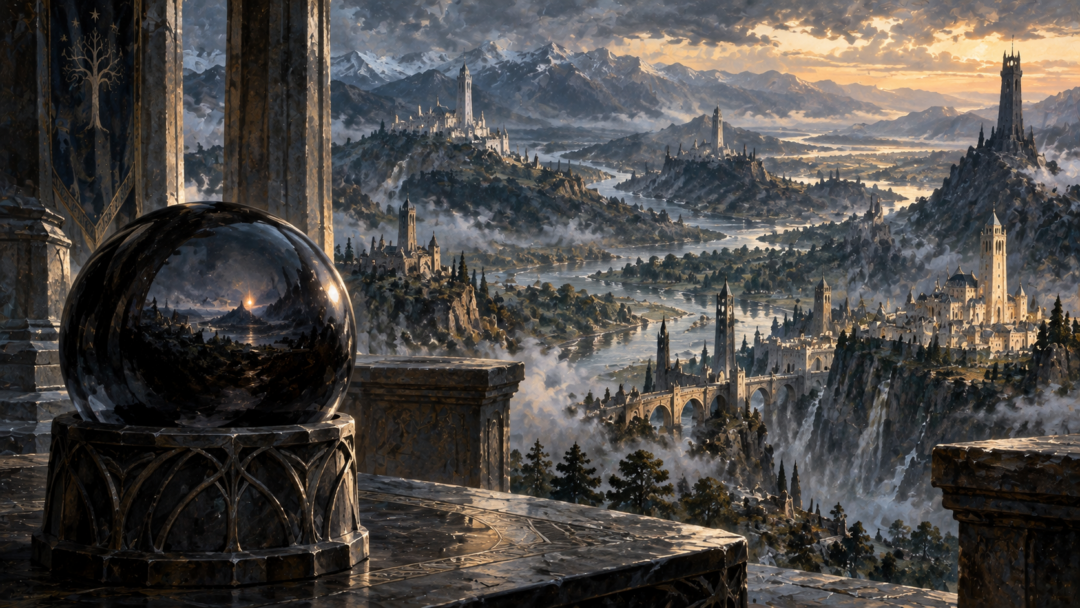
If the ships preserved people, the Seven Stones preserved connection.
The palantíri had come to the Faithful from the Eldar, and they escaped the Downfall with Elendil’s people. After the establishment of the Realms in Exile, they were distributed rather than gathered into one royal treasury.
Three belonged to the northern realm and four to the southern.
Elendil’s three were placed at Annúminas, Amon Sûl, and in the Tower Hills. The southern Stones were associated with Osgiliath, Minas Ithil, Minas Anor, and Orthanc.
This distribution had practical consequences. The Stones could reveal distant things, and kindred Stones could communicate with one another. Properly used, they gave the Dúnedain an extraordinary ability to watch, communicate, and coordinate across great distances.
Here the logic of dispersal is explicit in the geography even if Tolkien does not present it as a modern doctrine of redundancy.
A single hoard would have been magnificent.
Seven separated Stones became infrastructure.
The Faithful had escaped a destroyed island. Their new civilization would exist across enormous distances. The palantíri helped turn separated strongholds into connected realms.
The White Tree Was Different
The most precious living thing aboard the fleet was not divided at all.
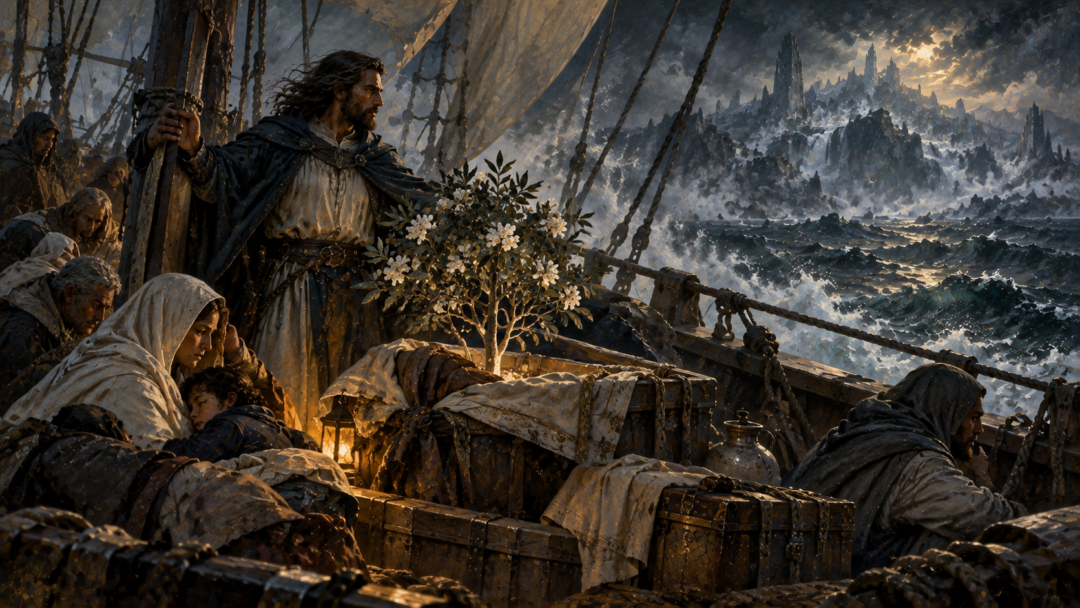
Isildur’s ship guarded the young tree descended from Nimloth.
Its survival had already required sacrifice. Before Númenor’s destruction, when Sauron sought the destruction of Nimloth, Isildur entered the guarded court in disguise and stole a fruit from the Tree. He was grievously wounded during his escape, but the fruit survived and produced a new shoot.
That young tree went aboard Isildur’s ship.
This is the strongest reason to be cautious with the phrase “seed-stock.” The canonical narrative gives us a specific preserved plant lineage, but it does not say that agricultural seeds from Númenor were systematically divided among the nine ships. The Faithful carried a “great store of goods,” which could naturally have included practical supplies, but anything more specific would be conjecture.
Nimloth’s scion, however, is explicit.
And it represents something greater than food production.
Its ancestry ran backward through Nimloth to the White Tree associated with Tol Eressëa and ultimately, through that line of likeness and descent, toward Telperion. The young tree therefore carried a living connection with the friendship between Númenor and the Eldar that Sauron had tried to destroy.
Jewels could commemorate the past.
The Tree could grow.
Why Isildur’s Tree Matters More Than a Relic
After reaching Middle-earth, Isildur planted the White Tree at Minas Ithil.
Then disaster struck again.
Sauron attacked Gondor, captured Minas Ithil, and destroyed the Tree. Isildur escaped, taking another seedling with him. After the War of the Last Alliance and the death of Anárion, Isildur eventually planted that successor at Minas Anor in memory of his brother.
The pattern is striking.
The line of the Tree survives not because one ancient object is indestructible, but because life can produce a successor before destruction comes.
That separates the White Tree from nearly every other Númenórean treasure.
A palantír can be lost.
A manuscript can burn.
A sword can break.
A living lineage can be renewed—provided someone preserves it in time.
This is one of the deepest themes hidden inside the cargo of the Faithful. Survival is not the same thing as keeping every object unchanged. Sometimes continuity depends upon transmitting something into a new form.
Heirlooms Preserved Legitimacy and Memory
The Faithful also carried heirlooms, though the texts do not provide a complete ship-by-ship manifest.
That silence is important. We should not assign particular unnamed treasures to particular vessels merely because such an arrangement seems sensible.
What can safely be said is that the Exiles brought significant Númenórean treasures into Middle-earth, and these objects became part of the identity of the kingdoms they founded.
The Seven Stones are the clearest example. The Stone of Erech was also remembered as having been brought from Númenor by Isildur. Other surviving objects and traditions connected the Dúnedain with the world they had lost.
Such relics mattered because Elendil and his sons were not arriving as conquerors who wished to forget their past. Their kingdoms were explicitly realms in exile.
Their authority rested partly upon continuity.
They were descendants of Elros. They preserved friendship with the Eldar. They carried the lore and treasures of Westernesse. Their realm was new, but its identity deliberately reached backward.
The Most Important Cargo Was Not Treasure
The phrase “heirlooms and great store of goods” can make the escape sound like the evacuation of a treasury.
But the first people mentioned among the Faithful’s preparations are wives and children.
That changes the meaning of everything else.
A collection of palantíri without a surviving people would have been a museum of a dead civilization. Scrolls without readers would eventually become undeciphered marks. Royal heirlooms without descendants or communities would lose much of the authority attached to them.
The Faithful carried families because continuity ultimately lives in people.
The heirs mattered for the same reason.
Elendil survived with Isildur and Anárion, and the separation of their ships did not sever their political identity. When they established Arnor and Gondor, the realms were distinct but related.
The disaster had scattered them geographically without completely destroying their continuity.
That is exactly what Númenor itself had failed to understand at the end.
Númenor Tried to Defeat Death; the Faithful Accepted Succession
The final Kings of Númenor became consumed by mortality.
Under Sauron’s influence, Ar-Pharazôn attempted the ultimate act of refusal: he sailed against Aman seeking what Men could not possess by force.
The Faithful escaped through almost the opposite principle.
They did not make Númenor immortal.
They allowed something of it to pass onward.
A father entrusted authority to sons. Lore was placed into scrolls so another generation could read it. The Seven Stones were distributed through new kingdoms. A fruit became a seedling; when that tree was destroyed, another seedling continued its line.
This does not mean the evacuation was planned as an elaborate philosophical statement. The texts never say so.
But the contrast is difficult to miss.
Ar-Pharazôn tried to preserve himself.
The Faithful preserved inheritance.
What the Nine Ships Really Saved
Númenor still died.
Its cities, temples, harbours, fields, tombs, roads, and countless works disappeared beneath the Sea. Most of its people perished. Much of its accumulated beauty and knowledge could never be recovered.
The nine ships did not undo that loss.
What they carried was smaller and more durable: families, memory, knowledge, authority, tools of communication, and a living emblem of an older friendship.
Even the later distribution of the palantíri suggests that preservation did not mean locking the past inside a single fortress. The surviving inheritance of Númenor had to be used, planted, taught, divided, and entrusted to others.
That is the stronger lore-grounded meaning behind the idea of ships divided among heirs, relics, and “seed-stock.”
There is no canonical inventory showing sacks of Númenórean seeds carefully distributed across the fleet. There is something subtler.
There are nine ships carrying a remnant.
There are sons separated from their father who nevertheless build related kingdoms.
There are Seven Stones scattered across towers so distant rulers can remain connected.
There are scrolls carrying knowledge that otherwise would have drowned.
And there is one young White Tree aboard Isildur’s ship: not the ancient tree itself, but its descendant.
The Faithful could not save their world.
They saved enough for another one to grow from it.
Sources & Notes
- Tolkien Gateway, “Elendil” — Nine ships and the Faithful’s preserved stones and heirlooms. https://tolkiengateway.net/wiki/Elendil
- Tolkien Gateway, “Isildur” — The division of ships among Elendil and his sons and the White Tree seedling. https://tolkiengateway.net/wiki/Isildur
- Tolkien Gateway, “Faithful” — Amandil’s warning and the Faithful’s preparation to depart. https://tolkiengateway.net/wiki/Faithful
- Tolkien Gateway, “Palantíri” — Seven seeing-stones brought from Númenor. https://tolkiengateway.net/wiki/Palant%C3%ADri
Sources document Elendil, Isildur, Faithful, Palantíri. Interpretive claims remain distinguished from the primary narrative.