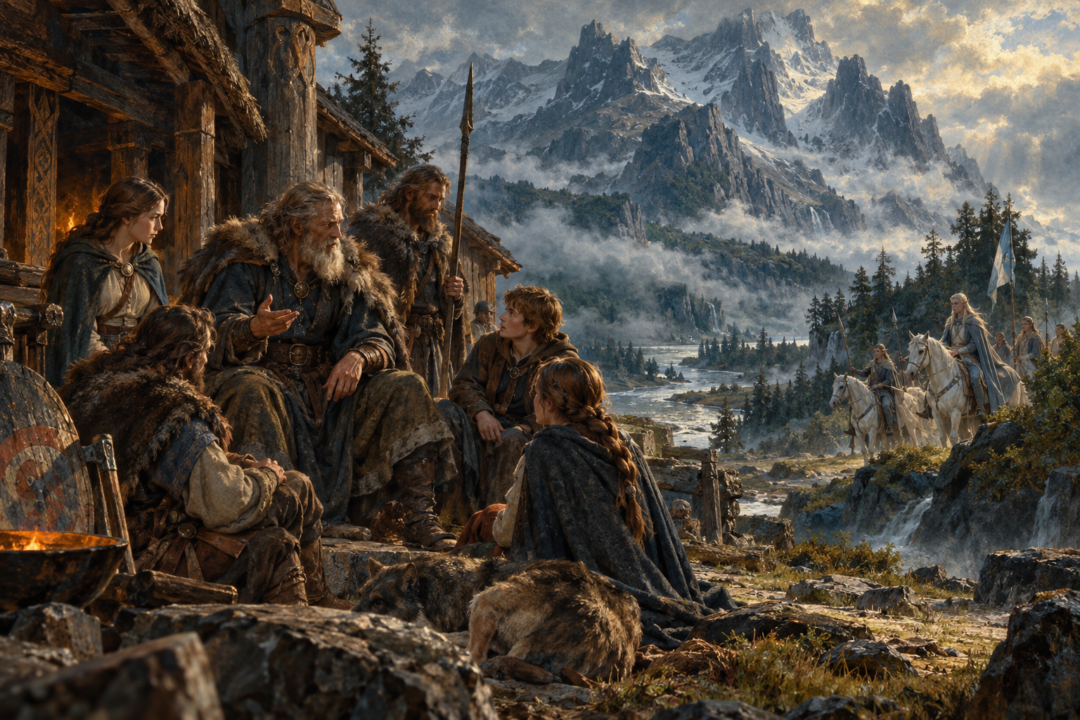
When the Men of Númenor spoke Adûnaic, they were using a language whose roots reached back beyond the destruction of Beleriand, beyond the War of Wrath, and into the migrations of mortal Men before their great houses had fully entered the histories of the Eldar.
That ancestry is certain in broad outline. The surviving linguistic trail is not.
The clearest thread leads to the Folk of Hador. Their ancestral speech survived in the First Age even while Sindarin became enormously important among the Edain, and from that Mannish inheritance came the principal native language of Númenor. Yet attempts to draw a neat family tree—First Age language A becomes transitional language B, which becomes documented Adûnaic C—quickly encounter gaps.
That is precisely what makes Adûnaic's origins so interesting. We know where the road broadly begins and where it eventually leads. Much of the road itself has disappeared.
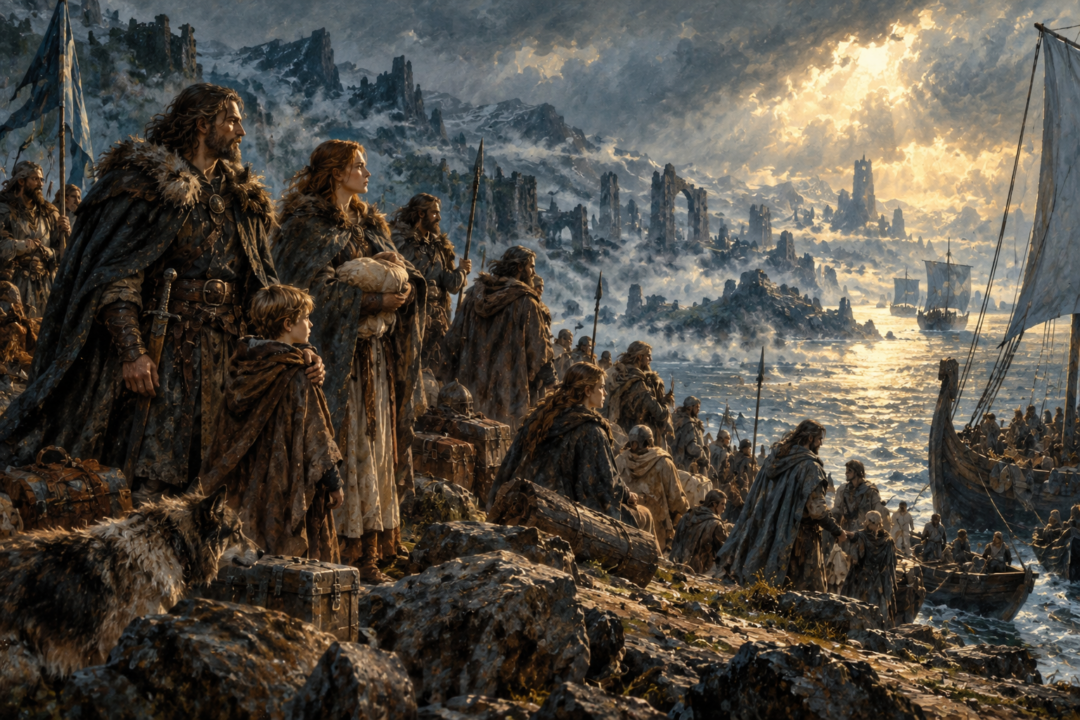
Adûnaic Was Not Created from Nothing in Númenor
Adûnaic is sometimes approached primarily as the distinctive language of the Second Age Númenóreans. In the internal history of Middle-earth, however, its ancestry is older than Númenor.
The crucial statement appears in the traditions concerning the House of Hador. In Dor-lómin, the people retained their own Mannish speech, even amid the cultural influence of the Eldar. The Silmarillion explicitly connects that speech with the later common tongue of Númenor.
Unfinished Tales reinforces the picture. Its linguistic notes distinguish regions of Númenor where Sindarin was especially strong from those where Adûnaic was the ordinary native language. The north-west of the island contained many people of Bëorian descent, whose ancestors had adopted Sindarin early in Beleriand. Elsewhere, the Númenórean Mannish language predominated.
So the foundation is firm: Adûnaic represents continuity from the Mannish linguistic world of the First Age, particularly the language associated with Hador's people.
But "continuity" does not mean that every stage of development is preserved for us.
The Problem with Calling the Missing Language Taliska
The name Taliska often appears in discussions of this ancestry, and it is useful—but it requires caution.
In earlier linguistic conceptions, Taliska was developed as a language associated with the Edain, especially the peoples connected with Bëor and Hador. It could therefore function as an apparent bridge between early Mannish speech and Adûnaic.
The difficulty is that the linguistic history of the Edain did not remain conceptually fixed.
In later writings, particularly the material published in The Peoples of Middle-earth, the relationship is presented differently. The Hadorians are associated with what is described as ancient Adûnaic, while the Bëorians possessed a closely related language. The language of the Folk of Haleth, by contrast, belonged to a different linguistic group.
This matters because it prevents us from treating "Taliska" as though it were an unproblematic, final canonical label for one precisely documented ancestral stage.
It is safer to speak of Hadorian or ancestral Adûnaic when discussing the late conception, while acknowledging that Taliska belongs to an important earlier phase of the linguistic construction.
The uncertainty is not evidence that there was no ancestry. It means the terminology and reconstruction changed.
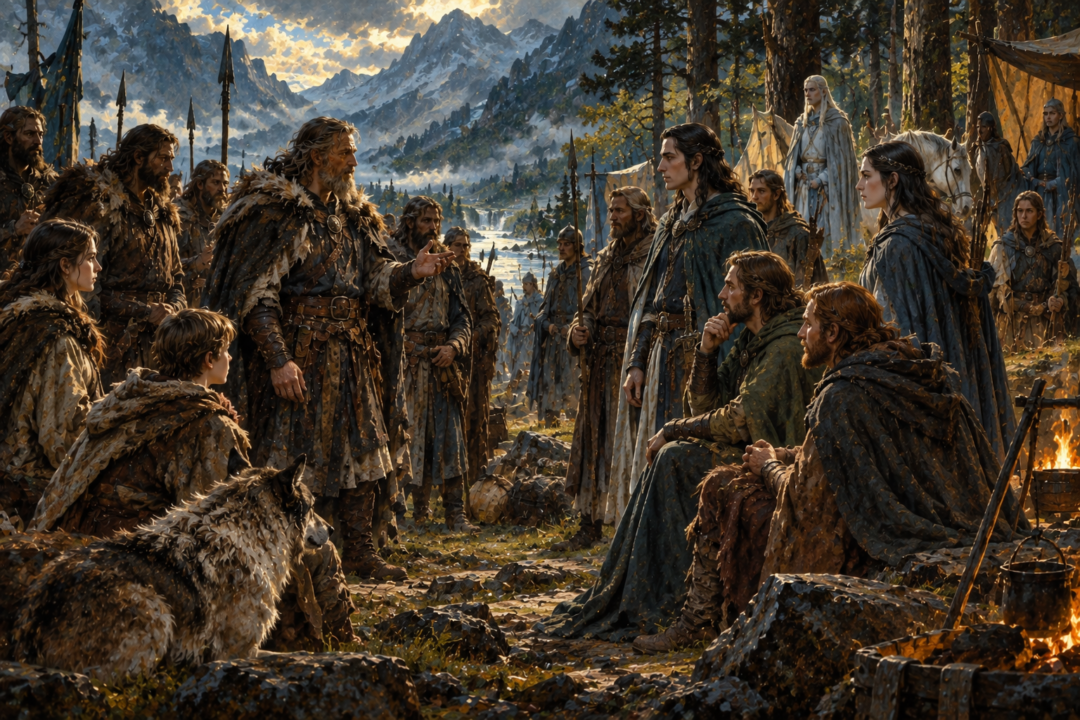
The House of Hador Preserved the Crucial Thread
Among the Three Houses of the Edain, the House of Hador is the central lineage for understanding Adûnaic.
Their people had not simply discarded their native language upon encountering the Eldar. Sindarin became important among the Edain, particularly among their leaders and in dealings with Elves, but Hador's folk retained their own speech.
That survival becomes enormously important after the First Age.
Beleriand was destroyed. The surviving Edain who received Númenor came from communities devastated and displaced by centuries of war. Their new civilization therefore inherited several cultural and linguistic traditions rather than beginning as an untouched continuation of one First Age society.
Yet the Hadorian Mannish element endured strongly enough to provide the basis of Númenor's native Mannish tongue.
That gives us descent without giving us a complete linguistic diary of the descent.
We are not supplied with generations of dated Hadorian inscriptions showing each phonological and grammatical change until recognizable Classical Adûnaic emerges. What survives instead is a collection of statements about relationships, examples of Adûnaic itself, scattered Mannish material, and different stages of linguistic conception.
The family connection is clearer than the path of development.
Bëorian Speech Complicates the Family Tree
The People of Bëor make the story more complicated—and more realistic.
Their ancestral language was related to that of Hador's people. But the Bëorians adopted Sindarin early in Beleriand. By the Númenórean period, Bëorian ancestry was particularly associated with parts of western Númenor where Sindarin remained widespread.
This does not mean that the Bëorians contributed nothing to Númenórean linguistic history. Unfinished Tales preserves evidence for a continuing Bëorian element in the island's population and linguistic geography.
What cannot safely be done is to calculate the exact amount of Bëorian material incorporated into Adûnaic.
There is no surviving canonical dictionary allowing us to label large portions of Adûnaic vocabulary "Hadorian," "Bëorian," and "later Númenórean" with confidence.
The texts give relationships and historical tendencies rather than a complete dataset.
That distinction is essential. Saying that Adûnaic grew from the First Age linguistic inheritance of the Edain, principally the Hadorian branch, is well grounded. Claiming a fully reconstructable fusion of three precisely known Edain languages would go beyond the evidence.
The Halethians Were Not Simply Another Adûnaic Branch
The Folk of Haleth are especially important because they show why the phrase "language of the Edain" can become misleading.
The Three Houses were united historically by alliance with the Eldar and resistance to Morgoth. That does not require their languages to have belonged to one close linguistic family.
In the later conception, the Halethian language was unrelated to the closely connected languages of the Houses of Hador and Bëor.
That separation has consequences extending beyond the First Age. Later Mannish peoples in parts of Middle-earth could preserve linguistic relationships reflecting ancient divisions among Men even when their histories had become geographically and politically remote from Beleriand.
The Edain were therefore a historical alliance and collection of kindreds, not a guarantee of linguistic uniformity.
Adûnaic should not be imagined as the inevitable combined language of all three Houses simply because survivors of the Edain eventually reached Númenor.
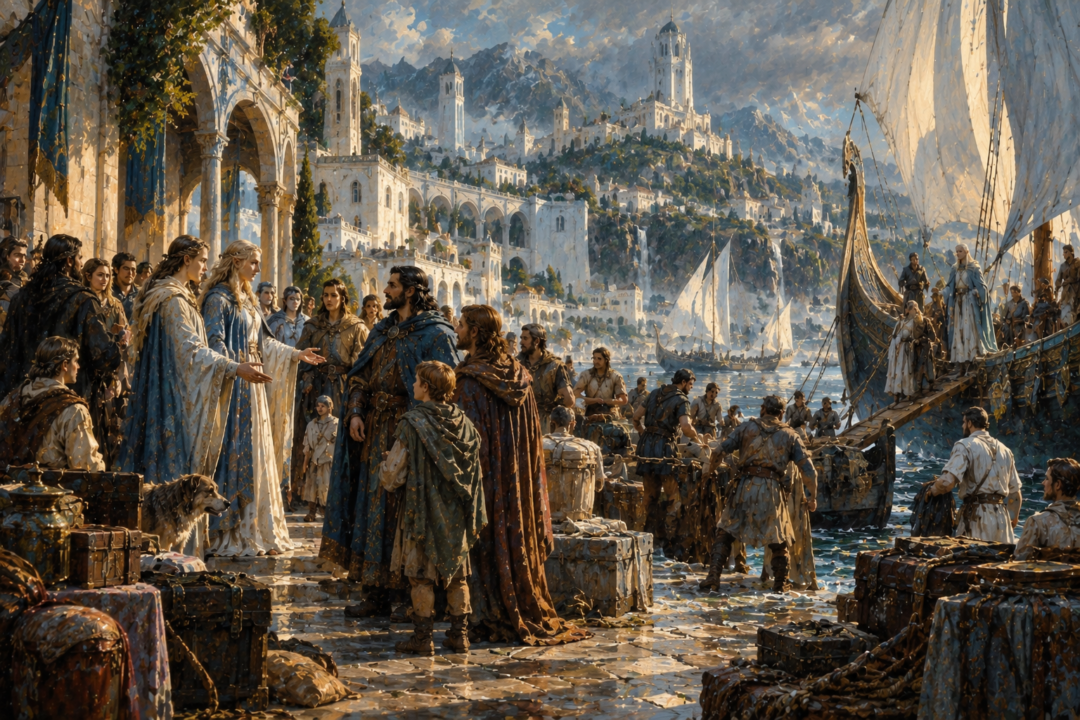
Elvish Influence Was Real, but It Did Not Make Adûnaic Elvish
Another complication is the extraordinary cultural prestige of the Eldar.
The Edain lived among Elves in Beleriand. Sindarin was widely learned, and the Bëorians in particular adopted it extensively. In Númenor, Sindarin remained important, while Quenya was revered and used in high names and learned traditions.
Adûnaic nevertheless remained a Mannish language.
Borrowing and contact do not erase ancestry. One particularly revealing case is the element adûn, "west," which is associated with an Eldarin borrowing into the speech of Hador's folk. The very vocabulary that eventually helps identify Adûnaic as the "language of the West" therefore illustrates linguistic contact reaching back before Númenor.
That is a glimpse of the process—but only a glimpse.
It shows that First Age Mannish speech could absorb Eldarin material before becoming Númenórean Adûnaic. It does not give us enough evidence to reconstruct the entire transformation.
Why the Missing Chain Matters
There is a temptation with Middle-earth's languages to imagine that every relationship can be placed into a perfectly finished chart.
Adûnaic resists that treatment.
We can confidently place its principal ancestry among the speech of the Folk of Hador. We can recognize a related Bëorian language. We can distinguish the Halethian linguistic tradition in the later conception. We can identify significant contact with Elvish languages. And we can observe Adûnaic as the established native Mannish language of Númenor.
What we cannot do is fill every century between those points with documented intermediate forms.
This is not merely a minor technical problem. It changes how the linguistic history should be described.
"First Age Mannish speech contributed to Adûnaic" is safer than imagining a single standardized First Age language changing smoothly into the fully recorded forms associated with Númenor. Even "Taliska became Adûnaic" requires qualification because Taliska belongs to a shifting history of linguistic conceptions and terminology.
The strongest late picture is simpler: the Hadorians possessed an ancestral form of the linguistic tradition that became Númenórean Adûnaic, while the Bëorians spoke a related tongue.
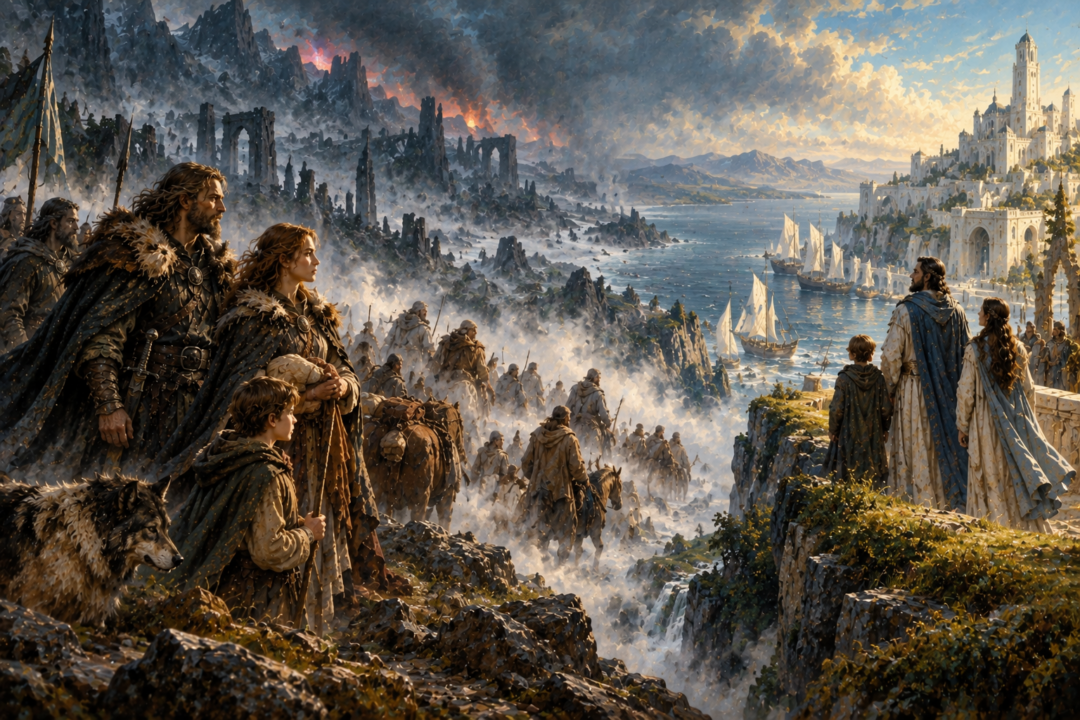
A Language Carrying a World That Had Vanished
There is something fitting about this incomplete ancestry.
The Númenóreans lived on an island created for survivors whose original homelands had disappeared beneath the sea. They preserved memories, names, friendships, grievances, and traditions from a world they could no longer physically return to.
Their language carried another kind of survival.
Everyday Adûnaic belonged to Númenor, but its deepest history did not begin there. Behind it stood mortal peoples moving westward long before Númenor existed, the House of Hador preserving its own speech in Beleriand, related Bëorian traditions, and centuries of contact with Elves and other peoples.
The surviving texts allow us to see those connections without pretending that we possess every missing link.
And perhaps that is the most accurate way to understand Adûnaic: not as a language with a perfectly preserved genealogy, but as the linguistic survivor of a shattered First Age—a Mannish inheritance carried across the ruin of Beleriand and transformed into the voice of Westernesse.
Sources & Notes
- Tolkien Gateway — Adûnaic: Hadorian descent, Bëorian relations and limits of the documented chronology — https://tolkiengateway.net/wiki/Ad%C3%BBnaic
- Tolkien Gateway — Taliska: changing linguistic conceptions and the later distinction from ancestral Adûnaic — https://tolkiengateway.net/wiki/Taliska
- Tolkien Gateway — House of Hador: retention of native Mannish speech and relationship to Númenórean Adûnaic — https://tolkiengateway.net/wiki/House_of_Hador
Primary reading: The Silmarillion, 'Of the Coming of Men into the West'; Unfinished Tales, 'A Description of the Island of Númenor'; and The Peoples of Middle-earth, 'Of Dwarves and Men'. These are secondary reference links, not a complete linguistic reconstruction. Taliska terminology changed between drafts; broad ancestry does not supply every intermediate stage.