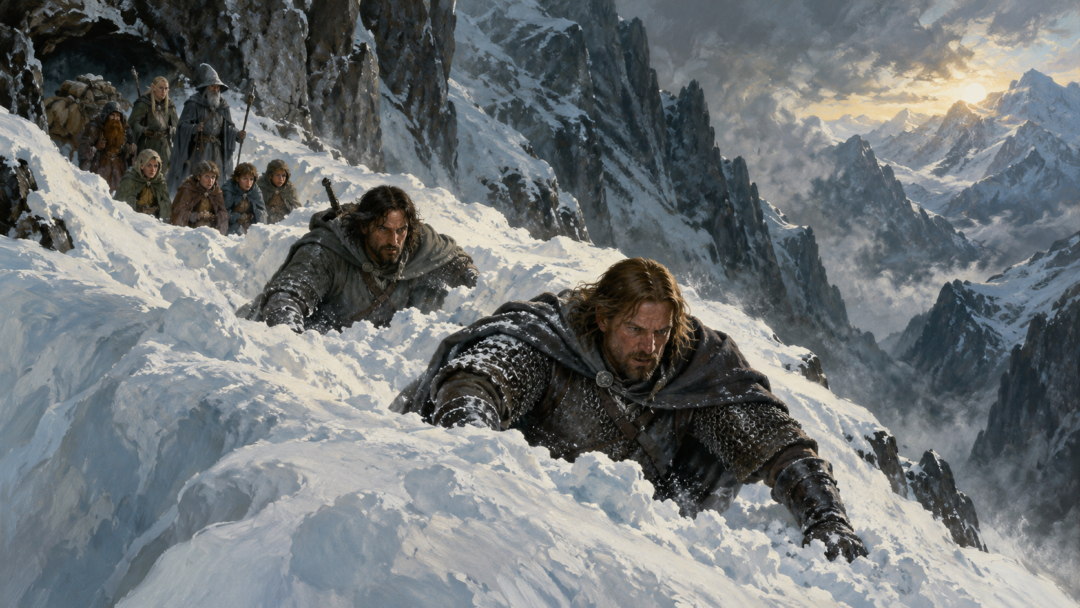
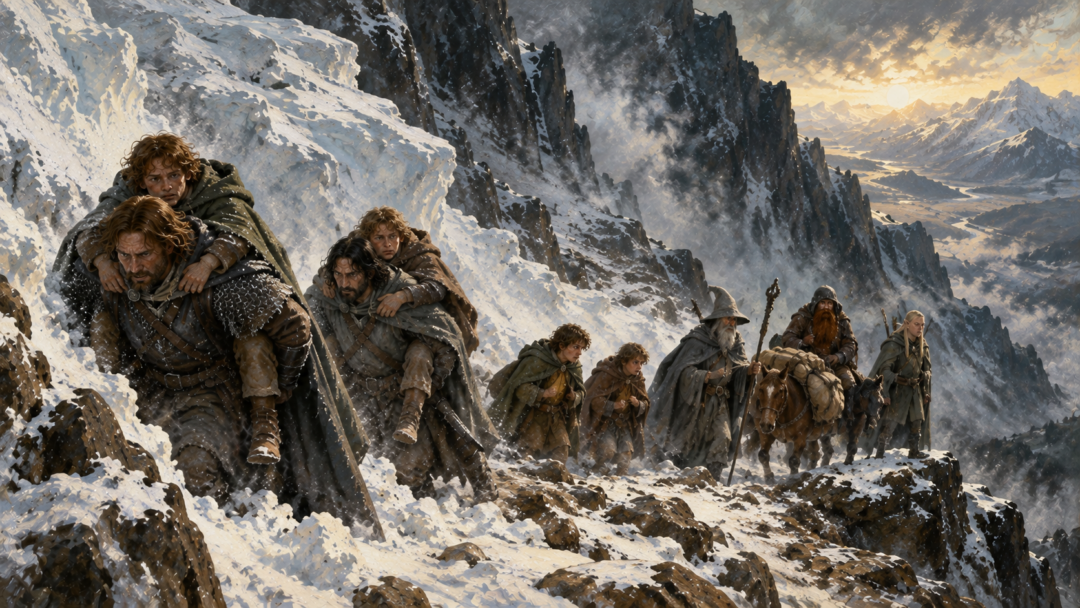
On the slopes of Caradhras, the Fellowship of the Ring discovers that snow can defeat a company without a single enemy appearing. Aragorn and Boromir are strong enough to struggle through the drifts. The hobbits, however, are so deeply buried that ordinary walking becomes impossible.
That difference changes everything.
The Company has set out as nine companions, traveling together toward Mordor. Yet the mountain does not treat them as nine equally capable travelers. Their different heights and strengths suddenly matter more than their weapons, courage, or determination.
When the attempt to cross the Redhorn Pass fails, the problem is no longer simply how to turn around. It is how to get everyone down alive.
The retreat becomes a remarkable example of organized physical labor. Two taller members must force a passage through the snow, while the smaller travelers must be carried through it.
The episode reveals an overlooked truth about the Fellowship: staying together sometimes means that the strongest must do more than lead. They must make movement possible for those who cannot move themselves.
The Mountain That Makes Height Matter
In *The Fellowship of the Ring*, the Company attempts to cross the Misty Mountains by the Redhorn Pass, beneath Caradhras. The mountain is known among the Dwarves as Barazinbar, one of the great peaks above Moria.
The crossing is already dangerous because of winter conditions. Gandalf knows that the journey through the mountains may be difficult, but the Company hopes to find a way across without entering the darkness beneath them.
As the travelers climb, snow begins to fall heavily. Their progress slows, the weather worsens, and the mountain becomes increasingly hostile to their passage.
The crucial detail is that snow depth has different consequences for travelers of different sizes.
For a tall Man, a drift may obstruct the legs and make each step exhausting. For a hobbit, the same drift can rise toward the chest, shoulders, or beyond. The smaller traveler cannot simply copy the movements of the larger one.
This is not a question of courage.
Frodo, Sam, Merry, and Pippin have already shown their willingness to endure hardship. But courage cannot make a hobbit taller, and determination cannot create a passage through snow that overwhelms the body.
Caradhras turns a difference in stature into a difference in mobility.
And once the hobbits cannot move independently, the Company faces a problem that its original marching arrangement cannot solve.
Why Turning Back Is Not Enough
One of the most revealing aspects of the Caradhras episode is that retreat is not automatically easier than advance.
The Fellowship has already traveled upward through worsening conditions. Snow has continued falling, and the route behind them is no longer simply an open track waiting to be retraced.
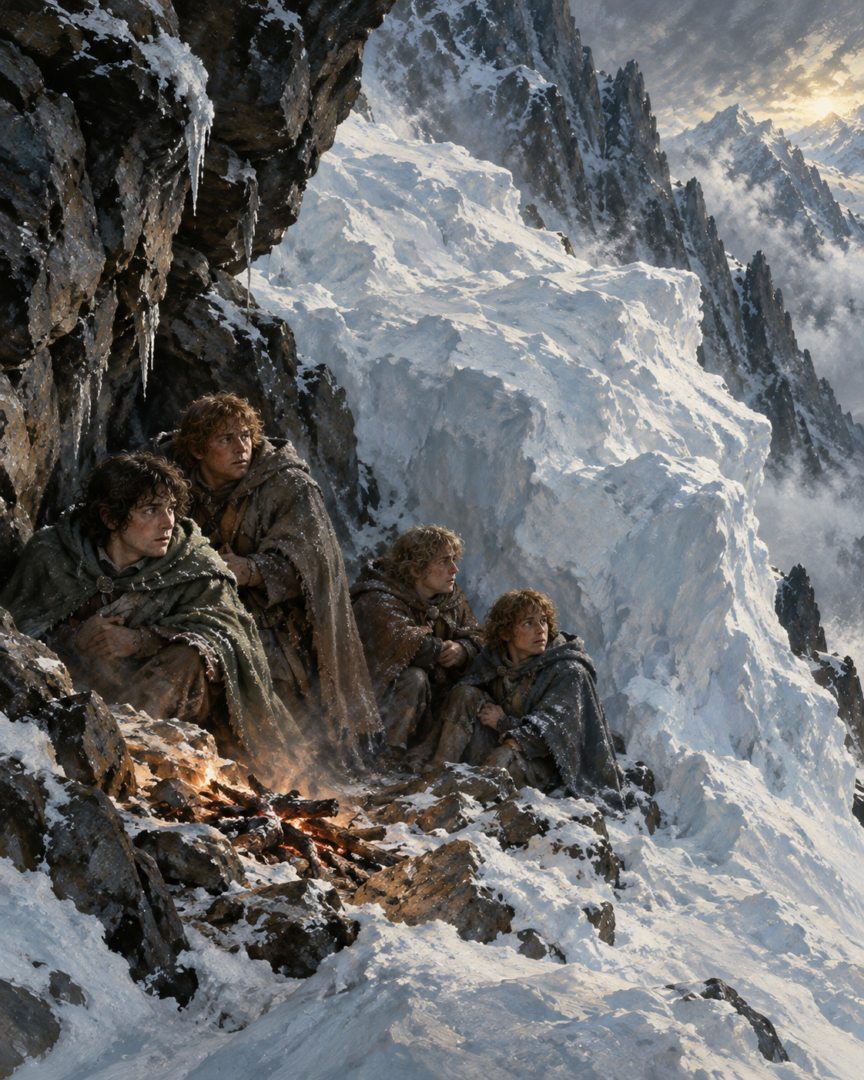
At the height of the storm, the companions shelter against the mountain. They are cold, exhausted, and increasingly threatened by the accumulation of snow.
Eventually, continuing toward the pass is abandoned.
But deciding to retreat does not remove the physical obstruction.
The travelers still need a usable path through the drifts. The hobbits cannot be expected to struggle through snow that has already immobilized them. Nor can the taller companions assume that the route will open merely because they are traveling downhill.
This is where the scene changes from a failed mountain crossing into something closer to an evacuation.
The immediate objective is no longer distance toward Mordor. It is the recovery of a route that every member can use, whether walking or being carried.
That requires a new division of labor.
Aragorn and Boromir Become the Pathbreakers
The decisive work falls to Aragorn and Boromir.
Both are tall, powerful Men, and their greater stature gives them an advantage that the hobbits do not possess. They are not unaffected by the snow, but they have the strength and reach to force their way through conditions that stop the smaller companions.
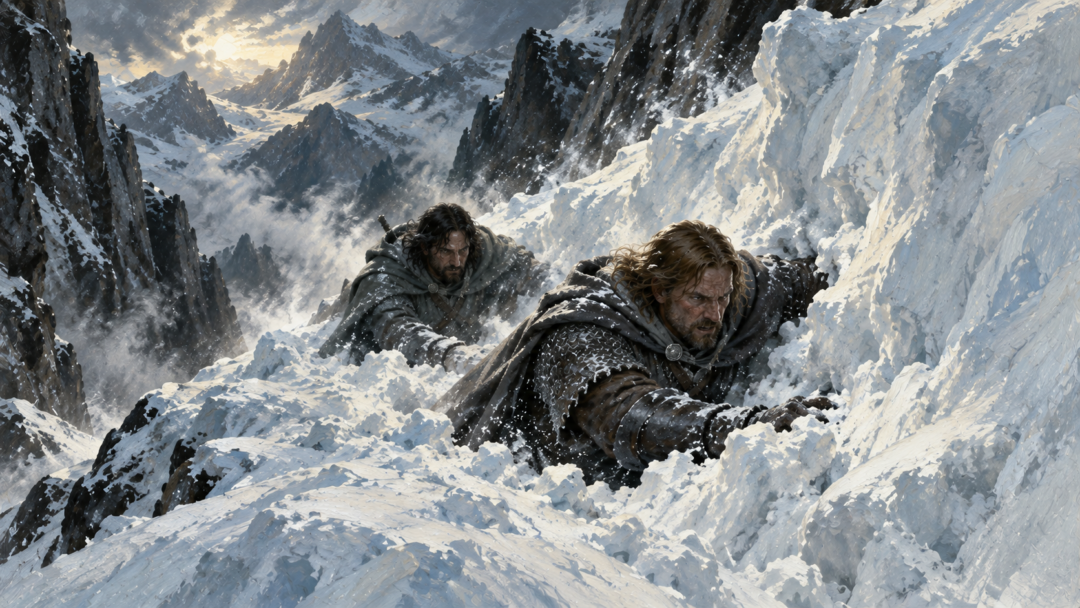
In the chapter “The Ring Goes South,” the two Men go ahead to break a path down the mountain.
This is not a heroic charge against an enemy. It is exhausting, practical work.
They must push through the snow, creating a passage where the Company cannot otherwise proceed. Their progress makes the retreat possible for those waiting behind them.
Their role is especially significant because neither Man can simply solve the problem by walking away from it.
Aragorn and Boromir could make better progress alone than the hobbits can. But the Fellowship’s purpose depends on keeping its members together.
Their strength therefore becomes useful not through personal speed, but through the work they perform for everyone else.
Boromir’s contribution deserves particular attention. His physical power, often remembered in connection with his martial identity, becomes indispensable in a situation where swords and battlefield courage offer little help.
On Caradhras, his strength serves the Company in an immediate and unambiguous way.
The two Men are not competing to reach safety first. They are opening a way through which others may survive.
The Moment the Hobbits Become Passengers
Breaking the path is only part of the solution.
Even after Aragorn and Boromir have forced a passage, the hobbits cannot simply be assumed capable of walking the entire retreat. The snow remains too difficult for them.
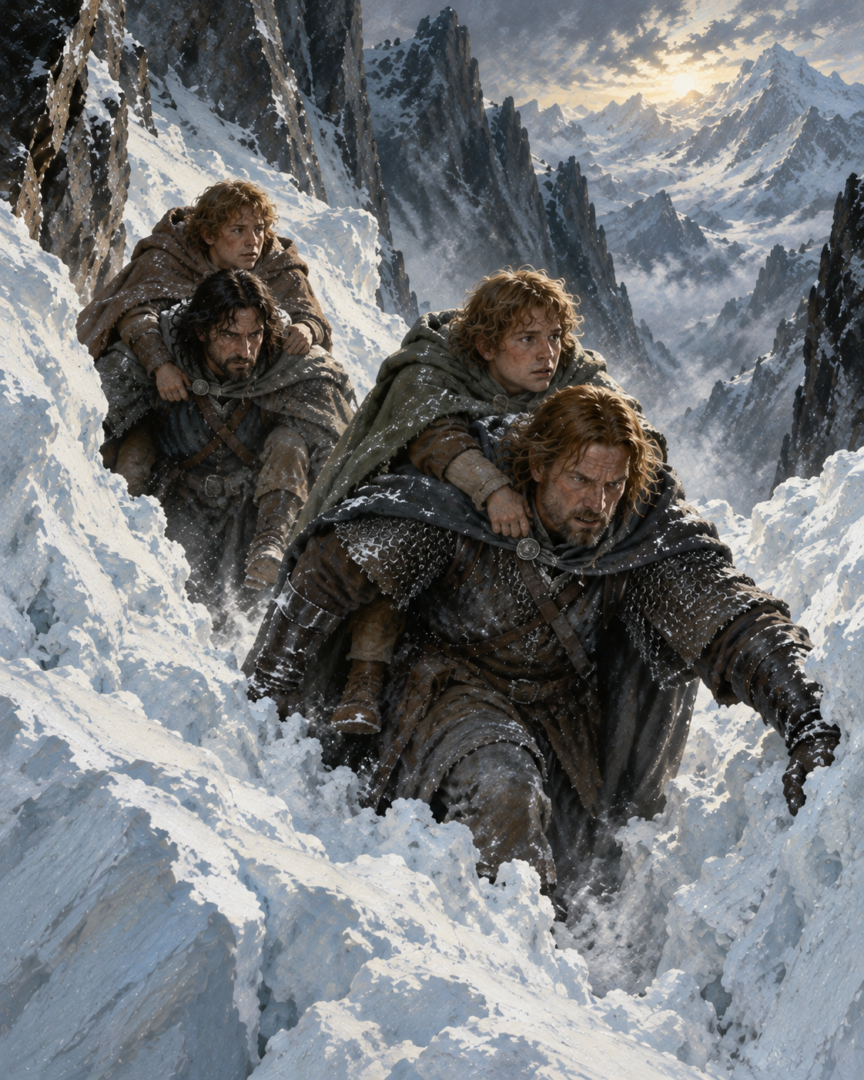
The text makes the practical arrangement clear: the Men carry the hobbits.
This is the defining physical consequence of the storm.
The hobbits begin the crossing as independent travelers, responsible for their own steps. By the retreat, their movement depends directly on the strength and labor of others.
It is important not to exaggerate what this means. The hobbits do not lose their courage, judgment, or importance to the Quest. Frodo remains the Ring-bearer, and the others remain members of the Fellowship.
What changes is their ability to travel under their own power.
That distinction matters because the Ring itself cannot make Frodo physically capable of crossing the mountain. His central responsibility in the Quest does not grant him any special advantage against the snow.
The most important traveler may still need to be carried.
This creates one of the episode’s quietest ironies. The Company exists to protect and accompany the Ring-bearer, yet its immediate success depends on an ordinary physical task: moving smaller bodies through a blocked route.
No grand weapon or hidden knowledge replaces that work.
Someone must open the way. Someone must carry those who cannot walk.
Why the Retreat Requires Two Kinds of Labor
The Caradhras retreat can be understood through two distinct physical tasks.
The first is route-breaking.
Before the Company can descend, the deep snow must be crossed and a passage opened. Aragorn and Boromir undertake this work because their stature and strength make them the most suitable members for it.
The second is carrying.
Once a passage has been made, the hobbits still need help moving through the difficult ground. The Men must therefore use their strength not only to overcome the obstruction but also to transport the smaller companions.
These tasks are connected, but they are not identical.
A broken path is not necessarily an easy path for a hobbit. A traveler capable of forcing a way through deep snow is not automatically able to bring the entire Fellowship along without further effort.
That is why the episode is more complicated than a simple account of the strongest members going first.
The stronger travelers must turn their greater mobility into a shared advantage.
There is a physical cost to that arrangement. Carrying another person adds a burden to movement that is already exhausting. The narrative does not provide measurements of the snow, the travelers’ loads, or the exact energy required, and no such calculations are necessary.
The essential relationship is visible in the action itself: the hobbits cannot get down unaided, and the Men must work harder to bring them.
The Fellowship’s retreat succeeds because its members do not all have to perform the same task.
They have to perform complementary tasks.
Why Fire Cannot Solve the Whole Problem
Another important detail is Gandalf’s use of fire during the ordeal.
With the Company trapped in bitter conditions, he uses his power to kindle a fire, helping the companions survive the cold.
This intervention is significant, but it does not make the mountain passable.
The fire provides immediate relief. It cannot create a safe descent through all the accumulated snow, nor does it remove the need for Aragorn and Boromir to break the route.
The contrast is revealing.
Gandalf possesses knowledge and abilities beyond those of the other travelers. Yet when the Company must get down from Caradhras, the decisive solution still involves the physical labor of two Men.
Magic can help the companions endure the night. It does not eliminate the practical demands of their retreat.
This is consistent with the wider story, in which extraordinary power rarely removes every ordinary difficulty faced by the travelers.
On Caradhras, survival depends on both timely aid and the ability to do difficult, unglamorous work.
Does the Mountain Deliberately Separate the Strong From the Weak?
The hostility of Caradhras raises another question: is the mountain merely dangerous, or is some will acting against the Fellowship?
The narrative leaves room for uncertainty.
Characters suspect more than ordinary weather, and Caradhras has a sinister reputation. The possibility of malice is part of the atmosphere surrounding the failed crossing.
But the text does not conclusively establish a single supernatural author responsible for the storm.
It would therefore be misleading to say that Caradhras deliberately designs the snowfall to immobilize the hobbits while allowing the Men to move.
The physical effect does not require that interpretation.
Whatever causes the storm, its consequences are plain. The smaller members are more severely obstructed, and the larger members must compensate for their inability to travel.
The scene works precisely because the immediate danger is understandable without a definitive explanation of the weather’s origin.
Snow has accumulated. The hobbits cannot get through it. Aragorn and Boromir must open the way and carry them down.
The mystery of Caradhras remains, but the mechanics of the retreat are concrete.
The Fellowship Is Not a Company of Equals in Strength
The Fellowship contains travelers of strikingly different kinds.
Gandalf brings wisdom and extraordinary abilities. Aragorn contributes experience, endurance, and leadership. Boromir possesses the strength and training of a warrior. Legolas and Gimli have abilities shaped by their own peoples and histories.
The four hobbits are physically smaller and generally less accustomed to the hardships of such a journey.
These differences do not make some members more worthy than others.
They do mean that different dangers expose different limitations.
In the deep snow, the hobbits’ small stature becomes a serious disadvantage. The taller Men are better equipped for the immediate task, and the Company’s survival depends on recognizing that difference rather than pretending it does not exist.
This is an important distinction between equal membership and identical capability.
The Fellowship is united by its purpose, but its members cannot always contribute in the same way.
At Caradhras, the correct response is not to demand that the hobbits keep pace through impossible conditions. It is to change the method of travel.
The group remains together because its stronger members accept a greater share of the physical work.
What Caradhras Reveals Before Moria
The failed crossing has consequences beyond the mountain itself.
Unable to continue over the pass, the Company must reconsider its route. The retreat leads toward the decision to attempt the passage through Moria, with all the dangers that choice will bring.
Yet the snowbound withdrawal deserves attention independently of what happens afterward.
It shows the Fellowship confronting a problem that cannot be solved by individual bravery alone.
The hobbits cannot simply become stronger through determination. Aragorn and Boromir cannot merely announce a retreat and expect everyone to follow. Gandalf cannot make the accumulated snow irrelevant with a single act of power.
Instead, the Company must adapt to the actual physical conditions.
The taller Men break the way. The smaller travelers are carried. The group moves because its members accept different responsibilities.
That is the distinctive lesson of Caradhras.
The mountain does not need to destroy the Fellowship to endanger its mission. It only needs to make independent movement impossible for some of its members.
And the answer is not to abandon them.
It is to turn strength into service.
Before the Company enters Moria, before the great losses and choices that lie ahead, the snow on Caradhras has already tested what traveling together truly means.
The Fellowship survives its retreat not because every member can carry the same burden, but because those who can still move are willing to carry those who cannot.
Sources & Notes
- The Encyclopedia of Arda — Caradhras — The Redhorn and the pass attempted by the Fellowship. https://www.encyclopedia-of-arda.com/c/caradhras.html
- The Thain’s Book — Boromir — Aragorn and Boromir clear the snow and carry the four hobbits down the mountain. https://thainsbook.minastirith.cz/boromir.html
- The Thain’s Book — Aragorn — The retreat through the Redhorn Gate and the practical help given to the hobbits. https://thainsbook.minastirith.cz/aragorn.html
Primary passage: The Fellowship of the Ring, Book II, chapter 3, “The Ring Goes South.” The carrying and path-breaking are textual events; “load-bearing problem” is interpretation. The text does not conclusively identify the author of the storm.