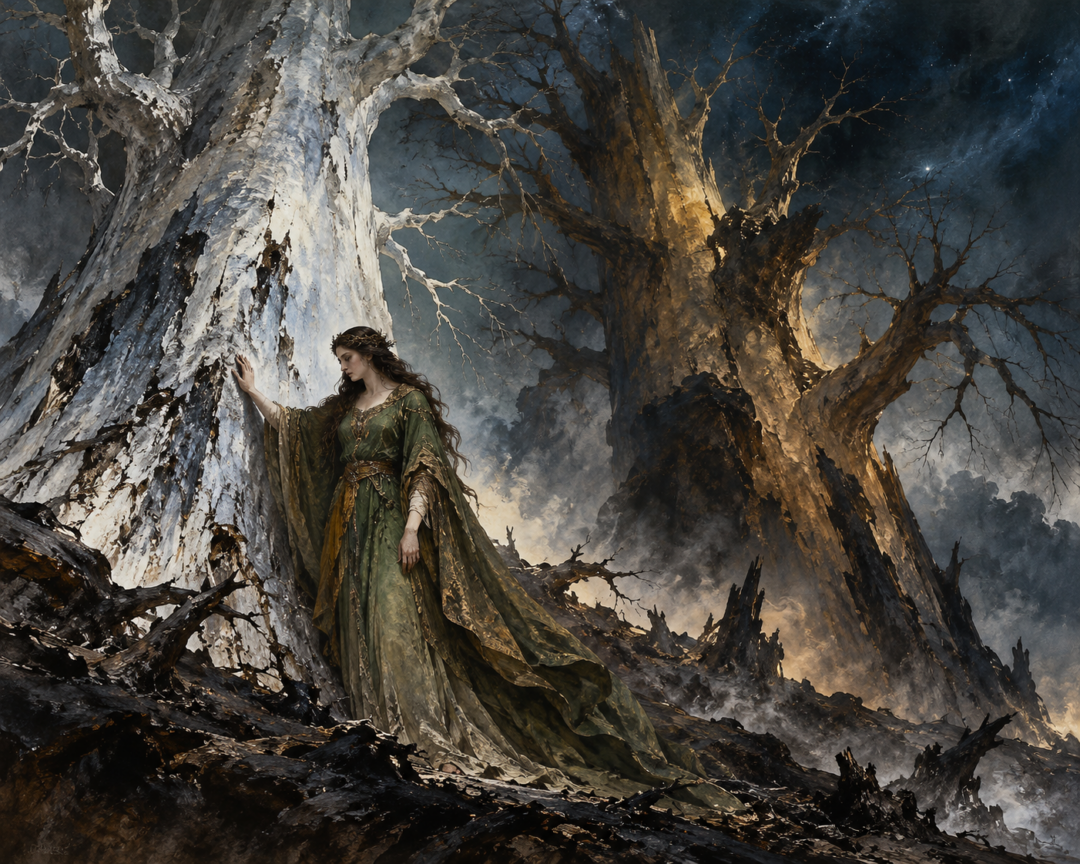
When the Two Trees of Valinor were destroyed, the Valar faced a loss that even their extraordinary powers could not simply undo. Telperion and Laurelin, the silver and golden Trees that had illuminated the Blessed Realm, were dying from the poison of Ungoliant. Their light had faded, their living strength was exhausted, and Yavanna, who had brought them into being, could not restore them by her own power alone.
Yet there was one remaining possibility.
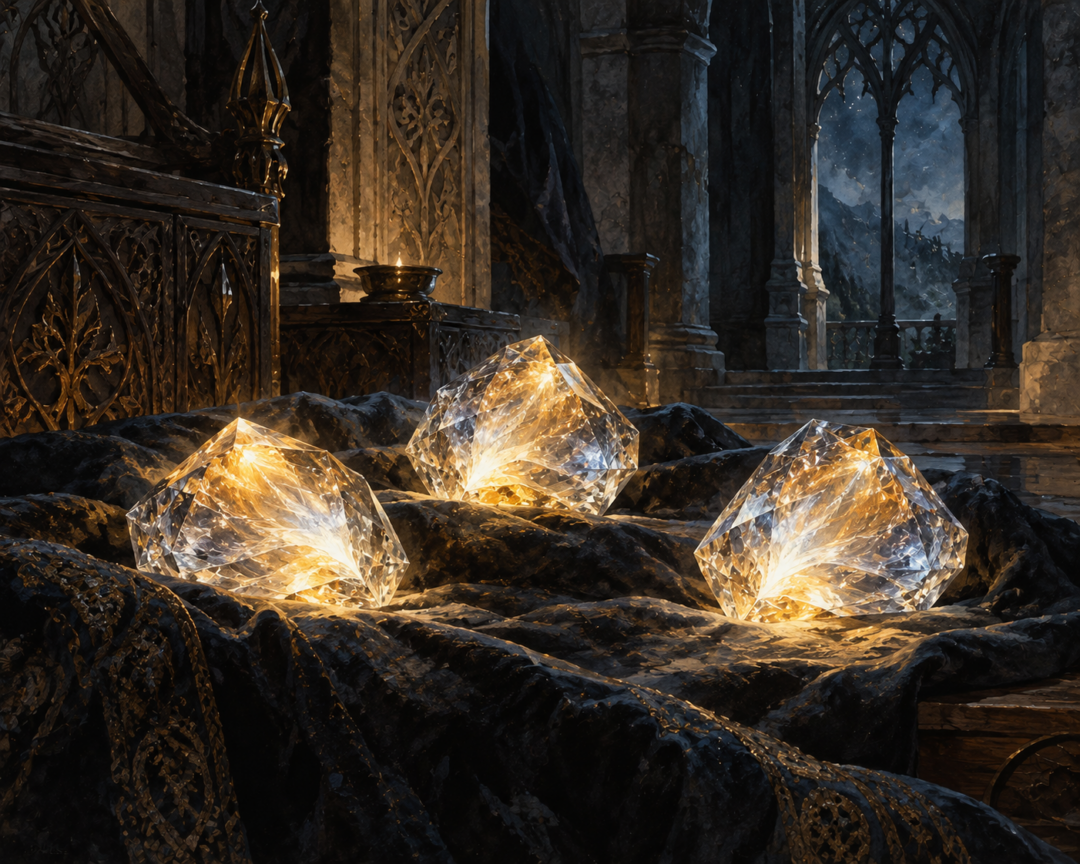
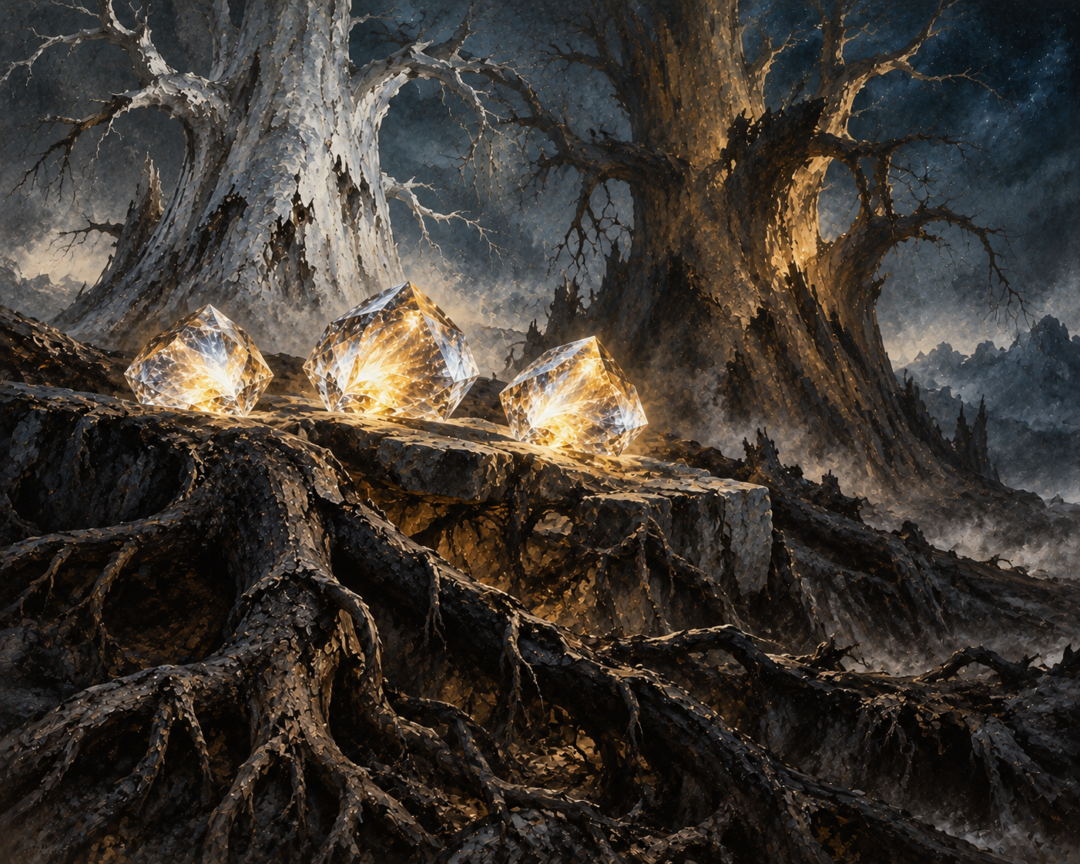
Far from the poisoned roots, within three jewels fashioned by Fëanor, the ancient light of the Trees still endured. The Silmarils had preserved something that the Trees themselves could no longer give.
This is why Yavanna asked for the Silmarils after the Darkening of Valinor. She did not merely wish to recover a beautiful reminder of what had been lost. She believed their preserved light might enable her to restore the Trees to life.
The distinction matters. The Silmarils were not simply treasures of the Elves. At that moment, they held a unique remnant of a vanished order of the world.
And the possibility of restoration depended upon something no longer available anywhere else.
The Two Trees Were More Than Sources of Light
Before the rising of the Sun and Moon, the Blessed Realm was illuminated by the Two Trees of Valinor.
Telperion shone with silver light, while Laurelin gave forth golden radiance. Their brightness waxed and waned in a great rhythm, and their mingled light marked the most beautiful hours of Valinor.
The Trees were living creations of Yavanna, the Vala whose powers were especially concerned with growing things and the life of the earth.
In The Silmarillion, the account of their creation places them among the greatest wonders of the Valar. They were not ordinary plants enlarged by divine power. Their light was an essential part of the beauty and blessing of Aman before the first sunrise.
Their destruction therefore meant more than the loss of two extraordinary trees.
It marked the end of an entire condition of the world.
When Melkor and Ungoliant attacked them, they struck at something that could not easily be replaced. Melkor wounded the Trees, and Ungoliant consumed their light and poisoned their living substance.
The result was not merely darkness caused by an extinguished lamp.
The very sources from which that light had flowed were dying.
Why Yavanna Could Not Simply Grow the Trees Again
One of the most revealing aspects of the Darkening is the limitation it exposes.
Yavanna had originally brought the Two Trees into being. Surely, then, she could make new ones?
The text gives a more difficult answer.
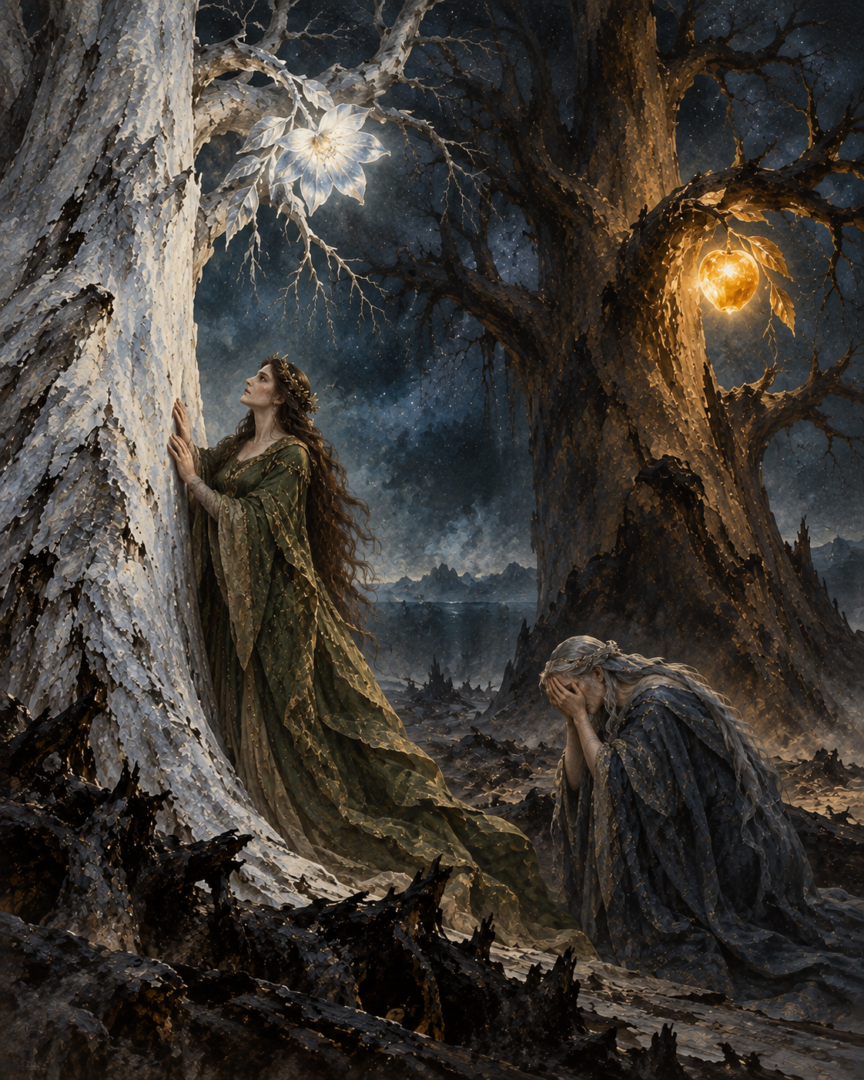
After examining the ruined Trees, Yavanna explains that the light they once possessed survives within Fëanor's jewels. She believes that, if even a little of that light can be recovered, she may be able to restore life to the Trees before their roots perish completely.
But she also acknowledges the uniqueness of their original making.
The creation of the Trees was a work that could not simply be repeated at will.
This is a recurring distinction in Middle-earth: possessing great creative power does not necessarily mean being able to reproduce a particular work after it has been destroyed.
The Valar are mighty, but they are not unlimited creators. Their powers operate within the world and its history, where certain losses can become irreversible.
Yavanna's dilemma is therefore both practical and profound.
She knows the Trees as their maker. She understands their condition. Yet her ability to heal them appears to depend on recovering something that their destruction has taken away.
That missing element is their original, uncorrupted light.
What Made the Light Inside the Silmarils Unique?
Fëanor created the Silmarils during the Years of the Trees, before the Darkening of Valinor.
Their greatest wonder was not simply their brilliance.
Within them he had captured and preserved the blended light of Telperion and Laurelin.
The account of the Silmarils in The Silmarillion describes their inner fire as containing that mingled radiance. They shone with a light that belonged to the Trees themselves, rather than merely imitating their appearance.
This distinction explains their importance after the catastrophe.
The Silmarils preserved the light of the Trees from before their poisoning, while the Trees themselves could no longer supply that light.
The jewels had become repositories of something otherwise lost.
Their substance was also extraordinary. Fëanor had made them from a crystal-like material whose nature was not fully understood by others, and which he alone knew how to fashion.
Yet their relevance to Yavanna was not primarily the mystery of their material.
It was the light preserved within them.
The Silmarils were unique because they held the radiance of both Trees in an enduring form, separate from the living sources that Ungoliant had destroyed.
This made them more than beautiful artifacts.
They were the surviving vessels of an earlier light.
Why Preserved Light Offered a Chance of Restoration
Yavanna's proposal is specific.
She does not claim that any sufficiently powerful light could heal the Trees. Nor does she suggest that the Valar could replace their lost radiance with a new illumination of equal brightness.
Her hope rests on recovering the particular light that once belonged to Telperion and Laurelin.
The distinction is crucial.
The Trees had been poisoned, and their own living light had been consumed. The Silmarils, however, still contained light captured before that corruption.
One reasonable reading is that this preserved radiance offered a means of renewing what had been lost from the Trees themselves.
The texts do not explain the process as a technical operation. There is no account of how Yavanna would have drawn out the light, how it would have entered the Trees, or what physical transformation would have followed.
Instead, the narrative establishes a relationship between the surviving light and Yavanna's power to heal.
She believes the Silmarils could supply what her restorative art now lacks.
Importantly, her statement is a declaration of possibility, not a report of success.
She does not demonstrate that the Trees can certainly be revived. Her proposal concerns an attempt that must be made while their roots still retain the possibility of life.
The urgency comes from that narrow remaining opportunity.
If the roots die completely, even the preserved light may no longer be enough.
Why the Valar Turned to Fëanor
The problem was that the Silmarils belonged to Fëanor.
He had made them through an achievement of craft that he himself could not necessarily repeat. The jewels represented the highest expression of his skill, and their uniqueness was already recognized before the Trees were destroyed.
When Yavanna declared that their light might restore the Trees, the Valar faced a conflict between two irreplaceable works.
Fëanor's jewels preserved the light of Yavanna's creation. To restore one wonder, it seemed necessary to surrender another.
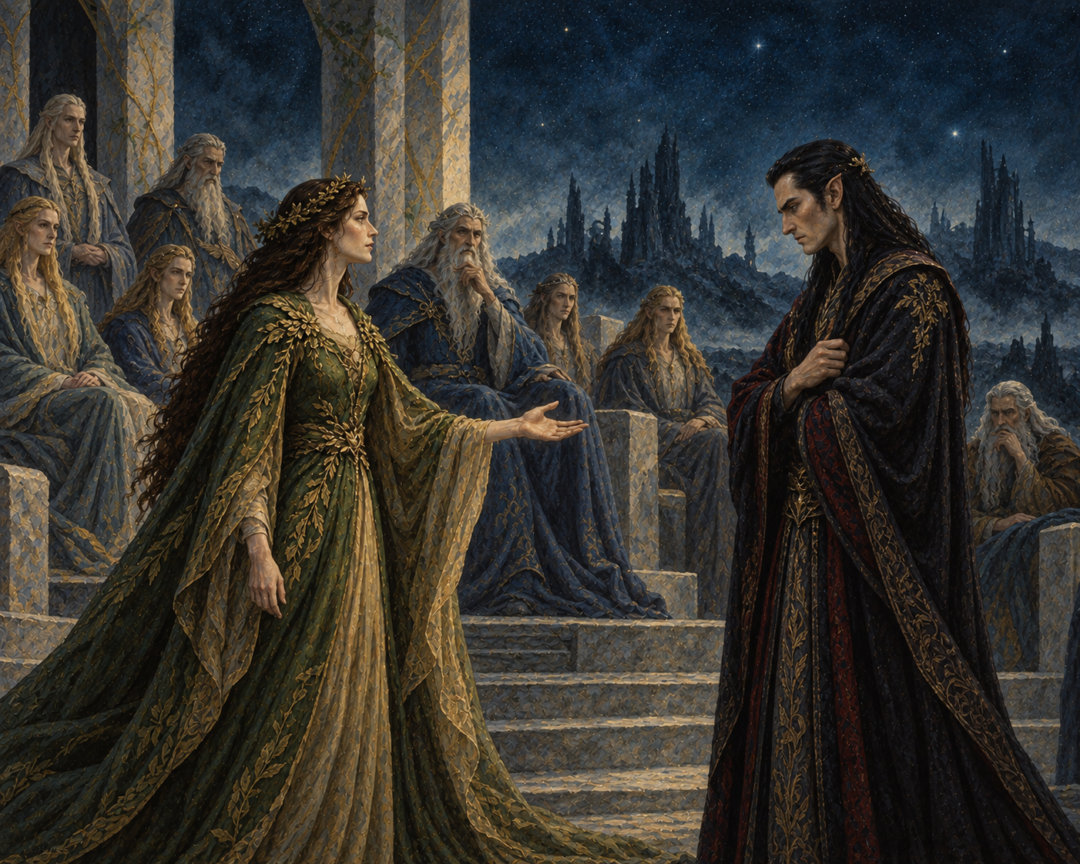
Manwë asked Fëanor whether he would grant the Silmarils for this purpose.
Fëanor understood that the request might require the destruction of his own masterpiece. In his response, he indicated that breaking the jewels would break his heart and that he could never make their like again.
This reveals another limitation of creative power.
Yavanna could not simply remake the Trees. Fëanor could not simply remake the Silmarils.
Both faced the possible loss of their greatest works.
Yet the consequences were not equal in scale. Yavanna sought the restoration of the Trees for the light and beauty of Valinor, while Fëanor was being asked to surrender something uniquely his own.
His refusal is part of the tragedy, but it does not explain away the restorative possibility that prompted the request.
The central issue remains the same: the light needed for Yavanna's attempt was preserved in objects that only Fëanor could surrender.
Varda's Hallowing Was Not the Restorative Power
The Silmarils had also been hallowed by Varda.
Because of this, evil and unclean hands could not touch them without being scorched and withered.
That property would later become especially important in the history of the jewels, but it should not be confused with Yavanna's proposed restoration.
Varda's hallowing concerned the sacred character of the Silmarils and the consequences of contact with them.
Yavanna's hope concerned the light they contained.
The narrative does not say that the hallowing itself would revive the Trees, nor does it describe Varda's blessing as a mechanism for transferring light.
The relevant power was Yavanna's ability to heal living things, combined with the possibility of recovering the Trees' preserved radiance.
These are related elements of the same story, but they are not interchangeable.
The Terrible Timing of Fëanor's Refusal
There is another tragic detail in the sequence of events.
When the Valar asked for the Silmarils, they did not yet know the full extent of Melkor's actions at Formenos.
Fëanor refused to surrender the jewels. Soon afterward, messengers brought news that Melkor had killed Finwë, Fëanor's father, and stolen the Silmarils.
This means the requested restoration never proceeded.
The jewels were already beyond Fëanor's possession by the time their theft became known to the assembly.
The story therefore does not establish that Yavanna tried and failed to revive the Trees using the Silmarils.
She never received them.
Nor does it prove that their restoration would certainly have succeeded had Fëanor agreed.
What the account establishes is that Yavanna saw a remaining possibility in the preserved light, and that the opportunity was lost amid refusal, violence, and theft.
The tragedy is sharpened because the Silmarils survived the Darkening, but were no longer available to heal what had been destroyed.
Why the Sun and Moon Were Not the Same as Restoring the Trees
The story did not end in permanent darkness.
Without the Silmarils, Yavanna and Nienna continued their efforts. From Telperion came a final silver flower, and from Laurelin a final golden fruit.
These became the vessels of the Moon and Sun, guided through the heavens by Tilion and Arien.
This was an extraordinary transformation of what remained of the Trees.
But it was not their restoration.
Telperion and Laurelin did not return to their former living condition. Their ancient rhythm of silver and golden light did not resume in Valinor.
Instead, their last gifts became the foundations of a new order of light for Middle-earth.
The difference is fundamental.
Yavanna had hoped to revive the original Trees through their preserved radiance. The Sun and Moon arose from what the dying Trees could still yield.
One possibility concerned recovering the old living sources.
The other concerned carrying their final light into a changed world.
The Sun and Moon were therefore not evidence that the Silmarils had been unnecessary to Yavanna's earlier proposal. They represented a different outcome after the opportunity for restoration had passed.
The Deeper Tragedy of the Preserved Light
The Silmarils endured because Fëanor had captured something of extraordinary beauty before it was lost.
That achievement became both their glory and their tragedy.
The jewels preserved the unsullied light of the Two Trees, but preserving light was not the same as restoring its living source.
Yavanna could not recover that light from the poisoned Trees themselves. Her hope depended on the three jewels that had survived apart from them.
And those jewels, though still radiant, passed into a history of theft, exile, warfare, and grief.
The Darkening of Valinor thus reveals a painful distinction between survival and renewal.
Something can endure as a treasure even when the living wonder from which it came has perished.
The Silmarils preserved the light of a world that could no longer be recovered by ordinary means. Yavanna saw in them a possible path back, but the path was never taken.
That is what makes her request so important.
She was not asking merely for the return of stolen beauty, or for the possession of a greater treasure.
She was asking for the one surviving light that might allow her to heal the Trees before their last chance of life disappeared.
The Silmarils continued to shine.
But Telperion and Laurelin did not bloom again.
Sources & Notes
- Tolkien Gateway — Of the Flight of the Noldor. https://tolkiengateway.net/wiki/Of_the_Flight_of_the_Noldor
- Tolkien Gateway — Two Trees of Valinor. https://tolkiengateway.net/wiki/Two_Trees_of_Valinor
- Tolkien Gateway — Silmarils. https://tolkiengateway.net/wiki/Silmarils
Primary text: The Silmarillion, “Of the Silmarils and the Unrest of the Noldor,” “Of the Darkening of Valinor,” and “Of the Flight of the Noldor.” These references cover the preserved light and Yavanna’s request. Restoration was a proposed possibility, not a successful or guaranteed event.