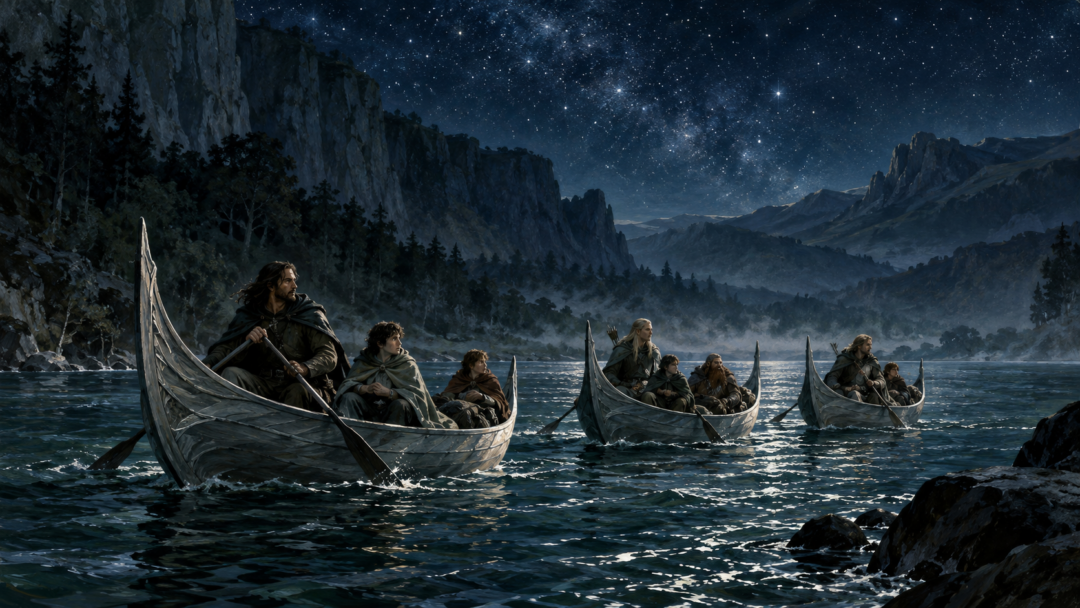
The Great River Anduin should have offered the Fellowship a welcome escape. After the darkness of Moria and the sorrow of leaving Lothlórien, three light Elven boats carried Frodo and his companions southward toward the lands of Gondor. The current helped them forward, and the river offered a passage through country that would have been difficult to cross on foot.
Yet the farther they travelled, the less the Anduin resembled a safe road.
The Fellowship increasingly relied on darkness for movement and concealed places for rest. What appeared to be a simple decision about when to row was actually part of a more complicated struggle: they needed to advance without allowing the servants of the Enemy to discover where the Ring-bearer was going.
And the river itself was becoming dangerous.
The explanation lies in the changing landscape, the possibility of pursuit, the uncertain intentions of watchers along the banks, and one disastrous night near the rapids of Sarn Gebir.
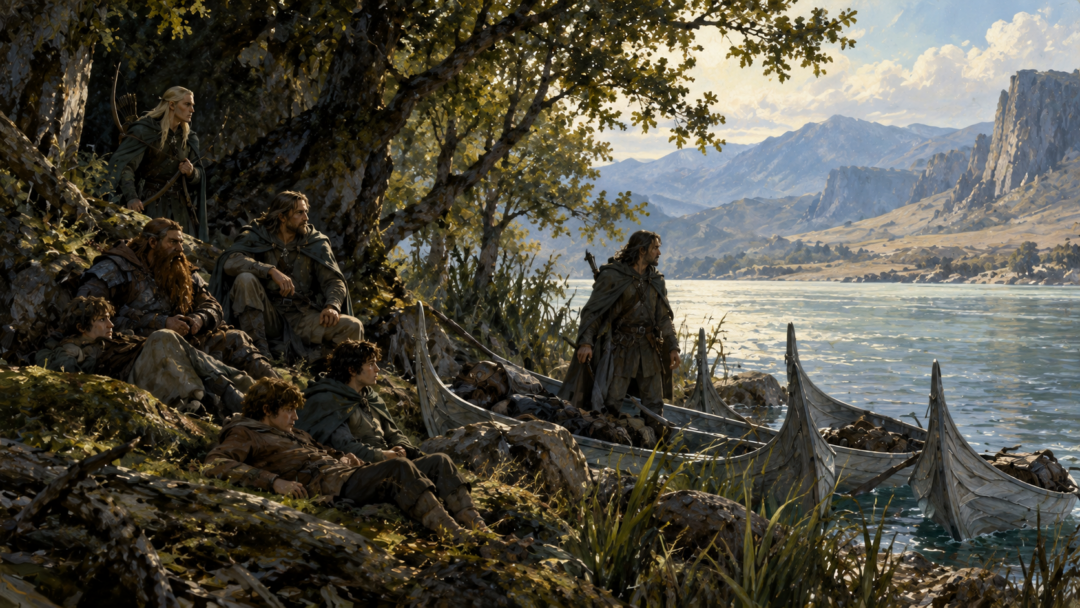
The Great River Offered Speed, but Not Safety
When the Fellowship departed Lothlórien, the Elves provided three boats suitable for travelling down the Anduin.
These vessels offered important advantages. The Company could carry its supplies, travel with the current, and avoid some of the difficulties of crossing the wilderness on foot.
But a river journey also imposed restrictions.
On land, travellers might choose among different paths, take shelter behind hills, or alter their direction to avoid a suspected enemy. On the Anduin, the Fellowship was largely committed to a visible corridor between two shores.
The river determined where they could go, while its banks offered potential hiding places to anyone watching their passage.
This mattered especially because the Company was not simply trying to reach Gondor. Frodo carried the One Ring, and the success of the Quest depended upon preventing Sauron from recovering it.
A swift journey was valuable only if it did not reveal the Ring-bearer.
The river therefore presented a contradiction: it made movement easier while limiting the Fellowship’s freedom to escape observation.
Why Darkness Became Their Protection
In The Fellowship of the Ring, Book II, Chapter 9, “The Great River,” the Company’s journey develops into a pattern of travelling by night and taking shelter during daylight.
The immediate advantage is understandable.
On open water, boats are more easily observed when sunlight illuminates the river. Travelling after dark reduces their visibility, particularly to watchers stationed at a distance.
But the Fellowship did not adopt a universal rule that daylight travel was forbidden.
Their decisions changed as the journey progressed, responding to the country around them and to signs that they might be watched.
That distinction matters. Night rowing was a practical choice under threatening circumstances, not a permanent nautical doctrine.
Darkness also carried disadvantages. The Company could miss rocks, misjudge the current, or approach dangerous stretches without recognizing them.
Aragorn understood this risk, and his warnings before Sarn Gebir show that concealment was being purchased at a real cost.
The Fellowship was choosing between dangers, not eliminating them.
The Eastern Bank Was Becoming More Threatening
As the boats travelled south, the country on either side of the Anduin changed.
To the west lay the plains associated with Rohan. To the east stretched the Brown Lands, a desolate region whose emptiness gave the travellers little reassurance.
The Company was moving toward territories increasingly exposed to the influence and movements of the Enemy.
The eastern shore was especially troubling because Orcs could approach the river from lands beyond it.
This did not mean that every stretch of the eastern bank was occupied by hostile forces. The text does not establish an unbroken line of enemy watchers.
Nevertheless, the possibility of discovery was serious enough to influence the Company’s movements.
The Fellowship had little reason to assume that the absence of visible enemies meant the absence of danger.
A watcher concealed among rocks or on a distant bank might observe boats long before their occupants could identify the observer.
This was one of the central problems of the Anduin: the Company could see the river ahead, but not everything waiting beside it.
Gollum Made the River Journey More Dangerous
The Fellowship’s fears were not limited to unknown enemies.
Gollum had already followed Frodo through earlier stages of the Quest, and his presence remained a concern after the Company left Lothlórien.
During the river journey, Sam noticed a suspicious dark shape following the boats. It proved to be Gollum, travelling on a log.
This discovery changed the meaning of the river behind them.
The Fellowship was not necessarily escaping pursuit simply because it had taken to the water.
Gollum’s persistence demonstrated that someone determined enough could continue following their route even under difficult conditions.
His motives were closely bound to his desire for the Ring, but whether he had already communicated the Company’s whereabouts to Orcs along the river is not established.
Later, when the Fellowship was attacked near Sarn Gebir, Sam suspected Gollum’s involvement.
That suspicion was understandable, but it was not proof.
The important point is that the Company had reason to fear both pursuit from behind and discovery from the banks ahead.
Night movement reduced one form of exposure, but it could not make them invisible to a follower who already knew their course.
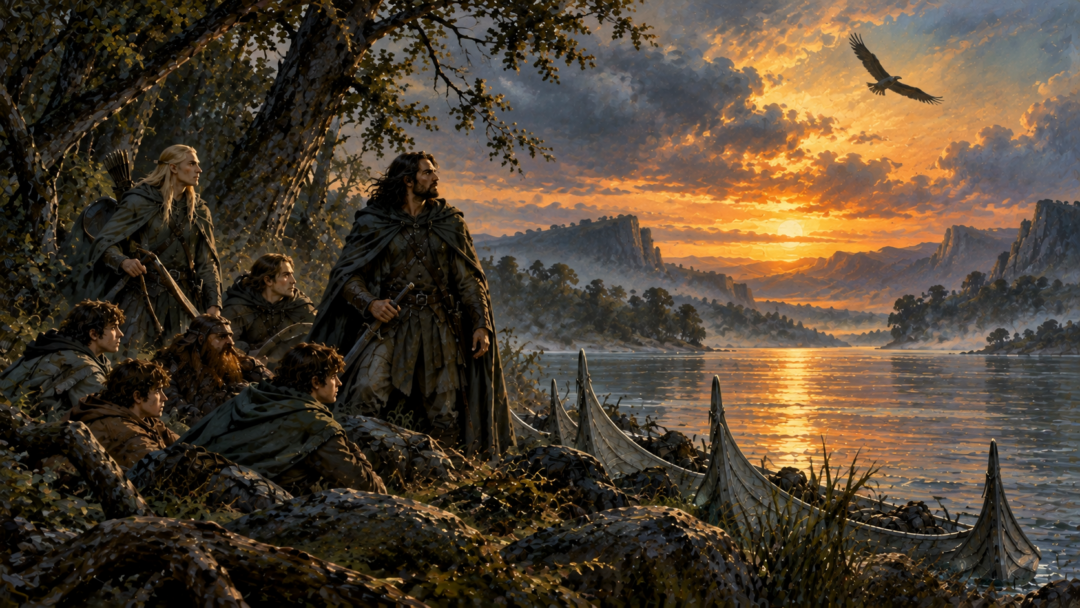
The Eagle That Made Aragorn Wait for Darkness
One revealing moment occurs before the Fellowship reaches Sarn Gebir.
As the Company prepares to resume its journey near sunset, Aragorn notices a great bird flying high in the distance.
Legolas identifies it as an eagle, but he cannot explain what its appearance means.
Aragorn then decides that they should wait until full darkness before setting out.
The episode is important because it shows caution operating under uncertainty.
The eagle is not identified as an enemy spy. Eagles have their own place in the history of Middle-earth, and the narrative does not establish that this particular bird was reporting to Sauron.
Nor does Aragorn accuse it of doing so.
What the moment demonstrates is his reluctance to expose the Company unnecessarily when something unusual has appeared in the sky.
The decision to delay departure is explicitly connected with the sighting, although the precise danger Aragorn fears is not explained.
The Fellowship’s secrecy depends upon avoiding risks that cannot always be fully understood.
Sarn Gebir Revealed the Price of Night Travel
The most dramatic test of the Company’s river strategy came on the eighth night of its journey from Lothlórien.
Aragorn knew that Sarn Gebir, the dangerous rapids of the Anduin, lay somewhere ahead.
He also admitted that he did not know this part of the river well from travelling by boat.
He believed the rapids were still some distance away.
The Company therefore continued into the darkness, with instructions to proceed cautiously and watch for rocks and stony islands.
Sam was placed at the front of the leading boat as lookout.
But the river was flowing faster than Aragorn had calculated.
Near midnight, Sam detected danger immediately ahead.
Sharp rocks rose from the water, and the current began drawing the boats toward the eastern side of the river.
The Fellowship had arrived at Sarn Gebir sooner than expected.
Boromir recognized the danger of attempting the rapids, while Aragorn struggled to turn the boats against the current.
Suddenly, their preference for travelling unseen had placed them in a situation where they could barely see enough to navigate.
This was the central weakness of their strategy.
Darkness might conceal the Fellowship from distant observers, but it could also conceal the river’s hazards from the Fellowship itself.
The Orc Ambush Proved the River Was No Refuge
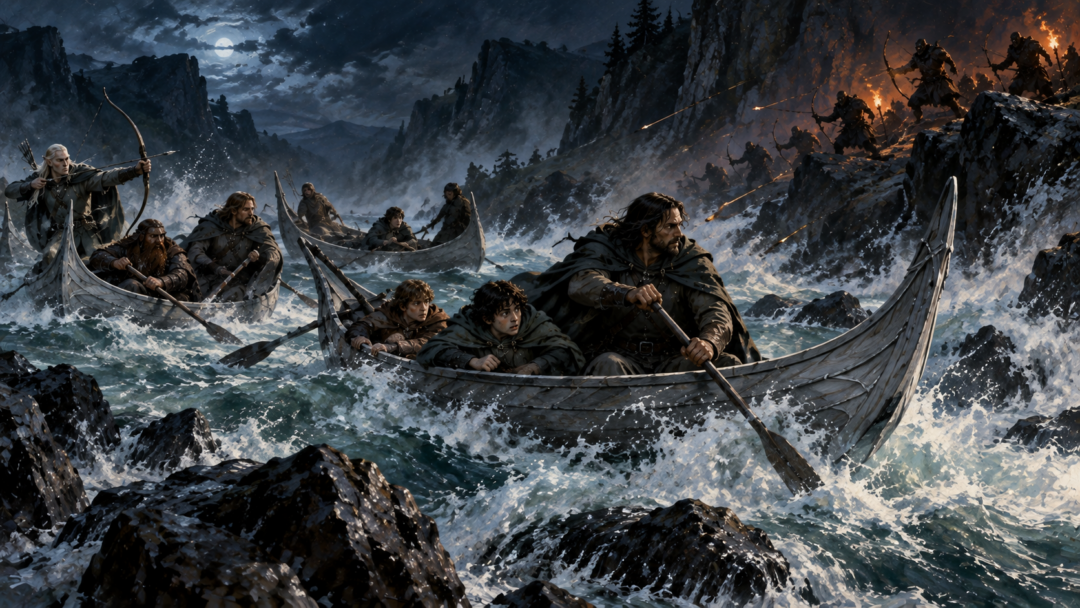
As the boats struggled near the eastern bank, arrows flew toward them.
Orcs were attacking from the shore.
One arrow struck Frodo between the shoulders, but his concealed mithril coat prevented it from piercing him. Other arrows struck dangerously close to his companions.
The Fellowship was caught between two threats.
Ahead lay the rocks and rushing water of Sarn Gebir. Beside them waited armed enemies who could shoot at the boats while the current restricted their movements.
The Orcs had an advantage because the river’s geography was working against the travellers.
This encounter also demonstrated that moving by night did not guarantee secrecy.
The Company had attempted to reduce its exposure, yet hostile forces were still able to attack.
The text does not conclusively explain how those Orcs came to be waiting there.
Sam blamed Gollum, but that remained his suspicion.
What the episode establishes beyond doubt is that the eastern bank could become deadly, particularly where the river made escape difficult.
The Anduin was not a protected passage through enemy territory. It was a route whose dangers could converge without warning.
The Winged Shadow Above the River
The ambush became even more terrifying when a great winged shape appeared against the night sky.
Frodo felt an overwhelming chill and dread as it approached.
Legolas drew his bow and shot at the creature, bringing it down into the darkness.
The immediate threat from the sky was broken, and the Orc attack ceased.
The Company did not yet possess a complete understanding of what Legolas had struck. The narrative later establishes the connection between the winged creature and the Nazgûl.
For the Fellowship, the incident was another warning that concealment had limits.
Danger did not come only from men or Orcs watching the riverbanks.
The servants of the Enemy could also threaten travellers from above.
This made the choice of when and where to travel more difficult than a simple preference for darkness.
Night protected the Fellowship from some forms of observation, but it was not itself a shield against the powers pursuing the Ring.
Why the Fellowship Had to Travel by Day Again
After escaping the ambush, the Company found refuge on the western side of the river.
The next problem was Sarn Gebir itself.
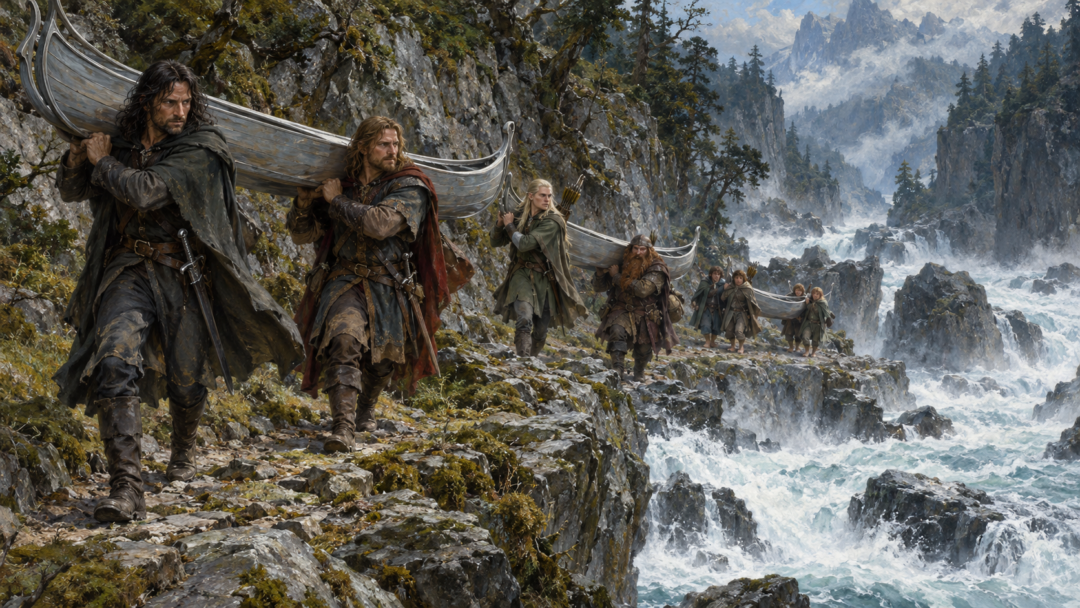
The rapids could not safely be navigated by their boats. The Fellowship therefore had to use an old portage-way along the western bank.
This required them to unload their belongings and carry the boats past the dangerous water.
The work took place during daylight.
That detail is essential to understanding the Company’s actual practice.
They did not refuse all movement while the sun was up. When the river demanded a different method of travel, they adapted.
The old path was difficult and neglected, making the passage laborious.
But it provided a way around the rocks that had nearly destroyed them.
Here, the logic of their journey changed again.
Concealment remained important, but avoiding the rapids became the immediate necessity.
The Fellowship could not allow a preference for night travel to override the physical realities of the river.
Survival required judgment rather than rigid adherence to a timetable.
The Anduin Was Carrying Them Toward a Greater Decision
Once the boats were launched again below Sarn Gebir, the Company continued southward.
They passed between the Argonath, the enormous stone figures of Isildur and Anárion marking the ancient northern approach to Gondor.
Beyond lay Nen Hithoel and the approach to the Falls of Rauros.
The river journey was nearing its end, but the greater question facing the Fellowship remained unresolved.
Would they turn toward Minas Tirith, as Boromir desired, or continue toward Mordor with the Ring?
Aragorn could guide the boats through much of the journey, but he could not make Frodo’s ultimate choice for him.
The changing dangers of the Anduin had brought the Company closer to the moment when it would have to decide how to proceed.
Even the river’s current could only carry them so far.
The Real Reason They Rowed by Night
The Fellowship’s night travel was not based on a mysterious rule about the Anduin or an assumption that darkness made the river safe.
It was an attempt to reduce the chances of discovery while moving through increasingly dangerous country.
The pattern of resting in concealment by day and rowing after dark reflected a practical compromise between secrecy and progress.
Yet the events near Sarn Gebir exposed the limits of that compromise.
The darkness that helped hide the boats also hid the rocks. The river that carried them forward also swept them toward enemies. The banks that offered shelter could conceal attackers.
And when the rapids blocked their passage, the Fellowship abandoned the boats temporarily and carried them overland in daylight.
That flexibility is the deeper lesson of the journey.
The Company survived not because it possessed a perfect method of travelling unseen, but because its members repeatedly adjusted to dangers they could neither predict nor entirely control.
On the Great River, secrecy was never the same as safety.
The Fellowship rowed by night because it feared being seen. At Sarn Gebir, it discovered how dangerous it could be not to see.
Sources & Notes
- Tolkien Gateway — The Great River. https://tolkiengateway.net/wiki/The_Great_River
- Tolkien Gateway — Sarn Gebir. https://tolkiengateway.net/wiki/Sarn_Gebir
- Tolkien Gateway — Gollum. https://tolkiengateway.net/wiki/Gollum
Primary text: The Fellowship of the Ring, Book II, “The Great River.” The sources cover night travel, the rapids and portage, and Gollum’s pursuit. Concealment versus navigational risk is a reading of this changing journey, not a permanent nautical rule.