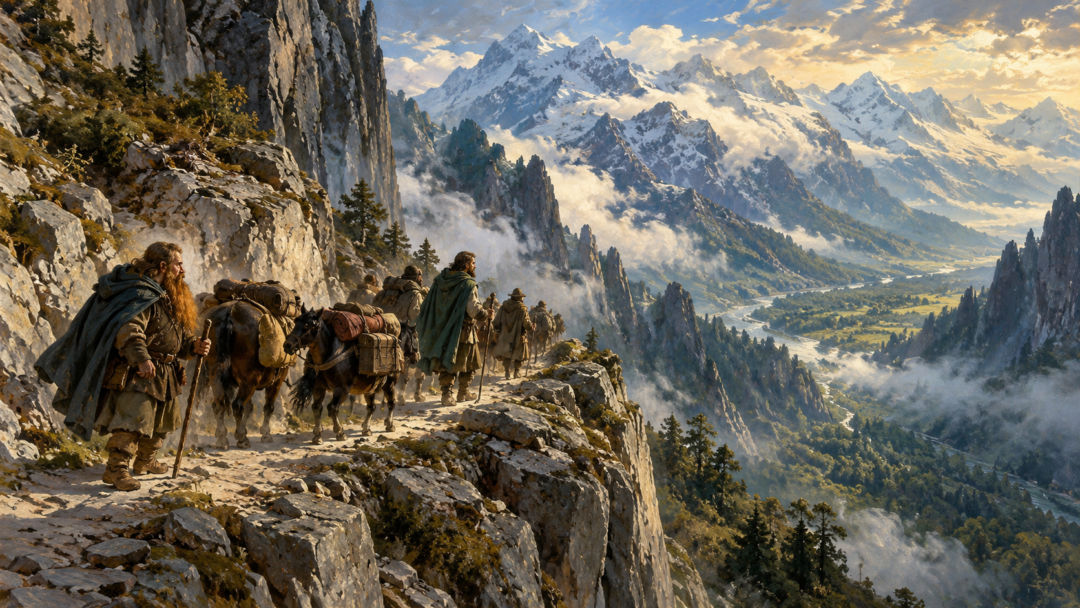
When Bilbo Baggins crossed the Misty Mountains with Thorin Oakenshield’s company, the greatest danger was not simply the height of the mountains. It was the uncertainty of what waited along the road.
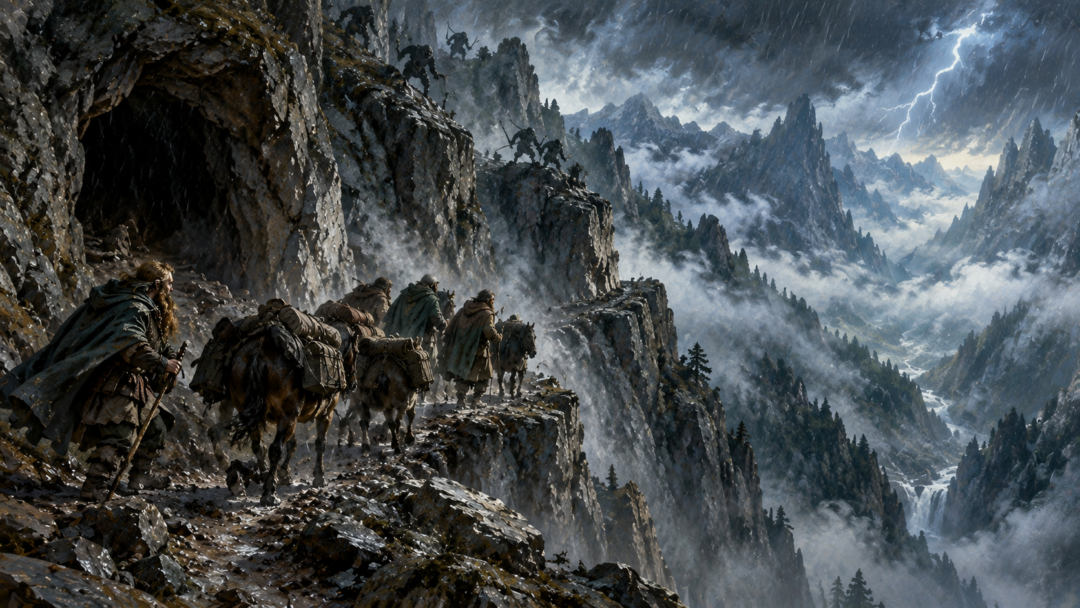
A storm drove the travellers into a cave. Goblins captured them. Their intended crossing became a desperate struggle for survival.
Yet the same mountain range had once carried armies, travellers, and connections between distant peoples. Its passes were not merely obstacles. They were vital links between western and eastern Middle-earth.
After Sauron’s defeat and the restoration of the northern and southern kingdoms under Aragorn, what might safer passage through the Misty Mountains have changed?
The surviving histories do not describe a comprehensive Fourth Age programme of mountain-road reconstruction. Nor do they provide trade figures, merchant agreements, or evidence that every dangerous crossing became secure.
Nevertheless, the geography of Middle-earth and the experiences of earlier travellers allow a meaningful exploration.
If the established mountain corridors became more dependable, the greatest transformation might not have been shorter journeys. It might have been journeys that ordinary people could undertake with greater confidence.
The Misty Mountains Divided More Than Landscapes
The Misty Mountains formed an immense north-south barrier between Eriador in the west and the lands surrounding the upper Anduin and Wilderland in the east.
Westward lay the Shire, Bree-land, the surviving settlements of Eriador, and the territories associated with the restored northern kingdom.
Eastward lay the Vales of Anduin, the Woodland Realm, and the more distant communities of Dale and Erebor.
These regions were not completely isolated during the Third Age.
Dwarves travelled along the East Road through the Shire and Bree-land. Bilbo’s journey demonstrates that travellers could cross the mountains and continue towards the Lonely Mountain. The history of Dale also establishes that commerce between Men and Dwarves had long been important around Erebor.
But a route existing on a map did not guarantee that it was dependable.
For merchants carrying valuable goods, the possibility of robbery, capture, severe weather, or an impassable road could matter as much as the distance itself.
The High Pass: The Northern Connection
The High Pass, also called the Pass of Imladris, crossed the Misty Mountains east of Rivendell.
It was associated with an ancient route leading towards the Vales of Anduin and the Old Forest Road beyond.
In Unfinished Tales, the account of the Disaster of the Gladden Fields describes the ancient road and the northern mountain crossing associated with Isildur’s intended journey towards Rivendell.
The route had considerable historical importance. During the preparations for the Last Alliance, the passage across the mountains and the crossing of the Anduin formed part of a major east-west connection.
Yet by the late Third Age, the High Pass had become dangerous.
In The Hobbit, the company encounters hostile weather and falls into the hands of the goblins inhabiting the mountains.
Later, in The Lord of the Rings, the northern regions around the mountains remain associated with Orcs and other dangers.
A crossing that had once supported significant movement could become unreliable without disappearing geographically.
For Fourth Age trade, a safer High Pass would therefore represent the recovery of an established connection rather than the invention of an entirely new one.
In a hypothetical period of greater security, travellers from Eriador could have found it easier to reach the Anduin valley and continue towards eastern communities.
That would not automatically make the whole journey to Erebor safe. Rivers, forests, weather, and the condition of connecting roads would still matter.
But removing one major source of uncertainty could change how often travellers were willing to attempt the route.
The Redhorn Pass: A Different Kind of Difficulty
Farther south stood another important crossing: the Redhorn Pass beneath Caradhras.
This route connected the region of Eregion with Dimrill Dale on the eastern side of the Misty Mountains.
Its ancient significance was closely associated with Khazad-dûm and the surrounding lands.
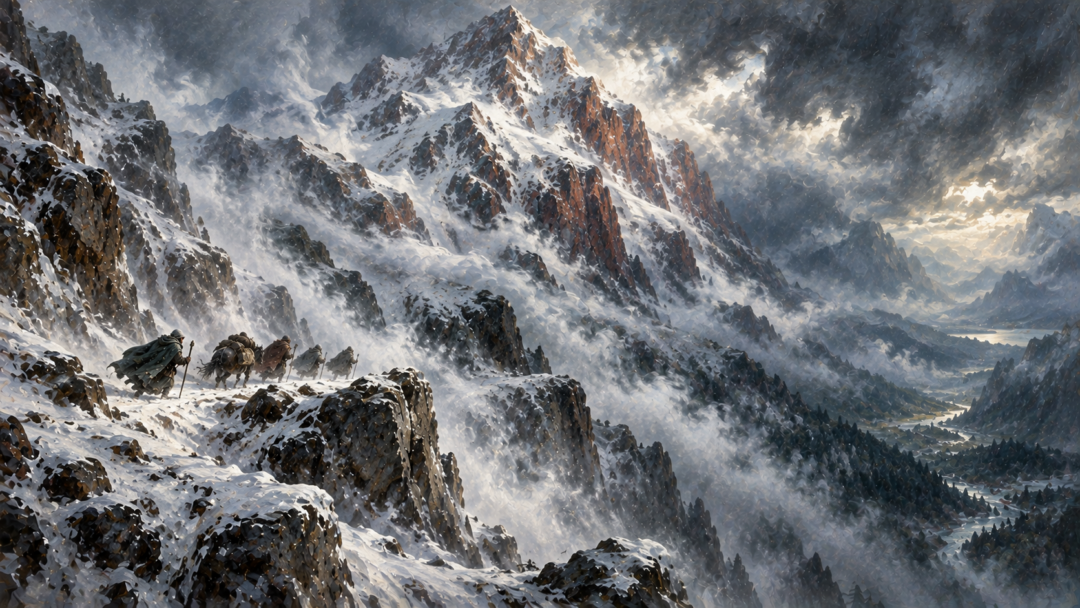
Yet the Fellowship’s attempt to cross Caradhras demonstrates why political peace alone could never guarantee safe mountain travel.
Snow, wind, and the mountain’s dangerous terrain forced the company to turn back.
The narrative leaves room for uncertainty about the precise agency behind the hostile conditions, but the physical danger is unmistakable.
A restored kingdom could defeat enemies and protect roads. It could not abolish winter.
This makes the Redhorn Pass an important comparison with the High Pass.
The northern crossing illustrates the danger posed by hostile inhabitants. Caradhras demonstrates the continuing power of geography and weather.
Even in a peaceful Fourth Age, the Redhorn route would presumably remain difficult during severe conditions.
Travellers would need reliable information about seasonal conditions, usable approaches, and the safety of the surrounding country.
These are reasonable practical inferences, not documented Fourth Age policies.
Why Moria Cannot Simply Be Treated as an Open Road
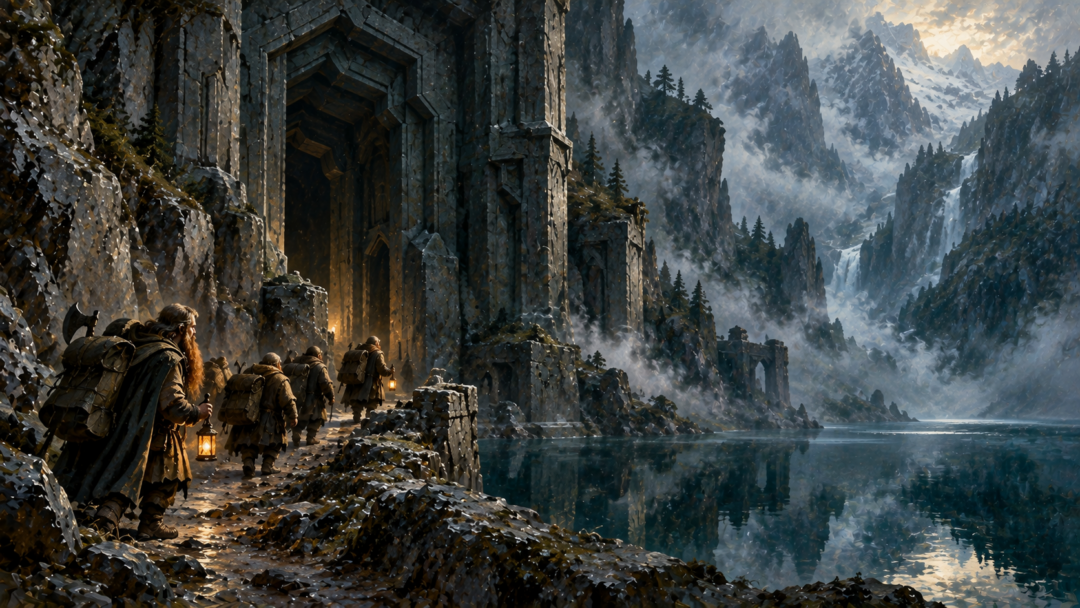
Khazad-dûm had once been one of the greatest centres of Dwarven civilization. Its western and eastern entrances connected regions separated by the mountains.
In the Second Age, the friendship between the Dwarves of Khazad-dûm and the Elves of Eregion gave this connection particular importance.
But the great Dwarven realm eventually fell into darkness.
By the time of the Fellowship, Moria was a place of danger, inhabited by Orcs and overshadowed by the Balrog.
Gandalf’s victory over the Balrog removed that terrible being, but it did not establish that Moria immediately became a secure commercial passage.
Later traditions concerning Durin VII associate him with the eventual return of Durin’s Folk to Khazad-dûm during the Fourth Age.
However, the surviving material does not establish a precise timetable for reopening its routes to ordinary commerce.
It would therefore be misleading to describe Moria as an operating Fourth Age trade highway.
The more defensible possibility is conditional.
If Dwarven settlement and security were eventually restored, the old underground connections might again have become important.
Until then, the Redhorn Pass and other established routes must be considered independently of any assumed reopening of Moria.
The Gap of Rohan: The Alternative That Already Existed
Not every journey between eastern and western Middle-earth required crossing the high mountains.
At the southern end of the Misty Mountains lay the Gap of Rohan.
This broad passage between the Misty Mountains and the White Mountains connected regions that could otherwise be separated by the mountain barrier.
Its strategic importance appears repeatedly in the history of Rohan, Isengard, and the western approaches to Gondor.
The Gap offers a useful comparison because it shows that safer northern crossings would not necessarily create access where none existed.
Instead, they could provide alternatives to longer journeys around the mountains.
For someone travelling between northern Eriador and the upper Anduin, a dependable High Pass might be more practical than a great southern detour.
For travellers whose destinations lay farther south, the Gap of Rohan could remain preferable.
The best route would depend on origin, destination, season, and conditions.
This is why the economic significance of safe passage cannot be reduced to a single claim that every journey would become faster.
The more important change would be the availability of dependable choices.
The Fourth Age Created New Possibilities, Not Guaranteed Outcomes
The defeat of Sauron transformed the political circumstances of northwestern Middle-earth.
Aragorn became King Elessar, ruling the Reunited Kingdom of Arnor and Gondor.
The northern kingdom was restored, while the southern kingdom emerged from the War of the Ring with renewed royal authority.
Elsewhere, the surviving communities of Dale and Erebor continued into the new age after enduring the northern battles of the war.
These developments created a different setting from the fragmented and threatened world of the late Third Age.
Yet they did not establish that all hostile creatures vanished.
The destruction of Sauron ended his dominion, not every possible source of danger across Middle-earth.
Nor does the restoration of royal authority prove that distant mountain roads were immediately repaired, patrolled, or regularly maintained.
Such developments remain hypothetical.
Nevertheless, the political changes make the question worth asking.
If communities were increasingly able to maintain peaceful relationships, improved travel security could have reinforced those connections.
Why Predictability Could Matter More Than Speed
Consider two hypothetical merchants attempting to cross the Misty Mountains.
One chooses a relatively short route threatened by ambushes and uncertain passage.
The other follows a longer but more dependable road.
The second merchant might arrive later under ideal conditions, yet face less risk of losing an entire journey.
Reliable passage would make it easier to plan departures, arrange meetings, and expect travellers to return.
It might also encourage journeys that were previously considered too dangerous to attempt.
The texts provide an especially useful precedent in the movements of Dwarves along the East Road.
Their travels through Bree-land and the Shire connected comparatively sheltered communities with events and peoples farther away.
They carried news as well as participating in wider networks of movement.
The potential Fourth Age benefit was therefore not limited to merchandise.
Safer roads could also support the circulation of information, craftsmanship, and personal relationships.
None of these outcomes is recorded as a measured Fourth Age economic transformation.
They are plausible consequences of reducing the risks demonstrated throughout the earlier narratives.
What Could Change for Dale, Erebor, and the Western Lands?
Before Smaug destroyed Dale, the town had prospered through its relationship with the Dwarves of the Lonely Mountain.
The Hobbit describes a world in which Dwarven craftsmanship and the activities of neighbouring communities supported an important regional economy.
After Smaug’s death, Dale was rebuilt under Bard, and the Kingdom under the Mountain was restored under Dáin Ironfoot.
By the end of the Third Age, these northern realms had survived another terrible conflict.
A safer connection westward across the Misty Mountains might have made journeys between these regions and Eriador more attractive.
Dwarven travellers could potentially have found more dependable access to western communities, including those connected with the Blue Mountains.
Merchants from the west might have faced fewer obstacles when travelling towards the Anduin and beyond.
But there are important limits.
The High Pass did not lead directly to Erebor. Travellers still had substantial distances to cover through Wilderland.
The Woodland Realm, river crossings, and the condition of eastern roads would all influence the usefulness of any mountain improvement.
It is therefore more accurate to imagine stronger possibilities for contact than to claim a documented expansion of trade.
The Quiet Importance of Ordinary Travellers
The great histories of Middle-earth frequently describe journeys undertaken by kings, warriors, messengers, and exceptional companions.
Yet roads also matter to people whose names never enter chronicles.
A safer crossing could affect a craftsman seeking work, a Dwarf visiting distant kin, or a traveller carrying news between settlements.
These are illustrative possibilities rather than recorded Fourth Age individuals.
Bilbo’s company survived the Misty Mountains through courage, assistance, and extraordinary circumstances.
A healthy network of connections cannot depend on every traveller possessing such advantages.
If passage became dependable enough for less exceptional travellers, the social meaning of the mountains could gradually change.
They would remain a formidable geographical boundary, but perhaps become less of a barrier between communities.
That possibility fits the broader theme of renewal associated with the beginning of the Fourth Age without requiring an invented account of specific reforms.
What the Surviving Histories Actually Allow Us to Conclude
The High Pass was an ancient crossing connecting western lands with the Anduin valley.
The Redhorn Pass offered another route but remained vulnerable to severe mountain conditions.
Moria had once connected peoples across the mountains, although its later commercial reopening cannot be assumed.
The Gap of Rohan provided a southern alternative.
The Fourth Age began with major political changes, including the restoration of the Reunited Kingdom and the survival of important northern realms.
What the texts do not establish is equally important.
They do not describe a comprehensive system of Fourth Age mountain patrols, record a network of new trade treaties across the passes, or quantify an economic revival resulting from safer crossings.
Those claims would go beyond the surviving evidence.
The strongest conclusion is therefore conditional.
If the established passages through the Misty Mountains became safer and more dependable, communities on opposite sides could have gained more regular opportunities to exchange goods, knowledge, and visits.
The scale of that change would depend on conditions elsewhere along the routes.
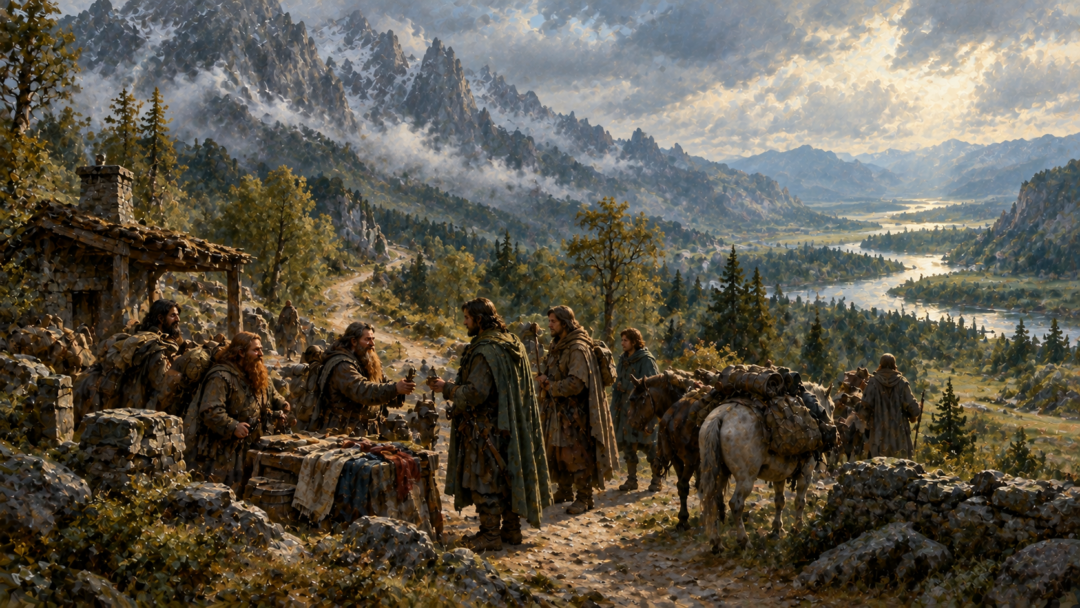
The Greatest Change Would Be the Freedom to Travel
The Misty Mountains would never cease to be mountains.
Their steep slopes, dangerous weather, and difficult approaches would remain part of Middle-earth’s geography long after Sauron’s defeat.
But the history of their roads reveals something important.
A route can connect two regions on a map while remaining too dangerous for ordinary people to use confidently.
Conversely, a familiar road can become far more valuable when travellers no longer expect disaster at every crossing.
For the Fourth Age, this offers a compelling possibility.
The renewal of Middle-earth need not be imagined only through restored thrones, rebuilt cities, and the defeat of great enemies.
It could also be understood through the quieter consequences of peace: journeys undertaken more freely, distant communities remaining in contact, and ancient routes becoming useful again.
The surviving texts do not tell us how fully that possibility was realized.
But they give us enough to understand why it would matter.
The greatest gift of safer passage through the Misty Mountains might not have been faster trade. It might have been making the road between distant peoples feel possible again.
Sources & Notes
- Tolkien Gateway — High Pass. https://tolkiengateway.net/wiki/High_Pass
- Tolkien Gateway — Redhorn Gate. https://tolkiengateway.net/wiki/Redhorn_Gate
- Tolkien Gateway — Beornings. https://tolkiengateway.net/wiki/Beornings
Primary text: The Hobbit, “Over Hill and Under Hill”; The Fellowship of the Ring, “The Ring Goes South” and “Many Meetings”; Unfinished Tales, “The Disaster of the Gladden Fields.” The cited routes and Beorning protection are attested; the proposed Fourth Age trade consequences are explicitly hypothetical, not a documented reconstruction programme.