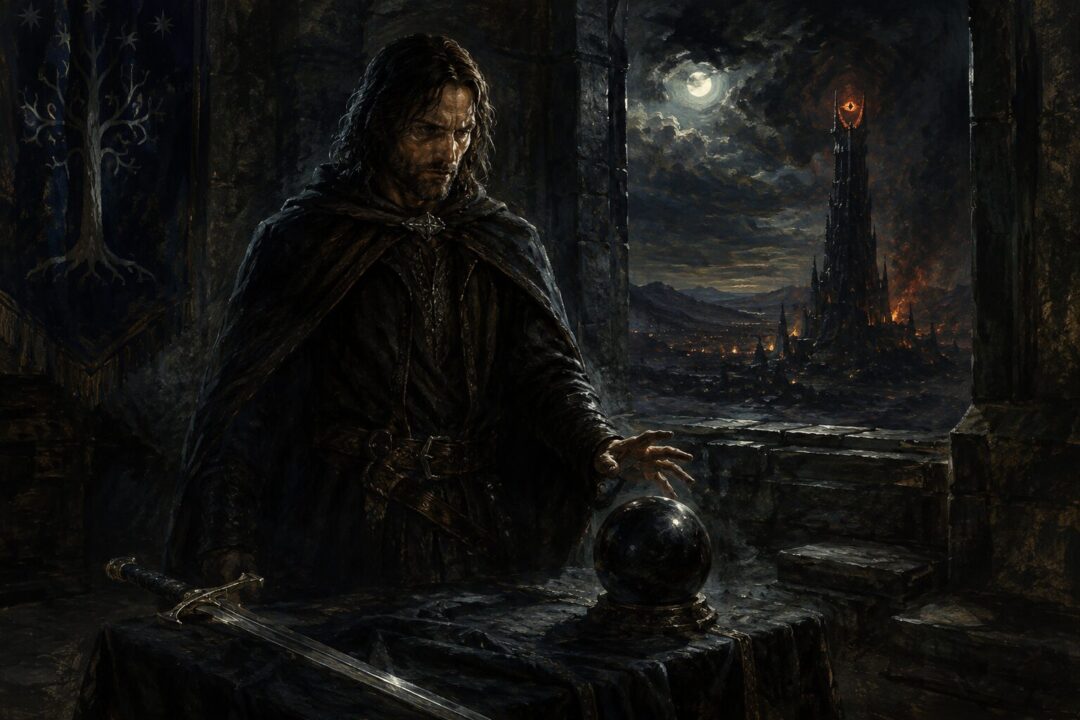
The palantír of Orthanc was not merely a magical seeing-stone. In Aragorn’s hands, it became a battlefield.
That is easy to miss. In many memories of The Lord of the Rings, Aragorn’s confrontation with Sauron feels like a dramatic gesture of defiance: the hidden king reveals himself, Sauron is shaken, and the war moves toward its final stage. But in the book, the moment is stranger, riskier, and more consequential. Aragorn is not simply “calling” Sauron. He is taking up an ancient royal instrument that has already helped ruin Saruman, terrify Pippin, and deepen Denethor’s despair.
The danger was not only that Sauron might see him. The danger was that Aragorn might be mastered.
The Stone Was Already in Enemy Territory
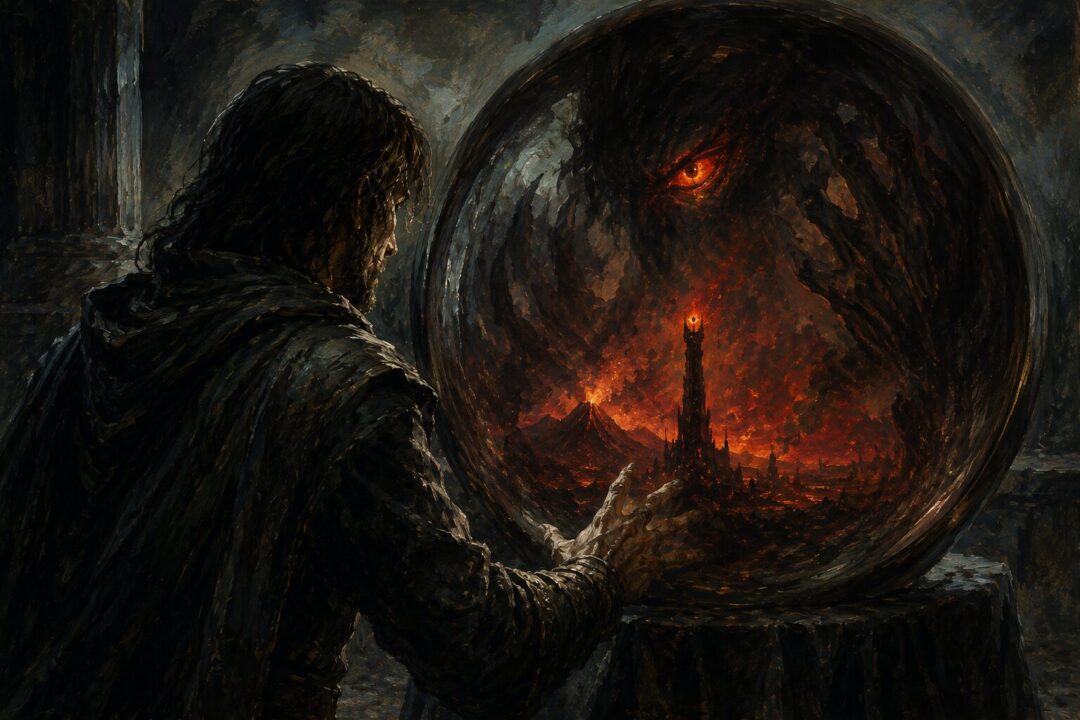
The Orthanc-stone had once belonged to the realm of Gondor. It was one of the palantíri brought to Middle-earth by the Númenóreans, made for far-seeing and communication between distant towers and kingdoms. In their proper use, the stones were instruments of ordered rule: kings and stewards could look across their lands, exchange counsel, and understand events from afar.
By the late Third Age, that older world had decayed. The Ithil-stone had fallen into Sauron’s hands when Minas Ithil became Minas Morgul. Saruman had used the Orthanc-stone and become entangled with the will of Mordor. Denethor used the Anor-stone in Minas Tirith, and though he was strong enough not to be simply enslaved, what he saw helped feed his hopelessness.
So when Aragorn takes the Orthanc-stone, he is not picking up a neutral tool. He is entering a line of corrupted sight. The palantír can show true things, but truth without wisdom can still destroy. That is one of the hidden rules of the stones: they do not need to lie in order to deceive.
Aragorn Had the Right — But Right Was Not Safety
Aragorn’s claim mattered. He was Isildur’s heir, descendant of the kings who had lawful authority over the stones. This is one reason his use of the palantír differs from Saruman’s or Pippin’s. He is not a thief, a meddler, or a servant trying to steal forbidden knowledge. He is the returning heir taking up a perilous inheritance.
But rightful claim did not make the act safe.
Aragorn himself says the struggle was hard. He does not treat the moment as easy triumph. He wrests the stone to his own purpose, but only after a contest of wills. That distinction is crucial. Aragorn does not defeat Sauron in full. He does not overpower the Dark Lord as a greater being. He wins mastery of this encounter, through right, strength of will, timing, and courage.
That is far more dangerous than a simple heroic challenge. Aragorn stands before the mind that broke kingdoms, corrupted Númenórean ambition, and dominated lesser wills. The palantír gives Sauron a path of contact. Aragorn’s gamble is that he can reveal enough to frighten and mislead Sauron without exposing the true mission of the Ring.
What Aragorn Shows Sauron
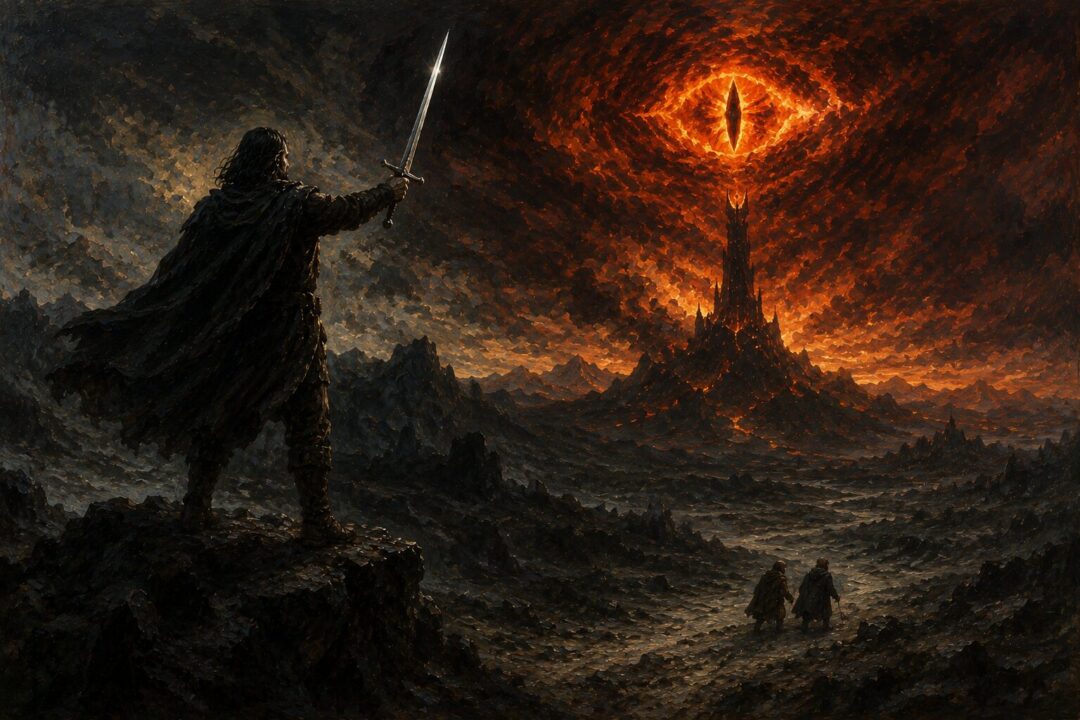
In the book, Aragorn reveals himself as Isildur’s heir and shows Sauron the reforged sword. That is not theatrical vanity. It is psychological warfare.
Sauron knows the sword. The blade that cut the Ring from his hand has returned. The line of Elendil has not failed. A king has come out of hiding and now dares to use a stone that Sauron expected to dominate through fear.
This matters because Sauron’s greatest blind spot is not ignorance. It is pride. He assumes others will seek power as he seeks it. When Aragorn reveals himself, Sauron is encouraged to believe that the Heir of Isildur may now possess the Ring and is preparing to challenge him openly.
That false conclusion is the heart of the gamble. Aragorn does not need Sauron to believe a lie spoken aloud. He needs Sauron to interpret a true sign wrongly.
The Real Prize Was Time
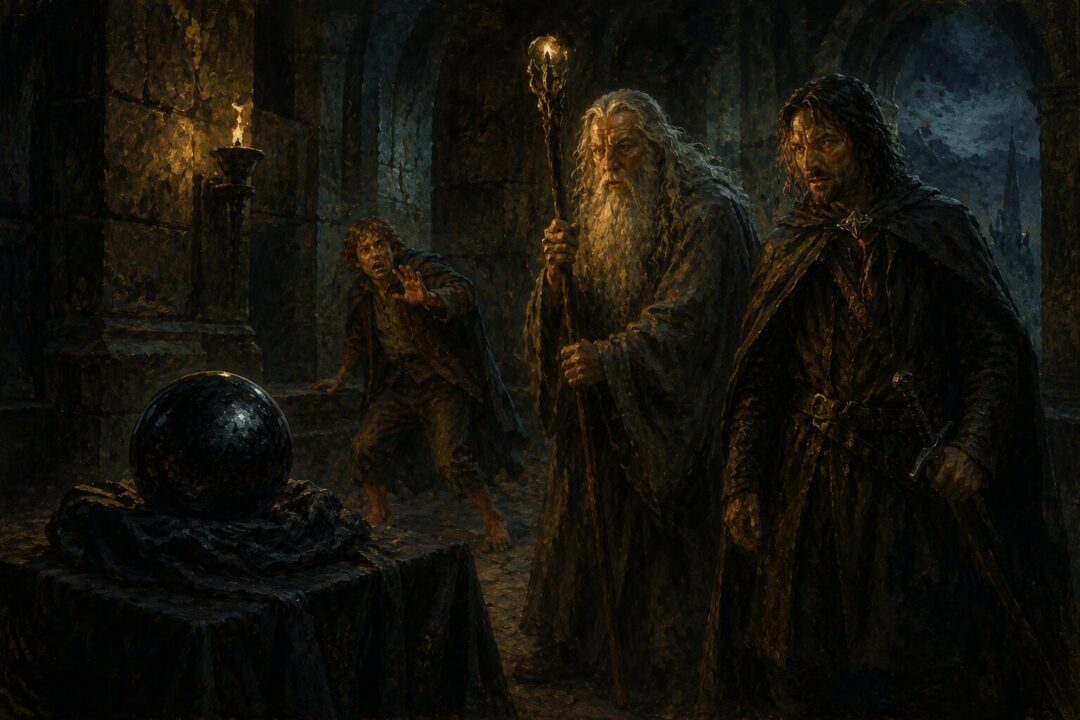
Frodo and Sam were approaching Mordor by a path Sauron did not truly understand. The Wise knew that the Ring could not be used safely against him, but Sauron did not believe his enemies would choose destruction over possession. Aragorn’s revelation helped draw Sauron’s attention toward the visible war: Minas Tirith, the heir of Elendil, the sword reforged, and later the march to the Black Gate.
This is why the act is so costly. Aragorn is not merely trying to look brave. He is making himself bait.
He places his identity, his kingship, and perhaps his life under Sauron’s gaze in order to protect the hidden Ring-bearer. The more convincing Aragorn appears as a rival claimant to power, the less likely Sauron is to imagine two small hobbits moving through the shadow with the Ring.
The Stone Also Shows Aragorn the Corsair Threat
Aragorn’s use of the palantír is not only a challenge to Sauron. It also gives him vital knowledge: he sees the danger from the Corsairs of Umbar moving toward Gondor.
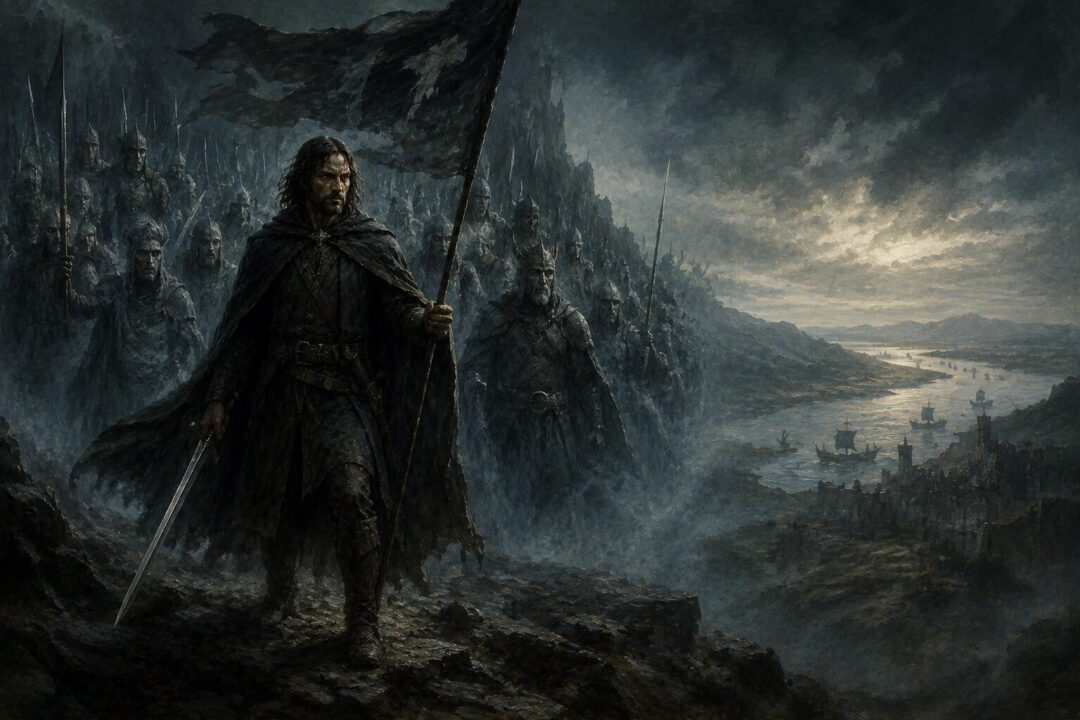
This vision changes his path. He does not simply ride with the Rohirrim to Minas Tirith. Instead, he takes the Paths of the Dead, summons the oath-breakers, defeats the Corsairs, and comes to the Pelennor in the captured ships. Without that knowledge, the defense of Minas Tirith might have unfolded very differently.
This makes the palantír moment even more layered. Aragorn risks spiritual domination and strategic exposure, but he gains the information needed to act decisively. He sees enough to understand where he must go — and then chooses the road almost no living man would dare take.
Why the Movie Version Feels Smaller
Adaptations often turn inner contests into visible scenes. That is understandable. But the book’s version is more unsettling because much of the danger is invisible.
There is no need for Sauron to physically appear in the room. The horror lies in the fact that looking can become a form of combat. The stone is not a window only; it is a channel. Pippin’s earlier encounter proves how quickly an unprepared mind can be exposed. Saruman’s fall shows how long-term use can bend ambition toward Mordor. Denethor’s despair shows that even true visions can become poisonous when filtered through fear.
Aragorn walks into that same peril with open eyes.
The movies emphasize the drama of defiance. The book emphasizes the cost of command. Aragorn is not reckless in the shallow sense, but he is willing to take a risk that only he can take. Gandalf does not casually encourage such use. The palantír is dangerous, and Aragorn’s strength does not make him immune to danger. It makes him responsible for facing it.
The Difference Between Aragorn and Denethor
Aragorn and Denethor form one of the great contrasts of the War of the Ring. Both are proud. Both are strong. Both are connected to Gondor’s ancient authority. Both look through a palantír while Sauron holds another.
But their responses differ.
Denethor sees much that is true: the might of Mordor, the Black Fleet, the scale of the coming assault. Yet his sight becomes enclosed. He reads the future through despair and control. He cannot imagine deliverance arriving in a form he does not command.
Aragorn also sees danger. But he does not surrender to it. He acts. He takes the road of the Dead, not because it is safe, but because it is necessary. Where Denethor’s knowledge narrows into hopelessness, Aragorn’s knowledge becomes service.
The point is not that Aragorn is simply stronger. It is that he uses sight differently. He does not seek the palantír to possess certainty. He uses it to accept a burden.
A King Revealed Before He Is Crowned
Another reason the moment matters is that Aragorn reveals himself before he has any outward security. He is not yet crowned in Minas Tirith. He has no throne, no settled kingdom, and no guarantee of victory. His kingship at this stage is still a claim carried through peril.
That makes his confrontation with Sauron profoundly symbolic. Aragorn is not using power from a place of comfort. He is declaring himself while the outcome is still uncertain. In doing so, he accepts the ancient burden of his house: to stand against the Shadow even when victory is not assured.
The reforged sword is therefore more than a weapon. It is a memory returned to history. Sauron is forced to confront the possibility that what he thought broken has been renewed.
The Gamble Worked Because It Was Not About Glory
Aragorn’s palantír gamble succeeds because it serves the larger strategy of humility. That may sound paradoxical, since revealing himself to Sauron is a bold and kingly act. But Aragorn’s aim is not self-exaltation. He is not trying to win the Ring for himself or prove that he can master the Enemy’s power.
He is helping conceal the only plan that can actually defeat Sauron.
That is the irony. Aragorn looks like the obvious threat precisely so the true threat remains hidden. The king draws the Eye so the Ring-bearer can pass unseen. His greatness is real, but it is placed in service of someone smaller, weaker, and almost unknown to the Enemy.
This is why the scene is one of the most important acts of leadership in the story. Aragorn does not merely fight battles. He understands what kind of story Sauron expects to be in — a story of rulers, weapons, domination, and rival claims. Then he uses that expectation against him.
The Most Dangerous Victory Is Still a Wound
Aragorn wins the contest of the palantír, but it is not a clean or easy victory. The text treats it as exhausting and perilous. He has looked directly toward the will of Mordor and forced the stone to serve him. That triumph comes with strain.
This matters because Tolkien’s world rarely treats power as harmless. Even rightful power has weight. Even necessary choices leave marks. Aragorn’s greatness is not that he can use dangerous things without consequence. His greatness is that he knows the danger and still chooses the burden when the need is great enough.
The palantír gamble was more dangerous than a dramatic staredown. It was a contest over sight, fear, interpretation, and kingship. It risked Aragorn’s mind. It risked revealing too much. It risked provoking Sauron at the worst possible moment.
And yet it helped save the Quest.
Not because Aragorn defeated Sauron by force, but because he understood the Enemy’s pride. He let Sauron see the king — and hid the hobbit.
Sources & Notes
- J.R.R. Tolkien, The Lord of the Rings, Book III, Chapter 11, “The Palantír” — Gandalf explains the seeing-stones, the Orthanc-stone’s peril, and why Sauron’s possession of another stone made any use dangerous.
- J.R.R. Tolkien, The Lord of the Rings, Book V, Chapter 2, “The Passing of the Grey Company” — Aragorn says he used the Orthanc-stone, showed Sauron the reforged sword, mastered the Stone, and saw the Corsair threat.
- J.R.R. Tolkien, The Lord of the Rings, Book V, Chapter 9, “The Last Debate” — Gandalf and Aragorn frame the march on Mordor as a deliberate attempt to draw Sauron’s Eye away from Frodo.
- J.R.R. Tolkien, The Lord of the Rings, Book V, Chapter 7, “The Pyre of Denethor” — Denethor’s despair and the Anor-stone show how true visions through a palantír could still be turned toward ruin.
- J.R.R. Tolkien, Unfinished Tales, “The Palantíri” — gives the wider history and rules of the stones, including lawful use, orientation, and the danger once the Ithil-stone was in Sauron’s hands.