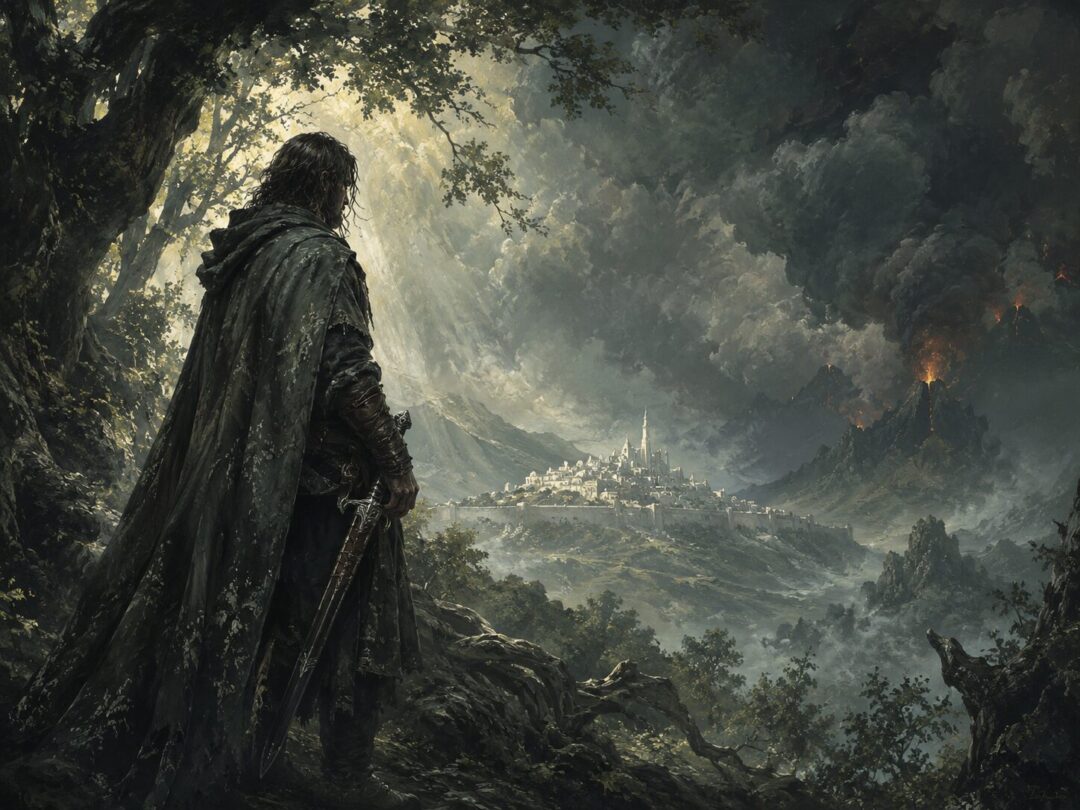
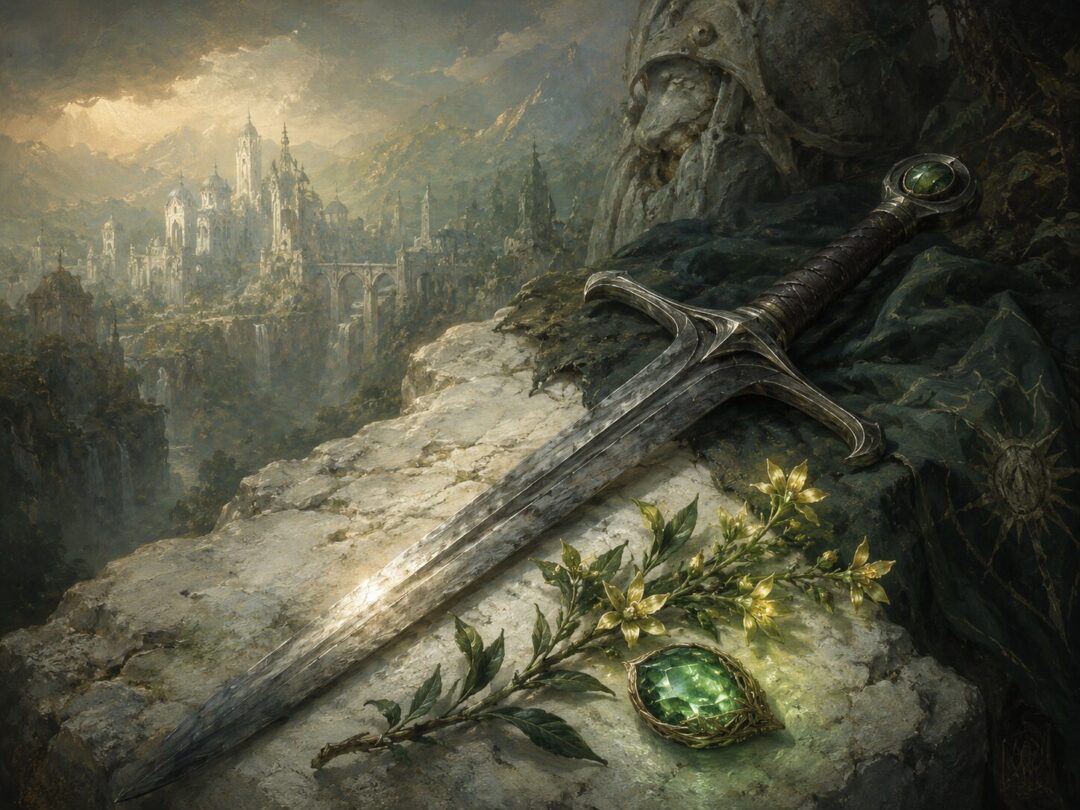
Andúril is one of the most recognizable objects in The Lord of the Rings: the reforged sword of Elendil, the blade that had once cut the Ring from Sauron’s hand. In another kind of story, that would be enough. The lost king would return, lift the ancient weapon, and prove himself by force.
But Aragorn’s deepest power was never simply that he carried a famous sword.
The sword mattered. It connected him to Elendil, Isildur, Arnor, Gondor, and the long memory of the Dúnedain. It was a visible sign that the line of kings had not vanished. Yet the story is careful to show that Aragorn does not become king because he owns a weapon. He becomes king because he can do what a true king must do: endure without being corrupted, command without domination, heal what war has broken, and bring hope without pretending that hope is easy.
Andúril could frighten enemies. Aragorn’s real authority could make the fearful stand, the wounded breathe again, and even the dead answer an old oath.
The Sword Was a Sign, Not the Source
When the shards of Narsil are reforged in Rivendell, Aragorn receives more than a weapon. He receives a public sign that the hidden heir is no longer merely waiting in exile. The sword is renamed Andúril, the Flame of the West, and it carries the memory of Elendil into the last struggle against Sauron.
Yet even here, the sword is not magic in the simple sense of “whoever holds it wins.” Its power is symbolic, dynastic, and moral. It says: the old defeat was not the end. The line that failed to destroy the Ring has survived long enough to face the Shadow again.
That distinction matters. Boromir has martial courage. Théoden has a king’s battlefield nobility. Éomer has fire, loyalty, and speed. Many warriors in the War of the Ring can kill. Aragorn’s difference lies elsewhere. He carries the sword of kings, but he spends much of the story proving that kingship is not the same thing as violence.
He does not seize command from others simply because he has the right name. In Rohan, he serves Théoden’s war. In Gondor, he does not immediately march into Minas Tirith demanding the throne. Even after the Pelennor, he waits outside the city in humility, because entering as a claimant before the proper time might deepen fear and political division.
That restraint is part of his power. The sword can announce a claim. Only wisdom can decide when not to press it.
The Hidden Strength of Strider
Before Aragorn is “Elessar,” he is Strider: weathered, suspicious-looking, and easily underestimated. This is not a disguise thrown away once the true king appears. It is part of what made him fit to rule.
As a Ranger, Aragorn has lived without glory. He has guarded lands that barely knew they were being guarded. Bree does not celebrate him. The Shire does not understand the labor of the Dúnedain. He spends years protecting people who would be frightened of him if they knew the truth.
That is one of the great ironies of his character: his kingship is formed not in palaces, but in obscurity.
This also explains why his authority feels different from Sauron’s. Sauron rules by surveillance, fear, deception, and the will to possess. Aragorn has learned the opposite discipline. He watches over the vulnerable without demanding worship. He carries ancient blood without turning it into arrogance. He knows hardship from the ground upward.
When the hobbits first meet him, his power is not obvious. He does not arrive crowned, armored, and obeyed. He appears as someone rough, secretive, and uncertain to strangers. The reader, like the hobbits, must learn that true nobility in Middle-earth is often veiled.
That is why Aragorn’s return works. He is not merely a hidden king revealed at the last moment. He is a man whose hidden years have trained him in patience, pity, endurance, and service.
His Command Over Fear
Aragorn’s authority becomes unmistakable in moments where ordinary courage is not enough. One of the clearest examples is the Paths of the Dead.
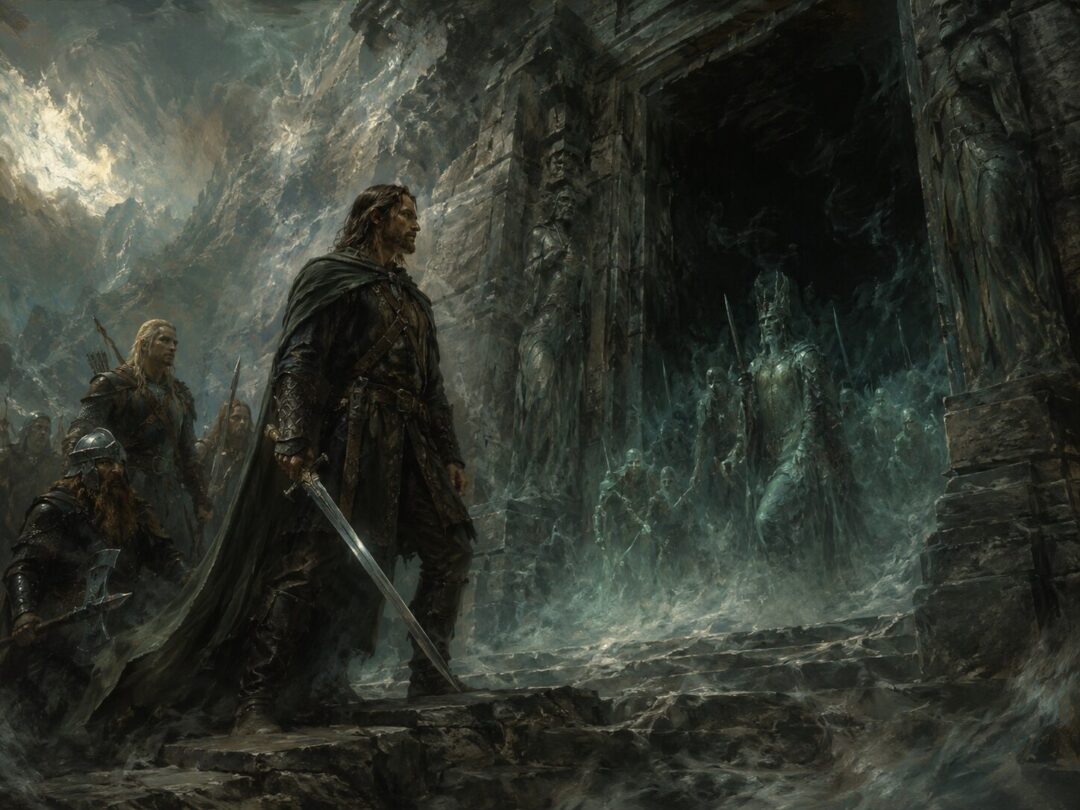
The Dead Men of Dunharrow are not defeated by Andúril in a normal battle. Aragorn does not overpower them as one warrior overpowers another. He calls them by right. Their story is bound to Isildur: they swore an oath and broke it, and their unrest remains tied to that ancient failure. Aragorn, as Isildur’s heir, can summon them to fulfill what they refused.
This is not brute force. It is lawful authority moving through history.
Even then, Aragorn does not use them as an endless supernatural army. In the book, the Dead fulfill their oath by bringing terror upon the Corsairs at Pelargir, allowing Aragorn’s forces to take the ships. After that, he releases them. They do not sweep across the Pelennor as a permanent weapon of conquest. Their service has a limit because their oath has a limit.
That detail is crucial. Aragorn’s power over the Dead is not necromancy. It is judgment, command, and release. He does not enslave the oathbreakers forever. He calls them to answer, and then he lets them go.
The same pattern appears elsewhere. Aragorn does not deny fear. He passes through it. He does not make others fearless by pretending danger is small. He gives them a reason to stand while knowing the darkness is real.
The Palantír and the Power to Reveal Himself
Another overlooked sign of Aragorn’s power is his use of the palantír of Orthanc.
The palantíri are dangerous not because they are evil in themselves, but because they expose the user to overwhelming wills and misleading visions. Saruman is corrupted in part through his dealings with one. Denethor is driven toward despair through another, though his case is complex and should not be reduced to simple weakness.
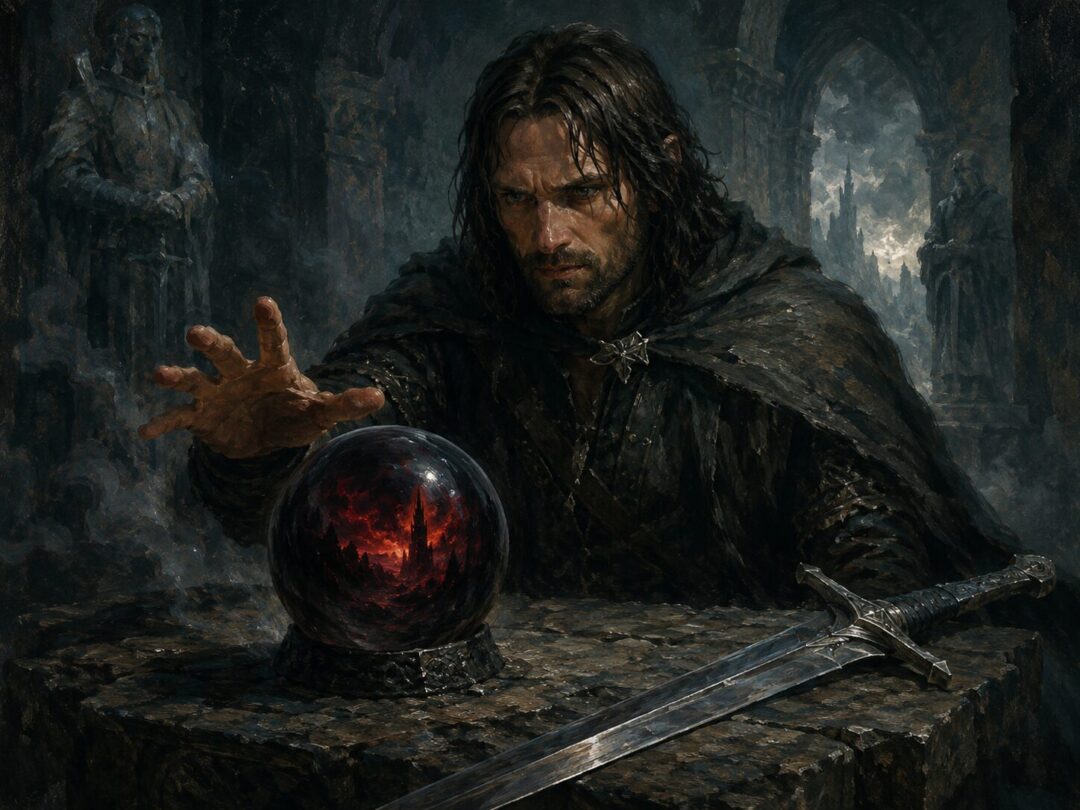
Aragorn’s use of the Stone is different. He has a rightful claim to it as heir of Elendil, and he possesses the strength to confront Sauron through it without being mastered. He reveals himself and shows the reforged sword, forcing Sauron to reckon with the return of Isildur’s heir.
This moment is not a simple victory. It is a gamble. Aragorn does not defeat Sauron through the Stone. He challenges him, draws his attention, and helps hurry the Enemy’s fear. The texts imply that this contributes to Sauron moving before his plans are fully ripe.
Again, the sword is present, but the real power is the will behind it. Andúril is what Aragorn shows. Aragorn himself is what Sauron must fear.
The courage here is not battlefield courage alone. It is the courage to be seen by the Enemy at exactly the right moment. For much of his life Aragorn has remained hidden. Now he reveals himself not for pride, but as part of a larger strategy of sacrifice and misdirection, buying space for Frodo and Sam in Mordor.
Healing as the Proof of Kingship
If one scene most clearly proves that Aragorn’s power was not his sword, it is the Houses of Healing.
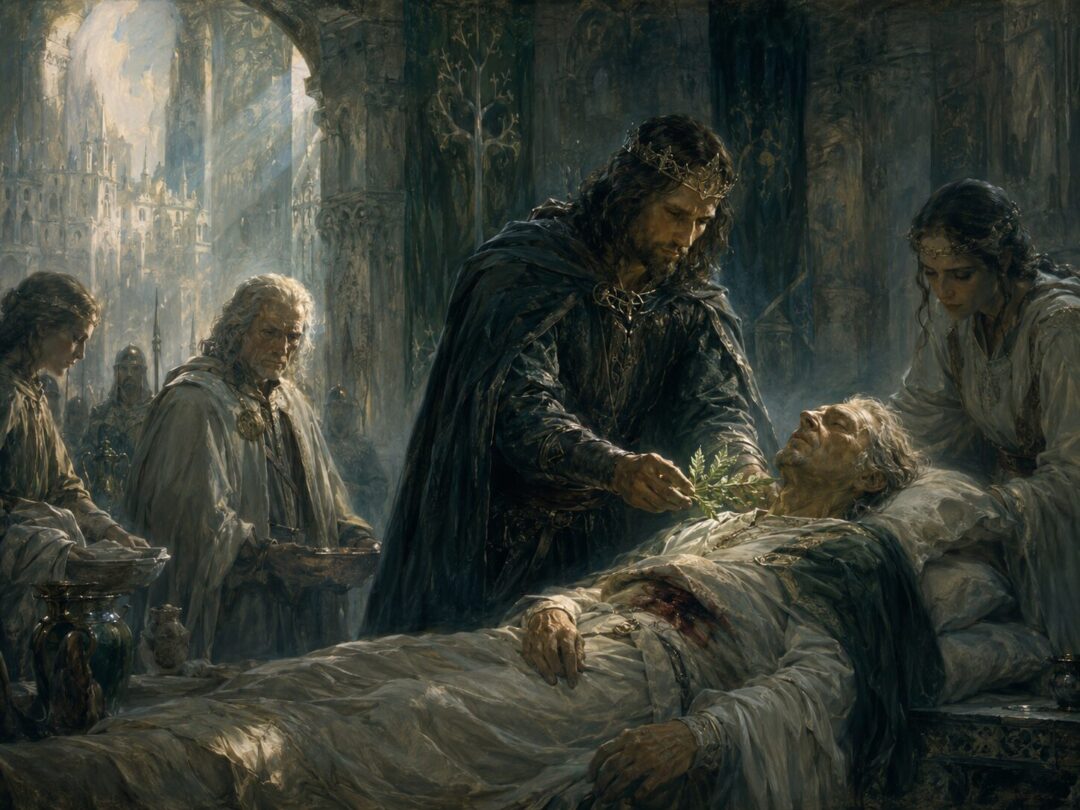
After the Battle of the Pelennor Fields, Minas Tirith is full of victory and grief. Faramir, Éowyn, and Merry are all suffering under wounds connected to the Black Breath and the shadow of the Nazgûl. This is where Aragorn’s kingship becomes known not through conquest, but through healing.
The old saying remembered in Gondor is that the hands of the king are the hands of a healer. This does not mean that any political claimant could prove kingship by performing a trick. It is lore, memory, and sign woven together. In Aragorn’s case, the sign fits the man.
He uses athelas, or kingsfoil, a plant known to common folk mostly as a fragrant herb with little understood value. Aragorn knows its deeper virtue. Yet the healing is not presented as herb-lore alone. His hands, words, presence, lineage, and knowledge all work together. He calls the wounded back from darkness.
This is the most radical image of power in the story. The returned king is not first recognized because he kills the most enemies. He is recognized because he restores life.
Faramir’s healing is especially meaningful. Gondor’s Steward lies near death, and Aragorn does not treat him as a rival obstacle to be removed. He saves him. The king’s return does not begin by crushing the Steward’s house, but by preserving it.
Éowyn’s healing is also morally rich. She has won great renown, yet her despair is not solved by glory. Aragorn can call her back from the shadow, but he does not claim her heart or rewrite her grief. Healing opens the door; it does not erase the path she must still walk.
Merry too is healed, and the smallness of the hobbit matters. Aragorn’s kingship is not only for great captains and noble houses. His care reaches the overlooked, the wounded, and the seemingly minor figures whose courage helped turn the age.
Mercy, Not Possession
Aragorn’s power is also shown by what he does not take.
He does not take the Ring from Frodo. This is one of the clearest differences between Aragorn and many other powerful figures. As Isildur’s heir, he carries the memory of the Ring’s great historical failure in his own bloodline. The temptation would be obvious: take the Ring, wield it against Sauron, repair the ancient defeat by strength.
But that road is closed. The Wise understand that using the Ring would mean becoming what they oppose. Aragorn’s greatness lies partly in accepting limits. He can lead armies, face Sauron through the Stone, command the Dead, and heal the wounded, but he cannot save Middle-earth by possessing the Enemy’s weapon.
That refusal is quiet but enormous. In a story obsessed with power, Aragorn’s legitimacy depends on renunciation as much as action. He is strong enough not to grasp at the thing that would make him appear strongest.
This also explains his relationship to Frodo. Aragorn protects the Ring-bearer, but he does not replace him. He understands that the fate of the world may depend on someone smaller, weaker, and less kingly in outward appearance. A lesser ruler might resent that. Aragorn honors it.
The King Who Restores More Than a Throne
By the end of the War of the Ring, Aragorn does receive the crown. But the crown is not the beginning of his authority; it is the public recognition of what has already been revealed.
He has walked in exile. He has guarded the helpless without thanks. He has chosen patience over ambition. He has mastered fear without denying it. He has used the signs of his lineage without becoming trapped in pride. He has healed when he could have merely ruled.
The name Elessar, the Elfstone, deepens this image. It is associated with renewal, greenness, and healing. Aragorn’s reign begins after long decline: the fading of Gondor, the broken line of kings, the shadow over Mordor, the wounds of war, and the departure of much that was ancient and fair. He cannot stop all loss. The Elves still depart. The Third Age still ends. But he can restore what belongs to Men in the new age.
That is his real power: not to prevent change, but to make renewal possible after devastation.
Andúril remains important because symbols matter in Middle-earth. A broken sword reforged is not a small thing. It tells the world that defeat need not be final. But the blade alone could never have healed Faramir, released the Dead, resisted the Ring, or united wounded peoples after war.
Aragorn’s sword proved who he was descended from.
His mercy, restraint, healing, and courage proved who he had become.
Sources & Notes
- J.R.R. Tolkien, The Lord of the Rings, Book II, Chapter 3, “The Ring Goes South” — the shards of Narsil are reforged as Andúril, making Aragorn’s lineage visible without reducing kingship to the blade itself.
- J.R.R. Tolkien, The Lord of the Rings, Book V, Chapter 2, “The Passing of the Grey Company” — Aragorn uses the palantír by right, reveals himself to Sauron, and takes the Paths of the Dead as a deliberate act of command and risk.
- J.R.R. Tolkien, The Lord of the Rings, Book V, Chapter 8, “The Houses of Healing” — “the hands of the king are the hands of a healer,” and Aragorn’s care for Faramir, Éowyn, and Merry becomes a proof of restored kingship.
- J.R.R. Tolkien, The Lord of the Rings, Book VI, Chapter 5, “The Steward and the King” — Aragorn waits outside Minas Tirith before his claim is received, then enters as healer and restorer rather than as a conqueror seizing power.
- J.R.R. Tolkien, The Lord of the Rings, Appendix A, “The Tale of Aragorn and Arwen” — traces Aragorn’s hidden years as Thorongil, his long patience, and the renewal associated with Elessar’s reign.