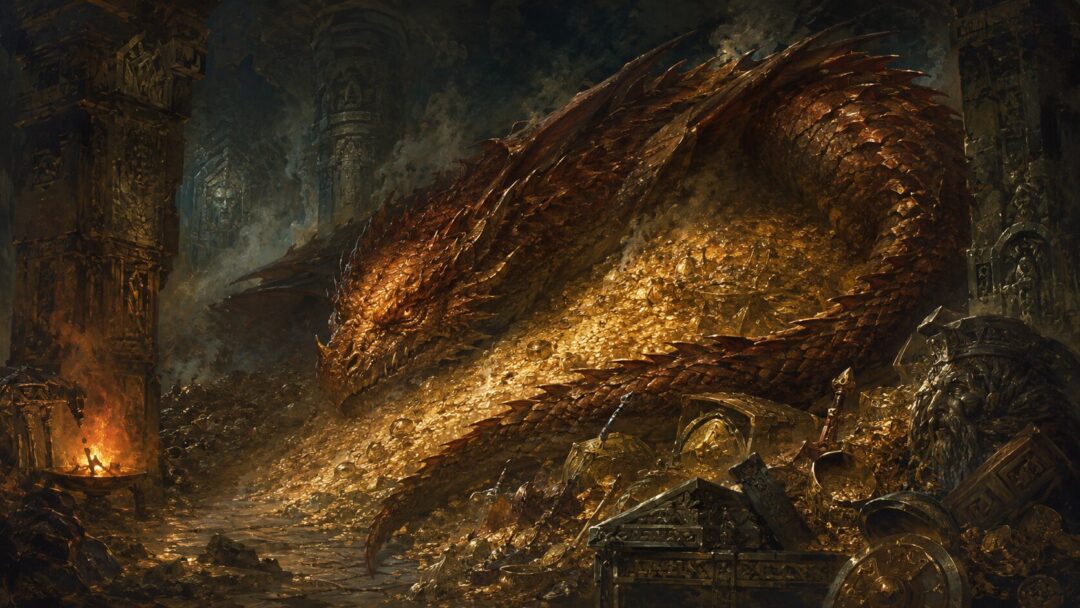
Smaug never needed to see Thorin Oakenshield face to face to understand him.
That is one of the most unsettling details in The Hobbit. The dragon lies beneath the Lonely Mountain, surrounded by gold he did not make, jewels he did not inherit, and heirlooms whose names he may not even fully care to know. Then Bilbo Baggins enters the hall, invisible but not undetectable, and speaks in riddles. Within a few minutes Smaug has learned enough to wound not only Bilbo’s confidence, but the whole purpose of Thorin’s quest.
He does not merely ask who sent the burglar. He asks what Bilbo expects to receive. He suggests that the dwarves will cheat him. He mocks the practical impossibility of carrying treasure away. He sniffs out Lake-town’s involvement. And, most importantly, he understands that Thorin’s desire is not simply to defeat a dragon. Thorin wants his mountain, his kingdom, his treasure, and the symbol of his house restored.
Smaug is not shown reading minds. Tolkien never presents him as omniscient. His insight is sharper and more dangerous than that: he recognizes greed, wounded pride, and possessive desire because those are the very forces by which he himself lives.
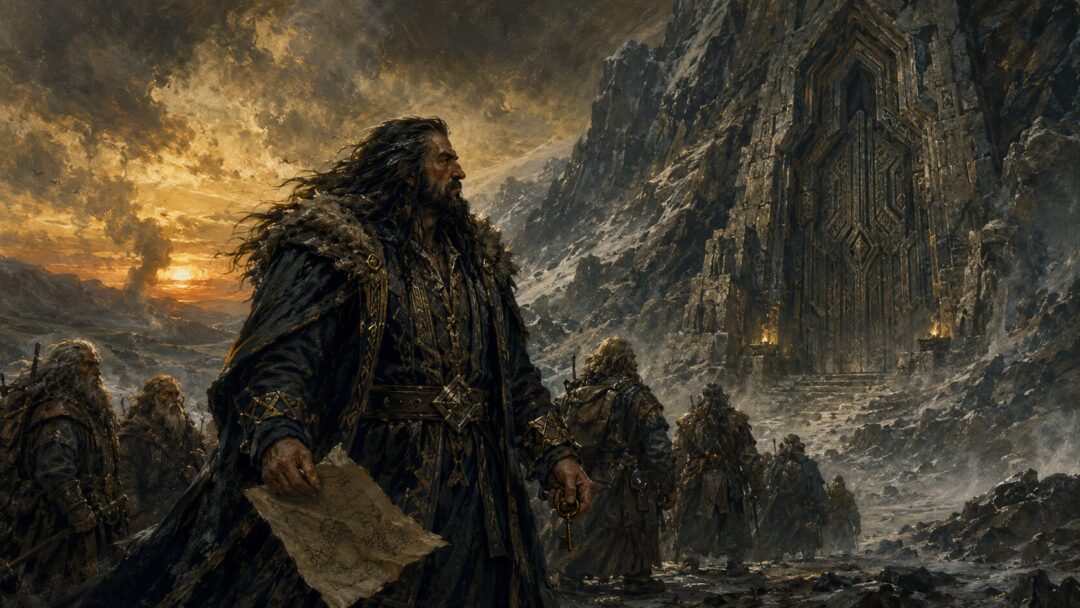
The Clue Was in the Quest Itself
Thorin’s expedition already tells Smaug a great deal before Bilbo says anything careless.
A company of dwarves has returned to the Lonely Mountain after many years. They have not come with an army. They have not challenged Smaug openly. Instead, they have sent a small, hidden burglar into the treasure chamber. That alone reveals a contradiction at the heart of the quest. Thorin claims the dignity of a dispossessed king, yet the first practical move into Erebor is theft by stealth.
That does not make Thorin’s claim false. Erebor was his people’s home, and Smaug had violently seized it. But it does expose the vulnerability of the mission. The dwarves are not only seeking justice; they are also reaching toward treasure. Smaug understands the difference, and he knows how easily the two can become tangled.
When Bilbo speaks with him, Smaug quickly notices what kind of story he has entered. This is not a rescue mission. It is not a simple dragon-slaying. Someone wants the hoard.
And to Smaug, wanting the hoard is already a weakness.
Bilbo’s Riddles Protected Him, but Also Betrayed the Company
Bilbo is clever in the conversation. He avoids giving his real name. He answers Smaug with riddling titles rather than plain facts. This protects him from immediate identification, and it shows how much he has grown since leaving the Shire.
But riddles still reveal patterns.
“Barrel-rider” is especially dangerous. It points Smaug toward Lake-town and the river route by which the company escaped the Elvenking’s halls. Smaug may not understand every step of the journey, but he understands enough. The burglar did not arrive alone. He was helped. There are connections beyond the Mountain. Men of the lake may be involved. Dwarves are certainly involved.
Smaug also detects the scent of dwarf. The text makes clear that his senses are formidable, and Bilbo’s invisibility does not make him scentless. Once Smaug knows that Bilbo has been among dwarves, the rest becomes easier. Dwarves returning to Erebor are unlikely to be random travelers. Their purpose is almost certainly tied to the lost kingdom and its treasure.
Bilbo avoids one danger but cannot avoid all of them. He keeps his own name hidden, yet Smaug still extracts the shape of the quest from what surrounds him: smell, route, timing, and motive.
Smaug Knew Dwarves — and Knew Their Treasure-Love
Smaug’s knowledge of dwarves is not abstract. He destroyed their kingdom under the Mountain. He has occupied their halls for generations. He lies upon the wealth they gathered, the work they made, and the heirlooms they cherished. Even if he does not value those objects in the same way the dwarves do, he knows that they value them.
That is crucial.
Smaug does not need a detailed biography of Thorin to understand the temptation. He knows that dwarves have returned to a place of ancestral loss. He knows that the treasure beneath him is not merely useful wealth. It is memory, status, craft, inheritance, and kingship made visible.
Thorin’s weakness is therefore not simple greed in the shallow sense. It is more tragic than that. His desire for the treasure is bound up with legitimate grief and rightful dispossession. Smaug had stolen the Mountain. Thorin’s longing to reclaim it is understandable.
But Smaug sees the danger inside that longing. A just claim can still become possessive. A king can begin by seeking restoration and end by treating every coin as an extension of himself.
That is exactly the kind of corruption a dragon understands.
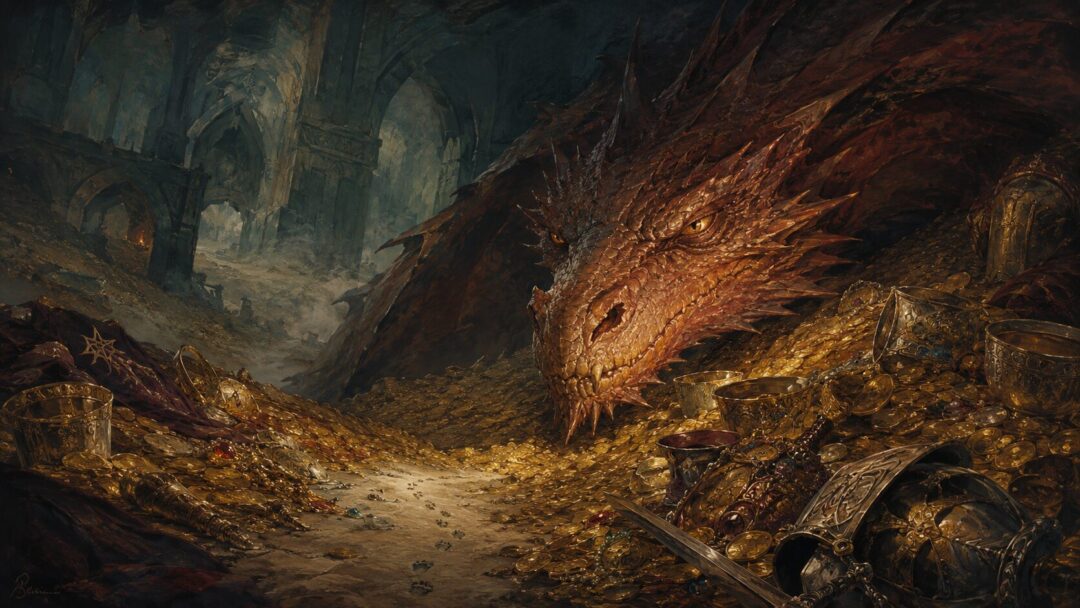
The Dragon’s Own Vice Becomes His Weapon
Smaug is effective because he attacks Bilbo and Thorin through the logic of hoarding.
He asks what Bilbo expects to gain. He suggests that the dwarves will not truly reward him. He raises practical questions: how will the treasure be transported, defended, divided, and enjoyed? These questions are not random. They force Bilbo to think not like a hero in a tale, but like someone involved in a dangerous business arrangement.
This is one of Smaug’s most poisonous moves. He tries to reduce the quest to payment.
If Bilbo is only a hired burglar, then he should worry about his share. If Thorin is only a treasure-seeker, then he may cheat the burglar. If Lake-town helped the company, then perhaps Lake-town expects profit. Smaug wants every alliance around the Mountain to appear selfish.
The terrible thing is that this temptation is not entirely imaginary. After Smaug’s death, disputes over the treasure do indeed threaten to consume the survivors. Bard has a claim on behalf of Lake-town, whose people suffer from Smaug’s attack. The Elvenking comes with his own interests and later acts with restraint compared to what might have happened. Thorin, once inside the Mountain, becomes increasingly unwilling to yield any part of the hoard.
Smaug’s words do not create all of this from nothing. They reveal cracks that already exist.
Thorin’s Pride Was Visible Before the Treasure Was Recovered
Thorin is noble, brave, and capable of deep loyalty. His deathbed reconciliation with Bilbo would not matter if he were merely a greedy caricature. But from the beginning, he is also proud.
At Bag End, he arrives as a figure of importance and speaks with the weight of inherited dignity. Throughout the journey, he often expects deference. His claim is royal, and he understands himself as heir to a wronged house. This pride is not baseless. His people suffered exile. His grandfather’s kingdom was taken. His family history is marked by loss.
Yet pride becomes dangerous when it cannot distinguish between justice and possession.
Smaug does not need to know every private thought in Thorin’s mind. The very structure of the expedition reveals that Thorin has returned not merely to settle an old wound, but to reclaim a throne whose visible proof lies in treasure. The Mountain is a kingdom, but it is also a hoard. In Erebor, those two realities are almost impossible to separate.
That is why Smaug’s psychological attack is so precise. He does not say only, “The dwarves are doomed.” He implies, “The dwarves will use you. Their promises will shrink once the gold is in reach.”
He is aiming at trust because he knows treasure destroys trust.
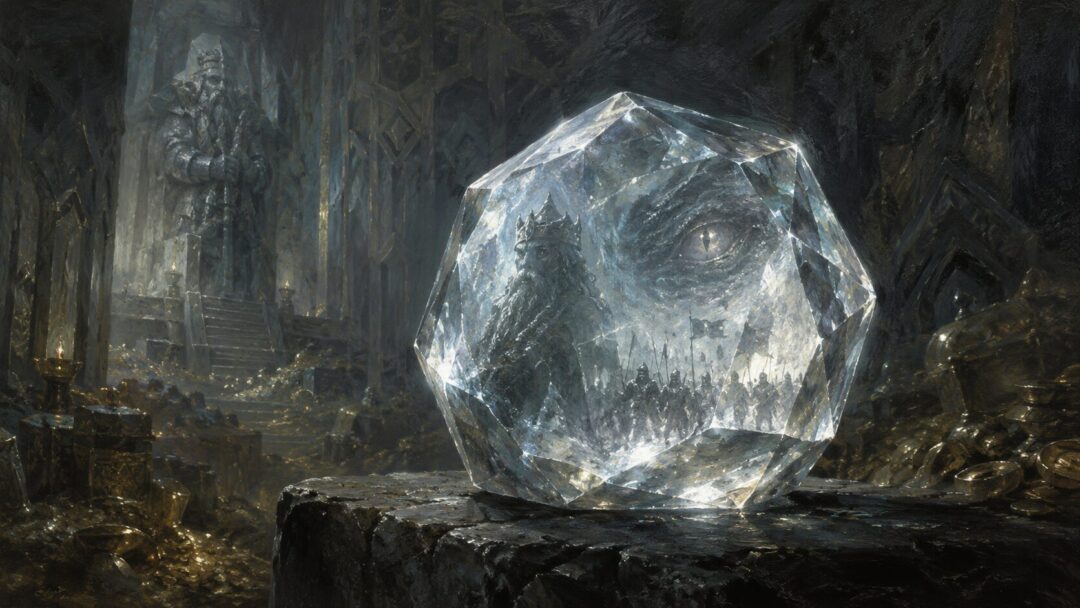
The Arkenstone Makes the Weakness Sharper
The Arkenstone, the Heart of the Mountain, reveals the deepest form of Thorin’s vulnerability after Smaug is gone.
Tolkien does not present the Arkenstone as a Ring-like object with a clearly defined supernatural power of domination. Its force in the story is symbolic, dynastic, and emotional. It is the great jewel of Thráin, treasured by Thorin above other treasures, and it becomes the one thing he cannot bear to lose.
This matters because Smaug’s insight into Thorin does not depend on Smaug naming the Arkenstone in the conversation with Bilbo. The broader weakness is already present: Thorin’s identity and authority are bound to recovered treasure. The Arkenstone later concentrates that weakness into a single object.
When Bilbo takes the Arkenstone and eventually gives it to Bard and the Elvenking as a bargaining piece, he is not merely stealing a jewel. He is placing Thorin’s inward conflict outside him, where everyone can see it. Thorin’s reaction confirms that the treasure has become more than treasure. It has become a test of kingship, mercy, and self-command.
Smaug understood the kind of danger before the final object of obsession came fully into play.
Smaug Is Clever, but Not Wise
Smaug’s quick understanding of Thorin should not be mistaken for wisdom.
He is perceptive, but his perception is bent toward malice. He sees selfish motives because selfishness is the language he speaks most fluently. He understands suspicion because he uses it. He understands possessiveness because he embodies it. He can identify weakness in others, but he cannot escape the same weakness in himself.
This is one of the ironies of the story. Smaug recognizes the danger of greed in Thorin’s quest, yet he is blind to how his own vanity exposes him. Bilbo flatters him and tricks him into displaying his armored underside. The dragon who can smell dwarves and unsettle a hobbit with words is still proud enough to show off.
His insight is real, but it is incomplete. He can diagnose corruption, but only as a predator. He cannot imagine generosity as anything other than foolishness. He cannot understand Bilbo’s pity, courage, or eventual willingness to sacrifice his own standing among the dwarves to prevent war.
Smaug can read greed quickly because greed is familiar to him. He cannot read mercy with the same accuracy.
Thorin’s Weakness Was Humanly Understandable
The tragedy of Thorin is that his weakness grows out of something readers can sympathize with.
He is not a random miser. He is an exile. He has inherited stories of splendor and catastrophe. He has lived with the memory of a kingdom destroyed by a creature that now sleeps on his people’s wealth. His desire to reclaim Erebor is not wrong in itself.
But The Hobbit repeatedly shows that rightful desire can become morally perilous when it hardens into absolute possession. Thorin’s claim may be stronger than anyone else’s, but it is not the only claim in the story. Lake-town suffers because of Smaug. Bard has both a heroic and a practical claim after the dragon’s death. Bilbo has been promised a share. The treasure exists inside a web of loss, labor, help, and consequence.
Thorin’s failure is not that he wants his home back. It is that, for a time, he cannot see beyond the hoard once it is within reach.
Smaug understands that danger because he has lived for years as the image of possession without responsibility.
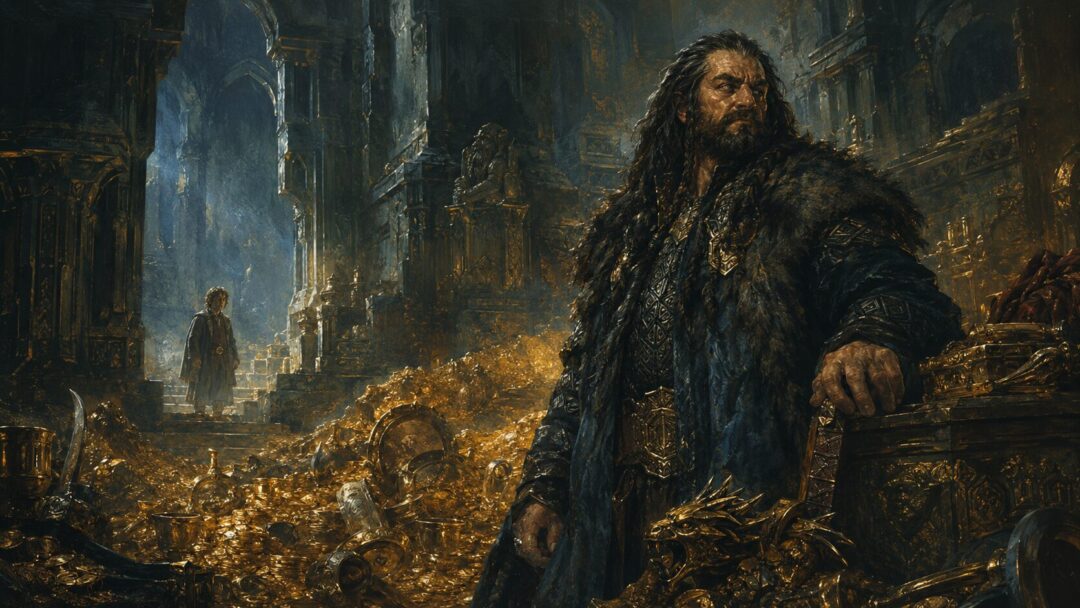
The Dragon Saw the Crack Before the King Fell Through It
Smaug understood Thorin’s weakness quickly because Thorin’s quest carried that weakness openly, even before Thorin himself fully collapsed under it.
A dispossessed king had returned without an army. A burglar had been sent into a treasure chamber. Dwarf-scent clung to the intruder. Lake-town’s help had left its trace. The goal was not only revenge, not only justice, not only restoration, but treasure — treasure with memory, bloodline, and kingship bound into it.
Smaug did not need prophecy. He needed only experience.
He knew what hoards do to hearts that claim them too completely. He knew how suspicion grows around gold. He knew that a promise made outside the Mountain might feel very different once the claimant stood inside it, surrounded by the wealth of his fathers.
Yet Smaug’s understanding has a limit. He sees Thorin’s danger, but not Thorin’s final repentance. He sees Bilbo’s usefulness, but not Bilbo’s moral courage. He sees treasure as the center of every motive, but the end of the story proves him wrong.
Thorin does fall into possessiveness, but he does not end there. Bilbo is tempted by reward, but he chooses peace over profit. Bard seeks recompense, but he is not merely a treasure-grabber. Even the Elvenking, who comes armed, is capable of pity and restraint.
Smaug understands weakness quickly because weakness is his native country. What he fails to understand is that Middle-earth is not ruled only by greed. In the shadow of the Mountain, the dragon can expose the crack in Thorin’s heart — but he cannot foresee the mercy that will still enter before the end.
Sources & Notes
- J.R.R. Tolkien, The Hobbit, ch. 12 “Inside Information”: Smaug smells dwarf on Bilbo, presses him about payment and profit, catches the “Barrel-rider” clue, and turns the quest toward suspicion of Thorin and Lake-town.
- J.R.R. Tolkien, The Hobbit, ch. 1 “An Unexpected Party”: Thorin frames the expedition around ancestral wrong, the Lonely Mountain, and the recovery of his people’s treasure, giving Smaug a recognizable motive to exploit.
- J.R.R. Tolkien, The Hobbit, ch. 13 “Not at Home”: Bilbo’s finding of the Arkenstone shows how one heirloom can concentrate Thorin’s royal memory, desire, and claim to Erebor.
- J.R.R. Tolkien, The Hobbit, ch. 15 “The Gathering of the Clouds”: after Smaug’s death, Thorin’s refusal of Bard’s claim confirms the treasure-strain that Smaug had already used against Bilbo.
- J.R.R. Tolkien, The Hobbit, ch. 16 “A Thief in the Night” and ch. 18 “The Return Journey”: Bilbo uses the Arkenstone to seek peace, and Thorin’s deathbed repentance keeps his fall into possessiveness from being the last word.