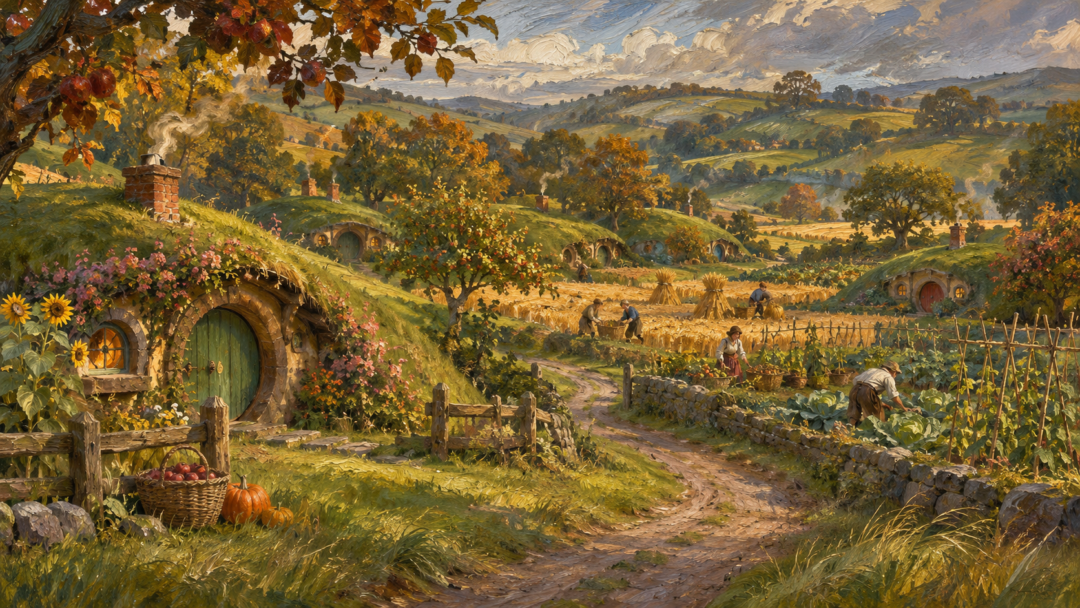
Bilbo Baggins’s eleventy-first birthday is an excellent place to ask the question. Hobbiton gathers for food, fireworks and a speech, while the Sackville-Bagginses have their own keen interest in the future of Bag End. In the Shire, an invitation can involve a long family connection, and a family connection can become a matter of property. With so many familiar surnames and tangled relationships, it is tempting to imagine every hobbit as somebody else’s cousin.
But Tolkien never says that every Shire hobbit descends from one founding couple, and he gives us no family tree covering its entire population. The Prologue to The Fellowship of the Ring establishes something more interesting: Shire hobbits belonged to one people formed through the mingling of three older branches, the Harfoots, Stoors and Fallohides. Shared ancestry and widespread distant kinship are reasonable conclusions. Universal cousinhood, in the strict sense, remains unproved.
Three branches, not three family names
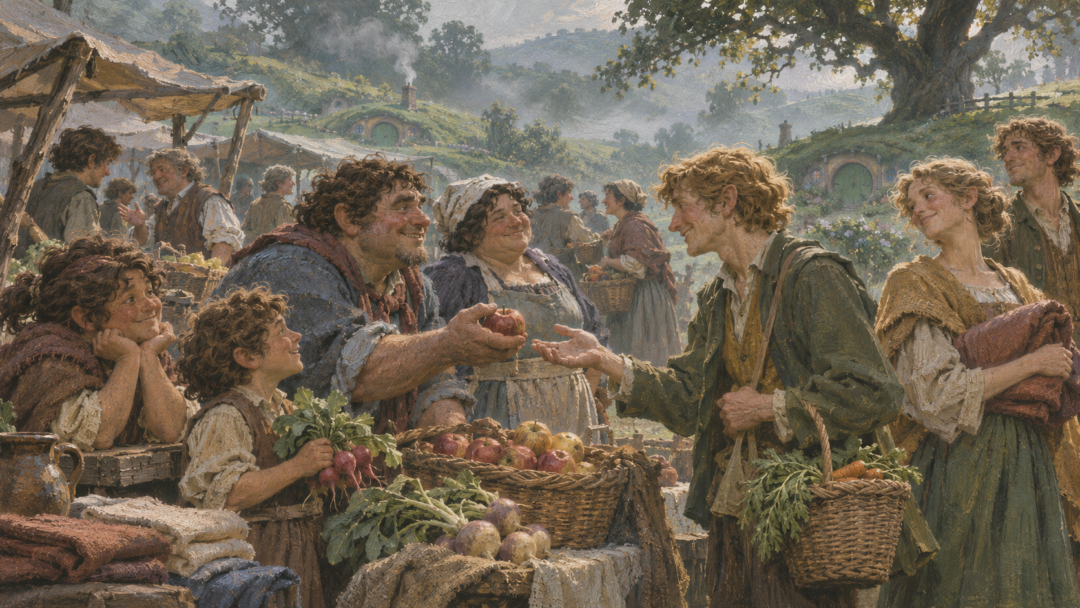
Long before the Shire became a landscape of comfortable holes and carefully tended fields, hobbits lived farther east. The Prologue describes three branches already distinguishable before their westward journeys. These were not rival Shire households, like the Bagginses and Tooks, but broad groups within the hobbit people. Their differences involved appearance, preferred surroundings and aspects of their way of life, not three neatly preserved pedigrees.
The Harfoots were the most numerous and, in the Prologue’s account, the most typical of hobbits. Generally smaller and browner, they favoured hillsides and kept the old habit of living in holes. The Stoors were broader and heavier, with larger hands and feet, and felt more at home beside rivers and on level ground. The Fallohides tended to be taller and slimmer, fairer in hair and complexion, and drawn to woods. Their traditional skills and associations differed too: the Harfoots had dealt with Dwarves, while the Fallohides were especially friendly with Elves.
Those descriptions are useful, but they should not be read as permanent borders. The branches travelled west by different routes and did not all arrive together. In Eriador the Fallohides mingled with hobbits who had come before them, and Fallohide ancestry remained noticeable among some prominent families. By the time we encounter Bilbo’s Shire, the names describe strands of ancestry within a settled society. They do not provide a way to sort every individual into one exclusive category.
The Marish still remembered the Stoors
The strongest evidence for mixing comes from a surprisingly small detail: the down on some hobbits’ chins. The Prologue describes the Marish, in the Eastfarthing beside the Brandywine, as home to hobbits who were often larger and heavier-legged than those elsewhere. Some wore dwarf-boots in muddy weather. Their substantial Stoor ancestry was reflected, the account says, in the facial hair some could grow; Harfoots and Fallohides are described as lacking it.
Buckland, across the river, belongs in the same story. The Prologue associates both the Marish and Buckland with hobbits who came into the area from farther south and retained peculiar names and words not found throughout the Shire. That is more than a passing remark about looks. Local speech, migration and physical appearance all preserve hints of a history that a simple list of households would miss.
There was another pattern at the opposite end of the description: the Fallohide strain was still especially noticeable among the Tooks and the Masters of Buckland. A family could therefore be firmly rooted in Shire society while carrying a remembered connection to one of the older branches. Even height varied considerably. The Prologue gives hobbits a usual range of two to four feet but recalls Bandobras Took, the Bullroarer, at four feet five, able to ride a horse. A visible trait might suggest ancestry; it cannot reveal a complete family tree.
What centuries in one countryside imply
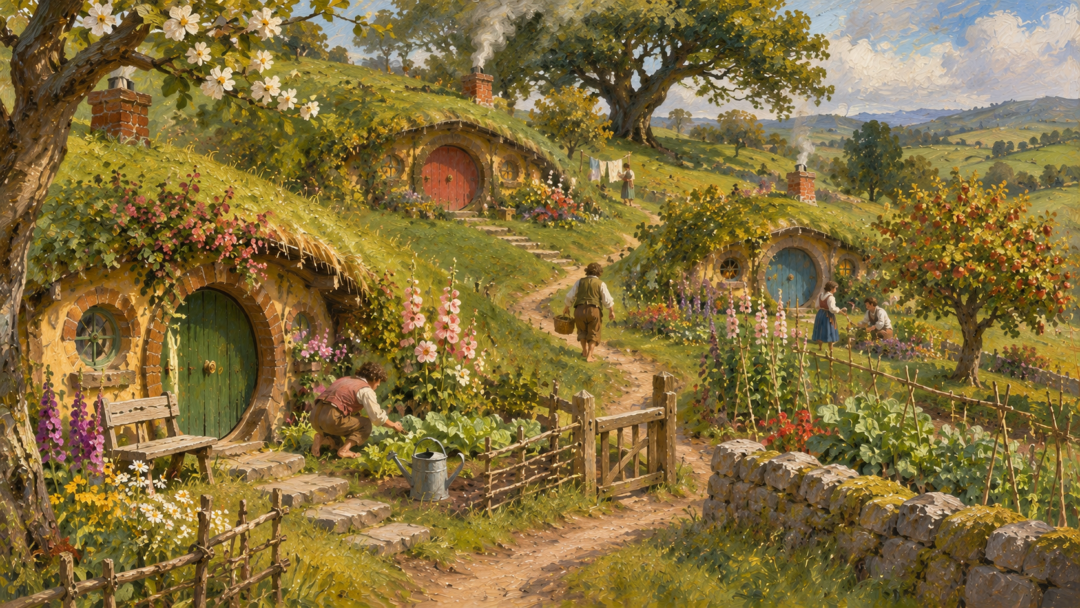
Imagine generations living among the same fields, lanes, villages and neighbouring farms. Some families stay close to their ancestral homes; others move across a river or marry into another household. Children grow up with cousins nearby, but the connections also stretch backward through grandparents and great-grandparents whose names are no longer in everyday use. Over many generations, separate lines can cross repeatedly without anyone needing to trace them all.
That is a reasonable inference about the Shire, not a calculation supplied by the books. Hobbits are depicted as settled, clannish and attentive to descent, so extensive kinship within communities is plausible. Yet a relatively settled countryside is not a sealed one. The account of movements into the Marish and Buckland is itself a warning against imagining the whole population growing unchanged from a single original household.
Nor does sharing an ancestor mean sharing a recognizable family identity. Two hobbits might have an ancestor many generations back without knowing it, while neighbours from differently remembered lines might regard one another simply as neighbours. The further back a possible connection lies, the harder it becomes to establish from the surviving stories. The distinction matters especially when the question uses the word all: widespread relatedness is plausible, but one unconnected line would be enough to defeat a universal claim.
In the Shire, a cousin was serious business
The Prologue makes hobbit genealogy a joke with a wonderfully practical foundation. Hobbits are described as clannish, careful about degrees of relationship and fond of elaborate family trees. Some households were enormous. At Great Smials and Brandy Hall, several generations of relatives could live within one ancestral complex. For a visitor, a list of names might look bewildering; for its inhabitants, knowing who belonged to which branch could be ordinary household knowledge.
This is different from the three ancient hobbit branches. A Took or Brandybuck is a member of a named family or household network, not automatically a pure Fallohide or Stoor. Family names identify particular social ties and lines of inheritance; Harfoot, Stoor and Fallohide describe older population histories. Confusing them produces an attractive but misleading shortcut, as though the entire Shire could be reconstructed by placing three surnames at the top of a chart.
The opening of The Fellowship of the Ring shows how lively these connections can become. Bilbo’s party draws people from beyond his immediate neighbourhood, while his choice of Frodo as heir has consequences for the Sackville-Bagginses. The comedy depends on knowing that relatives can be welcome guests, keen observers, competitors for an inheritance, or some mixture of the three. Kinship is not just a biological question in this world; it shapes visits, reputations, expectations and who may claim a home.
The same comic instinct explains why hobbit family lore feels so convincing. An elaborate family tree can be both a treasured record and a source of endless argument over its details. The Prologue presents hobbits as enjoying accurate information about things they already know, a habit perfectly suited to people who remember which branch of a family lives beyond the next hill. It shows how important descent was to them socially. It does not certify that their accumulated records connected every inhabitant of the Shire.
What the Prologue cannot count
We should also separate two senses of being related. At the broadest level, the Prologue calls hobbits relatives of Men, despite their later estrangement. That puts hobbits within the larger story of Middle-earth’s peoples; it does not offer a measurable degree of genetic separation, or mean that every two named hobbits have a documented common ancestor in the Shire. Shared peoplehood and a proven pedigree are different kinds of statement.
The text is rich in examples but silent on the figures needed for a definitive answer. We are not given a full census, a record of every marriage or an unbroken set of ancestors for all Shire families. The surviving family material is selective, favouring people relevant to the story. Even the Prologue acknowledges how much genealogical detail lies beyond what can sensibly be included. More names might make particular connections clearer, but they would not automatically settle the ancestry of everyone else.
The three branches cannot solve that problem either. They tell us that hobbit history includes variation, movement and intermingling; they do not establish a single pair of parents somewhere in the distant past. Nor does the fact that distant cousins can become common in long-settled populations justify assigning a percentage of relatedness to fictional people. There is no reliable number to extract from this evidence, and no need to invent one to appreciate the pattern.
Why the idea of one great family is so appealing
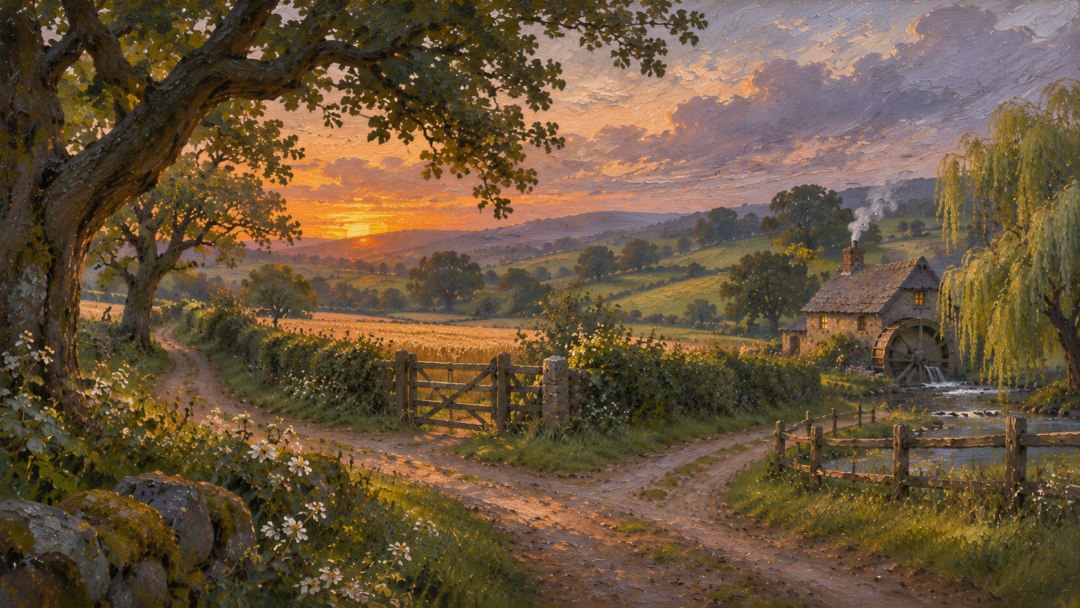
As a reading of the Shire’s atmosphere, the image of everyone being somehow related makes sense. Old names recur, family homes endure, and a birthday party can double as a gathering of people with complicated claims upon one another. Even the distinctions that survived in the Marish and Buckland suggest a place where the past remained present in ordinary life. That is an impression created by the fiction, not proof of a single shared pedigree.
The Shire is warm partly because belonging there has texture: a familiar path, an ancestral doorway, a name someone remembers, a relative who remembers rather too much. Its inhabitants are not interchangeable members of one enormous household. But in the crowded field at Bilbo’s party, with the food laid out and the Sackville-Bagginses watching, it is easy to understand why the question arises. The ties are everywhere, even when no chart can show them all.
Sources & Notes
- The Encyclopedia of Arda, Hobbits — the Harfoots, Stoors, Fallohides, and their mingling — https://www.encyclopedia-of-arda.com/h/hobbits.php
- Tolkien Gateway, Appendix C: Family Trees — selected Hobbit genealogies, not a census of all Shire families — https://tolkiengateway.net/wiki/Appendix_C
- Tolkien Gateway, Baggins Family — the named kinships and intermarriages around Bilbo and Frodo — https://tolkiengateway.net/wiki/Baggins_Family
Reading references: The Fellowship of the Ring, Prologue, Concerning Hobbits, and A Long-expected Party; The Return of the King, Appendix C, Family Trees. The surviving genealogies cover selected families, not the Shire's entire population. Universal cousinhood is not established by those records.