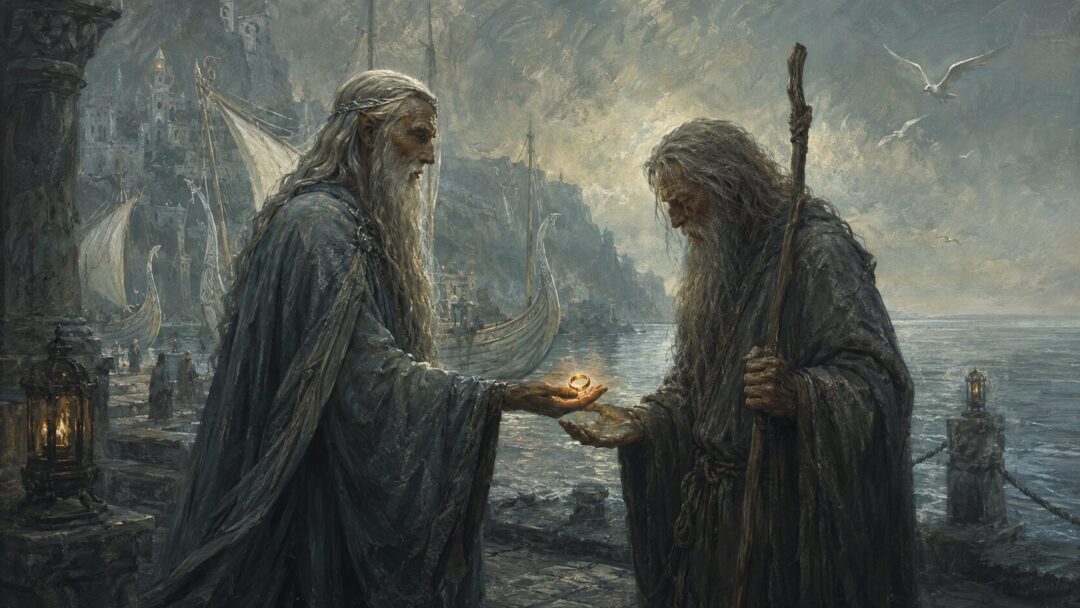
At the end of The Lord of the Rings, when the Ring-bearers come to the Grey Havens, Círdan is easy to overlook. He is not crowned like Aragorn, radiant like Galadriel, or transformed like Gandalf. He stands beside the sea, bearded, ancient, and quiet, as if he belongs more to the shore than to the story.
Yet that quietness is the clue.
Círdan is one of the rare figures in Middle-earth whose greatness is measured not by what he takes, rules, or conquers, but by what he understands early enough to surrender. He is present near the beginning of the long Elvish story in Beleriand. He endures through the ruin of the First Age, the rise and fall of Númenórean power, the making and hiding of the Rings, the return of Sauron, and the War of the Ring. And when the last great turn of the Third Age comes, he has already made one of the most important hidden choices in the whole history of Middle-earth: he gives Narya, one of the Three Elven Rings, to Gandalf.
That act reveals what makes Círdan so unusual. He does not merely see what is in front of him. He sees what things are for.
The Shipwright Who Stayed Behind
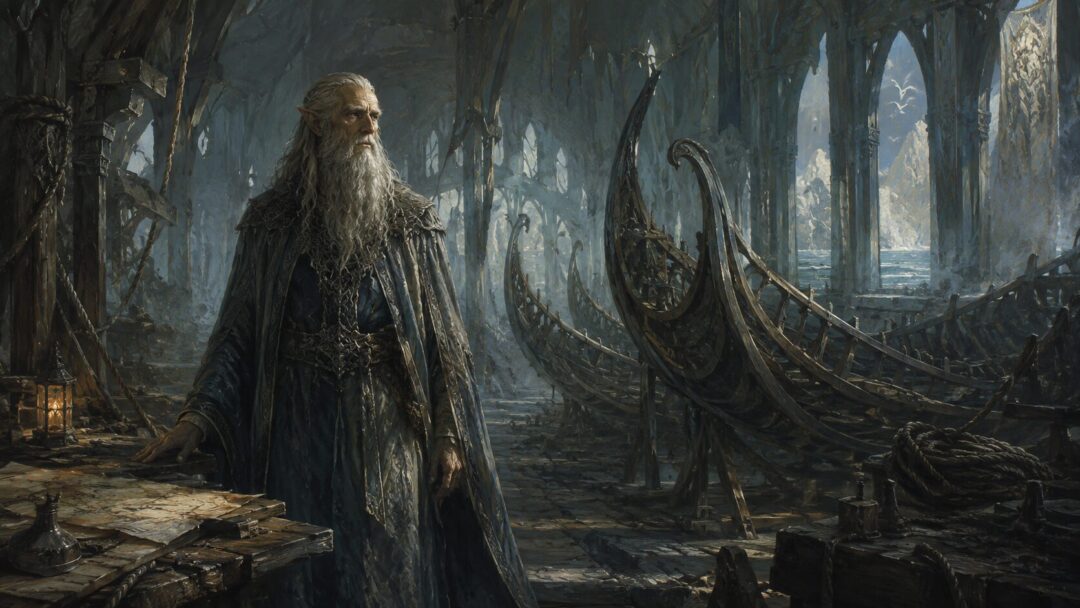
Círdan’s identity is bound to ships, harbours, and departure. He is remembered as the Shipwright, lord of the Falas in the First Age and later master of the Grey Havens. In a world where many rulers are defined by cities, swords, lineages, or jewels, Círdan is defined by passage.
That matters.
The sea in Tolkien’s world is not just geography. For the Elves, it is memory, longing, grief, and summons. It is the road west, the line between Middle-earth and the Undying Lands, the place where exile and healing meet. Círdan lives at that threshold for age after age. His task is not simply to build vessels. He serves at the edge of endings.
Unlike many powerful figures, he is not shown grasping after dominion. He does not become the center of a realm like Thingol, Gil-galad, Elrond, or Galadriel. He remains, watches, receives, sends forth, and waits. That restraint is not weakness. It is part of his wisdom.
Círdan’s story suggests a kind of power that is almost anti-dramatic: the power to remain faithful when history is long, confusing, and full of loss.
Foresight Without Possession
The texts associate Círdan with unusual foresight. He is among the wisest of the Elves, and his perception is not merely practical. He sees deeper than ordinary political judgment.
But it is important to define this carefully. Círdan is not portrayed as a simple fortune-teller who sees a complete script of the future. Foresight in Middle-earth is usually partial, grave, and morally demanding. It does not remove uncertainty. It often increases responsibility.
That is why Círdan’s clearest acts are not flashy predictions. They are decisions.
He recognizes where help is most needed. He understands when a gift should be passed on. He waits when others might grasp. He releases what others might hoard.
This makes his insight different from ambition. Saruman is learned, but his knowledge turns inward and possessive. Denethor is perceptive, but his sight is darkened by despair and pride. Even great Elven figures can be burdened by memory and preservation. Círdan’s clarity is quieter: he sees that the future of Middle-earth will not be saved by holding power in the safest hand, but by placing it in the hand that will spend itself for others.
The Hidden Weight of Narya
Narya, the Ring of Fire, is one of the Three Elven Rings. The Three are not weapons of conquest in the same way as the One. They are associated with preservation, resistance to decay, and the sustaining of what is fair against time and weariness. Yet they remain bound to the larger tragedy of the Rings. Once the One is destroyed, the power of the Three must fade.
Círdan once held Narya. This alone marks him as trusted and significant. But the more revealing fact is that he does not keep it.
When Gandalf comes to Middle-earth, Círdan perceives something in him that others do not yet see. Gandalf appears in humble form, an old man clothed in grey, not as a conquering angelic power. Yet Círdan recognizes his spirit and gives him Narya, foreseeing that Gandalf will need it in his long struggle against Sauron.
This is one of the great acts of discernment in the legendarium.
Círdan does not give the Ring to the most impressive political leader. He does not keep it as a relic of authority. He does not measure greatness by outward appearance. He sees the hidden pattern: Gandalf’s work will be to encourage, kindle courage, resist despair, and strengthen others rather than dominate them.
Narya belongs with that mission.
Why Círdan’s Gift Was So Different
Many characters in Middle-earth are tested by possession. Fëanor cannot release the Silmarils. Thingol is drawn into peril by the Nauglamír and the Silmaril. Thorin nearly loses himself to dragon-sickness and the treasure of Erebor. Boromir is overcome by the thought of using the One Ring for Gondor. Even Galadriel faces a terrible temptation when Frodo offers her the Ring.
Círdan’s great test is almost the opposite.
He holds one of the Three and gives it away.
That act is easy to miss because it happens quietly, before the main narrative of The Lord of the Rings. But morally it belongs beside the great renunciations of the story. Círdan understands that stewardship is not ownership. He holds a great thing only until its proper bearer arrives.
This is a rare kind of clarity. Many wise people in Middle-earth know that power is dangerous. Fewer are able to release power at the right time, without drama, resentment, or visible reward.
Círdan’s gift also shows that he understands the war against Sauron will not be won by matching domination with domination. Gandalf’s strength lies in guidance, pity, endurance, and awakening courage in others. The Ring of Fire becomes not a symbol of conquest, but of rekindling.
Seeing Gandalf Before Gandalf Is Proven
One of the most striking aspects of Círdan’s judgment is timing. He gives Narya to Gandalf at the beginning of Gandalf’s mission in Middle-earth, not after Gandalf has already proved himself through centuries of labour.
That means Círdan’s insight is not based on public reputation. It is recognition.
He sees through the disguise of age and humility. The Istari come clothed in bodies, limited, burdened, and forbidden to dominate the peoples of Middle-earth by open force. To many eyes, Gandalf is only one grey wanderer among others. Saruman appears more commanding. Radagast has his own special concern for birds and beasts. The Blue Wizards pass into obscurity in the eastern lands in the better-known accounts.
Círdan’s choice tells us that true sight in Middle-earth often means seeing against appearances. The mighty may look diminished. The essential may look marginal. A hidden wanderer may matter more than a throne.
This pattern repeats throughout The Lord of the Rings. Hobbits, not lords, carry the final burden. Mercy toward Gollum, not military victory alone, becomes decisive. The small and overlooked are woven into the deepest design. Círdan’s recognition of Gandalf belongs to that same moral architecture.
The Wisdom of the Shore
Círdan’s home at the Grey Havens is more than a location. It reflects his role in the world. He stands where stories end, but he also enables new beginnings. Ships leave from his havens, but hope also arrives there.
In the First Age, the sea becomes bound to the desperate hope of the Elves and Men of Beleriand. Eärendil’s voyage west is one of the central saving acts of that age, leading to the intervention that brings Morgoth down. Círdan’s people and craft belong to that maritime world of waiting, building, and seeking aid beyond the visible horizon.
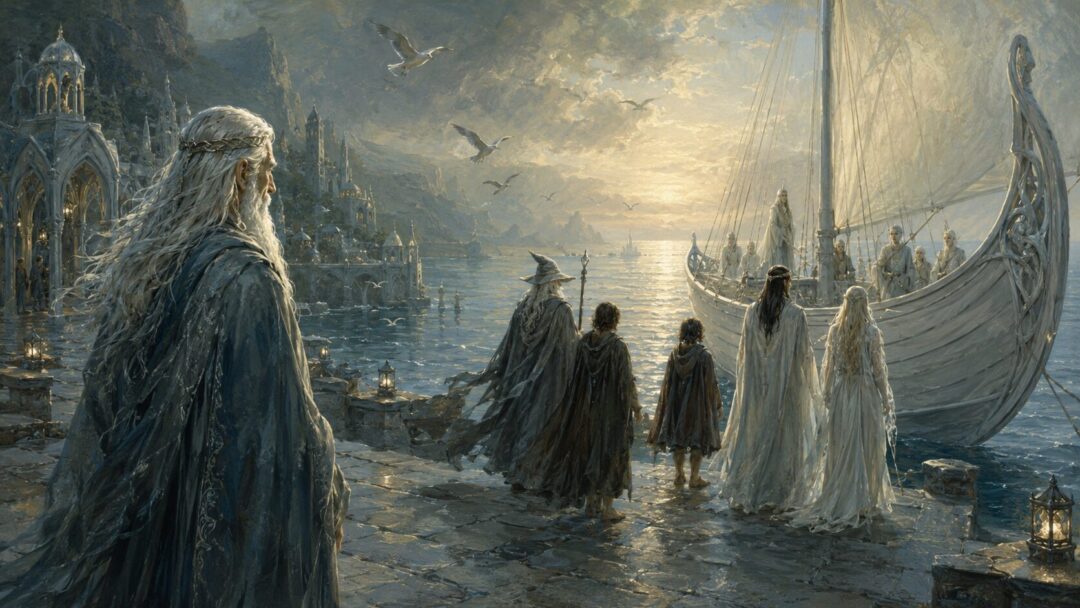
In the Third Age, the Grey Havens become the place of final healing for those who have borne wounds too deep for Middle-earth. Frodo does not depart because he has failed. He departs because victory has cost him something that cannot be fully restored within the world he helped save. Círdan is there for that ending too.
So Círdan’s clarity is not merely strategic. It is compassionate. He understands departure, loss, and the difference between victory and healing. He knows that some burdens can be fulfilled without being erased.
The Bearded Elf and the Sign of Age
Círdan is famously unusual among Elves because he is described with a beard. This detail has often drawn attention because Elves are generally imagined as beardless, especially in youth. The safest reading is that Círdan’s beard marks extraordinary age and dignity, not ordinary Elvish appearance.
It is a small visual sign of something immense: Círdan has endured almost beyond comparison among the Elves who remain in Middle-earth. He is not merely old in years. He has lived through the repeated collapse of hopes.
He has seen realms rise and vanish. He has seen proud kings fall, hidden kingdoms broken, the sea reshape the world, Sauron defeated and returning, and the slow fading of the Elves. His wisdom is not abstract. It has been burned into him by time.
Yet he does not become bitter. That is perhaps the most remarkable thing. Long memory in Tolkien’s world can become grief, pride, possessiveness, or withdrawal. In Círdan, it becomes service.
Clear Sight Means Knowing When to Let the Age End
Círdan’s final importance lies in his acceptance of the passing of the Elves. The Three Rings preserve, but they cannot stop the deeper movement of history forever. When the One is destroyed, the Elven Rings lose their sustaining power, and the time of the Elves in Middle-earth draws to its end.
Círdan does not rage against that ending. He has spent ages preparing the road west.
This is another kind of sight: not merely knowing that something will happen, but accepting when resistance is no longer faithfulness. The Elves fought evil; they preserved beauty; they guarded memory. But they were not meant to freeze Middle-earth forever in their own image.
The Dominion of Men must come. The Ring-bearers must depart. Gandalf must leave after his labour is complete. Galadriel and Elrond must pass over Sea. And Círdan, who has waited at the Havens longer than almost anyone, remains until the time comes for the last ship.
There is profound humility in that. He does not stand at the center of the victory celebration. He stands at the edge of the world, doing the work that lets others find rest.
The Character Who Understood the Shape of the Story
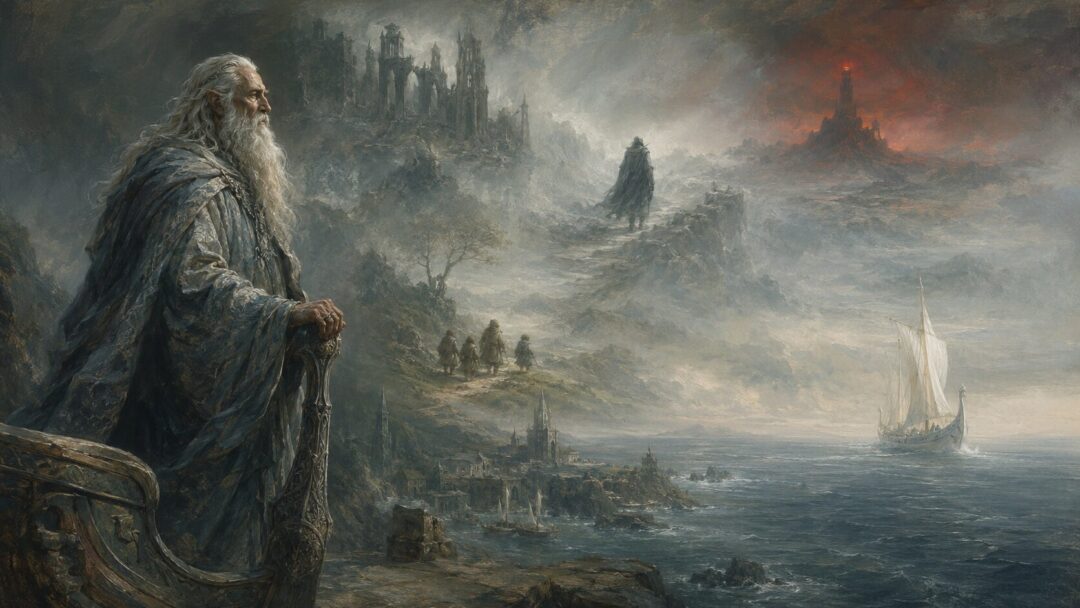
Círdan saw more clearly than almost anyone because he understood the direction of things. He saw that Gandalf’s humble form concealed a mission of enormous importance. He saw that Narya should be used not to exalt its keeper, but to strengthen the weary. He saw that the struggle against Sauron required courage, patience, and self-surrender. He saw that even victory would lead to departure.
His greatness is not loud. It is tidal.
He belongs to the deep rhythm beneath the wars: loss and hope, exile and return, fading and healing. In a story crowded with kings, wizards, warriors, and Ring-bearers, Círdan is the ancient figure at the harbour who knows that the most important journeys are not always the ones that begin with banners.
Sometimes the clearest sight in Middle-earth is the ability to recognize the right bearer before the world applauds him.
Sometimes it is the wisdom to give away a Ring.
And sometimes it is the patience to build ships for an ending that is also a mercy.
Sources & Notes
- Tolkien Gateway, “Círdan” — summarizes Círdan’s age, foresight, role at the Grey Havens, and his unusually clear judgment across the Second and Third Ages. https://tolkiengateway.net/wiki/C%C3%ADrdan
- Tolkien Gateway, “Grey Havens” — explains the harbour Círdan ruled and its importance as the place of departure into the West. https://tolkiengateway.net/wiki/Grey_Havens
- Tolkien Gateway, “Third Age” — provides chronology for Círdan’s counsel, the War of the Ring, and the ending of the Elven age in Middle-earth. https://tolkiengateway.net/wiki/Third_Age
Sources added for Círdan’s foresight, the Grey Havens, and late Third Age context.