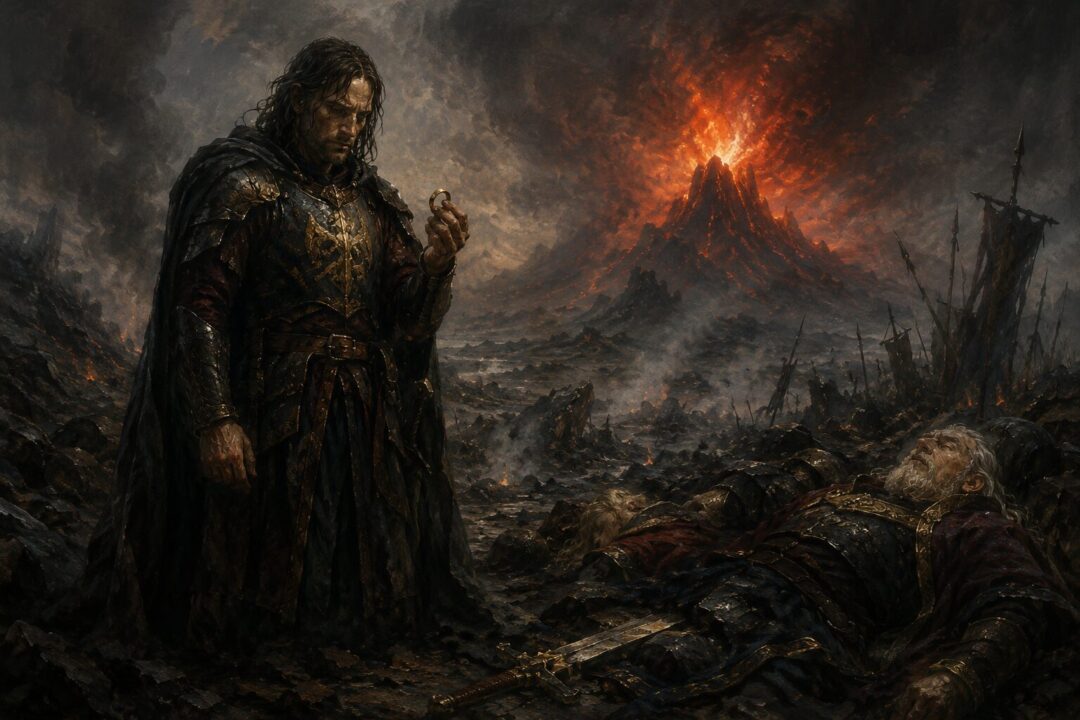
The One Ring judges no one fairly. It does not simply tempt the proud or overwhelm the weak. It waits. It studies. Then, when the cost of resistance has become almost unbearable, it asks a single question: Will you claim me?
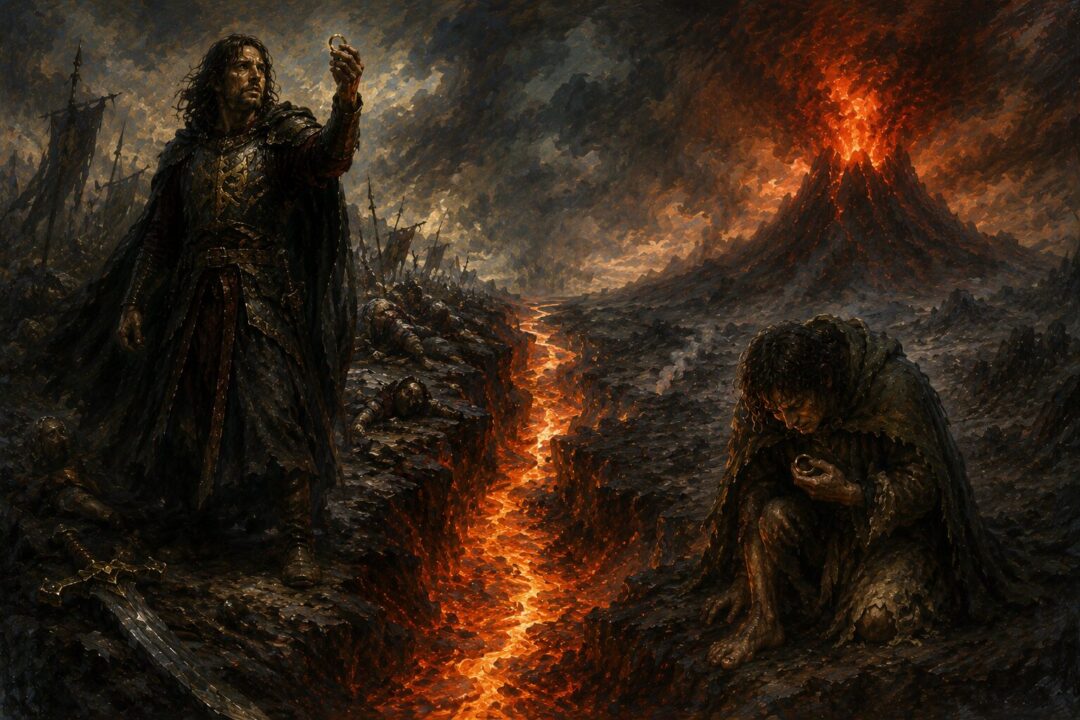
Two of Middle-earth's most important Ring-bearers answered that question with the same outward action. Both Isildur and Frodo ultimately claimed the Ring instead of destroying it. Yet treating their failures as identical misses one of the most important moral distinctions in the legendarium.
One failed almost immediately after victory, believing the Ring could become a rightful possession. The other resisted it across hundreds of miles, through terror, hunger, wounds, exhaustion, and increasing spiritual domination before finally breaking at the very edge of success.
The difference is not that one was strong and the other weak. The deeper lesson is that the Ring tests every bearer differently, and the circumstances surrounding each failure reveal very different truths about power, mercy, and the limits of endurance.
Isildur's Failure Began with Ownership
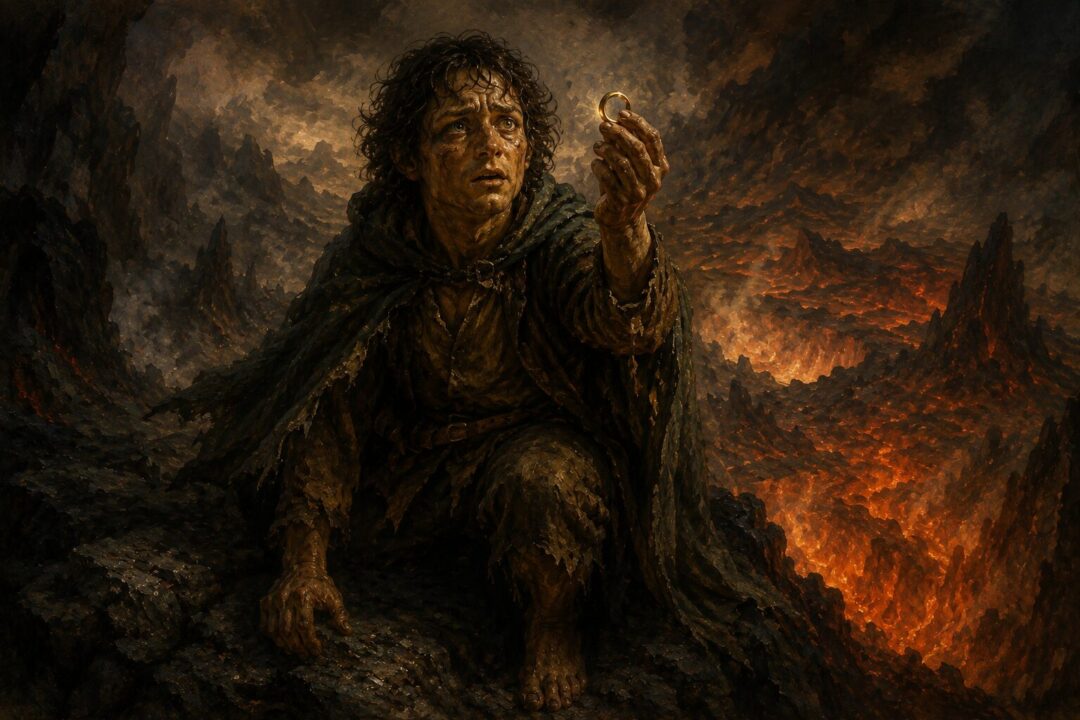
When Sauron was overthrown at the end of the Second Age, Isildur cut the One Ring from the Dark Lord's hand with the broken hilt-shard of Narsil after Elendil and Gil-galad had both fallen.
After the battle, Elrond and Círdan urged him to cast the Ring into the Fire of Orodruin. Instead, Isildur refused.
His explanation is one of the most famous statements in Tolkien's writings:
"This I will have as weregild for my father, and my brother."
"Weregild" was compensation for a wrongful death. Isildur had lost both Elendil and Anárion during the war against Sauron. From his perspective, the Ring represented lawful payment taken from a defeated enemy.
This does not make his decision wise, but it makes it understandable.
The texts never portray Isildur as someone already dreaming of world conquest. Rather, he believed the Ring belonged to him by right after terrible personal loss. That belief became the opening through which the Ring worked.
Its first victory over Isildur was not domination through fear.
It was convincing him that possession itself was justified.
Frodo's Failure Came After Long Resistance
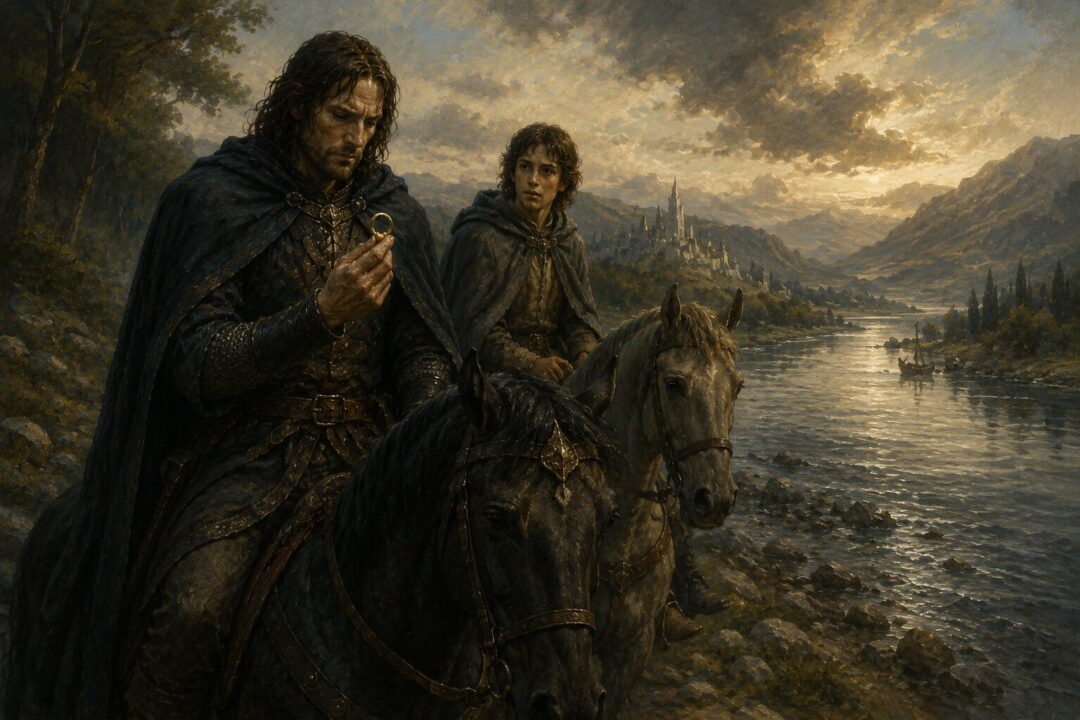
Frodo reaches the Cracks of Doom under utterly different circumstances.
Unlike Isildur, he never sought the Ring.
He inherited it unknowingly, accepted the burden reluctantly, repeatedly attempted to carry it only because no one else safely could, and spent the entire Quest trying to surrender it to destruction rather than ownership.
By the time he entered Sammath Naur, Frodo had endured:
the Morgul wound from the Witch-king
the lingering effects of Weathertop
months of bearing the Ring
starvation and dehydration in Mordor
near-total physical collapse
constant psychological assault from the Ring itself
Every mile made surrender harder.
The closer he came to Mount Doom, the stronger the Ring's influence became. The texts repeatedly describe its growing weight and increasing domination over his thoughts.
At the final moment Frodo declared:
"I do not choose now to do what I came to do. I will not do this deed. The Ring is mine."
His words echo Isildur's claim in an important way.
Both men ultimately chose possession.
But one choice came after years of ownership measured in relative peace.
The other came after perhaps the greatest sustained resistance any mortal ever offered the Ring.
The Ring's Power Was Strongest at the Place of Its Making
One crucial detail is often overlooked.
Frodo did not fail under ordinary conditions.
He failed inside Sammath Naur itself.
The Council of Elrond had already concluded that the Ring could only be destroyed there because that was where it had been forged. The narrative strongly implies that this was also where its own power over its bearer reached its greatest intensity.
Elsewhere in the story, powerful individuals refuse to take the Ring before it has become their burden.
Gandalf refuses it.
Galadriel refuses it.
Aragorn refuses it.
Faramir refuses even to seize it.
But none of these figures bears the Ring all the way into Mordor before standing inside the Cracks of Doom themselves.
The comparison is therefore imperfect if one imagines they faced the identical test.
The final trial belongs only to Frodo.
Isildur Eventually Recognized the Danger
Another important distinction appears in later accounts of Isildur's life.
His initial refusal to destroy the Ring did not remain a simple triumph in his own mind.
In the account of the Disaster of the Gladden Fields, Isildur acknowledges that the Ring has become a burden. He admits he cannot master it. His son Elendur advises surrendering it to the Wise, and Isildur agrees that this counsel is sound.
The texts imply he intended to seek Rivendell.
That does not erase his earlier mistake.
Nor does it prove he would certainly have relinquished the Ring.
His death prevents the question from ever being answered.
Still, this later change matters because it shows that Isildur was not permanently blind to the Ring's nature. Recognition came too late, but it did come.
Frodo Never Had That Opportunity
Frodo's story contains no similar second chance.
His failure occurs at the final instant.
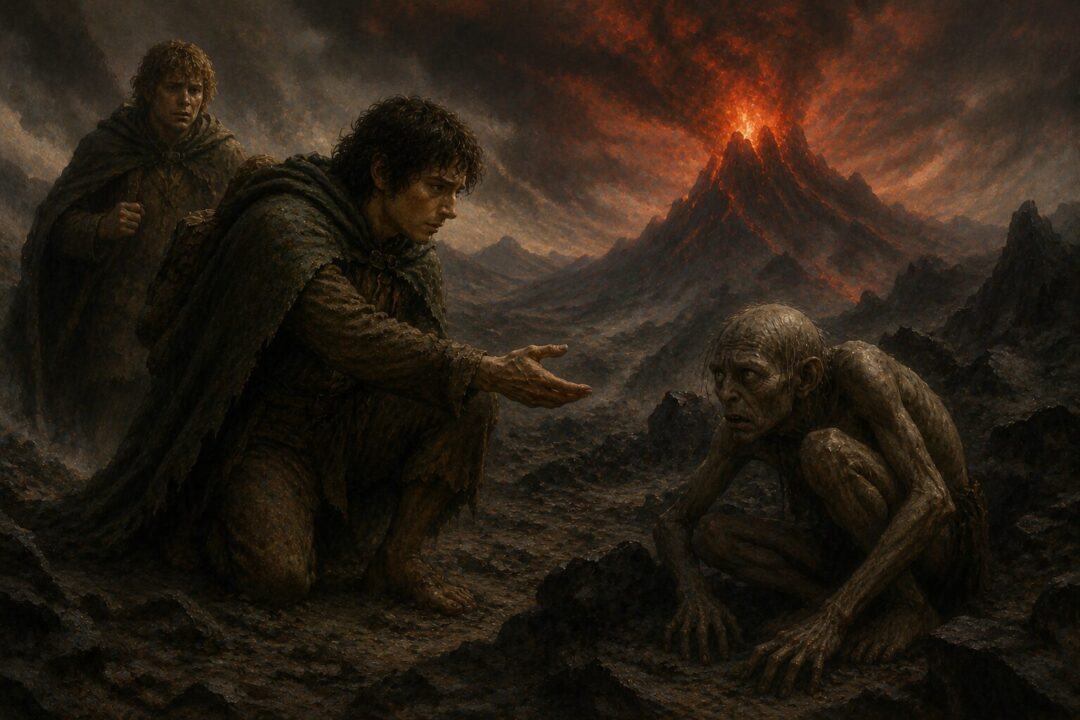
Immediately afterward, Gollum attacks.
In the struggle, Gollum bites off Frodo's finger, recovers the Ring, and then falls into the Fire.
The Ring is destroyed not because Frodo overcomes it at the last second, but because earlier acts of mercy make that ending possible.
This is one of the central moral structures of The Lord of the Rings.
Frodo's pity for Gollum, encouraged by Gandalf and later echoed by Aragorn and Sam in different ways, creates the only chain of events that can complete the Quest.
Victory arrives not through flawless heroism but through mercy shown long before the decisive moment.
Could Anyone Have Succeeded?
This question has fascinated readers for decades.
Could another character have stood where Frodo stood and voluntarily destroyed the Ring?
The text offers remarkably little confidence that anyone could.
Near the end of the story, Tolkien explained in a well-known letter that Frodo had done all that anyone could reasonably expect. The Quest was achieved because mercy and providence completed what individual strength alone could not accomplish.
That perspective changes how Frodo's failure should be understood.
It is not simply a moral collapse.
It marks the limit of created strength against an object specifically designed to dominate the wills of others.
The Ring wins its direct contest.
Providence defeats the Ring anyway.
Isildur Faced a Different Moral Decision
Unlike Frodo, Isildur encountered the Ring before understanding its full nature.
Elrond and Círdan urged its destruction, but the complete mechanics of the Ring's corruption were not yet understood in the way later generations would learn through painful experience.
Isildur knew enough to receive wise counsel.
He did not know everything later readers know.
That does not excuse his decision.
But it explains why his error begins as a mistaken claim of rightful possession rather than as the final collapse after impossible endurance.
The moral situations differ substantially even though the outward action appears similar.
Their Failures Reveal Two Faces of Temptation
Isildur represents temptation through entitlement.
He believes he deserves what should never belong to anyone.
Loss becomes the doorway through which corruption enters.
Frodo represents temptation through exhaustion.
He spends nearly the entire narrative denying the Ring's claims until his own strength is almost entirely consumed.
The Ring exploits different weaknesses because different bearers possess different vulnerabilities.
Its corruption is intensely personal.
It does not use the same strategy on everyone.
Why the Story Judges Them Differently
Neither Isildur nor Frodo is portrayed as an uncomplicated villain.
Neither is presented as morally perfect.
Instead, both reveal something profoundly human.
Isildur reminds readers that grief can become an argument for possessing dangerous power. The desire to reclaim what has been lost—even in the name of justice—can become self-deception.
Frodo reminds readers that endurance itself has limits. Extraordinary faithfulness does not necessarily guarantee perfect success. Sometimes a person can give everything and still require grace beyond their own strength.
The narrative consistently honors Frodo despite his failure. Aragorn bows before him. The people of Gondor celebrate him. The scars of the Quest never fully heal, and eventually he departs across the Sea because Middle-earth can no longer provide the peace he has earned.
Nothing in the story suggests that his claim of the Ring erased the sacrifice that came before it.
The Ring Was Defeated Before It Was Destroyed
The deepest irony is that the Ring loses long before it falls into the Fire.
It expects domination through power.
Instead, it is undone by pity.
It expects ambition.
Instead, it encounters humility.
It expects its bearers to seek mastery.
Instead, the central hero spends almost the entire story trying to surrender power rather than wield it.
Isildur's tragedy warns that even justified grief can become possessiveness.
Frodo's tragedy shows that perfect resistance may lie beyond the limits of any individual will.
Together, their stories reveal that the true "Ring test" was never simply whether someone could throw the Ring away. It was a far deeper examination of the human heart—asking whether power would be claimed as a right, endured as a burden, or finally overcome only through mercy and a providence greater than any one person could command.
Sources & Notes
- Tolkien Gateway, "Frodo Baggins" — https://tolkiengateway.net/wiki/Frodo_Baggins
- Tolkien Gateway, "Isildur" — https://tolkiengateway.net/wiki/Isildur
- Tolkien Gateway, "One Ring" — https://tolkiengateway.net/wiki/One_Ring
Sources added for article-specific Tolkien reference context.