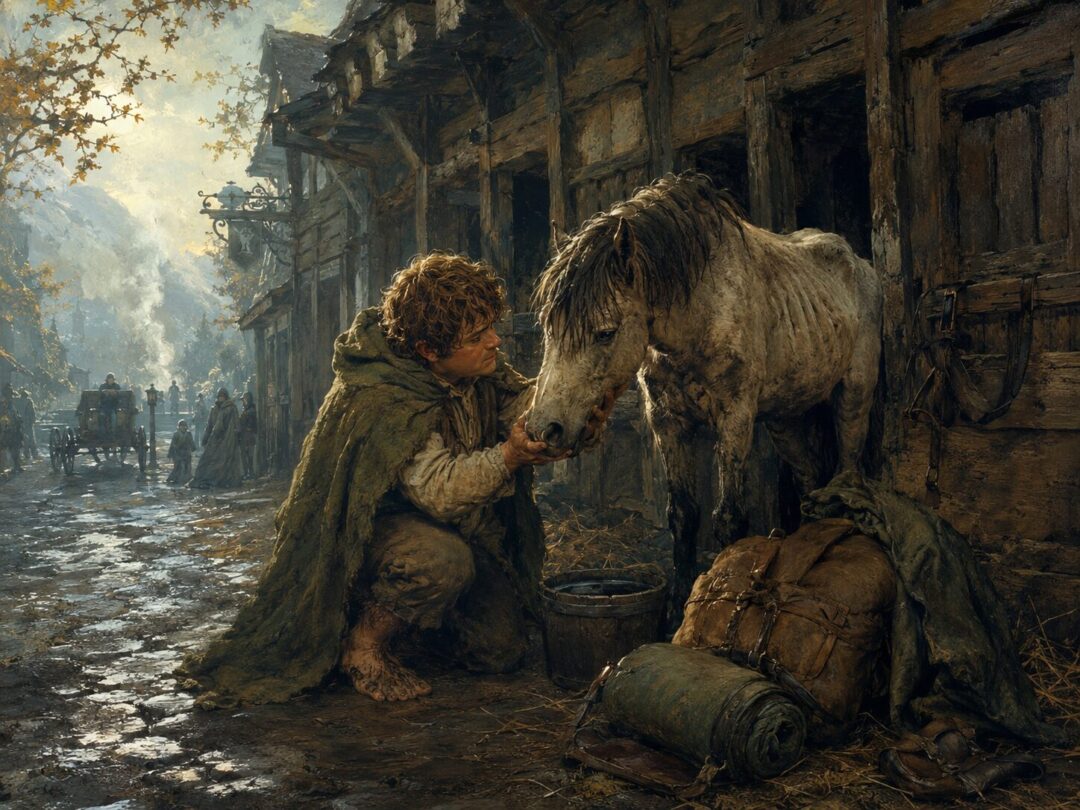
At first glance, Bill the Pony seems like one of the gentlest loose ends in The Lord of the Rings. He is the half-starved animal bought in Bree, loved by Sam, lost before the darkness of Moria, and then found again on the road home. His return can feel like a small comfort after the War of the Ring — a warm smile placed near the end of a long grief.
But Bill’s story matters more than that.
In a tale filled with kings, Ring-bearers, wizards, and ancient powers, Bill is one of the smallest victims of the Shadow’s widening reach. He cannot speak. He does not choose a side in the war. He carries baggage, suffers neglect, receives kindness, and survives a journey no one expected him to survive. His return is not only cute. It is a quiet moral answer to one of the central questions of Middle-earth: what becomes of the small, the useful, the mistreated, and the overlooked when great powers move across the world?
Bill’s survival tells us something important. The victory over evil is not complete only when Sauron falls. It is also seen when a battered pony finds his way back to care, safety, and home.
Bill Begins as a Casualty of Bree’s Fear
Bill enters the story at Bree, but not as a noble beast chosen for a quest. He appears because the hobbits’ original ponies have been driven away after the trouble at The Prancing Pony. This is already a sign that the Shadow has reached ordinary places. Bree is not Mordor. It is a roadside town, a place of inns, stables, gossip, and local suspicion. Yet even here, the movements of darker powers produce fear, theft, and inconvenience.
Bill Ferny, a disreputable man of Bree, sells the pony to Frodo for an inflated price. The animal is in poor condition, badly treated and underfed. This detail matters. Bill the Pony is not simply comic relief. His body has already absorbed the cruelty of a meaner world.
The contrast is immediate. To Ferny, the pony is a thing to exploit. To Sam, he becomes a creature to tend.
Sam’s care for Bill is one of the earliest signs of his moral imagination. Sam is not merely loyal to Frodo. He is attentive to weakness wherever he finds it. He notices hunger, exhaustion, and neglect. He gives care before there is any reward for it. Bill improves under his hands, and the pony’s transformation becomes a small mirror of Sam’s own goodness: practical, patient, and rooted in ordinary decency.
This is the first reason Bill’s return matters. Before the Fellowship is even formed, the story shows two ways of treating the powerless. Ferny abuses and profits. Sam feeds and restores.
A Pony Among the Fellowship
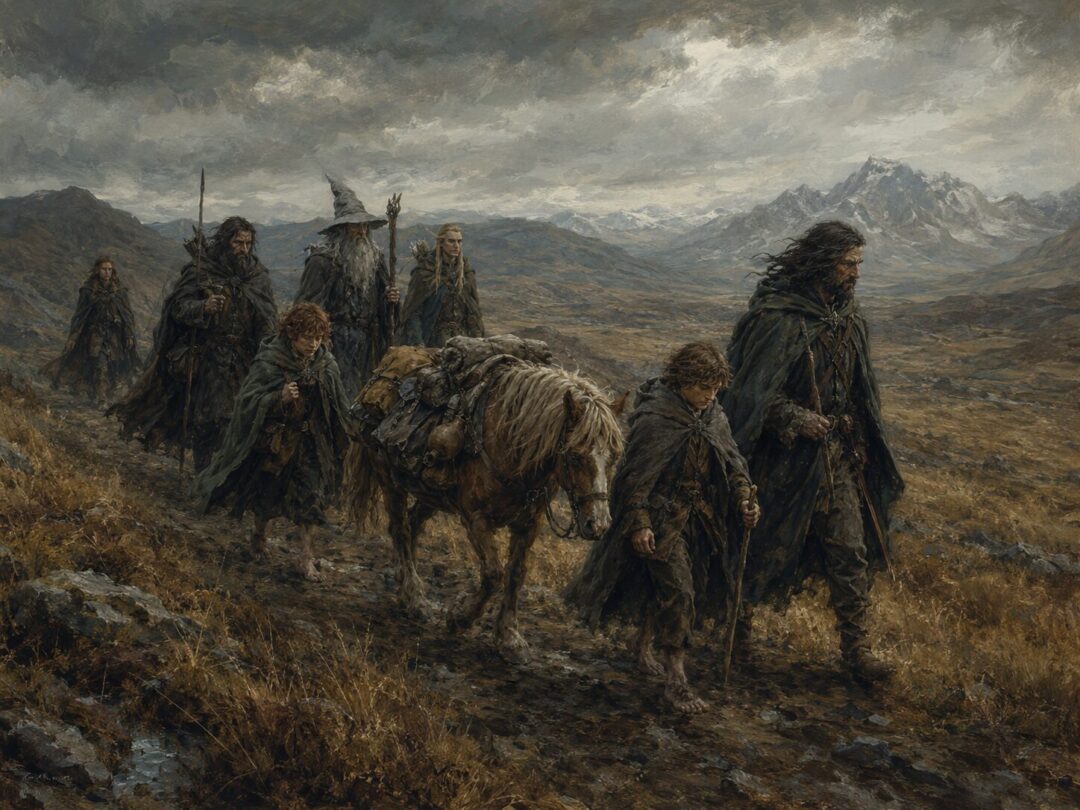
Bill’s place in the early journey is humble but essential. He carries supplies through the long miles between Bree, Rivendell, and the wild lands beyond. He is not counted among the Nine Walkers, yet he helps make their travel possible. The Fellowship’s heroism rests, in part, on unglamorous burdens: food, blankets, packs, and the endurance of a recovered pony.
That is deeply Tolkien-native in spirit. Middle-earth often turns on things that do not look grand from a distance. A gardener becomes a hero. A meal offered in the wilderness becomes mercy. A small hand spares Gollum. A pony’s strength helps carry the load that allows greater figures to continue.
Bill also belongs especially to Sam’s emotional world. Sam’s tenderness toward him is not sentimental weakness. It is part of the same quality that later enables Sam to carry Frodo, resist despair, and imagine gardens in a land of ash. He sees living things not as tools but as companions entrusted to him.
This makes the parting at Moria more painful than it first appears.
The Cruel Mercy at the Doors of Moria
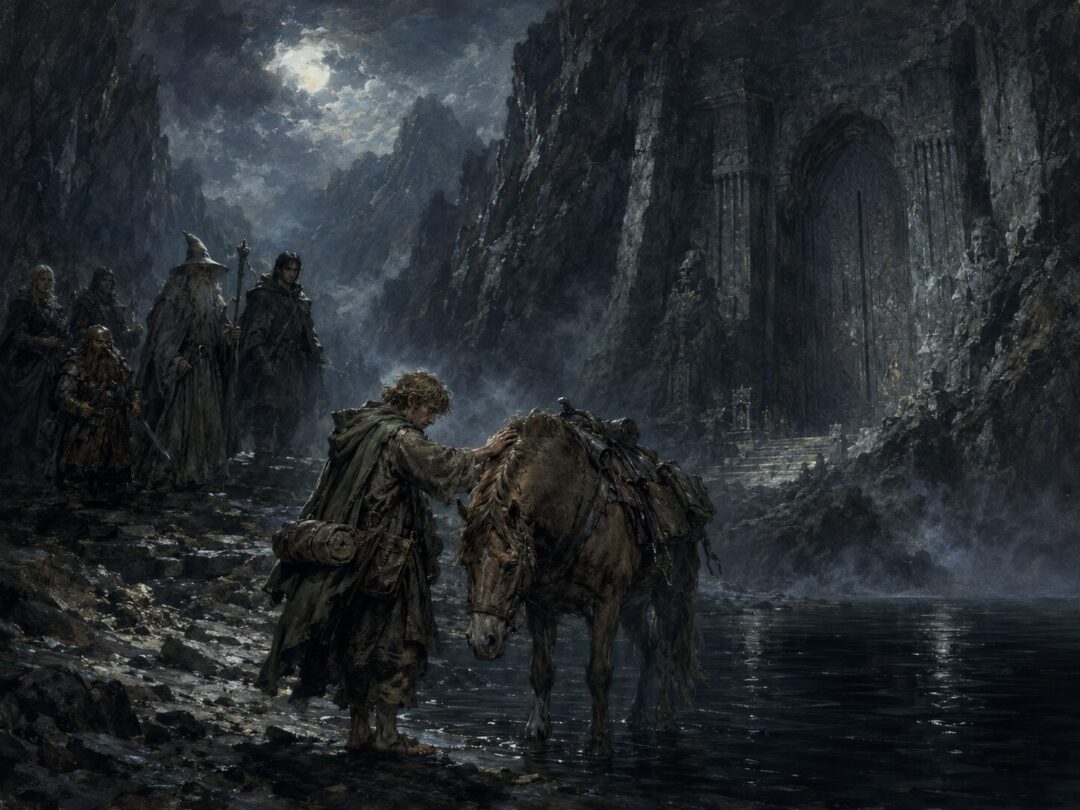
At the West-gate of Moria, the Fellowship faces a hard truth: Bill cannot go with them into the Mines. The road ahead is dark, enclosed, and deadly. The pony must be released.
This is one of the quieter wounds in The Fellowship of the Ring. Sam does not want to abandon him. His grief is not dramatic in the manner of a battlefield farewell, but it is real. He has taken responsibility for this creature. He has nursed Bill back from misery. Now the quest demands separation.
The decision is both cruel and merciful. Taking Bill into Moria would likely be impossible and dangerous. Letting him go gives him a chance, but not a guarantee. Outside the Doors are wild lands, wolves, fear, darkness, and the strange threat of the water before the gate. The texts do not give us a detailed account of Bill’s route after this moment. That silence is part of the power of the scene. For a long stretch of the story, Sam — and the reader — must live without knowing.
Bill disappears into uncertainty just as the Fellowship enters one of its deepest descents. The loss of the pony becomes one more sign that the quest strips away comfort. The company must go forward with less than they had before.
Yet because the story has already taught us to care about him, Bill’s absence remains emotionally present.
Bill’s Return Is a Reversal of Waste
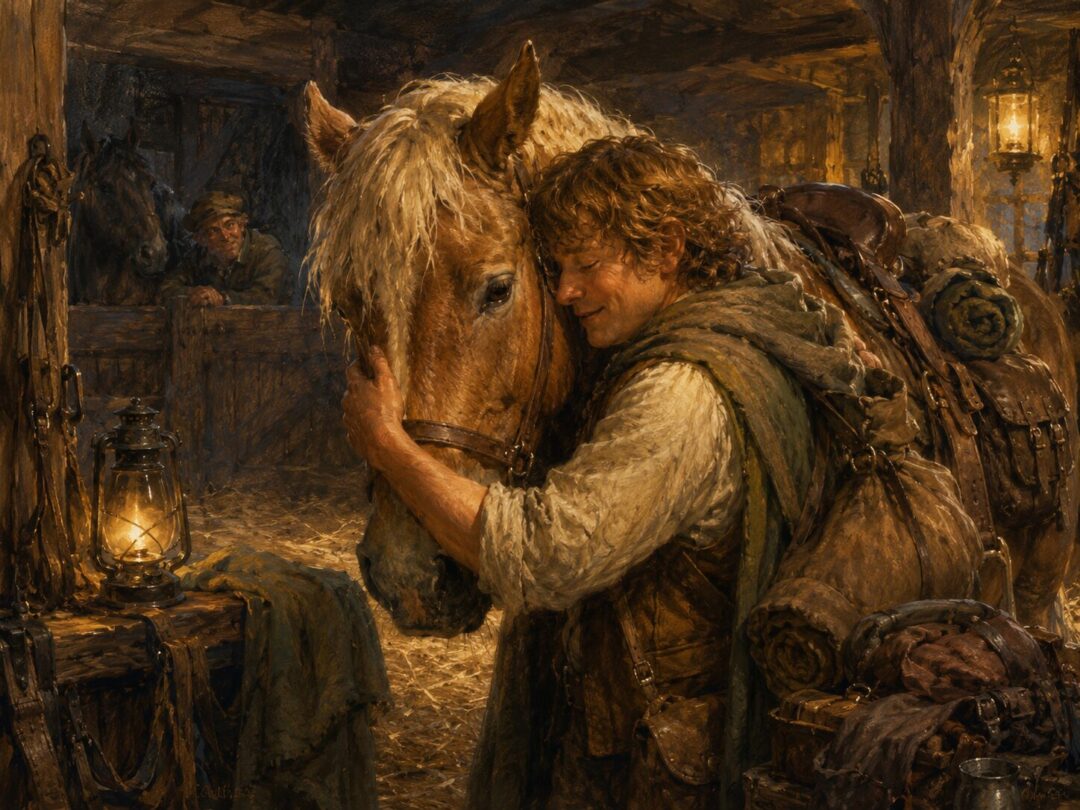
When the hobbits come back to Bree after the fall of Sauron, they find Bill again at The Prancing Pony. He has survived. He has returned on his own. The detail is small, but its emotional force is enormous.
In a darker kind of story, Bill would simply vanish. He would be another cost of the road: useful while needed, forgotten when lost. But The Lord of the Rings does not treat small lives that way. Bill’s return tells us that the world after the War is not measured only by crowns restored and towers overthrown. It is measured by whether the vulnerable can come back into the circle of care.
The return also reverses the earlier wrong done in Bree. Bill began as Ferny’s abused possession. He returns as Sam’s beloved companion. He began as a sign of exploitation. He returns as a sign of healing.
This is not merely “the pony made it home.” It is the story quietly refusing the logic of waste. Evil uses, discards, frightens, and consumes. Good remembers.
That remembering is crucial. Sam has worried about Bill. The reunion matters because affection has endured across distance and war. In a world where Sauron tries to reduce all things to instruments of will, Sam’s joy over a pony is a form of resistance. It says that no living thing is too small to matter.
Bill Ferny’s Defeat Is Almost Comic — and Morally Exact
Bill’s story gains another layer when he encounters Bill Ferny again near the Shire. Ferny, associated with betrayal, meanness, and collaboration with worse men, is no great lord of evil. He is petty, local, and nasty. That makes him important. The Shadow does not work only through Dark Lords and Ringwraiths. It also works through smaller people who profit from fear, cruelty, and disorder.
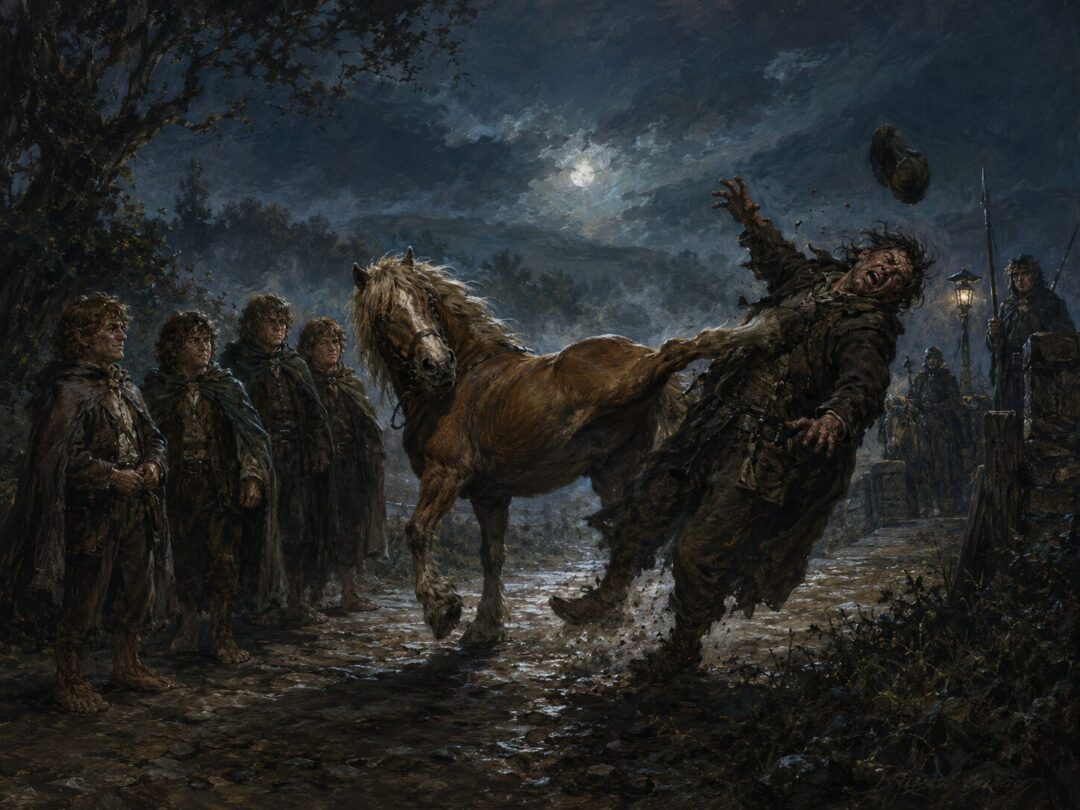
When Bill the Pony gives Ferny a kick, the moment is comic, but it is not meaningless. It is a tiny act of poetic justice. The abused creature gets the last physical answer to the man who mistreated him.
Of course, the pony is not making a moral speech. The text does not require us to imagine Bill as a human-like judge. But narratively, the moment is beautifully exact. Ferny’s power has shrunk. The hobbits are no longer helpless travelers needing to buy his overpriced animal. They are armed, changed, and returning with authority. Even the pony he once neglected is no longer under his control.
The kick matters because it brings the moral pattern down to earth. Not every wrong in Middle-earth is answered by a sword stroke or a king’s decree. Some are answered by the sudden, humiliating collapse of petty cruelty.
The Return Home Is Not Innocent Anymore
Bill’s return also belongs to the larger structure of the hobbits’ homecoming. The road back is not a simple restoration of the beginning. Frodo, Sam, Merry, and Pippin do not return as the same hobbits who left. Bree has suffered. The Shire has been damaged. The world they loved has been touched by the same darkness they thought belonged far away.
In that context, Bill’s survival is not an escape from the seriousness of the ending. It deepens it.
The hobbits are learning that home is not preserved automatically. It must be defended, healed, and rebuilt. Bill is one of the first living signs that healing is still possible. Before the Scouring of the Shire, before the full work of restoration begins, the reader is given this smaller restoration: a lost companion found alive.
That matters because The Lord of the Rings is not only about defeating evil. It is about what happens afterward. Victory must become shelter. Courage must become repair. Memory must become care.
Bill’s return prepares us emotionally for that work.
Sam’s Arc Is Hidden Inside Bill’s Arc
Bill the Pony also illuminates Sam’s journey. Sam begins as a gardener, servant, and caretaker. As the quest grows darker, those traits do not disappear; they become heroic. His care for Bill is of a piece with his care for Frodo, his love of the Shire, and his later role in restoring what has been damaged.
Sam’s greatness is not that he stops being ordinary. It is that ordinary virtues prove stronger than expected.
Bill’s return rewards exactly those virtues. Sam’s pity, patience, and tenderness were not wasted. The pony he saved from Ferny’s neglect survives the wild and comes back into his life. That reunion is one of the story’s quiet confirmations that mercy and care have consequences, even when those consequences are delayed and uncertain.
This does not mean every kindness in Middle-earth is rewarded so neatly. The story is far too grave for that. Frodo’s wounds do not simply vanish. Many losses cannot be undone. But Bill’s return gives one small, believable mercy in a book that understands sorrow deeply.
That mercy does not erase grief. It keeps grief from becoming the whole truth.
Why the Small Ending Matters
Bill the Pony’s return matters because it gives the epic a conscience at ground level. The War of the Ring involves ancient powers, but its meaning reaches down to a stable in Bree, a hungry animal, a gardener’s kindness, and a reunion no one could have guaranteed.
If the ending only restored kings, it would be grand but incomplete. If it only destroyed Sauron, it would be victorious but cold. Bill’s return reminds us that Middle-earth is worth saving because it contains lives like his: small, dependent, easily harmed, and still deserving of care.
That is why the moment lingers.
It is not just a cute ending. It is a small restoration of moral order. The abused are not always forgotten. The lost are not always lost forever. The road home may still bring back something gentle that the darkness failed to devour.
And for Sam, who understood the worth of gardens, meals, ponies, and ordinary loyalties better than almost anyone, Bill’s return is exactly the kind of victory that matters.
Sources & Notes
- Tolkien Gateway, "Bill the Pony" — https://tolkiengateway.net/wiki/Bill_the_Pony
- Tolkien Gateway, "Samwise Gamgee" — https://tolkiengateway.net/wiki/Samwise_Gamgee
- Tolkien Gateway, "Bree" — https://tolkiengateway.net/wiki/Bree
Sources added for article-specific Tolkien reference context.