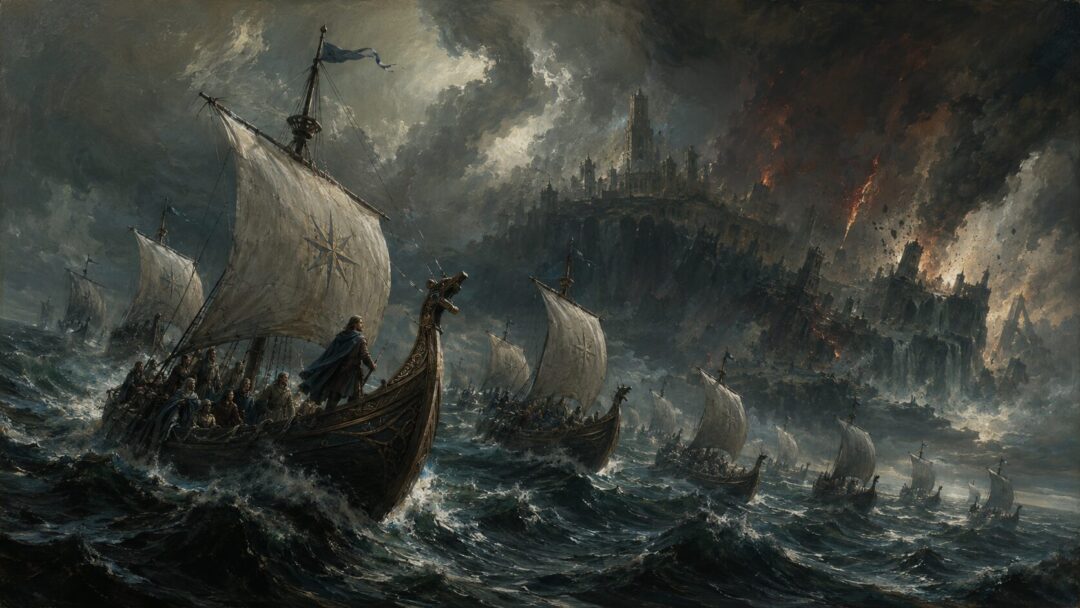
The image is easy to simplify: nine ships riding out of the ruin of Númenor, Elendil standing among the Faithful, the sea carrying the last hope of the West to Middle-earth. It feels, at first glance, like rescue. The old world falls, the righteous survive, and a nobler kingdom begins again.
But Elendil’s escape was not a clean new beginning. It was survival after judgment, not an escape from consequence.
The ships of the Faithful did not leave Númenor as conquerors, pilgrims, or ordinary migrants. They left as the remnant of a civilization that had broken itself. They carried heirlooms, memory, language, kingship, and loyalty to the Valar — but they also carried grief, displacement, and the unresolved shadow of Númenórean power. The Downfall did not wash all corruption from the world. It merely drowned the island where that corruption had reached its height.
Elendil’s task in Middle-earth was therefore tragically double: he had to preserve what was best in Númenor while living with what Númenor had become.
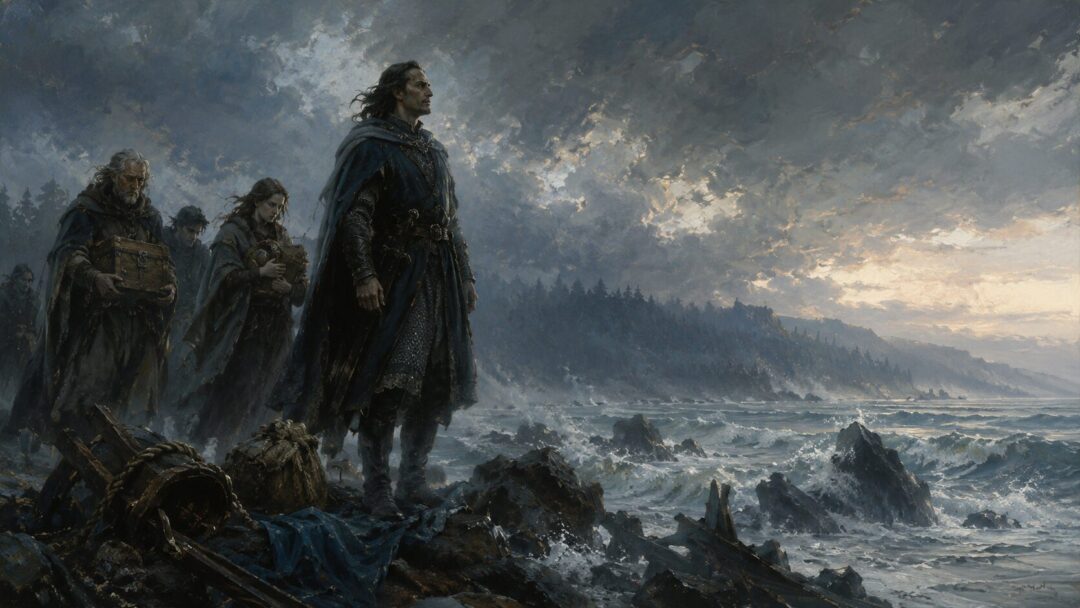
The Faithful Were Survivors, Not Untouched Innocents
Elendil belonged to the Faithful, the party of Númenóreans who remained loyal to the Eldar and the Valar when the kings of Númenor turned against them. In that sense, his escape preserved a true and ancient loyalty. The Faithful remembered friendship with the Elves, reverence for the West, and the limits placed upon Men.
Yet the texts do not present their survival as simple moral escape from a wicked people. The Faithful lived inside Númenor’s decline. They suffered under it, resisted it, and in some cases were persecuted by it, but they were still its children. Their speech, lineage, learning, and power all came from the very island that had become proud enough to challenge the Ban of the Valar.
That is part of the sorrow. Elendil did not sail away from a foreign evil. He sailed away from his own homeland.
Númenor’s fall was not merely the punishment of Ar-Pharazôn and his closest followers. It was the end of an entire world: its harbors, cities, tombs, memories, and households. Even the Faithful who escaped did not get to step into Middle-earth as people without a past. They arrived as exiles from a greatness that had both blessed and endangered them.
Amandil’s Warning Was an Act of Desperation
Elendil’s escape begins with his father, Amandil, the last lord of Andúnië. Seeing the disaster toward which Ar-Pharazôn was moving, Amandil attempted something that deliberately echoed Eärendil: he sailed westward, hoping to plead for mercy before the Valar.
But Tolkien’s account leaves Amandil’s fate unresolved. He does not return. No message comes back. Elendil receives no clear answer that his father succeeded.
That silence matters. The escape of the Faithful was not a confident, divinely explained rescue mission. It was an emergency preparation made under the shadow of fear. Amandil advised Elendil to ready ships and gather the Faithful, but there is no neat revelation that all would be well. Elendil obeyed amid uncertainty.
This makes the nine ships feel less like an ark of triumph and more like a last fragile obedience. The Faithful were not given a painless road into the future. They were told to prepare, wait, and endure whatever came.
The Sea Saved Them, But It Also Broke Them Apart
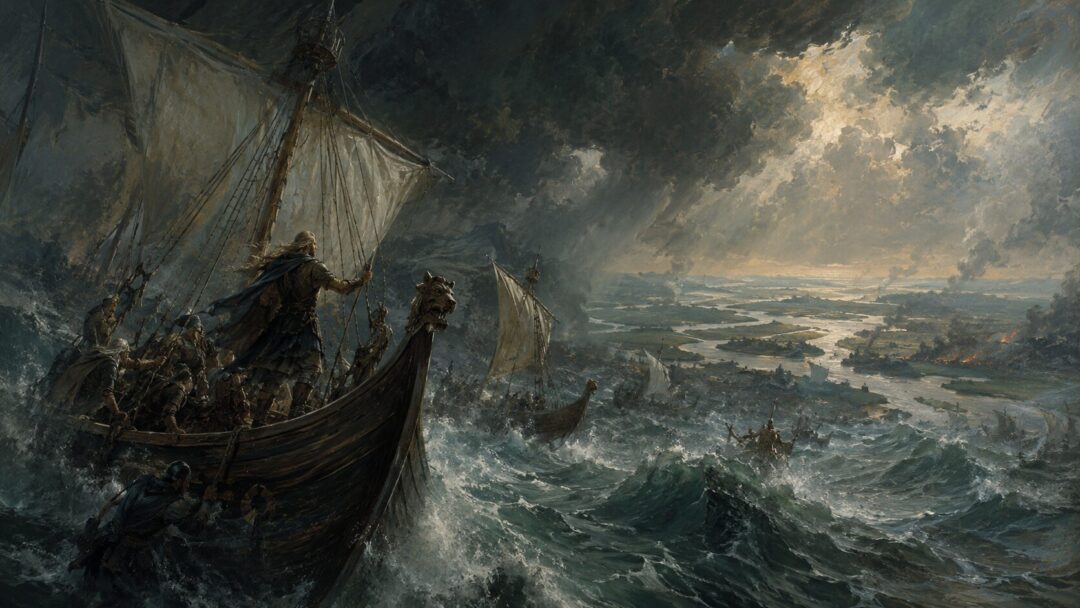
When the Downfall came, Elendil and his sons did not sail calmly into a planned landing. The great storm and the changing of the world drove their ships eastward. Elendil was cast toward the north-west of Middle-earth, landing in Lindon, while Isildur and Anárion were borne south toward the mouths of Anduin.
That detail prevents the escape from feeling orderly. The founding of the Realms in Exile was not the execution of a clean political blueprint. It began with separation, wreckage, and survival after catastrophe.
Elendil reached the lands of Gil-galad, where old alliances could still be renewed. His sons came to the region that would become Gondor. Out of that separation grew the two great Númenórean kingdoms in exile: Arnor in the north and Gondor in the south.
But even this achievement carries loss within it. Arnor and Gondor were not simply “new Númenor.” They were kingdoms founded because Númenor itself was gone. Their very identity depended on exile.
The Heirlooms Were Not Just Treasures — They Were Burdens
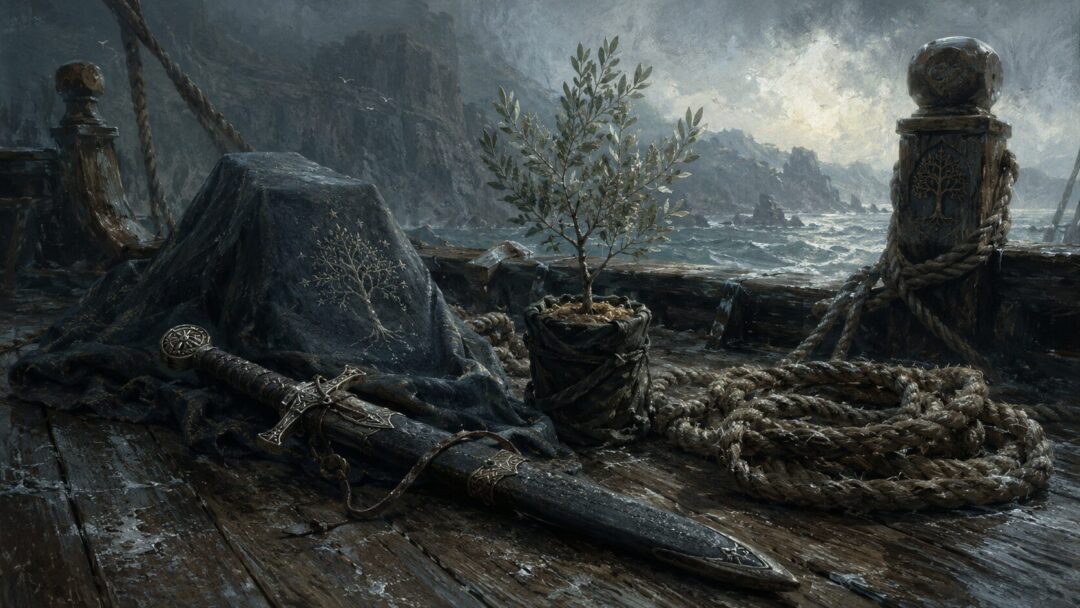
The Faithful preserved more than their lives. They carried with them the symbols and instruments of Númenórean memory: the palantíri, the line of the White Tree through the fruit Isildur had saved, and royal heirlooms associated with Elendil’s house.
These objects are often treated as signs of legitimacy, and they are. But they are also signs of pressure. The survivors were not free to become ordinary settlers. They arrived bearing visible proof that they were the remnant of a fallen high civilization.
A White Tree is not just a tree. It is a living memory of Númenor’s lost holiness and of Isildur’s dangerous act of preservation before Nimloth was destroyed. The palantíri are not just marvels. They are powerful tools of communication and sight, useful but never morally neutral in the larger history of Middle-earth. Narsil is not just a sword. It becomes part of the line of conflict that will eventually reach the War of the Last Alliance and, much later, the War of the Ring.
In other words, Elendil did not arrive empty-handed. He arrived history-laden. The past came with him.
Middle-earth Was Not an Untouched Refuge
It is tempting to imagine Middle-earth as a safe shore after the drowning of Númenor. But by the time Elendil founded the Realms in Exile, Middle-earth was already marked by Sauron’s earlier wars and dominion.
Sauron had been taken to Númenor as a prisoner by Ar-Pharazôn, but his power was not ended by the island’s fall. The Downfall destroyed his fair bodily form, yet his spirit returned to Middle-earth. There he resumed his place in Mordor. This is one of the darkest ironies of Elendil’s escape: the Faithful survived Númenor only to find that the chief corrupter of Númenor had survived too.
The new beginning was therefore immediately shadowed by an old enemy.
Gondor’s geography makes this especially stark. Isildur and Anárion established their realm in lands near Mordor. Minas Ithil, later seized by Sauron, stood on the borders of the Shadow. The southern kingdom was magnificent, but it was never innocent of danger. Its very greatness developed beside the threat that would define much of its history.
The Realms in Exile Preserved Númenor — Including Its Temptations
Elendil’s realms preserved the best of Númenórean inheritance: long memory, high craft, alliance with the Elves, and resistance to Sauron. But the phrase “Realms in Exile” should not be softened. Exile is not renewal without pain. It is continuity after rupture.
The Dúnedain did not cease being Númenórean because they were Faithful. Their long lives, royal structures, and sense of inherited greatness remained. In Elendil these qualities are noble. In later ages, similar inheritances can become brittle, nostalgic, or proud.
This does not mean Elendil caused later decline. The texts present him as one of the great leaders of Men. But the pattern of Middle-earth suggests that no people, however faithful at the beginning, is immune to decay. Arnor will fracture. Gondor will endure but diminish. The line of kings will fail in the south for many generations. Even the memory of Númenor can become a burden when people cling to what was lost more than they understand why it was lost.
Elendil’s escape preserved a remnant, not a cure for mortality, pride, or fear.
Elendil’s Oath Is Hopeful Because It Knows the World Has Ended
Elendil’s words upon coming to Middle-earth are among the most powerful associated with him: from the Great Sea he has come to Middle-earth, and there he and his heirs will abide until the ending of the world.
The force of that oath lies in its grief as much as its courage. He is not declaring that the past has been erased. He is standing after the destruction of his homeland and choosing rootedness anyway.
That is why the oath feels so different from conquest. Elendil does not arrive claiming that Middle-earth owes him a replacement for Númenor. He arrives as one who has lost the land behind him and must now build faithfully in the land before him.
His greatness is not that he escapes loss. His greatness is that he accepts the duty that survives it.
The Last Alliance Shows the Cost of the “New Beginning”
The clearest proof that Elendil’s escape was not clean is where his story ends. He does not die peacefully in a restored world. He dies in battle against Sauron on the slopes of Orodruin, beside Gil-galad, in the War of the Last Alliance.
The Enemy who helped corrupt Númenor becomes the Enemy Elendil must face in Middle-earth. The consequence follows him across the sea.
Even victory is incomplete. Sauron is overthrown, but not finally destroyed. Isildur takes the One Ring, and the next tragedy is already seeded. Elendil’s broken sword becomes a symbol of both heroism and unfinished history. The new kingdoms survive, but their founding king falls before he can see a lasting peace.
This is not the shape of a clean beginning. It is the shape of a wounded world in which good can still act, but never without cost.
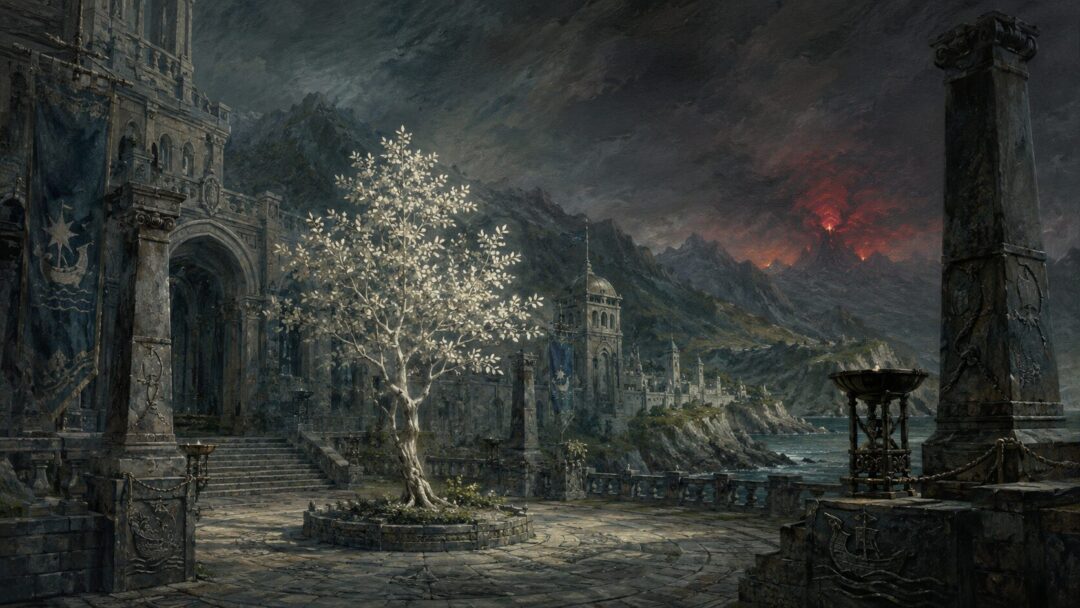
The Tragedy of Elendil’s Escape
Elendil’s escape matters because it refuses two easy readings.
It is not a simple triumph in which the good people leave the bad people behind and begin again untouched. Nor is it a hopeless tale in which corruption destroys everything. It is something more morally demanding: a remnant survives, but survival itself becomes a responsibility.
The Faithful carry memory without being allowed to worship the past. They carry power without being allowed to repeat Númenor’s arrogance. They carry grief without being allowed to surrender to it. They build kingdoms, but those kingdoms are named by exile.
Elendil’s new beginning was real, but it was not clean. It was salt-stained, storm-driven, and haunted by the drowned world beneath the waves. Its hope came not from forgetting Númenor, but from remembering it rightly — as glory, warning, wound, and inheritance.
That is why Elendil remains one of the great figures of the Second Age. He does not stand at the start of an untouched age. He stands at the edge of ruin, carrying what can be saved, knowing that even the saved things must be guarded from the shadow that destroyed their home.
Sources & Notes
- Tolkien Gateway, "Elendil" — https://tolkiengateway.net/wiki/Elendil
- Tolkien Gateway, "Akallabêth" — https://tolkiengateway.net/wiki/Akallab%C3%AAth
- Tolkien Gateway, "Realms in Exile" — https://tolkiengateway.net/wiki/Realms_in_Exile
Sources added for article-specific Tolkien reference context.