Gandalf arrives in the Shire with a cart full of fireworks, and at first it seems like one of the gentlest details in all of Middle-earth.
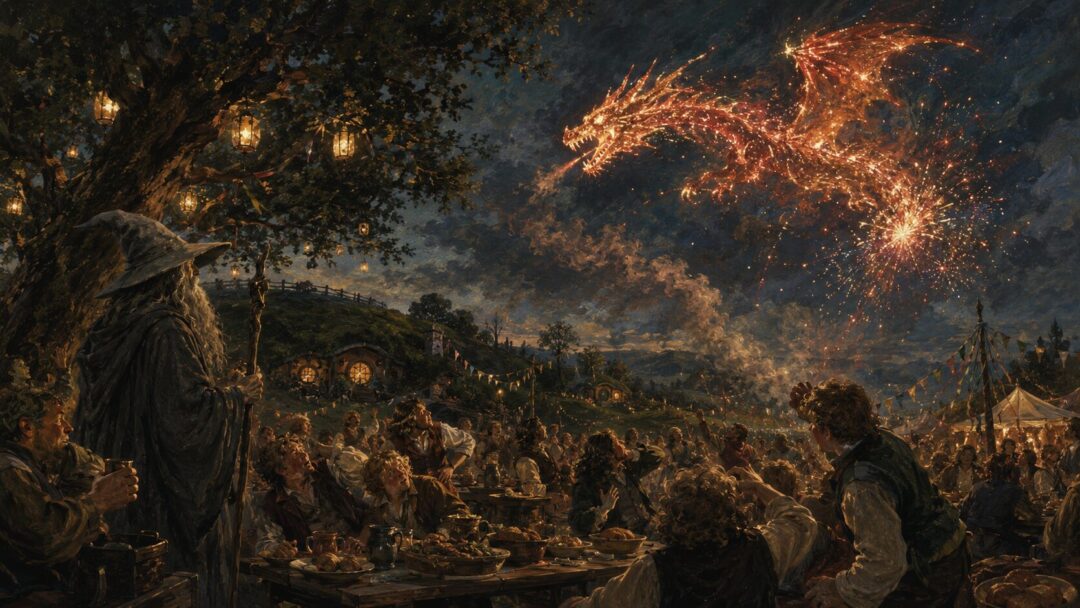
To the hobbits, he is the wandering old man who brings wonder: sparks, lights, smoke-shapes, and the famous dragon firework at Bilbo’s birthday party. Children run after him. Adults remember him with suspicion and affection. His fireworks belong to birthdays, laughter, and summer evenings under the Party Tree.
But that is exactly why they matter.
Gandalf’s fireworks are not just a charming hobby added to make him more whimsical. They are one of the first clues to the kind of power he truly possesses — and, more importantly, the kind of power he refuses to misuse. In a world where fire often means destruction, terror, and domination, Gandalf uses flame to awaken joy, memory, courage, and hope.
The same wizard who entertains hobbit children with fire will later stand before a Balrog and declare himself a servant of a far deeper flame. The contrast is not accidental. It reveals the heart of Gandalf’s mission.
The Shire Sees the Smallest Part of Him
In the Shire, Gandalf is remembered less as a great enemy of Sauron and more as a maker of fireworks. This is part of the humor of his character. The hobbits know only a little of what he is, and much of what they know is delightfully domestic.
He is associated with unexpected visits, strange tales, and “disturbances” that respectable hobbits might prefer to avoid. Yet his fireworks are loved. They are not weapons. They are not commands. They do not bend anyone’s will. They appear, dazzle, vanish, and leave behind wonder.
That matters because Gandalf’s work among hobbits is never based on coercion. He does not conquer the Shire. He does not organize it like an army. He does not reveal his full nature and demand reverence. He comes lowly, smoky, dusty, and half-comic, letting himself be mistaken for a travelling conjurer.
This humility is not weakness. It is strategy, and perhaps even mercy.
The Shire does not need a lord of fire. It needs someone who can stir its hidden courage without destroying its innocence. Gandalf’s fireworks do that on the smallest scale. They make hobbits look upward. They make them imagine beyond gardens, seed-cakes, and family trees. They suggest that ordinary life is not the whole of the world.
That is exactly what Gandalf later does to Bilbo, Frodo, Sam, Merry, and Pippin. He does not make them great by force. He kindles what is already hidden inside them.
Fireworks Are Fire Under Discipline
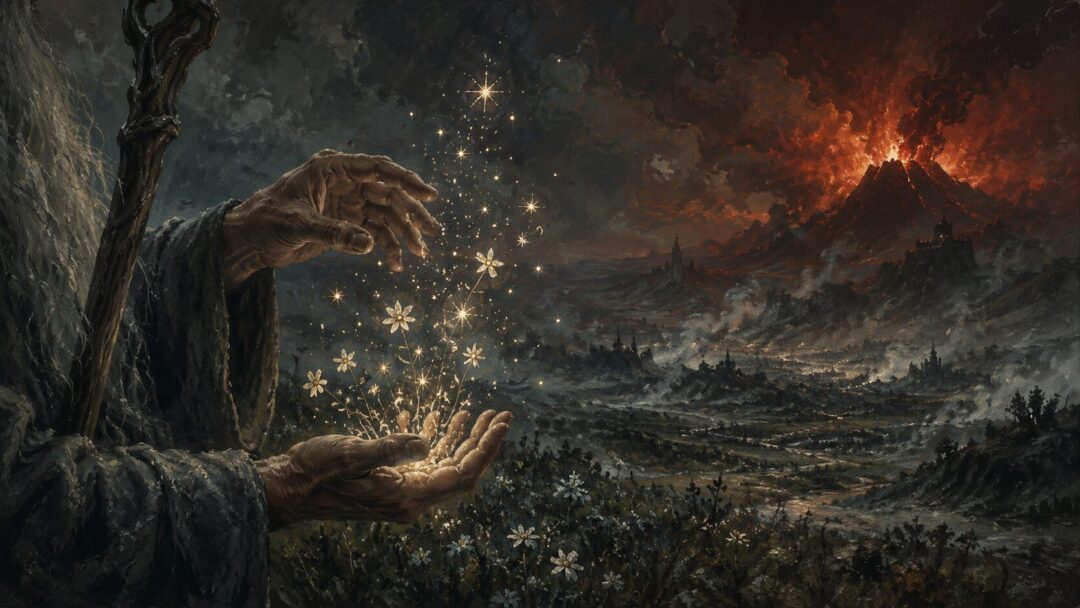
Fire in Middle-earth is often dangerous. Dragons breathe it. Balrogs are wrapped in it. Mount Doom is a place of volcanic terror. Sauron’s power is repeatedly associated with heat, furnaces, burning, and the making of things by domination.
Gandalf’s fireworks are different.
They are fire disciplined into beauty.
A firework is flame that has been shaped, timed, restrained, and given form. It is not a wildfire. It is not a consuming blaze. It spends itself in a moment of wonder. Its power is real, but it is not possessive. It does not remain to rule the sky.
This makes Gandalf’s fireworks a small but revealing image of his larger role. His power is not merely that he can create flame. The deeper sign is that he can govern flame. He can turn it toward delight rather than terror, toward awakening rather than destruction.
This distinction becomes sharper when we remember that Gandalf does use fire in dangerous situations. In The Hobbit, during the crisis with the Wargs, he uses fire against enemies. In The Lord of the Rings, his confrontation with the Balrog brings his fiery language into its most serious form. Yet these moments do not contradict the fireworks. They complete the pattern.
Gandalf’s fire is defensive, illuminating, and kindling. It is used against darkness, but it is not darkness wearing a brighter color.
The Dragon Firework Is More Than a Party Trick
The dragon firework at Bilbo’s party is one of the most memorable images of Gandalf’s art. It rushes over the heads of the guests in a form so vivid that it causes alarm before bursting above them.
On the surface, it is comic: hobbits diving under tables because the entertainment has become too convincing. But beneath the comedy is a strange foreshadowing.
Bilbo’s life has already been shaped by a real dragon. Smaug is not merely an adventure anecdote; he is the terror at the center of Bilbo’s earlier journey. Gandalf’s dragon firework turns that old terror into art. The dragon is no longer a hoarder of gold, a destroyer of towns, or a voice of temptation in the dark. It becomes light in the sky, frightening for a second, then gone.
This does not mean Gandalf is casually mocking danger. Rather, the scene shows how memory can be transformed. Evil leaves scars, but it need not have the final imaginative authority. A dragon can become a story. A story can become a celebration. A celebration can still contain a tremor of fear.
That is very Gandalf.
He never denies the reality of evil. He knows too much for that. But he also refuses to let evil define the whole meaning of the world. His fireworks turn shadow into shape, fear into spectacle, and danger into something that can be looked at without surrendering to it.
Narya and the Fire That Kindles Hearts
The strongest reason Gandalf’s fireworks feel like more than a hobby is revealed through Narya, the Ring of Fire.
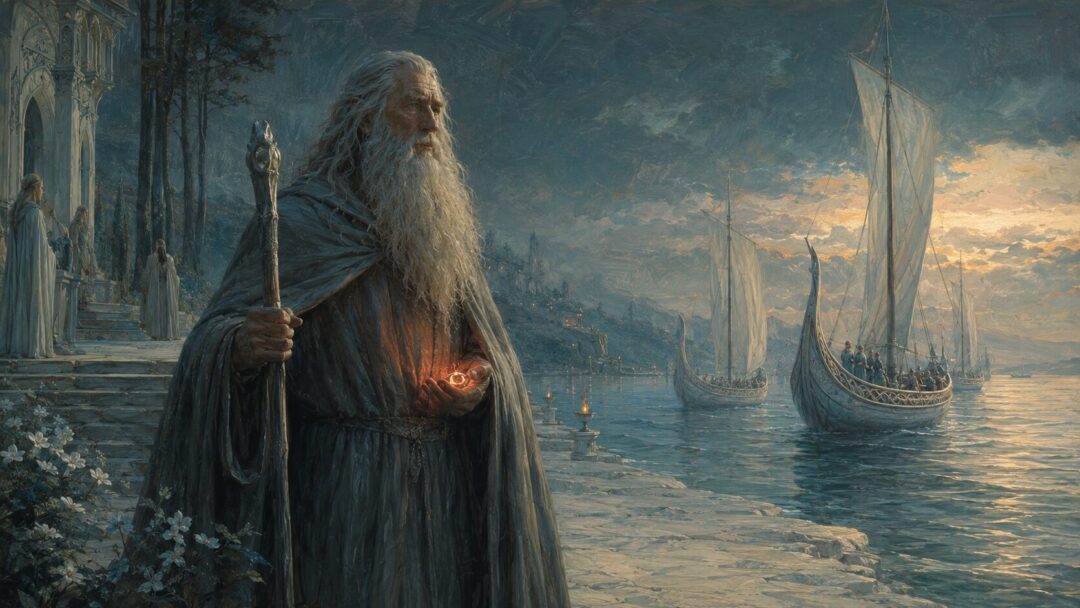
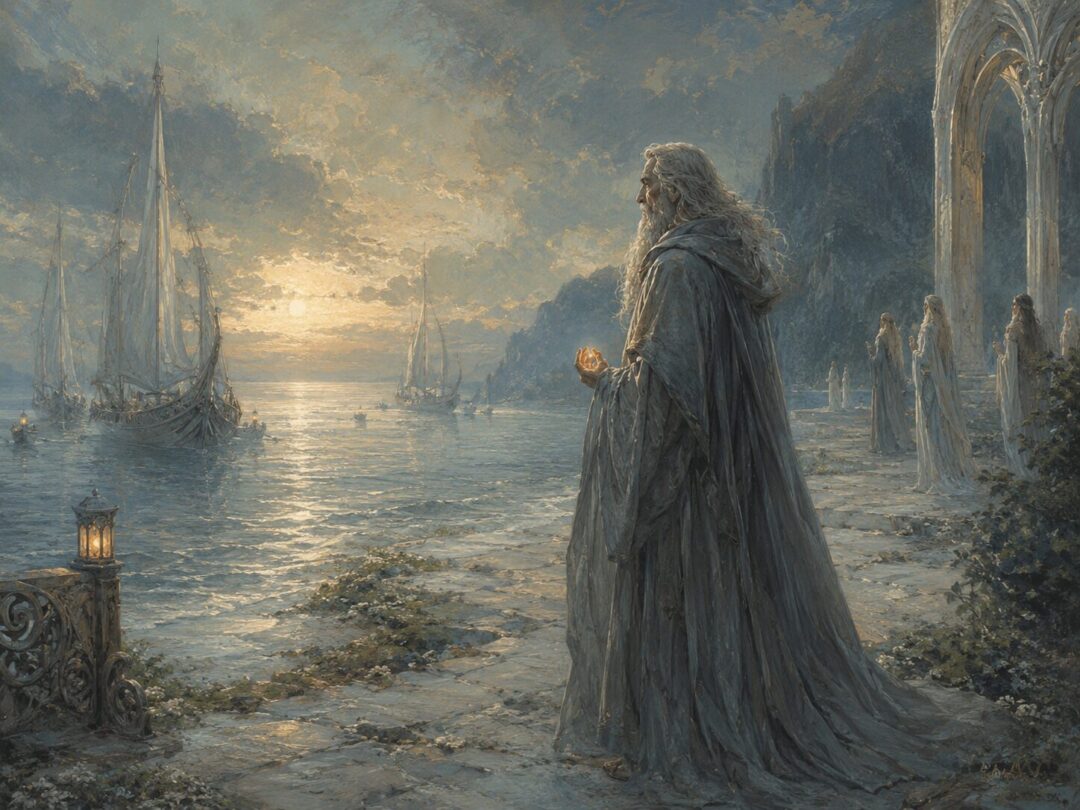
Gandalf bears Narya in the Third Age, though this is not openly known for most of the story. At the Grey Havens, the Ring is finally seen on his hand. In the tradition preserved around the Istari, Narya is associated not with burning enemies but with rekindling hearts in a world growing cold.
That phrase is essential to understanding Gandalf.
The Ring of Fire does not turn him into a fire-lord in the crude sense. It fits the work he is already sent to do: to encourage resistance, awaken courage, and sustain hope against Sauron. Its fire is inward as much as outward. It is not primarily about spectacle, though Gandalf can certainly produce spectacle. It is about warmth against despair.
This makes the Shire fireworks feel different in retrospect. They are the innocent visible edge of a deeper spiritual pattern. Gandalf’s great power is not that he can make flame appear. It is that he can make hearts answer.
He does this with Thorin’s company, though not without conflict. He does it with Bilbo, by drawing a timid hobbit into a story where pity and courage matter more than treasure. He does it with Frodo, by helping him face the burden of the Ring without pretending the road will be easy. He does it with Théoden, whose renewal is one of the clearest images of a chilled heart being awakened.
The fireworks are the childlike version of the same mystery: a spark in the dark, sudden and undeserved, saying that the world is larger than fear.
The Secret Fire and the Flame of Anor
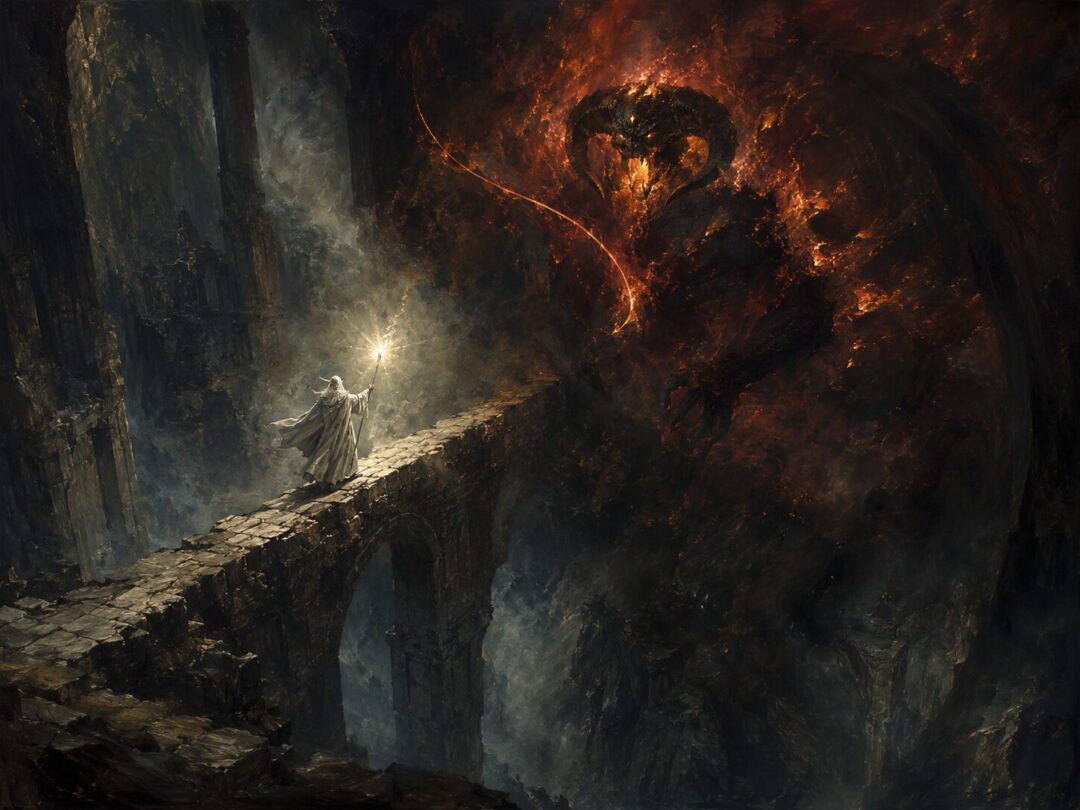
At the Bridge of Khazad-dûm, Gandalf’s language changes completely. There is no birthday laughter, no Party Tree, no delighted hobbit children. There is only the Balrog, an ancient terror of shadow and flame.
Gandalf declares himself a servant of the Secret Fire and wielder of the flame of Anor. The exact meaning of “flame of Anor” has been interpreted in more than one way. It may connect to the Sun, since Anor is the Elvish name associated with the Sun; some readers also see a possible link with Gandalf’s possession of Narya, the Red Ring. The text does not pause to explain the phrase in a technical way, so it is safest to treat it as layered rather than reduce it to a single mechanical definition.
But the moral contrast is unmistakable.
The Balrog is also a being of fire. Yet Gandalf calls it a flame of Udûn, tying it to the old darkness of Morgoth’s realm. This is not a contest between fire and water, or fire and no fire. It is a contest between two kinds of flame.
One devours. One serves.
One belongs to terror, ruin, and domination. The other stands under authority beyond itself.
That distinction is the key to Gandalf’s deepest power. He is not powerful because he is fiery. Many evil things in Middle-earth are fiery. He is powerful because his fire is obedient, sacrificial, and life-giving. It does not exist to magnify himself.
The fireworks in the Shire are the gentlest form of that same truth. Even there, his flame is not for possession. It is given away.
Gandalf’s Power Is Hidden by Gentleness
One of the great ironies of Gandalf is that his most familiar traits make him easy to underestimate.
He is old, grey, irritable, fond of smoke, prone to laughter, and apparently interested in fireworks. He appears less majestic than Saruman, less radiant than the High Elves, less kingly than Aragorn. Even his title, “the Grey,” suggests something weathered and in-between.
But the grey covering matters. Gandalf’s hidden fire is veiled.
This is one reason the fireworks are so revealing. They show a power that does not need to announce itself as power. Gandalf can fill the sky with wonder and still remain a shabby old wanderer at the edge of the party. He can shape fire into marvels and then let the hobbits talk mostly about the show.
That humility is part of his strength. Sauron’s power seeks visibility through fear. Saruman’s power increasingly seeks recognition through voice, order, and mastery. Gandalf’s power often works by leaving others more themselves, not less.
He does not make Frodo a puppet. He does not seize the Ring. He does not rule the Shire for its own good. He lights the road and allows others to walk it.
Why Hobbits Were the Right Audience
It is easy to treat Gandalf’s love for hobbits as a charming eccentricity. But his fireworks suggest something deeper: he understands the value of uncorrupted wonder.
Hobbits are not mighty in the usual sense. They do not build great towers or forge Rings of Power. Their strength lies in endurance, pity, loyalty, and the stubborn love of ordinary things. Gandalf sees that these qualities matter in a war where raw power cannot defeat the Ring without becoming like the Enemy.
Fireworks are perfect for hobbits because they honor joy without turning it into greed. They are beautiful and temporary. No one can hoard a firework once it has bloomed. No one can possess the dragon in the sky. The gift exists in the shared moment.
That is almost the opposite of the Ring.
The Ring concentrates power into possession. It whispers that the world can be mastered if only one will claims it. A firework gives beauty by vanishing. It asks only to be witnessed.
This may be why the image feels so right for Gandalf. His deepest victories often happen through things that refuse domination: pity, friendship, laughter, endurance, and hope.
The Small Spark Before the Great Darkness
By the time the War of the Ring begins, Gandalf’s fireworks may seem like a relic of a more innocent story. Yet they remain one of the clearest introductions to his nature.
They teach the reader how to understand him before the darker revelations arrive.
When Gandalf stands against the Balrog, his fire does not come from nowhere. When he bears Narya, the Ring of Fire, it does not feel random. When he rekindles Théoden, encourages Frodo, and trusts the small hands of hobbits, we are seeing the same principle that once lit the Shire sky.
His power is not merely explosive. It is kindling.
That is the hidden clue inside the fireworks. Gandalf’s flame is not the fire that consumes the world in order to rule it. It is the spark that reminds free people why the world is worth saving.
And perhaps that is why his first great sign among hobbits is not a weapon, not a prophecy, not a throne, and not a display of command.
It is a burst of light above a party field.
A little flame in the dark.
Gone in a moment, but remembered for a lifetime.
Sources & Notes
- J.R.R. Tolkien, The Hobbit, Chapter 1, “An Unexpected Party” — Bilbo remembers Gandalf as the maker of wonderful fireworks, tying the wizard’s first impression to wonder rather than command.
- J.R.R. Tolkien, The Lord of the Rings, Book I, Chapter 1, “A Long-expected Party” — Gandalf’s fireworks at Bilbo’s party include the famous dragon display, turning fiery terror into shared delight.
- J.R.R. Tolkien, The Lord of the Rings, Book II, Chapter 5, “The Bridge of Khazad-dûm” — Gandalf names himself servant of the Secret Fire and wielder of the flame of Anor against the Balrog’s flame of Udûn.
- J.R.R. Tolkien, The Silmarillion, “Of the Rings of Power and the Third Age” — Círdan gives Narya to Gandalf so that he may rekindle hearts in a world growing chill.
- J.R.R. Tolkien, Unfinished Tales, “The Istari” — describes Gandalf’s mission as counsel and encouragement against Sauron, not domination by matching the Enemy’s methods.