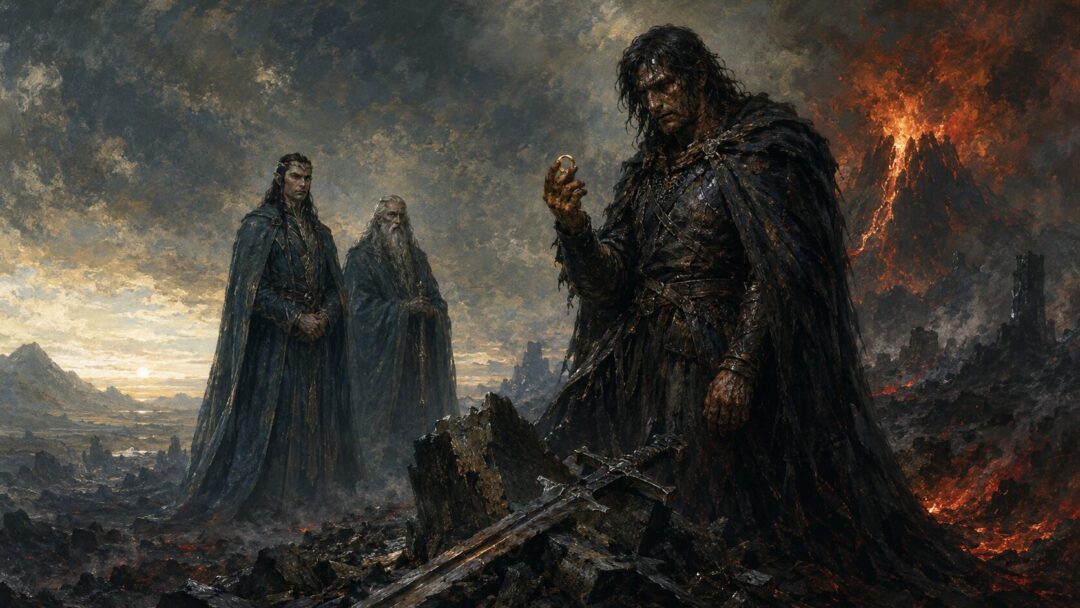
The Ring lying in Isildur’s hand is one of the great turning points of Middle-earth: a small golden thing taken from the ruin of Sauron, bright enough to seem like victory and dark enough to carry the next age’s doom.
It is easy to reduce that moment to a simple accusation: Isildur failed because Men are weak. But the texts give a more troubling picture. Isildur’s choice was wrong. Elrond remembered it as something that “should not have been.” Yet Isildur was not merely a greedy man refusing obvious wisdom. He was a king standing amid the bodies of his father and brother, holding an object whose maker had poured much of his own power into it. His failure was personal, moral, political, and supernatural all at once.
That is what makes it more frightening. The Ring did not need Isildur to be a monster. It needed him to be wounded, proud, bereaved, royal, and convinced that he had a claim.
The Victory That Was Not Finished
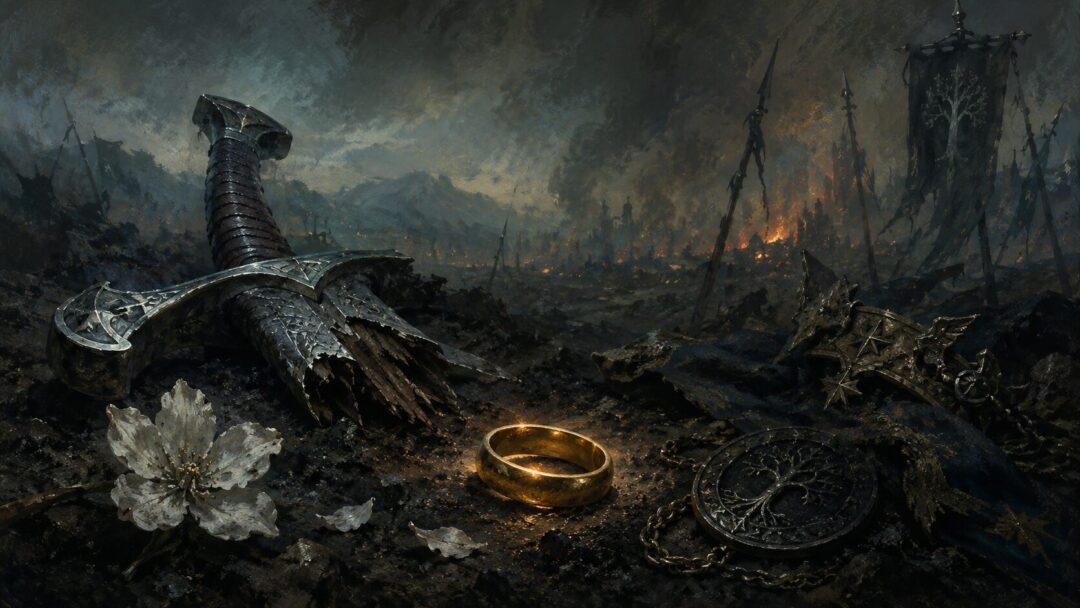
At the end of the War of the Last Alliance, Sauron was overthrown after Gil-galad and Elendil both died in the struggle. Isildur then cut the Ring from Sauron’s hand and took it for himself, against the counsel of Elrond and Círdan, who urged that it be destroyed in the fire of Orodruin. encyclopedia-of-arda.com
This is the terrible contradiction at the heart of the scene. The war had been won, but its deepest cause had not been removed. Sauron’s body was cast down, yet the Ruling Ring remained. In the logic of Middle-earth, that mattered enormously. The Ring was not just a trophy, weapon, or symbol. It was bound to Sauron’s power and will. To keep it was to leave the victory incomplete.
Isildur’s first error, then, was not simply that he wanted a beautiful object. It was that he treated the Ring as something that could pass into ordinary possession. He acted as though the Ring could be absorbed into the world of inheritance, vengeance, kingship, and memory. But the Ring belonged to a darker order. It was made to dominate.
“Weregild” and the Language of Injury
Isildur’s own justification is important. He claimed the Ring as weregild for the deaths of his father Elendil and his brother Anárion. In other words, he framed the Ring as payment for blood.
That does not make his choice innocent, but it does make it more human. Isildur was not choosing in a calm hall after years of reflection. He had seen the ruin of his house, the death of the High King of the Dúnedain, and the end of a war that had consumed Elves and Men alike. The Ring entered his hand at the precise point where grief and triumph met.
This is where the moral danger deepens. The Ring often works through something already present in the bearer. With Boromir, it speaks to the defense of Gondor. With Galadriel, it touches the temptation to rule beautifully and terribly. With Frodo, it eventually fastens itself to pity, burden, and exhaustion. With Isildur, one reading is that it found grief, royal entitlement, and the desire to make loss meaningful.
Weregild sounds lawful. It gives a name to the wound. It turns private anguish into public claim. But no payment could truly answer for Elendil and Anárion. The Ring could not heal what Sauron had destroyed. It could only preserve the injury in another form.
The Heirloom That Should Never Have Had Heirs
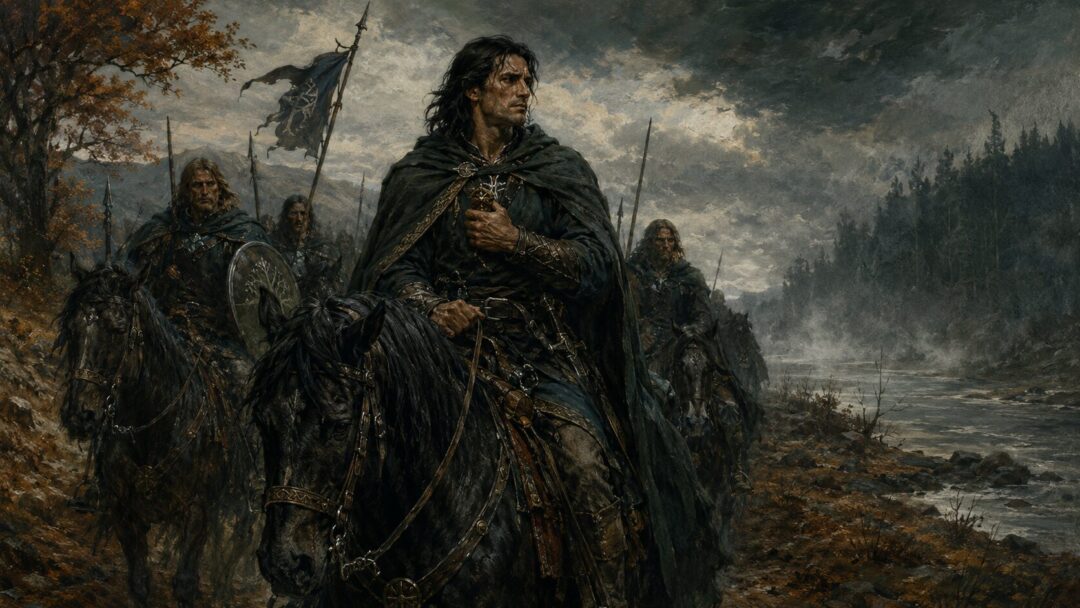
The later account associated with Isildur says the Ring would be an heirloom of his kingdom, yet also records his pain and attachment to it. Tolkien’s story preserves the disturbing fact that Isildur recognized something significant about the Ring, even while refusing the only action that would end its danger.
Galileo Educational Network
Calling the Ring an heirloom was not a small mistake. It placed a thing of domination inside the chain of memory and dynasty. Isildur’s house had already inherited great burdens: Númenórean exile, the kingdoms of Arnor and Gondor, the memory of the drowned West, and the war against Sauron. By naming the Ring as an heirloom, Isildur risked binding his line to an object that could corrupt every rightful claim it touched.
This is why his failure cannot be separated from kingship. A private person might covet treasure. A king turns coveting into policy. Isildur’s decision was not only about his own soul; it concerned the fate of kingdoms. His authority gave his error historical weight.
And yet the texts do not present him as a fool without greatness. Isildur had earlier rescued a fruit of the White Tree from Númenor before its destruction, a deed of courage and faithfulness remembered in the history of Gondor. He was capable of reverence, risk, and loyalty. That contrast matters. The Ring did not corrupt an empty man. It bent a great one at a vulnerable point.
Why Elrond and Círdan’s Counsel Matters
Elrond and Círdan urged the Ring’s destruction, but Isildur would not surrender it. encyclopedia-of-arda.com Their presence makes the scene morally clear without making it simple.
They were not merely offering a preference. They understood enough to know that the Ring should not remain in the world. Yet the texts do not show them seizing it by force. That absence is significant. The Ring cannot be safely solved by one more act of domination. To take it violently from Isildur would risk beginning its next corruption immediately.
There is also a political reality. Isildur was not a random soldier picking up spoils. He was Elendil’s heir, a king of the Dúnedain, and one of the victorious leaders of the war. For Elrond and Círdan to compel him would have meant turning the moment of victory into conflict among the allies. The texts do not spell out every calculation, so we should be careful here. But the situation itself implies that wisdom was constrained by history, authority, grief, and the Ring’s own peril.
The tragedy is that everyone stood near the only fire that could unmake the Ring, and still the world could not get free of it.
The Ring Did Not Make Isildur Strong
A common misunderstanding is that Isildur kept the Ring because he had mastered it or hoped to wield it easily. The fuller tradition around the Disaster of the Gladden Fields complicates that. When his son Elendur asks about using the Ring’s power against the attacking Orcs, Isildur admits that he cannot use it, dreads touching it, and has not found the strength to bend it to his will. He says his pride has fallen and that it should go to the Keepers of the Three.
That moment is crucial. Isildur’s failure was real, but it was not the final shape of his will. By the time of his last journey, he appears to understand that the Ring is beyond him. He does not boast that he will master it. He sees, too late, that the burden should pass to wiser hands.
This does not erase the first choice. It makes it sadder. Isildur’s story is not “a weak man wanted power and died.” It is closer to “a proud and wounded king claimed what he should have destroyed, learned that it was beyond him, and was overtaken before he could undo the damage.”
His repentance, if we may cautiously call it that, came inside a closing trap.
The Disaster at the Gladden Fields
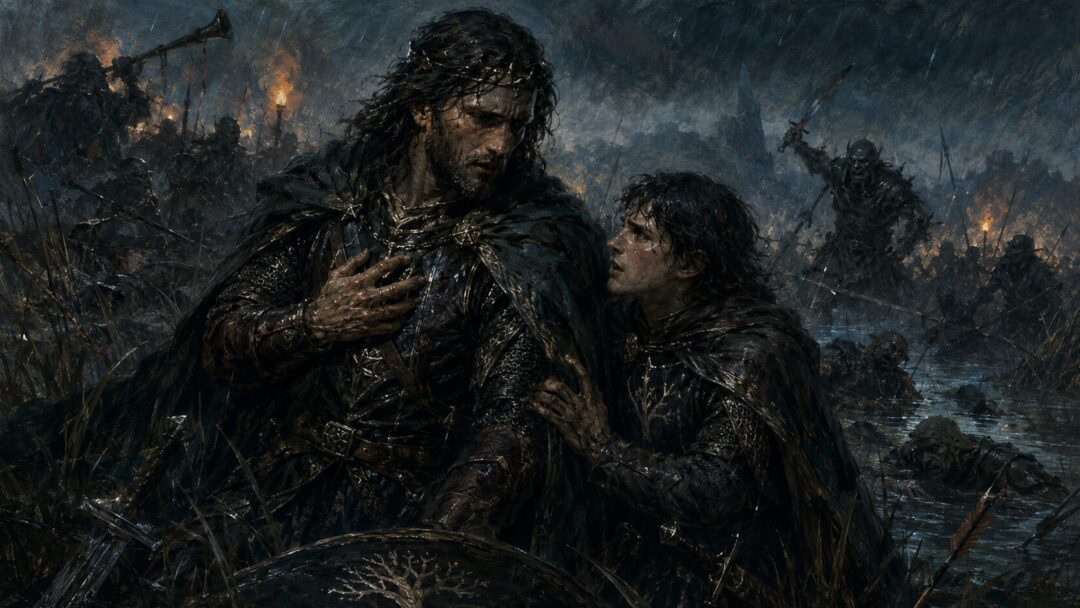
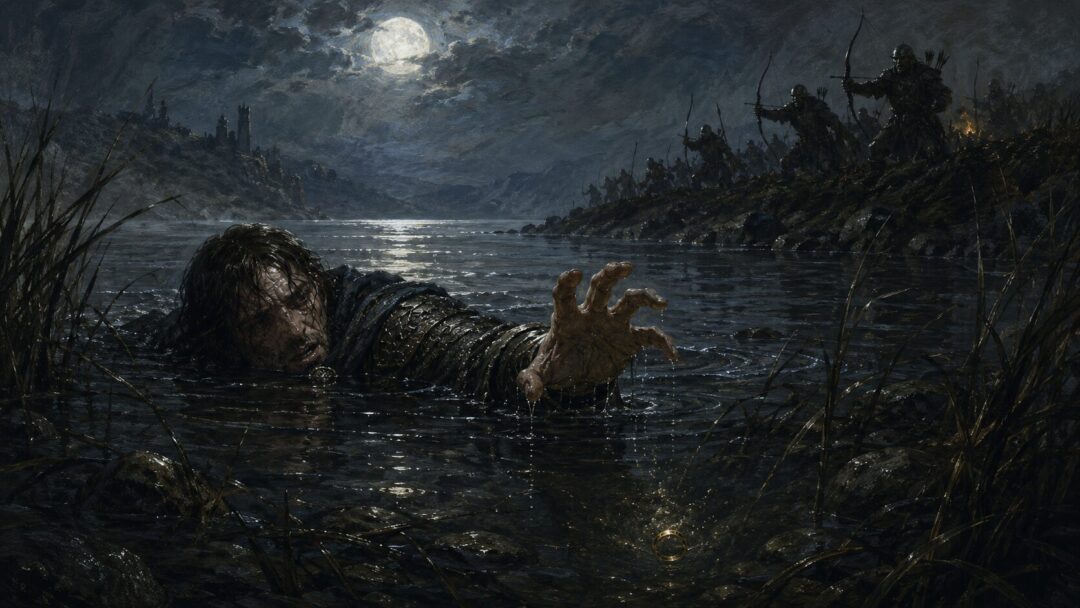
Isildur was later ambushed by Orcs near the Gladden Fields while traveling north. In the disaster, his sons were slain except for Valandil, who was not present, and Isildur tried to escape by putting on the Ring and entering the Anduin. The Ring slipped from his finger, making him visible, and he was shot by Orcs.
Here the Ring’s malice becomes almost narrative irony. Isildur had claimed it as compensation for death, but it brought more death into his house. He had named it an heirloom, but it abandoned him before it could be safely inherited. He had kept it from the Fire, and it carried itself into the River, hidden from the world until it could re-enter history in a new way.
The texts allow some mystery around chance and providence in such events. We should not overstate the Ring as if it acts exactly like a person with a complete independent mind. But the story strongly presents it as treacherous: it serves its own dark history, not the need of its bearer.
Isildur dies not as a conquering Ring-lord, but as a hunted man, stripped of the very object he once claimed.
More Than “Men Are Weak”
The phrase “human weakness” is not entirely wrong. Isildur was weak at the decisive moment. He refused wise counsel. He clung to a claim that should have been surrendered. But if we stop there, we flatten the moral world of the story.
His failure was also the failure of victory to purify grief. It was the failure of kingship to recognize a thing that could not be made lawful by possession. It was the failure of vengeance to heal loss. It was the failure of even the noble-hearted to stand untouched before an artifact made for domination.
That is why Isildur matters long after his death. The Ring becomes “Isildur’s Bane” not because he was the worst of Men, but because he shows how disaster can enter through the wound of a great man. His story warns that evil does not always ask us to love darkness. Sometimes it asks us to keep what we think we have earned.
And in that sense, Isildur’s failure was not just human weakness. It was human greatness turned at the wrong angle: courage mixed with pride, grief hardened into claim, memory corrupted into possession, and kingship unable to let go.
The Ring survived because Isildur fell. But Isildur fell because the Ring met him at the exact place where a noble heart was most exposed.
Sources & Notes
- J.R.R. Tolkien, The Lord of the Rings, Book II, Chapter 2, “The Council of Elrond” — Elrond’s account gives the core scene: Sauron overthrown, Isildur cutting away the Ring, and Elrond and Círdan urging its destruction.
- J.R.R. Tolkien, The Lord of the Rings, Book II, Chapter 2, “The Council of Elrond” — Isildur’s own scroll names the Ring as weregild for Elendil and Anárion, grounding the article’s reading of grief, claim, and royal possession.
- J.R.R. Tolkien, The Silmarillion, “Of the Rings of Power and the Third Age” — recounts the Last Alliance, Isildur’s refusal to cast the Ring into Orodruin, and the Ring’s survival as “Isildur’s Bane.”
- J.R.R. Tolkien, Unfinished Tales, “The Disaster of the Gladden Fields” — shows Isildur later recognizing that he cannot use the Ring, fearing to touch it, and intending that it go to the Keepers of the Three.
- J.R.R. Tolkien, The Lord of the Rings, Book I, Chapter 2, “The Shadow of the Past” — Gandalf’s explanation that Sauron let much of his power pass into the One Ring supports treating it as an active moral and supernatural danger, not a mere trophy.