What “You Shall Not Pass” Really Cost Gandalf
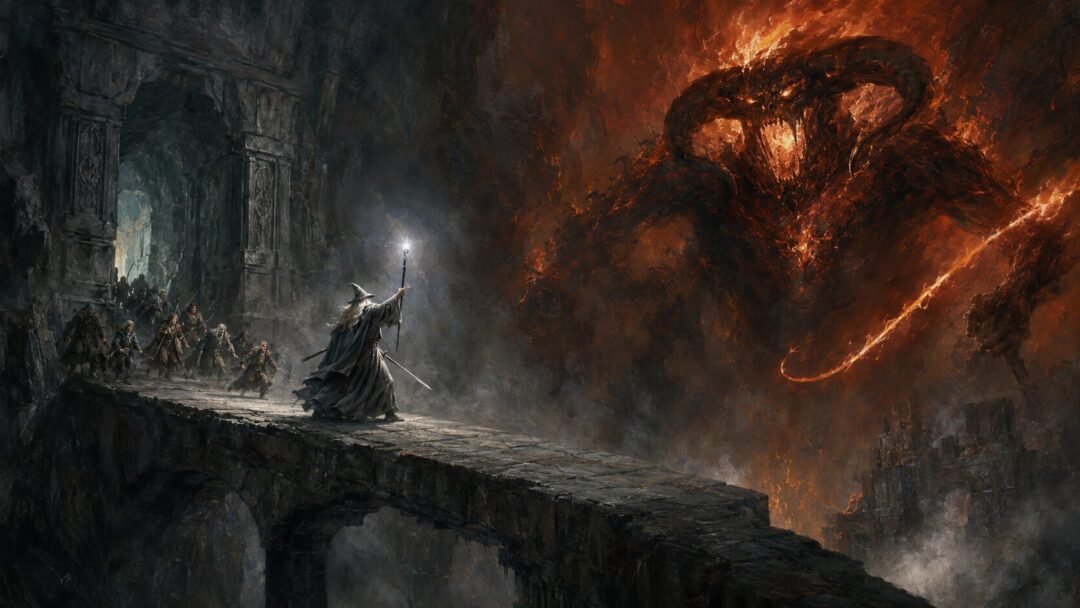
The bridge of Khazad-dûm is one of the clearest images in all of Middle-earth: a narrow span of stone, a pursuing darkness, a grey wizard standing between his friends and something older than kingdoms. To many readers and viewers, the moment is remembered by the famous phrase “You shall not pass.” In the book, Gandalf’s words are slightly different: “You cannot pass.” But the meaning is the same. He is not merely blocking a doorway. He is choosing to spend himself.
That choice is often treated as a heroic interruption in the Fellowship’s escape from Moria. Yet its real cost is far larger than one dramatic fall. Gandalf loses his body. He loses time. He is torn from the Company at the exact moment Frodo most needs guidance. He descends into a kind of struggle that few beings in the Third Age could have endured. And when he returns, he does not simply resume being Gandalf the Grey. Something has ended, even though something greater has been given back.
The Bridge Was Not Just a Battlefield
The confrontation in Moria matters because of where it happens. The Fellowship is not fighting in open country, where bravery can become spectacle. They are trapped inside the ancient realm of Khazad-dûm, a place once filled with Dwarven splendour and now marked by ruin, fear, and echoes. The bridge is narrow, almost mercilessly simple. It turns the entire crisis into a single question: who will stand behind so the others can pass?
Gandalf’s decision is not reckless. It is strategic, but also moral. The Balrog cannot be allowed to reach the Fellowship. The Ring-bearer must escape. Aragorn, Boromir, Legolas, Gimli, and the hobbits cannot meet this enemy on equal terms. Even Gandalf, who understands far more than the others, does not treat the Balrog as a common monster. His words declare rank and allegiance: he is a servant of the Secret Fire and wielder of the flame of Anor. This is not a spell shouted at random. It is a confrontation between powers with ancient roots.
The Company sees a wizard facing a demon of shadow and flame. But the deeper truth is that Gandalf is standing at the limit of his mission. He was sent to oppose Sauron chiefly through counsel, courage, and the awakening of resistance in others. On the bridge, counsel is no longer enough. Someone must physically hold the line.
The Enemy He Faced Was Older Than Moria’s Ruin
Durin’s Bane is not simply a beast living under the mountains. In the wider legendarium, Balrogs belong to the ancient terror of Morgoth’s wars. They are associated with fire, shadow, and ruin from the Elder Days. The Balrog in Moria had survived into the Third Age, hidden far beneath the Misty Mountains until the Dwarves uncovered it. It slew Durin VI and later Náin I, helping bring about the abandonment of Khazad-dûm.
That history matters because Gandalf is not merely protecting the Fellowship from a dangerous creature. He is confronting a remnant of the First Age, a power that should feel almost out of time in the War of the Ring. Moria’s darkness is not only political or military; it is geological, historical, and spiritual. The Balrog is like a buried consequence of ancient evil, suddenly rising into the path of the Ring.
This makes Gandalf’s stand more costly. He is not fighting an enemy chosen for him by chance. He is meeting a being whose nature is closer to his own than it first appears. Gandalf is one of the Istari, and behind the form of an old man is a Maia, a spirit sent into Middle-earth under limitation. The Balrog also belongs to the order of such spiritual beings, though corrupted into terror and domination. Their battle is therefore not a simple wizard-versus-monster scene. It is a collision between two ancient powers moving in opposite moral directions.
The First Cost: He Broke the Fellowship’s Guide
Gandalf’s fall does not only cost him personally. It breaks the Fellowship’s confidence. Until Moria, Gandalf has been the chief interpreter of danger. He is not always obeyed, and he does not always reveal everything, but his presence gives the Company a center. When he falls, that center vanishes.
This is one of the overlooked costs of the bridge. Gandalf saves the Fellowship from immediate destruction, but his absence leaves them wounded and leaderless at a crucial stage. Aragorn takes command, but even he is shaken. Frodo continues toward Mordor with less guidance than he might have had. Boromir’s inner conflict grows without Gandalf’s discernment nearby. The Company reaches Lothlórien alive, but not whole.
The texts do not say that Gandalf foresaw every consequence of his fall. It is safer to say that he understood the immediate necessity: the Ring-bearer had to escape. Yet the irony is sharp. Gandalf preserves the Quest by removing himself from it. His wisdom is needed, but his sacrifice requires its absence.
The Fall Was Not the End of the Battle
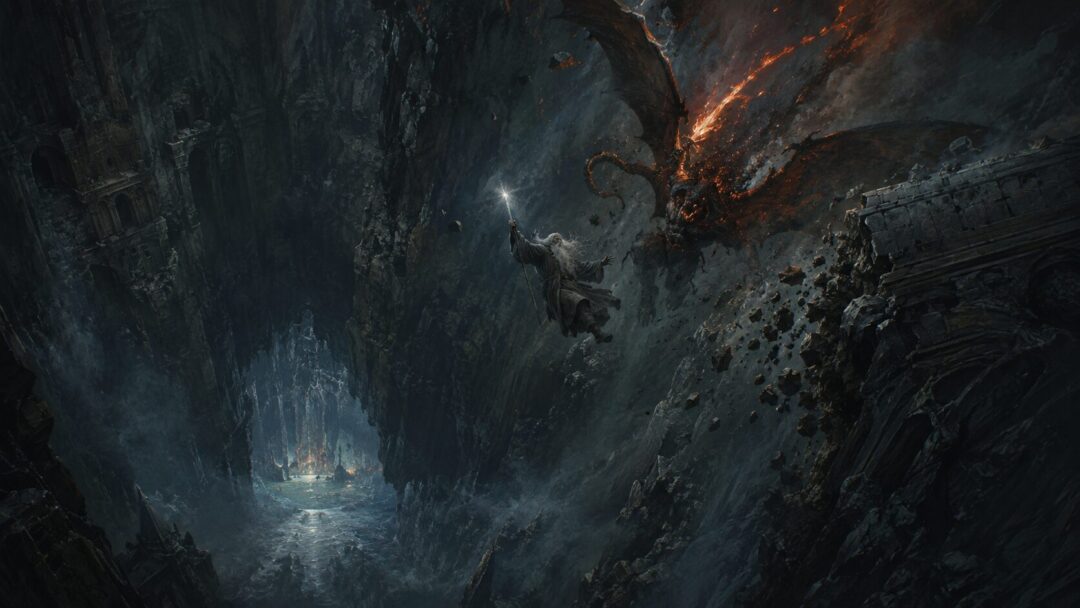
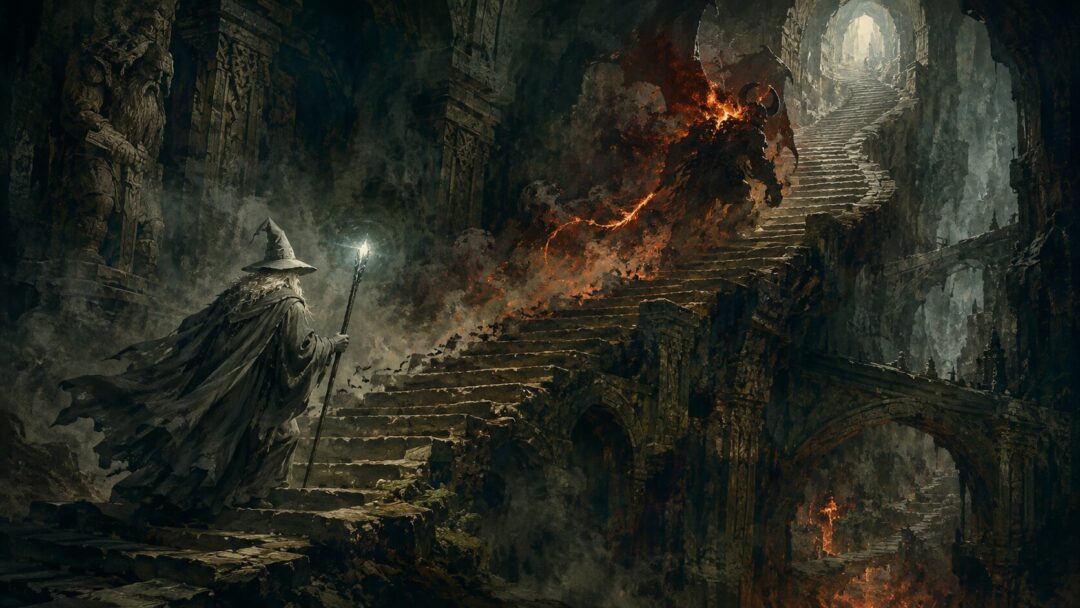
The bridge scene can feel final because the Company sees Gandalf disappear into the abyss. But for Gandalf, the fall is only the beginning. He and the Balrog plunge into the depths beneath Moria, into water far below the halls known to the Fellowship. The Balrog’s fire is quenched, but its terror does not end. Gandalf pursues it through the hidden roots of the mountain, by paths unknown to the Dwarves, until they reach the Endless Stair.
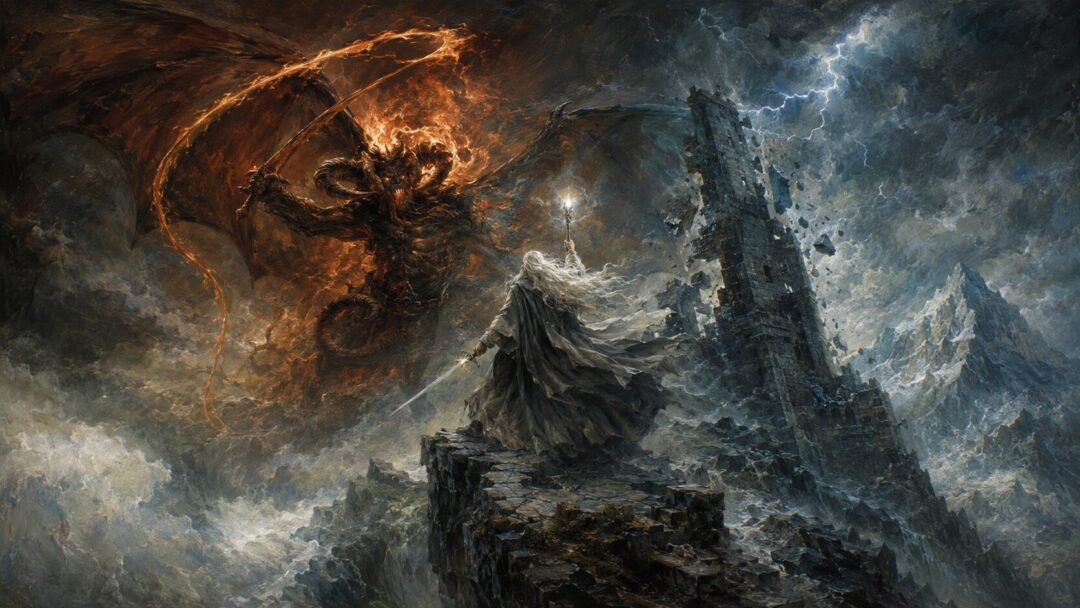
This pursuit is important because it changes the meaning of his sacrifice. Gandalf does not merely fall and die. He continues the battle for days, driven through deep places and up toward the peak of Zirakzigil. The struggle becomes almost mythic in scale: from abyss to mountain-top, from water and darkness to lightning, fire, and ice.
The cost here is endurance beyond ordinary imagining. Gandalf’s body is the body of an old man, however much power lies behind it. The Istari were not sent as unbound spirits blazing openly through Middle-earth. Their forms mattered. Weariness mattered. Pain mattered. Gandalf’s victory over the Balrog is therefore not effortless divine intervention. It is agony, pursuit, exhaustion, and finally death.
The Second Cost: Gandalf Truly Died
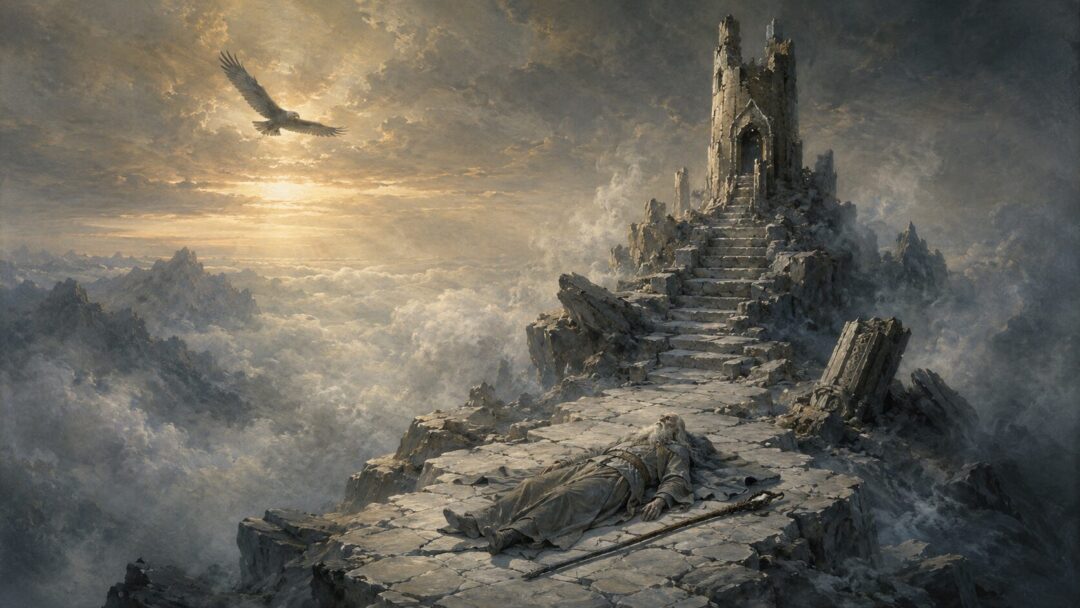
One of the most important points is also one of the easiest to soften: Gandalf did not simply faint, teleport away, or hide until a dramatic return. After casting down the Balrog from the peak, he passed away. His body lay on the mountain.
The language surrounding his return is mysterious, and it should remain mysterious. Gandalf later says he passed out of thought and time and was sent back until his task was done. The texts strongly imply that his return is not something he accomplished by his own power. He was returned by a higher authority. Tolkien never turns this into a mechanical rule, and the story does not invite us to treat resurrection as a common possibility. Gandalf’s return is exceptional.
That exception matters. His sacrifice was real because death was real. The fact that he came back does not erase the cost of dying. It also does not mean he gambled safely. On the bridge, Gandalf did not know he would return as Gandalf the White. The story gives us no reason to think he stepped into the abyss with certainty of resurrection. He acted because the Company had to be saved.
The Third Cost: The Grey Pilgrim Was Gone
When Gandalf returns, he returns changed. He is still Gandalf, still recognizable in memory, wisdom, and purpose. But he is no longer simply the Grey Wanderer who smoked with Bilbo, laughed with hobbits, and moved through Middle-earth as a restless counsellor. He comes back as the White, taking the place that Saruman had failed to occupy rightly.
This change is a gift, but also a loss. Gandalf the White has greater authority and clearer power, yet he feels less like a hidden pilgrim and more like a revealed instrument of the final crisis. His task has narrowed. The war is moving toward its end. He has been sent back “for a brief time,” and that phrase carries sorrow as well as strength.
The cost of the bridge, then, is not only death but transformation. Gandalf the Grey does not resume. The friend who fell in Moria is restored, but restored under a more urgent commission. The warmth remains, especially in his care for the hobbits, but the age of wandering counsel is nearly over.
Why the Balrog Had to Be Met There
Could Gandalf have fled? Could the Fellowship have escaped without his stand? The scene suggests otherwise. The bridge gives the Company its only chance because it narrows the enemy’s approach. Gandalf uses the place itself as part of the defense, breaking the bridge beneath the Balrog. It is one of the rare moments where geography, courage, and spiritual authority align perfectly.
But victory still has a terrible edge. Gandalf succeeds in stopping the Balrog from following the Ring, yet the Balrog’s whip catches him and pulls him down. Evil is defeated, but not cleanly. It cannot cross the bridge, but it can still wound the one who bars the way. This is very much in keeping with the moral texture of Middle-earth: great victories often preserve hope rather than prevent suffering.
The bridge does not offer Gandalf a heroic pose without consequence. It demands everything.
The Hidden Cost Was Obedience
Gandalf’s greatest strength is not raw power. It is obedience to his purpose. He does not seize the Ring. He does not dominate the Free Peoples. He does not set himself up as a rival Dark Lord in bright clothing. Again and again, his power is shown through restraint, guidance, and trust in smaller hands.
At Khazad-dûm, that restraint takes a different form. He finally does unleash open power, but only to protect the Quest, not to glorify himself. He stands alone so the others can continue. He falls so Frodo may go forward. He dies without seeing whether the Company will remain faithful.
That may be the deepest cost of “You cannot pass.” Gandalf pays without immediate assurance. He does not get to watch the Ring reach Mordor. He does not know, from the bridge, how mercy toward Gollum will matter, whether Frodo will endure, or whether Aragorn will rise into kingship. He gives himself to a necessary act, and the outcome passes beyond his sight.
What the Line Really Means
The famous line is often remembered as defiance, and it is. But it is also renunciation. Gandalf is saying that the Balrog cannot pass because Gandalf himself will become the barrier. He will spend his body, his strength, his place in the Fellowship, and even his life to hold that boundary.
That is why the moment still carries such force. It is not merely about magical authority. It is about the cost of protecting hope when hope is still fragile. The Ring is not destroyed on the bridge. Sauron is not overthrown there. No kingdom is restored in that instant. What happens is smaller and more essential: the road remains open.
Gandalf’s stand cost him the Grey life he had known, the companionship of the Fellowship, and a death-struggle through the roots and heights of the mountain. He returned greater, but he did not return untouched. In Middle-earth, resurrection does not make sacrifice cheap. It reveals that the sacrifice was accepted.
The bridge of Khazad-dûm is therefore not remembered only because Gandalf stopped a Balrog. It is remembered because he became, for one terrible moment, the narrow place through which all hope had to pass.
Sources & Notes
- J.R.R. Tolkien, The Lord of the Rings, Book II, Chapter 5, “The Bridge of Khazad-dûm” — gives Gandalf’s stand at the bridge, his words of authority, the breaking of the bridge, and the Balrog’s whip dragging him down.
- J.R.R. Tolkien, The Lord of the Rings, Book III, Chapter 5, “The White Rider” — Gandalf recounts the fall into the deep, the pursuit to the Endless Stair and Zirakzigil, the Balrog’s defeat, his death, and being sent back.
- J.R.R. Tolkien, The Silmarillion, “Valaquenta” — identifies Balrogs as Maiar corrupted by Melkor, supporting the article’s point that Durin’s Bane is an ancient spiritual power rather than a mere monster.
- J.R.R. Tolkien, Unfinished Tales, “The Istari” — explains the Wizards as emissaries sent in limited, incarnate form to oppose Sauron chiefly through counsel and resistance rather than domination.
- J.R.R. Tolkien, The Letters of J.R.R. Tolkien, Letter 156 — Tolkien distinguishes Gandalf’s return as an act of higher authority, useful for the article’s reading of resurrection as real sacrifice rather than a safe trick.