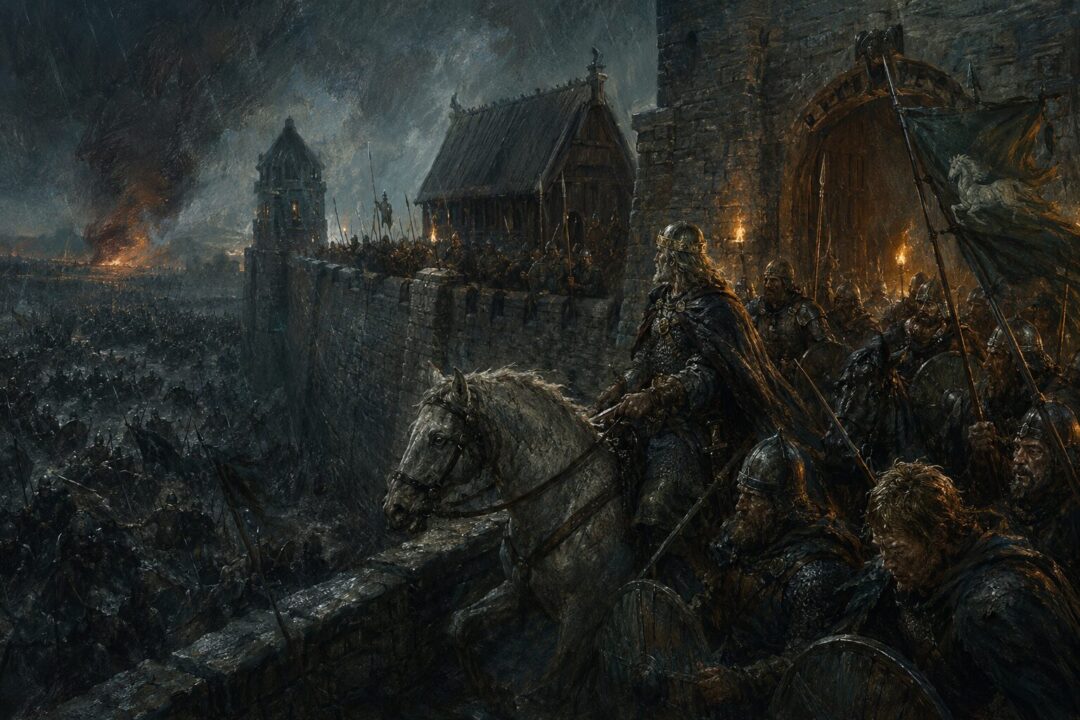
At first glance, Rohan should not have looked like the kingdom that would help decide the War of the Ring. Its king sat aged and diminished in Meduseld. Its greatest warrior, Éomer, was restrained by court suspicion. Its prince, Théodred, lay dead after fighting Saruman’s forces at the Fords of Isen. Its western lands were burning, its soldiers scattered, and its ancient ally Gondor was already facing the full weight of Mordor.
And yet when the moment came, it was Rohan that rode into the sunrise.
That contradiction is what makes Rohan so powerful in the story. It appears weak because its strength is not the kind Middle-earth usually teaches us to notice. It does not have Númenórean stone, Elven rings, hidden lore, or vast imperial memory. Its power lies in oath, speed, courage, and a hard simplicity that only becomes visible under pressure.
Rohan Was Never a Great Empire
Rohan was not Gondor. That matters.
Gondor carried the memory of Númenor: tall cities, ancient towers, archives, tombs, and a long line of kings and stewards. Rohan was younger, more open, and more exposed. Its people, the Rohirrim, came from the Éothéod in the North, and their bond with Gondor was born from rescue. In the Third Age, Eorl the Young rode south to aid Gondor at the Battle of the Field of Celebrant. In return, Cirion, Steward of Gondor, granted the land of Calenardhon to Eorl’s people, and the Oath of Eorl bound Rohan and Gondor in friendship.
That origin is important because it means Rohan’s identity was never imperial. It was covenantal. Rohan existed because of a promise made after desperate aid had arrived almost too late. Its deepest political memory was not conquest, but answering a call.
So when Rohan appears less grand than Gondor, that is not accidental. Rohan’s halls are timber, not marble. Its strength is mobile, not monumental. Its nobility is expressed through horses, songs, household loyalty, and battlefield courage. This makes Rohan easy to underestimate. A stone city looks permanent. A riding people can look fragile—until they move.
Théoden’s Weakness Was Real, But It Was Not Rohan’s Whole Truth
The most visible sign of Rohan’s weakness is Théoden. When Gandalf, Aragorn, Legolas, and Gimli come to Edoras in The Two Towers, the king appears bowed beneath age, grief, and manipulation. Gríma Wormtongue’s influence has helped turn the court inward. Rohan’s danger is not only military; it is psychological and political.
This is why Rohan feels so close to collapse. Théoden is not merely a private man in pain. He is the center of a heroic society whose morale depends on visible courage. When the king is diminished, the whole kingdom appears diminished.
But the texts do not suggest that Rohan is naturally cowardly or rotten. The opposite is clearer. Théoden’s recovery reveals that the weakness was partly imposed, partly cultivated, and partly the result of despair. Saruman’s strategy worked because he did not only attack Rohan’s borders. He attacked its decision-making.
That is a crucial distinction. Rohan looked weak because its will had been clouded. Once that will returned, its strength returned with startling speed.
Saruman Tried to Paralyze Rohan Before Conquering It
Saruman understood Rohan’s danger. If Rohan could muster freely, it could threaten Isengard and aid Gondor. So his war against it was not only a frontal assault. It involved delay, division, and targeted damage.
The fighting at the Fords of Isen shows this clearly. The Fords were strategically vital because they guarded the western approach into Rohan. Théodred, Théoden’s son, fought there and was slain. In Unfinished Tales, the account of the battles emphasizes how serious Saruman’s assault was and how important Théodred and Éomer were as obstacles to an easy conquest of Rohan.
This is one reason Rohan seems so weak when the reader first sees it. We are not meeting a kingdom at rest. We are meeting one that has already been strategically wounded. Its heir is dead. Its western defense has been battered. Its king has been isolated. Its most active captain is politically endangered. Its enemy has chosen the timing.
Rohan does not look weak because it lacks strength. It looks weak because Saruman has spent that strength down before open war reaches its climax.
Rohan’s Strength Was Decentralized
One of the overlooked reasons Rohan survives is that not all of its strength is trapped in Edoras.
A centralized kingdom can collapse when the court collapses. Rohan is more flexible. Its military power is spread among marshals, local lords, riders, and mustering places. The Westfold can suffer disaster, Théoden can be misled, and Éomer can be restrained, yet men still gather, ride, defend, and fight.
This does not mean Rohan is invulnerable. The opposite is true: its scattered nature makes communication difficult and its villages vulnerable. But it also means Saruman cannot defeat Rohan simply by darkening one hall. He can damage the king’s judgment, but he still has to face the Riders.
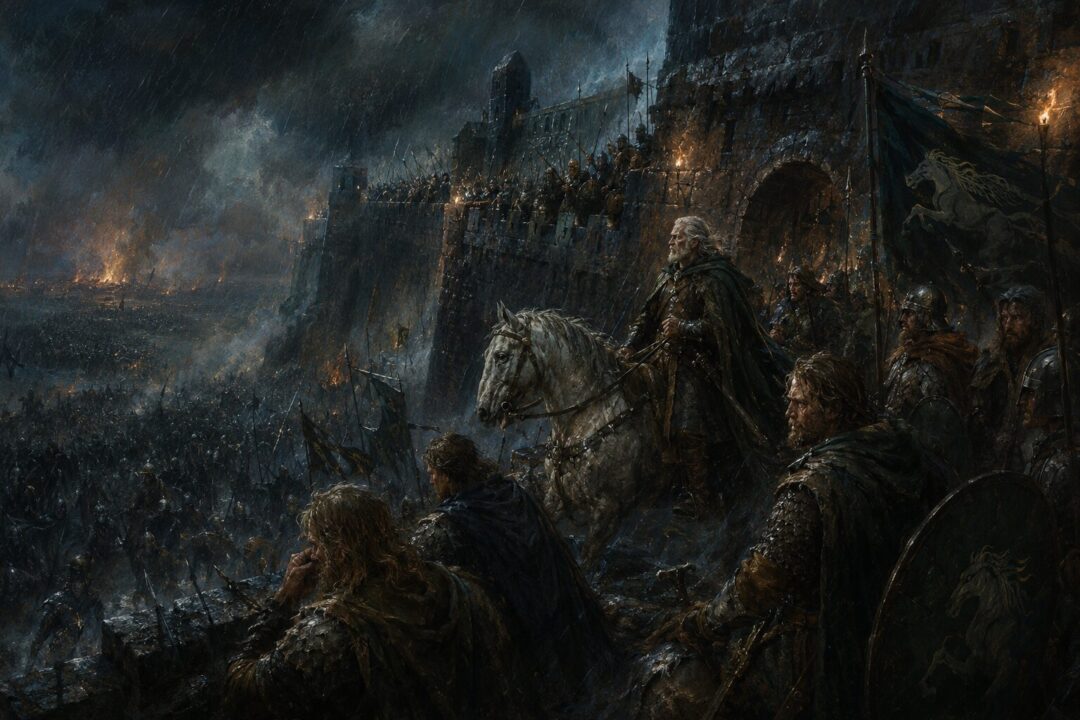
At Helm’s Deep, this becomes decisive. Théoden’s immediate force is not enough to make the situation comfortable. The defenders are under terrible pressure. Yet the kingdom is not exhausted. Erkenbrand’s men still matter. Gandalf’s return with aid matters. The victory at the Hornburg is not a miracle replacing Rohan’s strength; it is Rohan’s scattered strength being gathered at the last possible hour.
Helm’s Deep Was Not Rohan Hiding Forever
The retreat to the Hornburg can look like proof of weakness. A king leaves his hall. Civilians and soldiers seek refuge. The enemy presses in. The Deeping Wall is breached. Night falls.
But in the book’s logic, Helm’s Deep is not cowardice. It is survival under intelligent pressure. Théoden does not yet have full knowledge of every movement in the Westfold. Saruman’s forces are numerous and aggressive. The Hornburg is a defensible refuge with deep historical meaning for Rohan, associated with Helm Hammerhand and earlier wars.
The real question is not whether Rohan retreats. The real question is whether retreat becomes surrender.
It does not.
Theoden’s transformation is not from weakness to invincibility, but from paralysis to action. Even at Helm’s Deep, he eventually chooses to ride out. This matters symbolically. Rohan’s deepest strength is not that it never falls back. It is that, when enclosed by darkness, it still seeks the open charge.
Rohan’s “Smallness” Is Part of Its Moral Force
Compared with the great powers of Middle-earth, Rohan is almost modest. It does not claim to save the world through wisdom. It does not understand every hidden design. It does not possess deep knowledge of the Ring. Many Rohirrim do not fully grasp the cosmic scale of the war in which they are caught.
But that limitation gives their courage a special force.
Rohan rides because of loyalty, honor, kinship, and oath. Its people do not need to know everything to do the right thing. In a story filled with ancient beings and vast histories, Rohan represents a more immediate kind of virtue: keep faith, answer need, face death, and do not let fear become master.
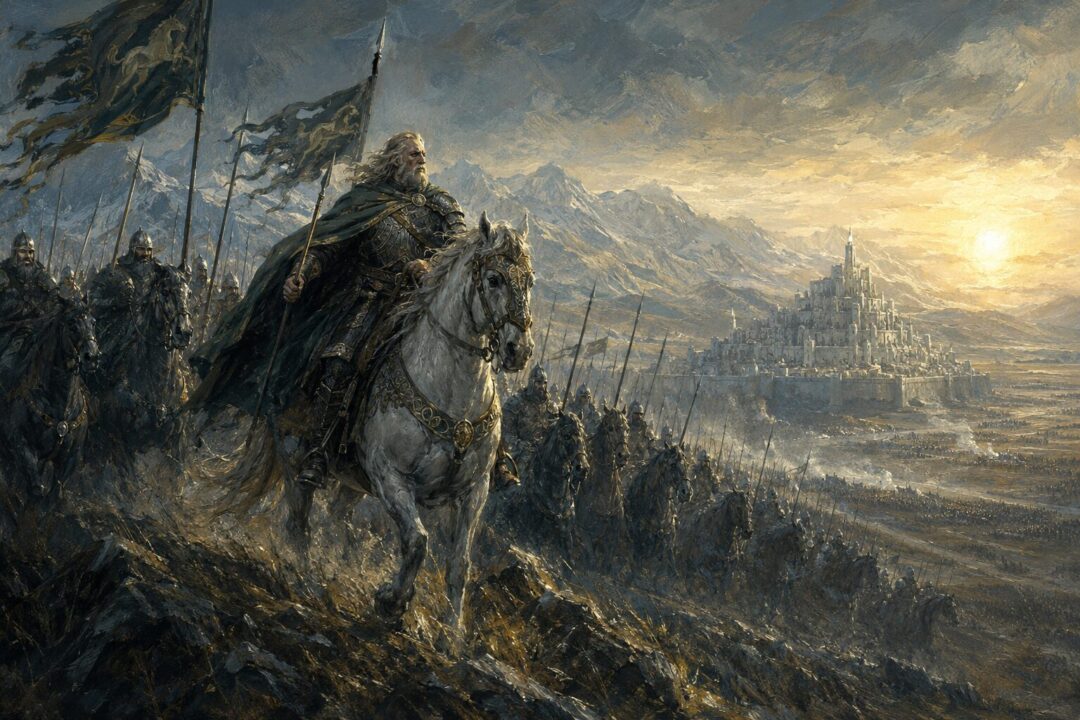
This is why the Ride of the Rohirrim is so moving. The Riders come to Minas Tirith not because victory is guaranteed, but because Gondor called and the old oath still has weight. In the book, Gondor’s formal summons is the Red Arrow, brought to Théoden by Hirgon. The beacons have their own role in Gondor’s warning system, but the Red Arrow is the direct token calling Rohan to aid.
Rohan’s greatness is therefore not measured by certainty of success. It is measured by fidelity under hopeless conditions.
The Pelennor Revealed What Rohan Had Been All Along
When the Rohirrim arrive at the Pelennor Fields, the earlier image of weakness is overturned. The old king who seemed nearly finished becomes the leader of a charge. The kingdom that looked late, wounded, and half-broken becomes the force that changes the emotional and tactical shape of the battle.
This does not mean Rohan wins the War of the Ring alone. It does not. The battle is larger than Rohan, and the war is ultimately decided by the destruction of the Ring. But the arrival of the Rohirrim matters profoundly. Without Rohan, Minas Tirith’s situation would be darker still. Without Théoden’s choice to ride, Gondor’s hope would be diminished.
The tragedy is that Rohan’s moment of glory is also costly. Théoden falls. Many Riders die far from their own fields. Éowyn’s confrontation with the Lord of the Nazgûl brings victory and suffering together. Rohan’s strength is not painless. It is sacrificial.
That is part of the answer to why Rohan looked weak until it mattered most. Its strength was never theatrical dominance. It was the willingness to spend itself at the decisive hour.
Saruman Misread the Thing He Tried to Break
Saruman’s mistake was not that he thought Rohan could be weakened. It could. He weakened it severely.
His deeper mistake was assuming that a weakened Rohan was the same thing as a conquered Rohan.
He understood influence, fear, and delay. He understood how to poison counsel and exploit grief. He understood the military importance of the Fords of Isen and the danger posed by Théodred and Éomer. But he did not fully master the stubborn moral core of the Rohirrim. He could bend the court for a time. He could not erase the oath-bound identity of the people.
Rohan’s recovery is therefore not just military. It is spiritual in the broad sense: the return of courage, clarity, and rightful action. Gandalf’s coming to Edoras matters because it breaks the spell of despair. But what emerges afterward was already present beneath the surface.
A dead kingdom cannot be awakened. Rohan could be awakened because it was not dead.
The Hidden Rule of Rohan
Rohan looks weak when judged by the wrong standard.
If strength means ancient blood, Rohan seems lesser than Gondor. If strength means hidden wisdom, it seems lesser than the Elves. If strength means fortified permanence, it seems fragile beside Minas Tirith. If strength means mastery of long strategy, it seems vulnerable to Saruman’s schemes.
But Middle-earth often reveals that the decisive virtues are not always the most impressive ones. Mercy can matter more than might. Pity can outlast power. Oaths can hold when armies fail. Small hands can carry the fate of the world.
Rohan belongs to that pattern. Its strength is not invulnerability. It is readiness restored. It is the courage to ride though the outcome is uncertain. It is the ability to look ruined and still answer the horn.
That is why Rohan had to look weak before it mattered. The story is not simply showing a hidden superpower. It is showing a people nearly broken by grief, manipulation, and war—then asking whether they will still keep faith.
At dawn before Minas Tirith, they do.
And in that moment, Rohan is revealed not as weak, but as exactly the kind of strength Middle-earth needed: mortal, wounded, late, afraid, and still riding.
Sources & Notes
- J.R.R. Tolkien, The Lord of the Rings, Appendix A, II, ‘The House of Eorl’ — Rohan’s origin in Eorl’s ride to Celebrant, Cirion’s grant of Calenardhon, and the oath-binding of Rohan and Gondor.
- J.R.R. Tolkien, The Lord of the Rings, Book III, Chapter 6, ‘The King of the Golden Hall’ — Théoden’s diminished court, Gríma’s influence, and the king’s restoration to action.
- J.R.R. Tolkien, Unfinished Tales, Part Three, II, ‘The Battles of the Fords of Isen’ — Saruman’s pressure on the Westfold, Théodred’s death, and the strategic importance of the Fords.
- J.R.R. Tolkien, The Lord of the Rings, Book III, Chapter 7, ‘Helm’s Deep’ — the Hornburg defence, the breached Deeping Wall, Théoden’s decision to ride out, and the late-arriving relief.
- J.R.R. Tolkien, The Lord of the Rings, Book V, Chapters 3 and 5, ‘The Muster of Rohan’ and ‘The Ride of the Rohirrim’ — the Red Arrow, Rohan’s oath-response to Gondor, and the Pelennor charge.