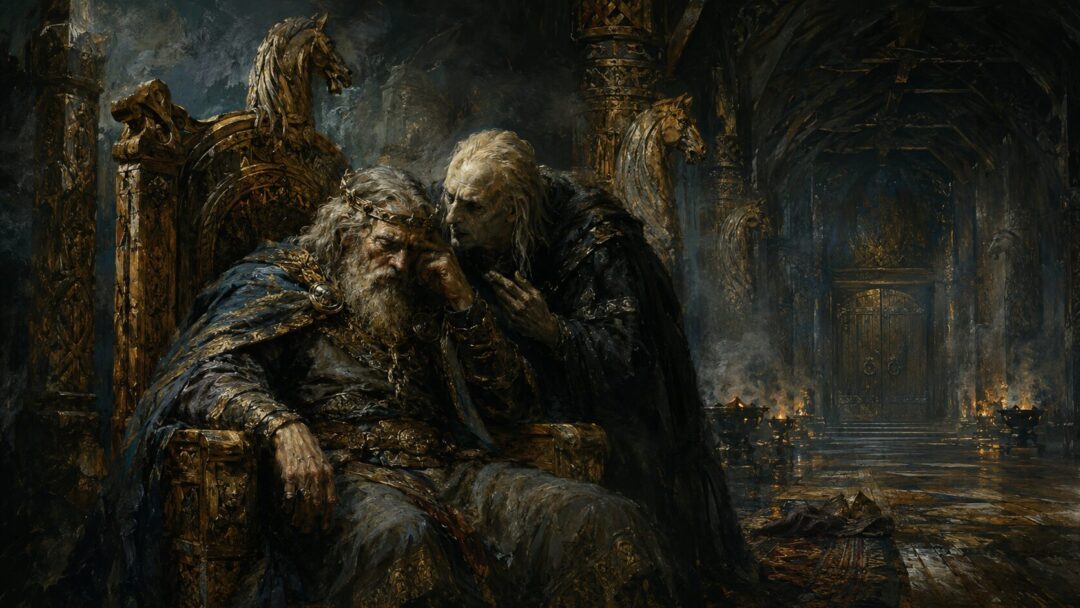
When Gandalf entered Meduseld, the Golden Hall of Rohan, he did not find a king speaking with Saruman’s voice. He found something more frightening in a quieter way: a living ruler still seated on his throne, still able to hear, answer, choose, doubt, and command — but almost buried beneath fear, bad counsel, age, grief, and a carefully maintained atmosphere of hopelessness.
That distinction matters. Théoden’s condition is often remembered as if Saruman had taken direct control of his body, like a dark spirit wearing a king’s skin. But in the book, the scene is more subtle and more human. Théoden is not shown as a puppet who has no will of his own. He is a king weakened from within and surrounded by voices that make weakness feel like wisdom.
Saruman’s power is there. Gríma’s treachery is there. But Théoden’s fall is not simple possession. It is the slow collapse of courage under pressure — and his recovery is not merely an exorcism. It is a king being called back into responsibility.
The King in the Shadows
When Aragorn, Legolas, Gimli, and Gandalf come to Edoras, Rohan is not merely waiting for rescue. It is politically and spiritually paralyzed. The kingdom’s enemies are moving. Saruman has betrayed the West. Orcs and Dunlendings threaten the land. Théodred, the king’s son, has already fallen at the Fords of Isen. Éomer, one of Rohan’s strongest defenders, has been imprisoned after disobeying the king’s orders. And in the hall itself, Gríma Wormtongue sits close to the throne.
The visual meaning of Théoden’s first appearance is important. He is old, bent, and dimmed, but he is not absent. He speaks. He recognizes Gandalf. He shows irritation, suspicion, weariness, pride, and pain. That is not how the text presents total possession. It presents a man whose judgment has been darkened.
The tragedy is that Théoden’s throne has not been seized by open force. It has been hollowed out. Rohan still has its king, but the king has been taught to see action as dangerous, hope as foolish, and loyal servants as threats.
That is why the scene feels so oppressive. Saruman does not need to sit openly in Meduseld if his servant can make the king distrust his own strength.
Gríma’s Power Was Counsel, Not Open Command
Gríma Wormtongue is the key to understanding Théoden’s condition. He is not simply a court flatterer. He is Saruman’s agent inside Rohan, and his weapon is language. He weakens the king through advice, delay, suspicion, and emotional pressure.
The texts strongly connect Gríma’s influence with Théoden’s decline. He gains power while the king’s health and strength are failing, and his counsel repeatedly serves Saruman’s interests. He turns Théoden against Gandalf. He helps isolate Éomer. He discourages open resistance. He presents caution as prudence, inaction as survival, and loyalty as dangerous recklessness.
This is one of the most realistic forms of evil in The Lord of the Rings. Gríma does not need to chain Théoden. He only needs to make every courageous choice seem irresponsible.
There are hints of physical weakening as well, especially through the idea that Gríma’s “care” of the king may have been harmful rather than healing. But Tolkien does not reduce Théoden’s condition to one neat mechanism. It is not stated as one spell with one cure. The picture is a mixture of bodily decline, poisoned counsel, fear, grief, and Saruman’s larger shadow working through a corrupted servant.
That makes Gríma more disturbing, not less. He is dangerous because he acts through ordinary channels: the court, the sickroom, the king’s ear, the language of concern.
Saruman’s Voice Could Bend Wills Without Possessing Them
Saruman’s power over speech is one of his defining traits. Later, at Orthanc, even after his military defeat, his voice still has force. Those who hear him are tempted to excuse him, pity him, trust him, or at least hesitate. His power is persuasive rather than merely magical in a crude sense. He does not need to seize minds completely; he can bend them toward the conclusion he wants.
That helps explain Théoden. Saruman’s influence in Rohan is real, but the book’s pattern suggests domination through persuasion, manipulation, and despair more than direct bodily possession. Gríma becomes an extension of Saruman’s voice inside the Golden Hall.
This matters because Saruman’s corruption often works by imitation of wisdom. He does not present evil as evil. He presents surrender as realism. He presents delay as strategy. He presents mistrust as intelligence. He turns the mind against its own sources of hope.
Théoden’s great danger is not that he has become Saruman. It is that he has begun to believe the world Saruman wants him to believe in: a world where resistance is too late, enemies are too strong, friends are troublesome, and the only remaining dignity is to sit still and fade.
Gandalf Does Not Merely “Cast Saruman Out”
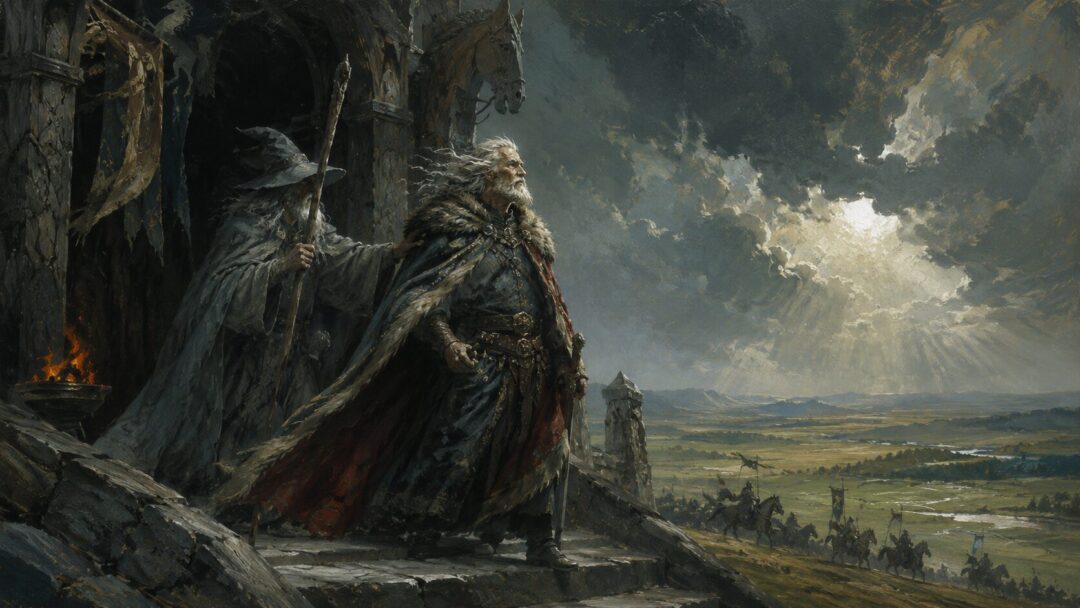
Gandalf’s intervention in Meduseld is dramatic, but it is not written as a simple possession scene. He confronts Gríma, exposes the poisonous atmosphere of the hall, and speaks directly to Théoden as a king. He does not treat Théoden as an empty vessel. He calls him by name and demands that he listen.
This is crucial. Gandalf’s power does not erase Théoden’s will. It awakens it.
The movement of the scene is from confinement to open air, from dimness to light, from sitting to standing, from dependence to decision. Théoden is brought out of the hall and made to look upon his land. He sees Rohan again not as a burden described by Wormtongue, but as a kingdom entrusted to him.
That is why his recovery is so moving. The change is not simply that an evil spell breaks. The change is that Théoden remembers who he is.
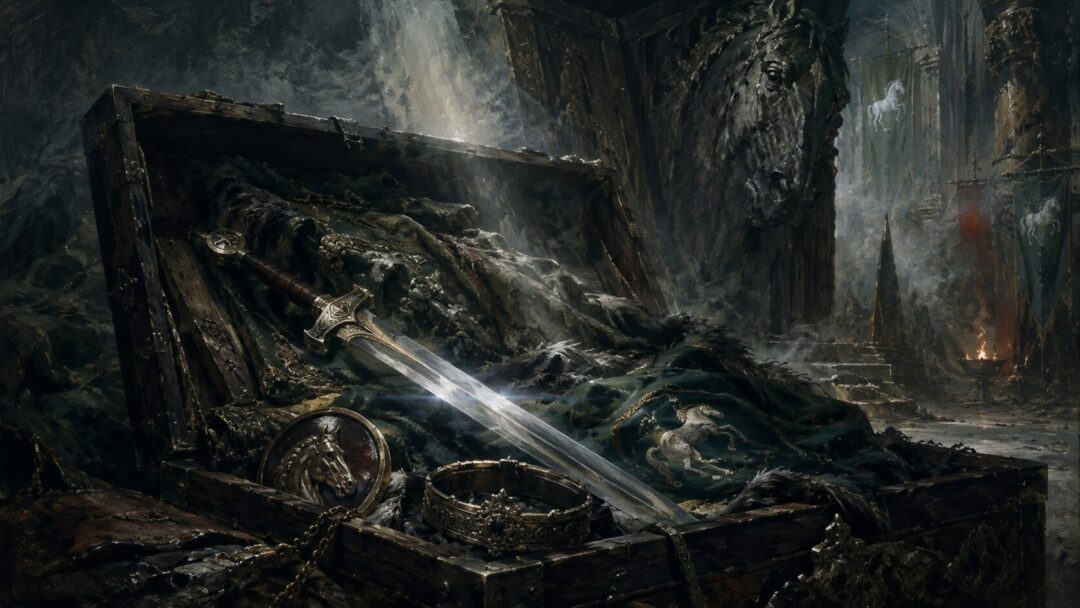
He asks for his sword. Herugrim has been kept from him, and its restoration is more than a practical arming. It is the return of kingship. A king who had been reduced to a passive figure takes back the sign of his office and becomes once more the defender of his people.
Théoden Still Has to Choose
One of the strongest arguments against simple possession is what happens immediately after Gandalf’s intervention. Théoden is not treated as a man who has been unconscious for years and now merely obeys his rescuers. He makes decisions.
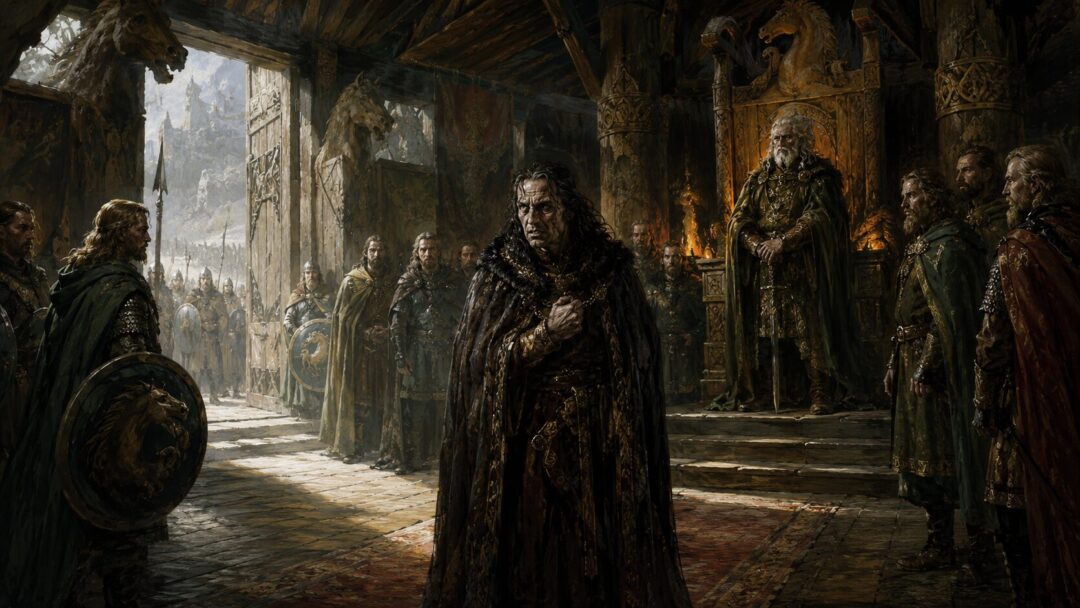
He judges Gríma. He chooses mercy rather than immediate execution. He gives Wormtongue a chance to ride with him and prove loyalty, though Gríma refuses. He decides to go to war. He leads his people to Helm’s Deep. Later, he rides to the aid of Gondor, not because he is enchanted into bravery, but because he has reclaimed the moral burden of kingship.
This does not mean Théoden was never under supernatural influence. The language around Saruman and Gandalf allows for more than ordinary politics. Middle-earth is a world where words, wills, fear, and spiritual authority have real force. But the book does not show Théoden as a mindless captive. It shows a weakened man whose will has been bent, clouded, and discouraged — and then strengthened again.
His agency is central to his redemption. If he were merely possessed, his restoration would be mostly Gandalf’s victory. But because Théoden still must choose, his restoration becomes his own return to honor.
Why the Difference Matters
The simpler version of the story makes Saruman more visually powerful. The book’s version makes evil more intimate.
A possessed Théoden is frightening because an enemy controls him. A manipulated Théoden is frightening because the enemy has learned how to use grief, age, fear, and bad counsel against him. That is closer to the moral world of The Lord of the Rings, where corruption usually begins by offering the victim a reason to cooperate.
Boromir is not possessed by the Ring when he tries to take it; he is tempted through love of Gondor and fear of defeat. Denethor is not simply controlled like a puppet; he is broken by pride, grief, despair, and the selective truth shown through the palantír. Saruman himself is not born a monster; he declines through pride, impatience, and desire for control.
Théoden belongs in that pattern. His darkness is not the loss of personhood, but the narrowing of hope. He has been persuaded to live as if defeat has already happened.
That is why Gandalf’s work is not only magical but pastoral, political, and moral. He removes the false counselor, clears the poisoned air, and places reality before the king again. Théoden must then answer it.
The Shadow Over Rohan Was Strategic
Saruman’s handling of Rohan was not random cruelty. Rohan was militarily important. Its riders could aid Gondor, threaten Isengard’s plans, and change the balance of war in the West. If Saruman could weaken Rohan from inside, he could delay or prevent its full strength from ever taking the field.
Gríma’s counsel serves that strategy. Théoden is encouraged to remain passive. Éomer is neutralized. Warnings are mistrusted. Loyal action is framed as disobedience. The king’s household becomes a battleground before the armies even meet.
This is one reason the Meduseld scene is so important to the wider War of the Ring. Gandalf is not just healing one old man. He is restoring a kingdom’s ability to act.
The moment Théoden rises, Saruman’s hidden campaign inside Rohan begins to fail. Soon Rohan will survive Helm’s Deep. The Ents will destroy Isengard’s power. And later, the Rohirrim will ride to the Pelennor Fields, where Théoden’s last great act will help save Minas Tirith from ruin.
All of that begins with a king standing up.
Théoden’s Healing Is Not a Return to Youth
Another important detail is that Théoden is not made young again. He is restored, but not made untouched by time. His age, losses, and mortality remain. The power of the scene is not that Gandalf reverses the natural order. It is that courage returns before death.
That makes Théoden’s later arc deeply poignant. He does not receive a long second life. He receives enough strength to do what a king must do. He goes from a shadowed throne to a battlefield where he dies in honor, leading his people and answering Gondor’s need.
The contrast is deliberate in effect, even if not spelled out as a doctrine. Under Gríma’s influence, Théoden’s old age becomes an argument for retreat. After his restoration, age becomes part of his nobility. He knows enough of loss to understand what is at stake. His courage is not the courage of someone untouched by fear, but of someone who has passed through fear and still rides.
Not Simply Possessed, But Nearly Lost
So was Théoden under Saruman’s power? Yes, in a meaningful sense. Saruman’s treachery reached into Meduseld through Gríma, through fear, through counsel, and perhaps through more subtle arts. The king was not merely tired or politically mistaken.
But was he simply possessed by Saruman? The text does not support that as the best reading. Théoden is never presented as an empty body controlled from afar. He is a diminished king, not a replaced one. His healing is not only the expulsion of an invader; it is the reawakening of judgment, courage, and responsibility.
That is the deeper tragedy and the deeper hope of the scene. Evil nearly wins in Rohan not by breaking down the gates, but by whispering long enough beside the throne. And good begins to answer not with conquest, but with a summons: stand, look out upon your land, take up your sword, and choose.
Théoden’s greatness is that he does choose. He had been bent, darkened, and misled. But when the shadow lifts, he does not hide behind what was done to him. He rises, rides, and spends the strength that remains in defense of his people.
That is why his story is more powerful than a simple possession tale. A puppet can be freed. But Théoden is called back — and answers as king.
Sources & Notes
- J.R.R. Tolkien, The Lord of the Rings, Book III, Chapter 6, “The King of the Golden Hall” — presents Théoden as weakened, suspicious, and misled by Wormtongue, then called by Gandalf to stand, look on his land, and take up Herugrim again.
- J.R.R. Tolkien, The Lord of the Rings, Book III, Chapter 10, “The Voice of Saruman” — shows Saruman’s chief power as persuasive speech that bends judgment and desire rather than simple bodily possession.
- J.R.R. Tolkien, Unfinished Tales, “The Battles of the Fords of Isen” — gives the wider Rohan context: Théodred’s death, Gríma’s influence, Éomer’s restraint, and Saruman’s strategy of weakening the Mark from within.
- J.R.R. Tolkien, The Lord of the Rings, Book V, Chapter 5, “The Ride of the Rohirrim” — confirms Théoden’s restored agency in his final free decision to ride to Gondor’s aid.
- J.R.R. Tolkien, The Lord of the Rings, Appendix A, “The House of Eorl” — supplies the Rohirric dynastic background and Théoden’s place in the line of kings, grounding the article’s focus on recovered kingship.