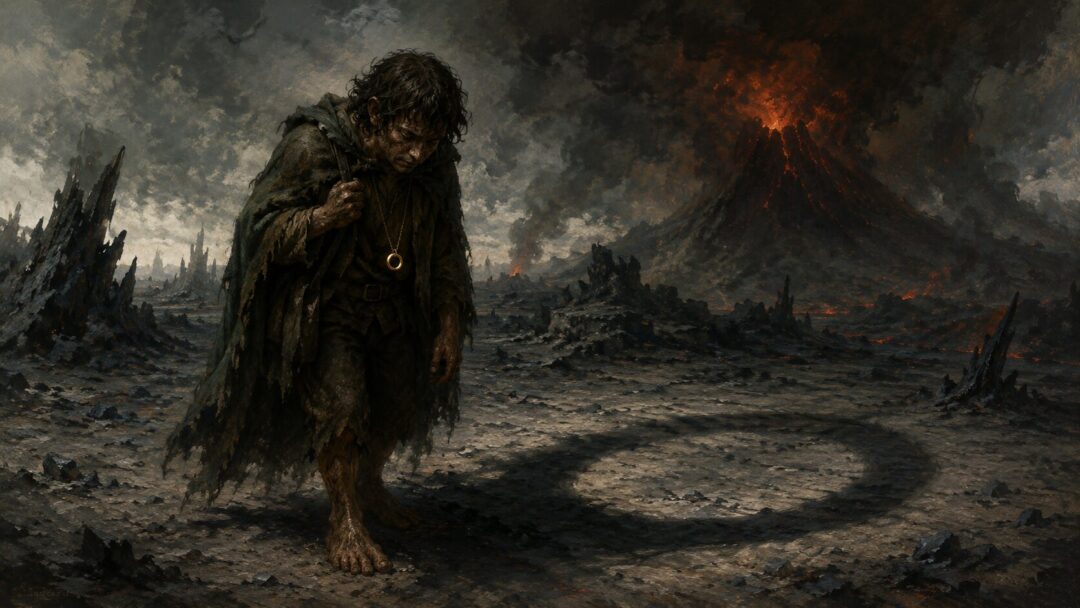
The One Ring is almost insultingly small. Not a crown, not a sword, not a tower of black stone — only a plain gold band, easy enough to hide in a pocket, slip onto a chain, or lose in the dark beneath the roots of the Misty Mountains.
And yet by the end of the Quest, Frodo can barely move beneath it.
That contradiction is one of the quiet horrors of The Lord of the Rings. The Ring does not need to grow larger to become unbearable. It does not need spikes, flames, or a visible curse. Its weight increases because its claim increases. The closer Frodo comes to the place where the Ring can be unmade, the more the burden becomes not merely physical, but inward: a pressure on memory, will, hope, identity, and desire.
Tolkien never gives a mechanical explanation that says, in simple terms, “the Ring became heavier because of this exact rule.” The story is more subtle than that. The texts show the Ring as a thing with power, malice, and a will of its own in some sense, though not as an independent person separate from Sauron. Its heaviness is best understood as the meeting point of several forces: Frodo’s exhaustion, the Ring’s growing domination, Sauron’s nearness, and the terrible spiritual pressure of Mordor itself.
The Ring’s size does not change. But Frodo does.
The Ring Was Always More Than Metal
From the beginning, the One Ring is not treated as an ordinary object. Gandalf explains that it is tied to Sauron’s power, that much of Sauron’s former strength passed into it, and that while it exists Sauron cannot be truly overthrown. It is not simply a magical tool. It is the Enemy’s power made portable.
That matters because the Ring’s danger is never only invisibility. Bilbo first uses it almost as a clever trick, but even in The Hobbit there is an early hint that the Ring is not passive: it slips away from Gollum, comes into Bilbo’s possession, and becomes the center of a contest of possession long before its full identity is known.
By The Lord of the Rings, the Ring’s deeper nature is clear. It tempts. It isolates. It preserves its bearer unnaturally, as seen in Gollum’s long life and Bilbo’s strange sense of being “thin.” It can betray its holder, as it did when it slipped from Isildur in the River Anduin. It seeks return to its master, but it also works through the desires of those who carry it.
So when Frodo later says that the Ring is heavy, the statement should not be flattened into simple physical mass. The Ring is a burden because it is a hostile power being carried by a living will.
Frodo’s Burden Begins Before Mordor
Frodo does not suddenly feel the Ring only at Mount Doom. Its pressure grows gradually.
In the Shire, he inherits it from Bilbo without fully understanding what it is. At first it is hidden, mysterious, and dangerous mostly because others may seek it. But once Gandalf reveals its nature, the Ring becomes a moral burden. Frodo is not carrying a trinket anymore. He is carrying the survival of the West in a form small enough to close in one fist.
At Weathertop, after the Witch-king wounds him, Frodo’s connection to the unseen world becomes more terrible. The wound never wholly leaves him, and it is important not to overstate this: the Morgul wound is not the same thing as the Ring’s weight. But both contribute to Frodo’s weakening. From that point onward, he is not merely tired from travel. He is a person being worn down by wounds of body and spirit.
At Rivendell, the Council understands that the Ring cannot simply be hidden or used. It must be destroyed. Frodo accepts the task, though he does not fully know the road. That acceptance is noble — but it also means the Ring is now being carried against its own preservation.
One reading is that from this point forward, the conflict intensifies. Frodo is not just keeping the Ring from Sauron. He is bearing it toward its end.
The Ring’s Weight Is Most Visible Through Sam
One of the clearest ways the story shows the Ring’s burden is by allowing Sam to bear it briefly.
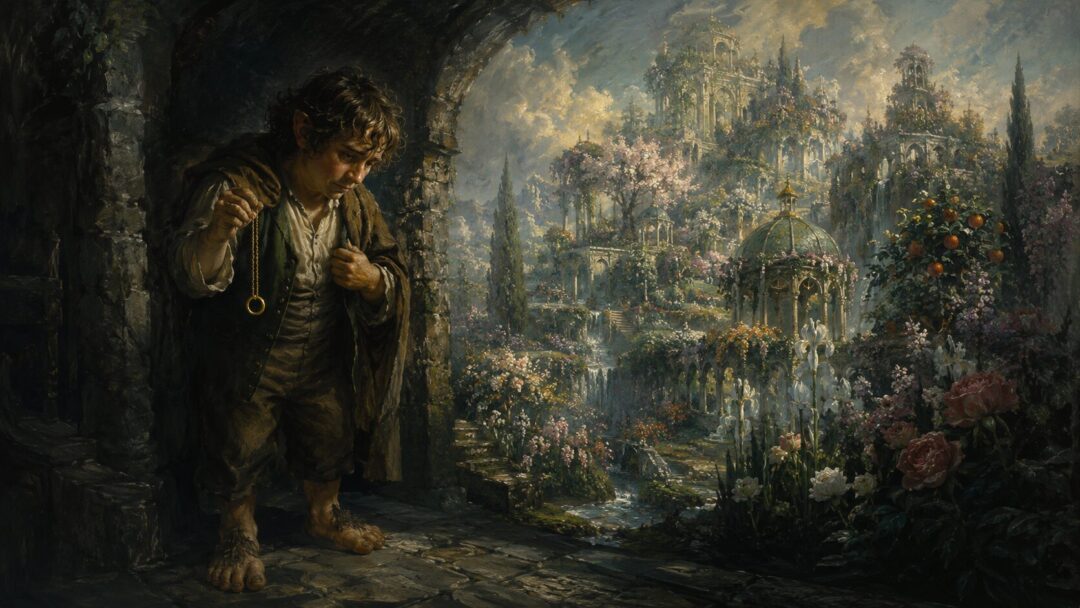
After Shelob’s attack, Sam believes Frodo dead and takes the Ring, intending to complete the Quest. This moment is crucial because Sam does not become another Frodo at once. His encounter with the Ring is shaped by his own character. It tempts him with visions suited to him — not with thrones and armies in the grand style of Boromir, but with images that distort his humble loves into impossible greatness.
Yet even for Sam, who bears it for a short time, the Ring is oppressive. The text presents it as a burden that seems to pull at him. This does not prove that the Ring’s literal mass changes like a stone gaining pounds. It shows that the Ring’s spiritual and mental pressure can be experienced as bodily weight.
That distinction matters. Sam is sturdy, loyal, and not deeply ambitious in the way many great lords might be. But the Ring still works on him. Its burden is not only about a person’s physical strength. It is about the point at which desire, fear, pity, loyalty, and temptation meet.
When Sam later offers to carry the Ring again, Frodo refuses with sudden fierceness. That refusal is not simple selfishness, though the Ring is clearly tightening its hold. Frodo knows, at some level, that he cannot freely hand it away. The burden has moved inward.
Mordor Makes the Burden Worse
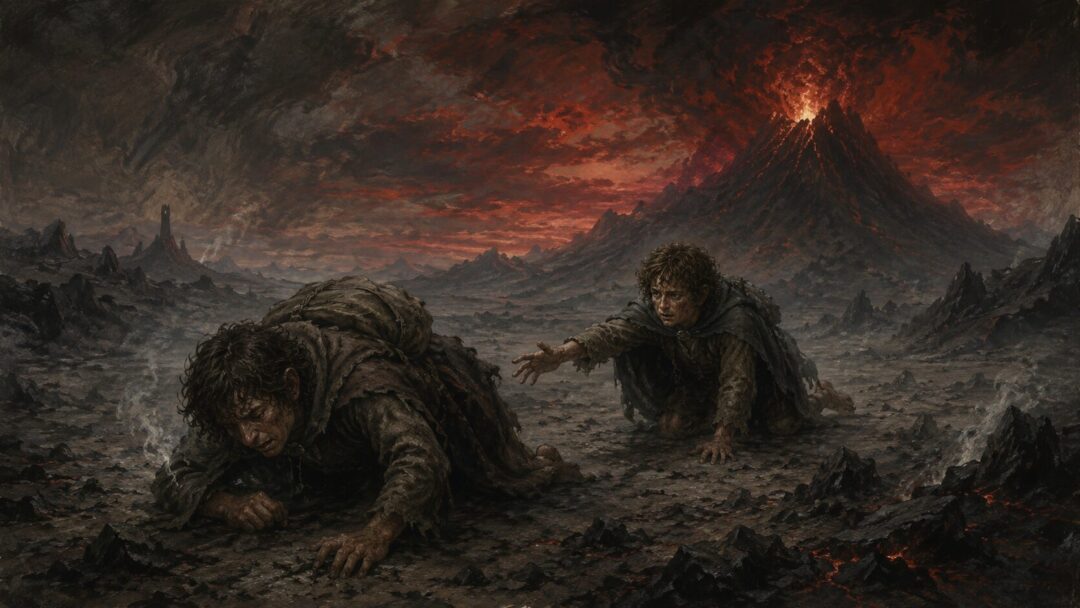
The closer Frodo and Sam come to the heart of Mordor, the more the world itself seems to become hostile to hope. They cross a land of ash, fumes, thirst, hunger, fear, and watchfulness. Their bodies are failing. Their supplies are nearly gone. Every step toward Orodruin is also a step deeper into Sauron’s realm.
It would be too simple to say, “the Ring got heavier because it was closer to Sauron,” as if nearness alone were a rule of magical gravity. The text does not state that. But the implication is strong that the Ring’s power is felt most terribly near the place of its making and near the center of the power to which it belongs.
Mount Doom is not just a volcano. It is the place where the Ring was forged. It is the only place where it can be destroyed. At the Cracks of Doom, the Ring reaches the crisis of its existence. If Frodo succeeds, it is unmade. If Frodo fails, Sauron may recover it and complete his victory.
That gives the final miles their terrible pressure. The Ring has always wanted to survive and return to its master. Now it is being carried to the one place where survival is impossible if the bearer’s mission is fulfilled.
So the “heaviness” is not random. It belongs to the final conflict between the Ring’s nature and Frodo’s task.
The Great Wheel of Fire
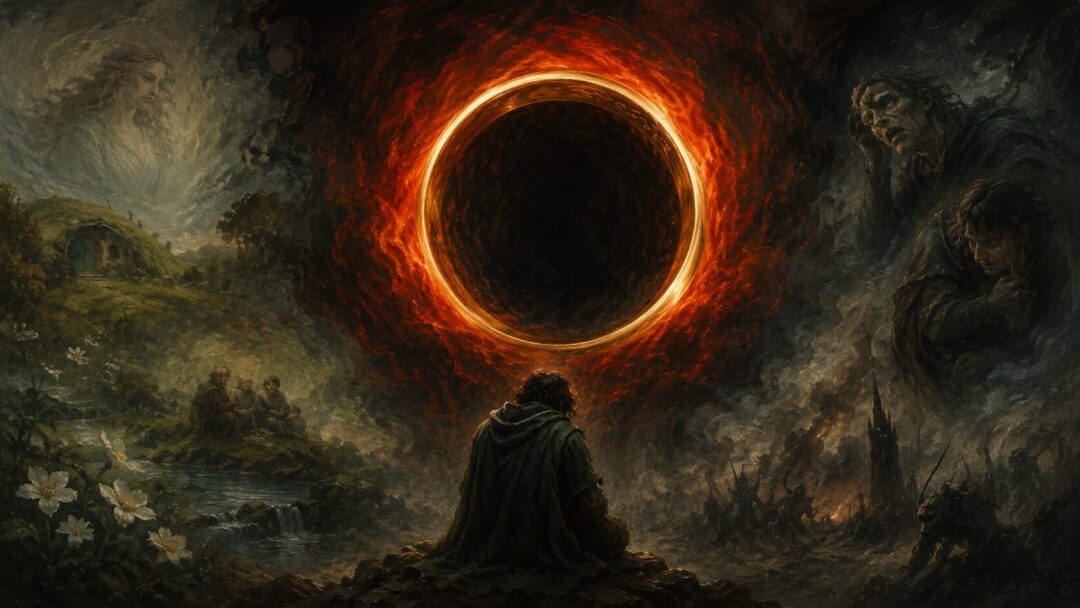
Near the end, Frodo tells Sam that he can see the Ring in his mind like a great wheel of fire. This is one of the most revealing details in the whole Quest.
The Ring has not changed size on its chain. But in Frodo’s inner sight, it has become enormous. That is the point. Its physical form remains small, but its presence fills his consciousness. The nearer he comes to the end, the less room there is in him for anything else.
This is why Frodo’s fading memory of the Shire is so devastating. Sam tries to call him back to water, grass, strawberries, and ordinary beloved things. Frodo cannot clearly hold them. The Ring has not merely made walking difficult. It has crowded out the inner world that gave the walking meaning.
That is one of the deepest answers to the question. The Ring gets “heavier” because it takes up more and more of Frodo’s mind. It becomes harder to carry because it becomes harder to remain a self distinct from the desire to possess it.
This is also why the burden is not solved by toughness. A stronger warrior might carry Frodo farther physically, but strength alone is not protection against the Ring. Boromir was brave and mighty, yet the Ring found a way through his desire to defend Gondor. Galadriel and Gandalf refuse it because they understand that even noble intentions would be corrupted by its power.
Frodo’s greatness lies partly in enduring long past the point where endurance seems possible. But the story does not pretend that endurance makes him invulnerable.
Why Sam Can Carry Frodo, But Not the Ring for Him
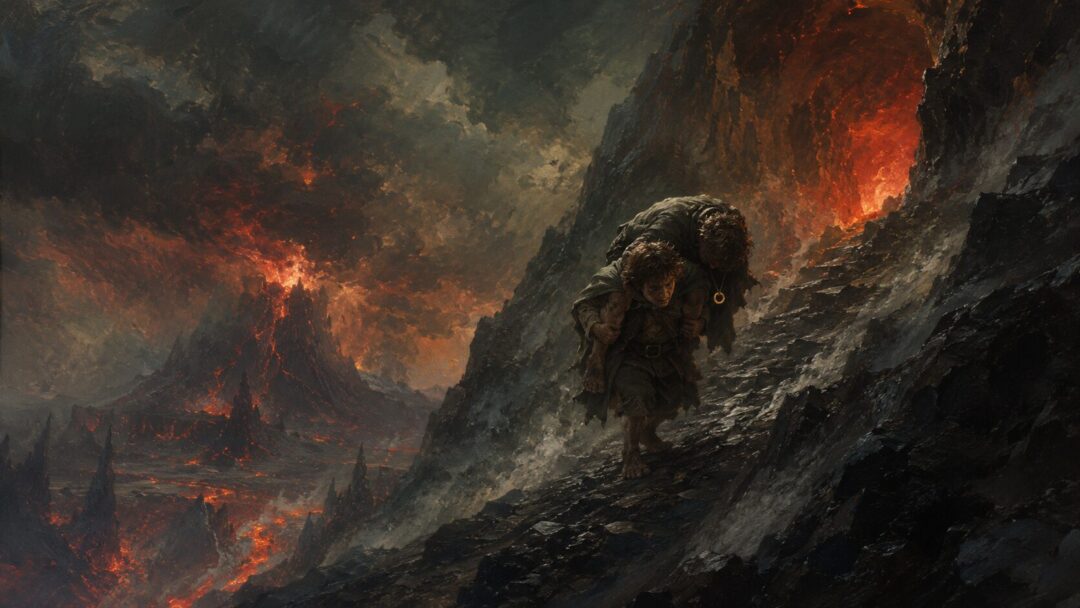
The famous emotional truth of the final climb is that Sam cannot carry the Ring for Frodo, but he can carry Frodo himself. This distinction is more than a moving line of friendship. It reveals a hidden law of the Quest.
The Ring-burden is personal. Not in the sense that Frodo was magically the only possible bearer, but in the sense that possession creates a direct relationship between the Ring and the one who holds it. Sam can support Frodo’s body. He can share the road, the danger, the hunger, the fear. But he cannot simply remove the inward claim the Ring has made on Frodo.
This is why the Quest is both communal and solitary. Frodo would never have reached the Fire without Sam. He also could not be replaced at the last moment as if the Ring were a sack of supplies. The longer he has carried it, the more deeply its possession has become entangled with his will.
That is the tragedy. The Ring must be brought to the Fire by someone who resists it, but at the Fire itself its power is at its height. Tolkien’s letters make clear that Frodo’s failure at the final moment should not be read as a simple moral collapse in the ordinary sense. At the point of maximum pressure, after such torment, the burden has become beyond his unaided strength.
The Ring became too heavy because no created will could simply master it there by ordinary effort.
The Weight of Possession
The Ring’s heaviness also reflects one of the central moral patterns of Middle-earth: possession possesses the possessor.
Gollum is the clearest long-term example. He begins as Sméagol, a being with recognizable desires and choices, and becomes consumed by the thing he calls Precious. The Ring does not make him powerful in any noble sense. It narrows him. It extends his life but hollows it. His world shrinks around appetite, secrecy, and loss.
Bilbo is spared the worst partly because he gives the Ring up willingly, though even that act requires Gandalf’s stern help. His pity toward Gollum and his eventual surrender of the Ring are among the quiet mercies on which the whole story turns.
Frodo carries the Ring further into danger than either of them. He does so with pity, courage, and humility. Yet even he is not immune. This is not a flaw in the story’s heroism. It is the story’s definition of heroism: not effortless purity, but costly resistance under a burden that grows as the goal approaches.
The Ring’s weight is the weight of wanting what must not be kept.
The Ring Did Not Need to Change
In the end, the Ring did not need to become larger, heavier, or visibly monstrous. Its terror is that it remains beautiful, plain, and small.
That is exactly why it works. It can be hidden under clothing. It can be mistaken for a tool. It can be imagined as a weapon for good. It can sit in a palm while kingdoms tremble around it.
By the time Frodo reaches the Sammath Naur, the Ring’s smallness is part of the horror. Something so little has bent the choices of kings, wizards, warriors, and hobbits. Something that weighs almost nothing as metal has become heavier than the road, heavier than memory, heavier than Frodo’s remaining strength.
The Ring got heavier without changing size because its true weight was never measured in gold.
It was measured in domination, temptation, exhaustion, and the terrible nearness of the moment when evil might either be unmade — or finally reclaim what it had lost.
Sources & Notes
- J.R.R. Tolkien, The Lord of the Rings, Book I, Chapter 2, “The Shadow of the Past” — Gandalf explains that Sauron poured much of his power into the One Ring and that it works on its bearers rather than remaining a neutral trinket.
- J.R.R. Tolkien, The Silmarillion, “Of the Rings of Power and the Third Age” — gives the primary account of the One Ring’s making as Sauron’s instrument for ruling and binding the other Rings.
- J.R.R. Tolkien, The Lord of the Rings, Book VI, Chapter 1, “The Tower of Cirith Ungol” — Sam’s brief Ring-bearing shows the burden as temptation, inward pressure, and imagined mastery, not mere metal weight.
- J.R.R. Tolkien, The Lord of the Rings, Book VI, Chapter 3, “Mount Doom” — Frodo’s “great wheel of fire,” failing memory of the Shire, and Sam carrying Frodo frame the Ring’s final heaviness as spiritual and bodily exhaustion together.
- J.R.R. Tolkien, The Letters of J.R.R. Tolkien, Letter 246 — Tolkien’s comments on Frodo at the Cracks of Doom support reading the final failure as occurring under overwhelming pressure, not simple weakness.