The Weapon That Did Not Look Like a Weapon
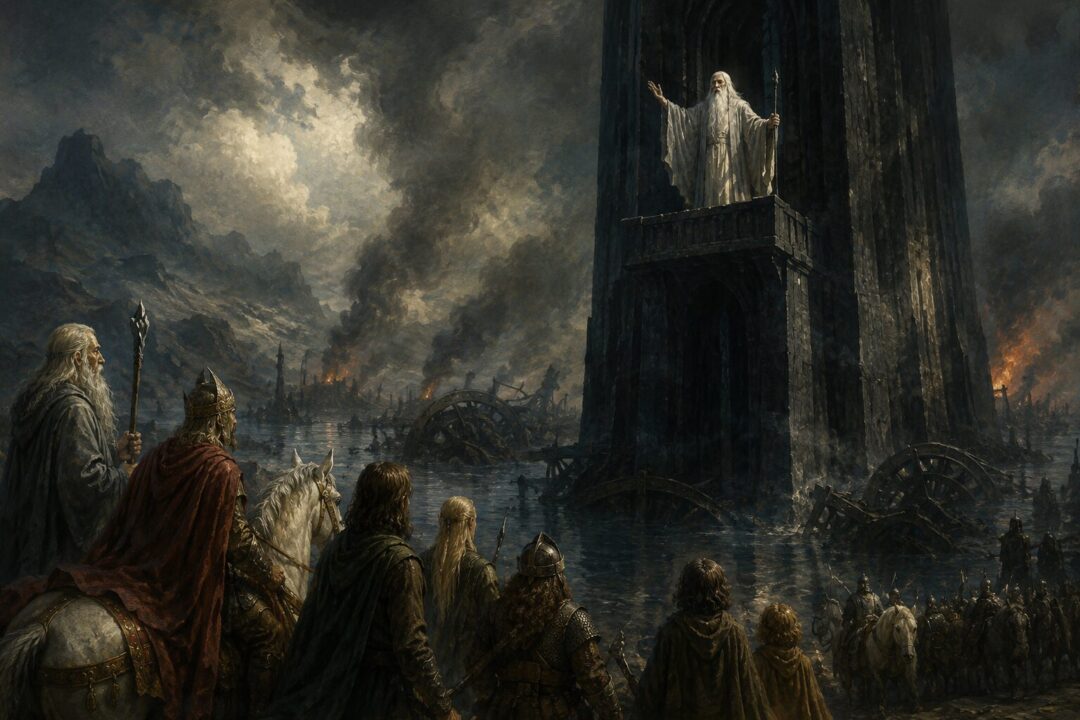
Before Saruman’s armies marched from Isengard, before the furnaces smoked beneath Orthanc, before the Uruk-hai crossed the plains of Rohan, his most dangerous weapon was already at work.
It was not a sword, a Ring, or a siege engine. It was his voice.
The Lord of the Rings makes this point with unusual care. Saruman is remembered as a maker of devices, a breeder of armies, a ruler of Isengard, and a traitor among the Wise. Yet when the story finally brings his enemies face to face with him after the ruin of Isengard, the chapter is not called “The Fall of Saruman” or “The Tower of Orthanc.” It is called “The Voice of Saruman.”
That title matters. By the time Gandalf, Théoden, Aragorn, Legolas, Gimli, Merry, Pippin, and the Riders come to Orthanc, Saruman’s military power has largely collapsed. His army has been destroyed at Helm’s Deep. The Ents have broken Isengard. His servants are scattered or trapped. And yet Gandalf still treats him as dangerous.
Why? Because Saruman’s deepest power was never merely force. It was persuasion bent toward domination.
Saruman the White, Saruman the Persuader
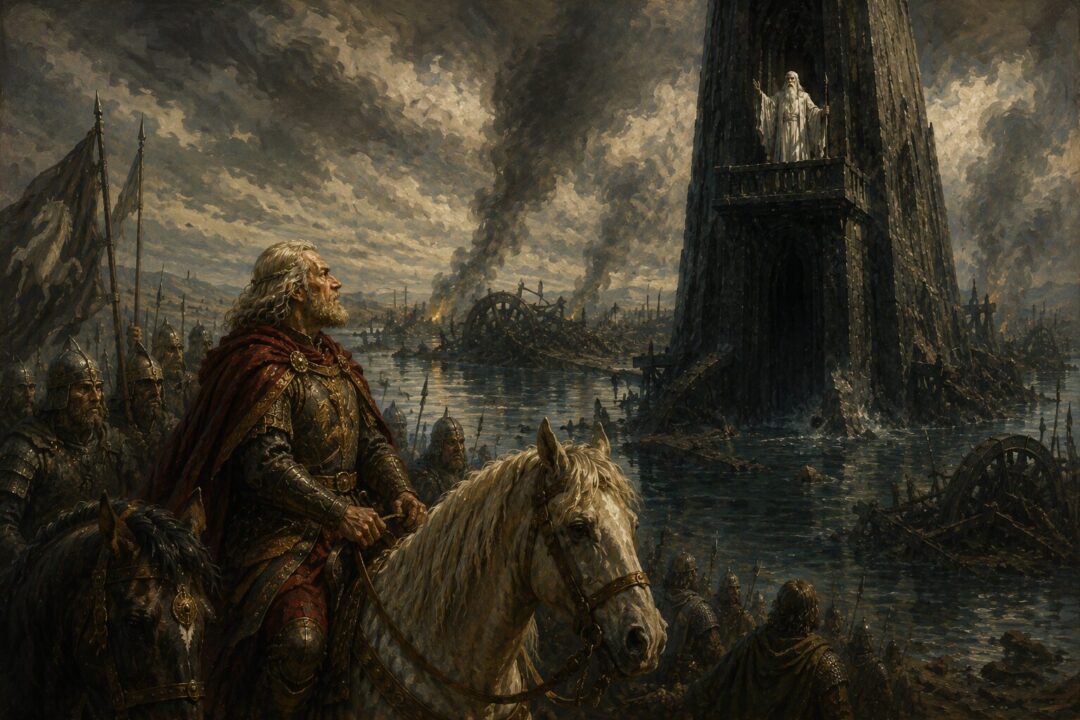
Saruman was not originally a warlord. He came into Middle-earth as one of the Istari, the Wizards sent to oppose Sauron. He was learned, powerful, and long regarded as chief among his order. In the Council of Elrond, Gandalf recalls that Saruman had studied the Rings of Power deeply, especially the devices and lore of the Enemy.
That learning is important. Saruman’s fall was not the fall of a brute. It was the corruption of intelligence, rhetoric, and authority. He knew how to sound reasonable. He knew how to clothe pride in prudence, betrayal in necessity, and domination in the language of order.
This is why his voice is so fitting as his signature weapon. It does not simply overpower the body. It seeks to rearrange the listener’s judgment. Saruman wants his victims not merely to obey him, but to feel that obedience is wise.
That is more frightening than an army. An army can be seen coming. A persuasive lie enters under the appearance of counsel.
The Voice at Orthanc
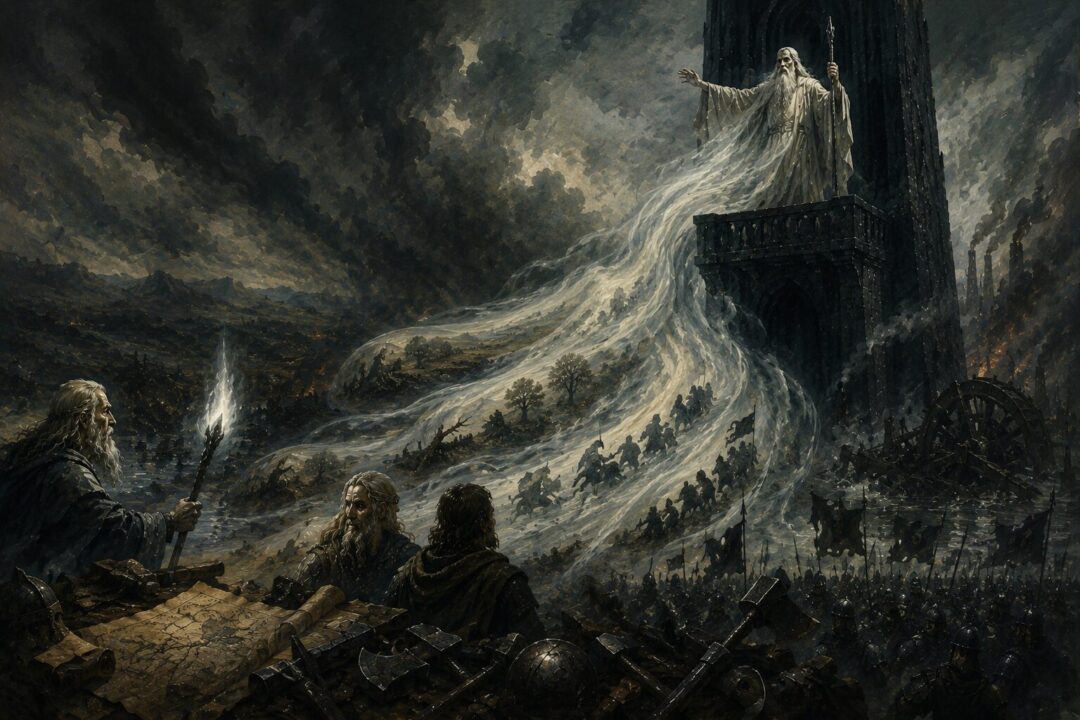
The clearest display of Saruman’s voice comes after the destruction of Isengard. He appears above the company at Orthanc and speaks to them. The scene is carefully staged: Saruman is defeated, yet he stands above them, still trying to command the encounter.
His voice is described as low, melodious, and deeply persuasive. Those who hear it find themselves tempted to agree, or at least to think well of him. The words seem reasonable. The tone seems wise. Even when his arguments are false or self-serving, the sound of the voice softens resistance.
The text does not reduce this to ordinary charm. Saruman’s speech has a power beyond mere cleverness. Yet it is not simple mind-control either. People can resist it. Its effect varies depending on the listener, the situation, and the moral clarity of those who hear him.
That distinction is crucial. Saruman’s voice is powerful because it cooperates with weakness already present in the listener: fear, pride, resentment, weariness, desire for peace, desire for advantage, or reluctance to face hard truth. He does not create corruption from nothing. He finds the opening and speaks into it.
Théoden and the Temptation of “Peace”
Saruman first turns his attention toward Théoden. This is not random. Théoden has already suffered under Saruman’s designs through Gríma Wormtongue, whose poisonous counsel weakened Rohan from within. Saruman’s armies then brought fire and death to the Westfold and Helm’s Deep. If anyone has reason to hate him, it is Théoden.
And yet Saruman tries to speak as though reconciliation is reasonable. He presents himself as misunderstood, dignified, and still able to offer friendship. He tries to make Théoden’s anger seem small, while making submission seem like wisdom.
This is one of the great moral tests of the scene. Saruman’s voice presses toward a false peace: not healing, not justice, not repentance, but a settlement that would leave evil unjudged and power intact.
Théoden resists. His answer is fierce, but it is not merely rage. He has learned what Saruman’s “friendship” means. He has seen the cost paid by his people. His refusal shows that clarity can break enchantment. Once the moral reality is named, Saruman’s beautiful speech begins to lose its hold.
Why Gimli Hears the Trick
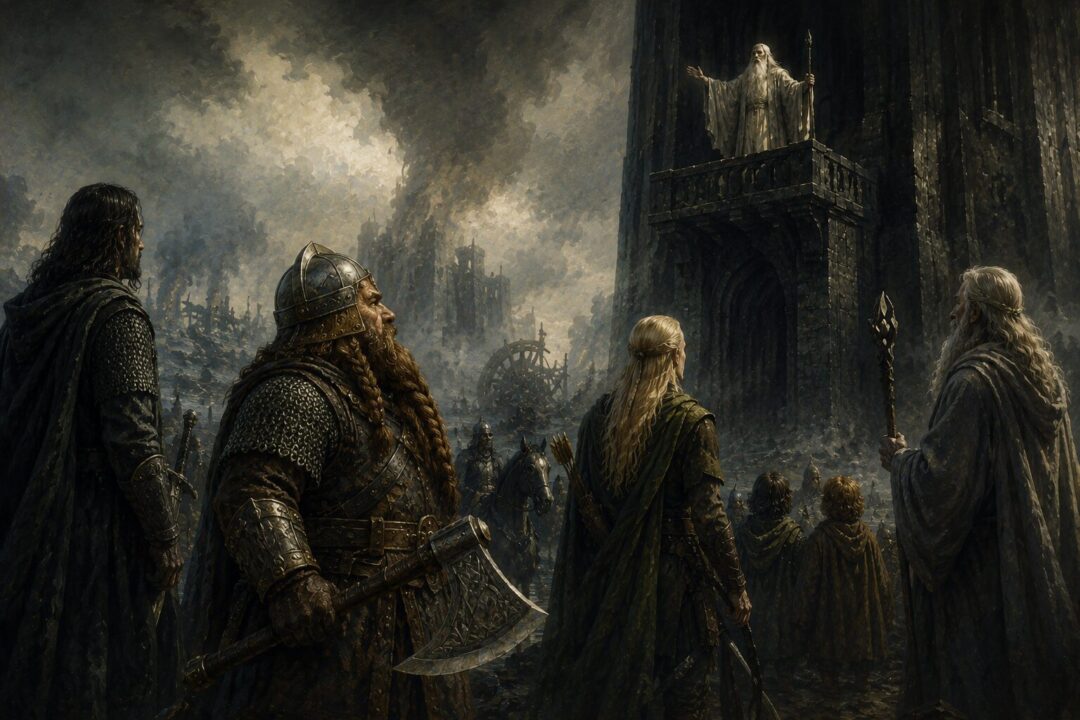
Gimli’s reaction is also important. He is not seduced by Saruman’s smoothness in the same way some others are. He calls attention to the mismatch between Saruman’s words and his deeds.
This matters because Saruman’s voice works partly by separating speech from reality. He wants listeners to consider the elegance of his argument while forgetting the burned fields, murdered men, ruined Isengard, and treachery behind it. Gimli’s bluntness pulls the conversation back to fact.
In that sense, Gimli becomes a kind of antidote. He does not defeat Saruman by matching eloquence with eloquence. He defeats him by refusing to let language float free from truth.
That is one of the hidden rules of the scene: Saruman’s voice is strongest where memory is weak. It is weakest where truth is remembered plainly.
Gandalf’s Different Kind of Authority
Saruman then turns toward Gandalf. This is perhaps the most revealing moment in the chapter.
With Théoden, Saruman tries flattery, regret, and political reason. With Gandalf, he appeals to shared status, shared wisdom, and the old hierarchy of the Istari. He speaks as one great mind to another, suggesting that Gandalf should understand him better than the lesser people gathered below.
This is not just persuasion. It is temptation by superiority. Saruman tries to draw Gandalf into the old error: the belief that the Wise have the right to rule others for their own good.
But Gandalf has already rejected that road. His authority after his return is not built on manipulation. He commands when he must, but he does not seduce the will. His power is clarified by obedience to his mission, not swollen by self-importance.
When Gandalf finally breaks Saruman’s staff and casts him from the order, it is not the beginning of Saruman’s defeat. It is the visible confirmation of a defeat already revealed. Saruman’s voice has failed before the truth.
The Armies Were an Extension of the Voice
Saruman’s military power should not be treated as separate from his persuasive power. His armies were the outward form of an inward corruption.
Isengard becomes a machine of domination because Saruman’s mind has already accepted domination as wisdom. He speaks of order, strength, and necessity, and then builds the physical world to match those ideas. Trees are cut down. Orcs and Men are mustered. The valley is reshaped by industry and war.
His voice comes first because ideology comes before machinery. Before Isengard can become a fortress of smoke and iron, Saruman must convince himself that this is reasonable. Then he convinces others.
This is why his fall feels so modern and so ancient at once. He is not merely a sorcerer in a tower. He is the corrupted counselor, the brilliant expert who mistakes control for wisdom, the leader who uses language to make surrender sound like safety.
Wormtongue as the Lesser Echo
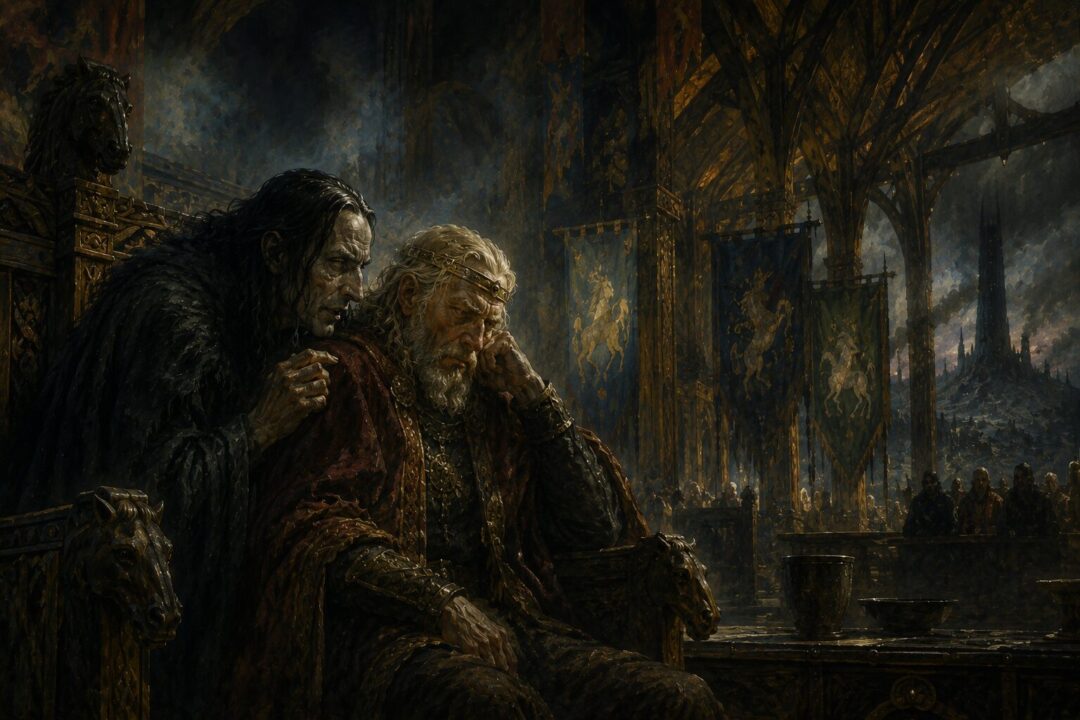
Gríma Wormtongue shows what Saruman’s method looks like in miniature. He does not conquer Rohan by force. He weakens Théoden through insinuation, delay, suspicion, and despair. His words drain courage before any army arrives.
That pattern reflects Saruman himself. The attack on Rohan begins long before Helm’s Deep. It begins in the king’s hall, where counsel is poisoned and perception is clouded.
This does not mean Gríma has the same supernatural power as Saruman. The texts do not require that. But narratively, Gríma functions as Saruman’s smaller instrument: a human mouth carrying the logic of Isengard into Meduseld.
By the time Saruman’s armies ride, his words have already prepared the wound.
The Limits of Saruman’s Power
Saruman’s voice is terrifying, but it is not absolute. That limitation is one of the most important details in the story.
It can be resisted by truth, humility, moral memory, and clear judgment. It falters when exposed to contradiction. It depends on the listener’s willingness, even if only briefly, to entertain the false frame Saruman offers.
This is why the scene at Orthanc is so tense. The danger is real, but not mechanical. Saruman is not a machine pressing a button in the mind. He is a fallen intelligence trying to enlist the listener’s own reason against itself.
That makes his voice more morally serious. If he simply controlled people, their choices would vanish. Instead, the scene shows persuasion as a battlefield of the soul. The listener must decide whether smooth words can erase known evil.
The Tragedy of a Voice Made for Wisdom
The deepest tragedy is that Saruman’s voice was not created only for evil. As one of the Wise, his speech should have been used for counsel, resistance to Sauron, and the strengthening of free peoples. His gifts were real. His learning was real. His authority was real.
That is why his corruption is so bitter. He does not become dangerous because he lacks gifts. He becomes dangerous because he turns gifts away from their proper purpose.
The same voice that might have guided now deceives. The same wisdom that might have humbled itself before the task now crowns itself. The same authority that might have served freedom now seeks mastery.
Saruman’s fall is therefore not merely the story of ambition. It is the story of a gift severed from humility.
Why the Voice Matters More Than the Army
Saruman’s armies could burn villages, breach defenses, and terrify kingdoms. But they could not accomplish what his voice attempted: the willing surrender of judgment.
That is why the confrontation at Orthanc remains one of the most important scenes in The Lord of the Rings. The battle is over, but the war of meaning continues. Saruman tries to rewrite defeat as dignity, treachery as misunderstanding, and domination as peace.
He fails because those before him have learned to see him clearly.
In the end, Saruman’s voice reveals the nature of his evil more completely than his armies do. His soldiers show what he wanted to do to the world. His voice shows what he wanted to do to the mind.
And that is the more intimate violence.
The armies of Isengard were terrible, but they were never Saruman’s first weapon. They were what came after the lie had found a language.
Sources & Notes
- J.R.R. Tolkien, The Lord of the Rings, Book III, Chapter 10, “The Voice of Saruman” — the central Orthanc scene where Saruman’s persuasive voice remains dangerous after Isengard’s military defeat.
- J.R.R. Tolkien, The Lord of the Rings, Book III, Chapter 6, “The King of the Golden Hall” — Gríma’s poisoned counsel shows Saruman weakening Rohan through words before open war.
- J.R.R. Tolkien, The Lord of the Rings, Book II, Chapter 2, “The Council of Elrond” — Gandalf’s account of Saruman’s Ring-lore, pride, and arguments for rule by the Wise.
- J.R.R. Tolkien, Unfinished Tales, “The Istari” — background on the Wizards’ mission and Saruman’s place among them, clarifying how his gifts were meant to serve resistance to Sauron.
- J.R.R. Tolkien, The Letters of J.R.R. Tolkien, Letter 131 — Tolkien’s account of Sauron-like tyranny as ordering and dominating wills supports the reading of Saruman’s rhetoric as domination disguised as wisdom.