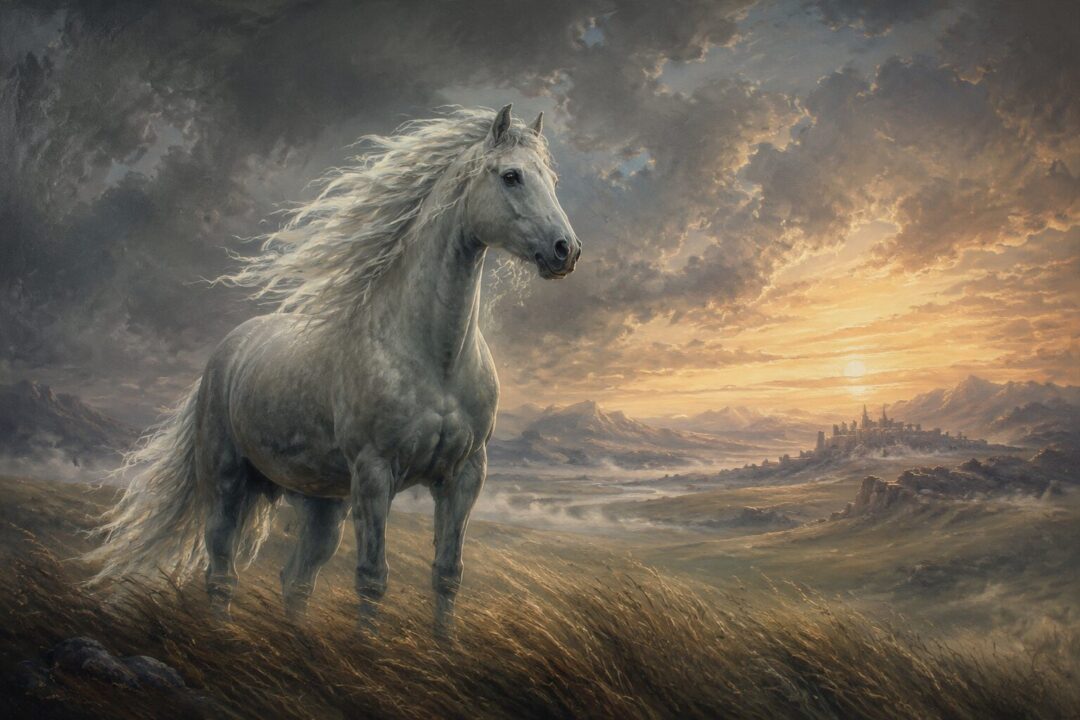
Shadowfax is often remembered as “the horse of Gandalf,” but that simple phrase hides one of the most unusual relationships in The Lord of the Rings: a great horse of Rohan who is never truly possessed, commanded, or even formally “given.” Instead, the texts suggest something rarer in Middle-earth—a bond formed by recognition, consent, and a shared refusal to be subdued.
In a world where kings are crowned, Rings are taken, and power is so often imposed, Shadowfax stands apart as a living contradiction: a steed who accepts no rider by right, yet willingly bears one who does not seek to master him.
The Lord of the Mearas: A Lineage Beyond Ordinary Horses
Shadowfax belongs to the Mearas, the royal line of horses of Rohan. These are not merely superior animals in strength or speed; Tolkien describes them as an ancient and almost semi-mythic breed, said to descend from the horse Felaróf, who lived in the time of Eorl the Young. The Mearas are noted for their intelligence, longevity, and an almost uncanny responsiveness to speech and will.
Within this lineage, Shadowfax is described as the greatest of them in the Third Age. The Rohirrim themselves regard him with a mixture of awe and unease. He is not simply a valuable mount or warhorse; he is spoken of as though he possesses his own sovereignty among horses. Even among the proud horse-lords of Rohan, he is not treated as property in the usual sense.
This distinction matters, because it frames everything that follows. Shadowfax is not a creature waiting passively to be claimed. He is already, in a sense, lord of his own kind.
Gandalf Comes to Rohan: A Meeting, Not an Acquisition
When Gandalf arrives in Rohan during the events leading toward the War of the Ring, he does not come as a conqueror or commander. He arrives as a wanderer—one of the Istari—stripped of dominion and forbidden to dominate through force. This constraint is not incidental; it is central to what he is.
It is in this context that he encounters Shadowfax.
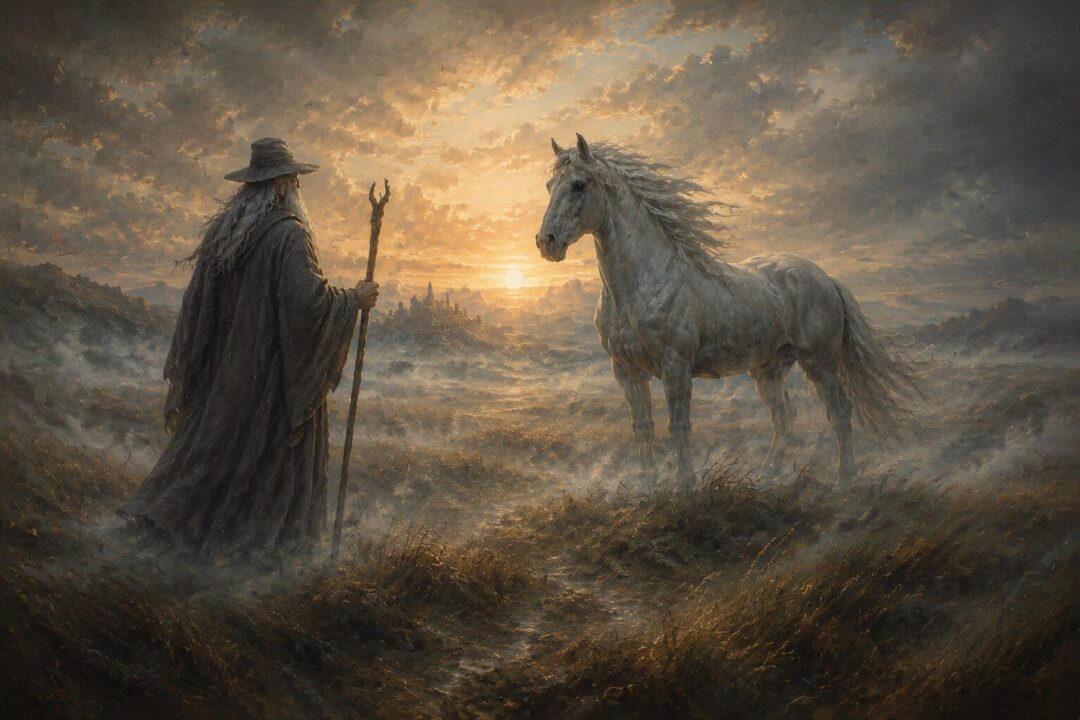
The texts present the meeting not as a transaction but as a recognition. Shadowfax is not simply assigned to Gandalf by Théoden. In fact, the King of Rohan is initially reluctant, and Gríma Wormtongue’s influence has already sown suspicion regarding Gandalf’s intentions. Yet Shadowfax himself is not bound by court politics or counsel.
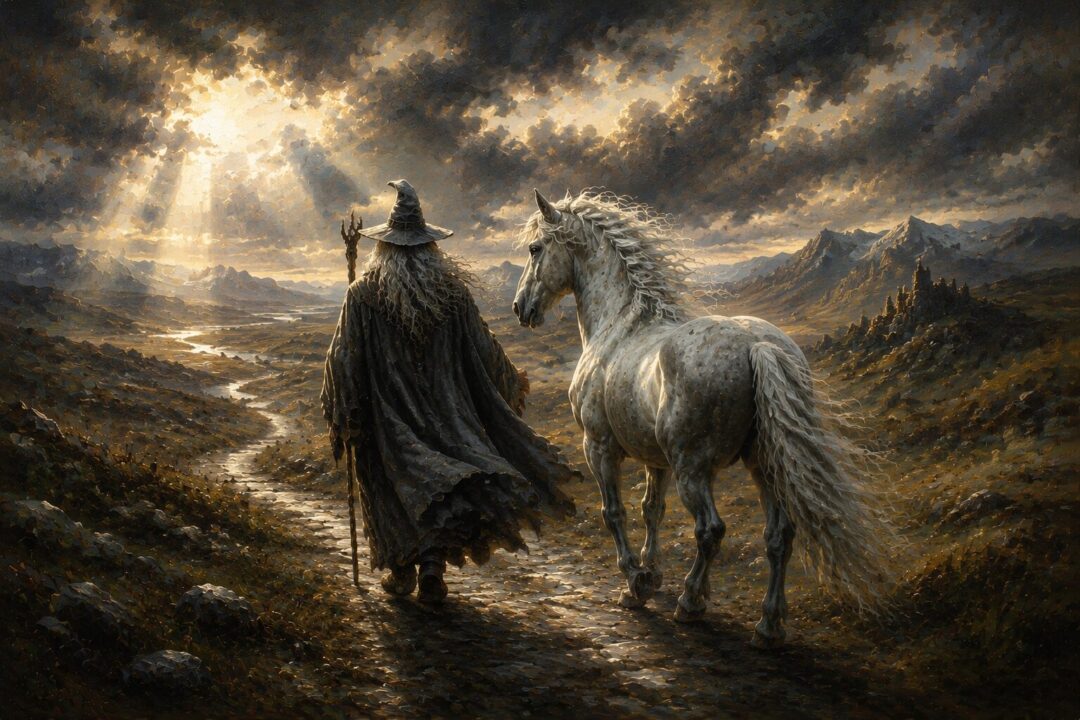
What follows is unusual even within Tolkien’s world: Gandalf approaches Shadowfax without bridle or saddle, speaking to him in a manner that is never fully translated into ordinary language. The implication is not control, but communication at a level beyond human speech.
Shadowfax does not submit. He accepts.
Not a Gift of Kings, But a Choice of the Free
It is tempting to say that Théoden “gave” Shadowfax to Gandalf, but that wording oversimplifies what the narrative carefully resists making straightforward. Théoden’s role is more permission than authorship. He allows what is already happening.
Shadowfax’s decision precedes formal ownership. The horse does not become Gandalf’s because a king decrees it, but because he will not serve anyone else in that way again. The distinction is subtle but important: in Middle-earth, authority over beings capable of will is never purely administrative.
Even among the Rohirrim—who prize horsemanship above almost all other arts—Shadowfax is not broken, trained, or assigned. He is acknowledged.
Thus, when Gandalf departs riding him, it is not the transfer of property, but the visible confirmation of a bond already formed.
No Bridle, No Saddle: The Reversal of Mastery
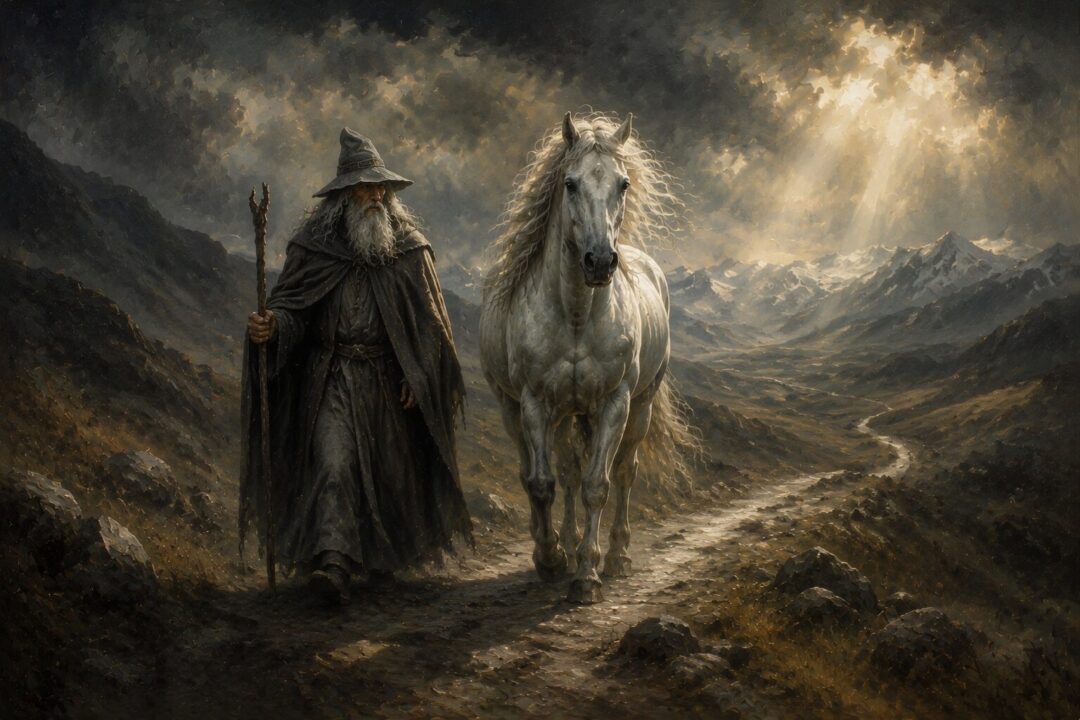
One of the most striking details in the account is that Gandalf rides Shadowfax without bridle, saddle, or reins. In a world where horses are typically guided through physical constraint and learned obedience, this absence is not decorative—it is ideological.
Control is replaced by trust.
Shadowfax does not become obedient in the conventional sense. Instead, he moves in alignment with Gandalf’s intent, suggesting a relationship based on mutual recognition rather than hierarchy. Gandalf does not dominate him, and Shadowfax does not resist him. The relationship bypasses the entire structure of domination that governs most rider-horse bonds in Middle-earth.
This is particularly significant given Gandalf’s own nature. As an Istar, he is explicitly forbidden from asserting dominance through force of will over Elves, Men, or any sentient beings. Shadowfax, though not an Elf or Man, is nevertheless treated in the narrative with similar moral weight—an independent will that cannot be ethically overridden.
What emerges is not command, but concord.
The Nature of Choice in Shadowfax’s Allegiance
A recurring theme in Tolkien’s legendarium is that greatness is often defined by refusal: refusal to be corrupted, refusal to dominate unjustly, refusal to submit to lesser powers when higher purpose is recognized.
Shadowfax’s alignment with Gandalf fits this pattern. He does not serve Sauron, who corrupts wills through fear and domination. He does not serve Théoden in the full sense of possession. And he does not serve Gandalf as a subject serves a ruler.
Instead, the texts suggest that he chooses Gandalf as a companion worthy of shared purpose.
This is not sentimentalization of animal behavior; rather, it reflects Tolkien’s broader tendency to attribute moral perception to non-human intelligences in the natural world—particularly in exceptional cases like the Mearas.
Shadowfax’s choice therefore becomes an echo of Gandalf’s own vocation: to guide rather than command, to inspire rather than compel.
Speed, Light, and the Breaking of Boundaries
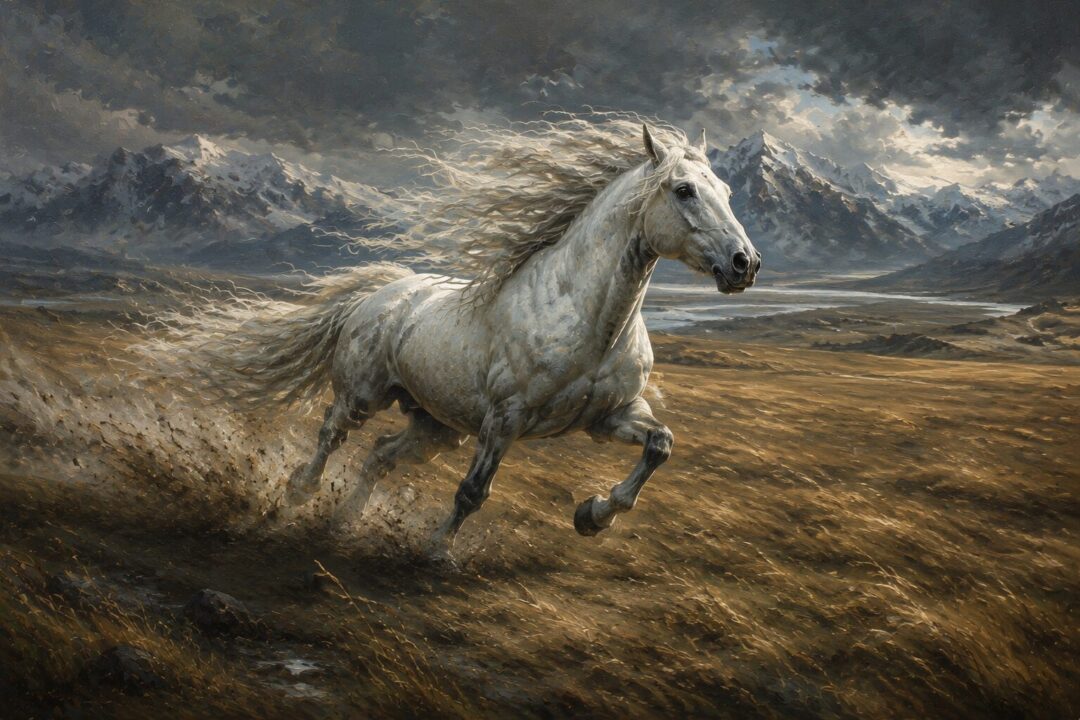
After their union, Shadowfax becomes known for extraordinary speed, carrying Gandalf across vast distances with minimal delay. In the narrative of the War of the Ring, this mobility is not merely impressive; it is strategically significant. He functions as a bridge between unfolding events, allowing Gandalf to move in accordance with rapidly changing threats.
Yet even here, the emphasis remains on freedom. Shadowfax is never described as exhausted in service of endless command. Instead, he moves as though the road itself is aligned with his will.
This creates a subtle inversion: rather than horse serving rider, movement itself seems to emerge from their shared intent.
In a world where so many powers depend on control of movement—armies, roads, gates, borders—Shadowfax represents a form of travel that resists constraint.
The Symbolism of an Unmastered Bond
Shadowfax and Gandalf together form one of the clearest symbolic contrasts in The Lord of the Rings. Against the backdrop of the One Ring—an object defined by domination and corruption—they represent a relationship defined by absence of possession.
The Ring binds through will and ownership. Shadowfax binds through recognition and consent.
Gandalf, as one of the Istari, is himself a study in limitation: power restrained, authority redirected into guidance. Shadowfax mirrors this structure in animal form. Neither is diminished by lack of domination; both are defined by it.
This makes their partnership quietly subversive within the moral architecture of Middle-earth. It suggests that the highest forms of relationship are not those of control, but of shared purpose freely accepted.
After the War: A Departure Without Claim
Following the destruction of the One Ring and the defeat of Sauron, Gandalf’s journey in Middle-earth concludes. Shadowfax remains associated with him until the end of his time in the Westlands, but even this continuation does not transform their bond into ownership.
There is no implication that Shadowfax becomes “retired” into service or possession. Rather, he remains what he has always been: the Lord of Horses who chose to travel with Gandalf for a time.
In this sense, their relationship resists closure. It is not resolved in the way political alliances are resolved, nor concluded like a contract fulfilled. It simply ends in the natural divergence of paths—each returning to the sphere of their own nature.
Conclusion: The Power of What Cannot Be Taken
Shadowfax’s significance lies not only in his speed or lineage, but in what he refuses to be. In a mythology filled with rings that bind, thrones that demand loyalty, and powers that seek dominion, he stands as a reminder that not all greatness can be claimed.
He is not given to Gandalf in the way objects are given. He is not conquered, not broken, and not owned.
He chooses.
And in that choice, one of the simplest relationships in Middle-earth becomes one of its most profound: a Maia in mortal form and a lord of horses moving together, not because one rules the other, but because neither needs to.
Sources & Notes
- Tolkien Gateway, “Shadowfax” — identifies Shadowfax as lord of the Mearas, records Théoden lending/giving him to Gandalf, and notes Gandalf could ride him without bridle or saddle. https://tolkiengateway.net/wiki/Shadowfax
- Tolkien Gateway, “Mearas” — explains the Mearas as the royal horses of Rohan, unusually intelligent and long-lived, ridden only by the kings of the Mark with Gandalf as the notable exception. https://tolkiengateway.net/wiki/Mearas
- Tolkien Gateway, “Felaróf” — gives the origin tradition for the Mearas and Shadowfax’s descent from Felaróf, supporting the article’s point that Shadowfax is no ordinary horse. https://tolkiengateway.net/wiki/Felar%C3%B3f
- Tolkien Gateway, “Gandalf” — provides wider context for Gandalf’s role in Rohan and the War of the Ring, including his association with Shadowfax and his non-possessive mode of guidance. https://tolkiengateway.net/wiki/Gandalf
Sources cover Shadowfax, the Mearas lineage, Felaróf, and Gandalf’s exceptional relationship with Rohan’s greatest horse.