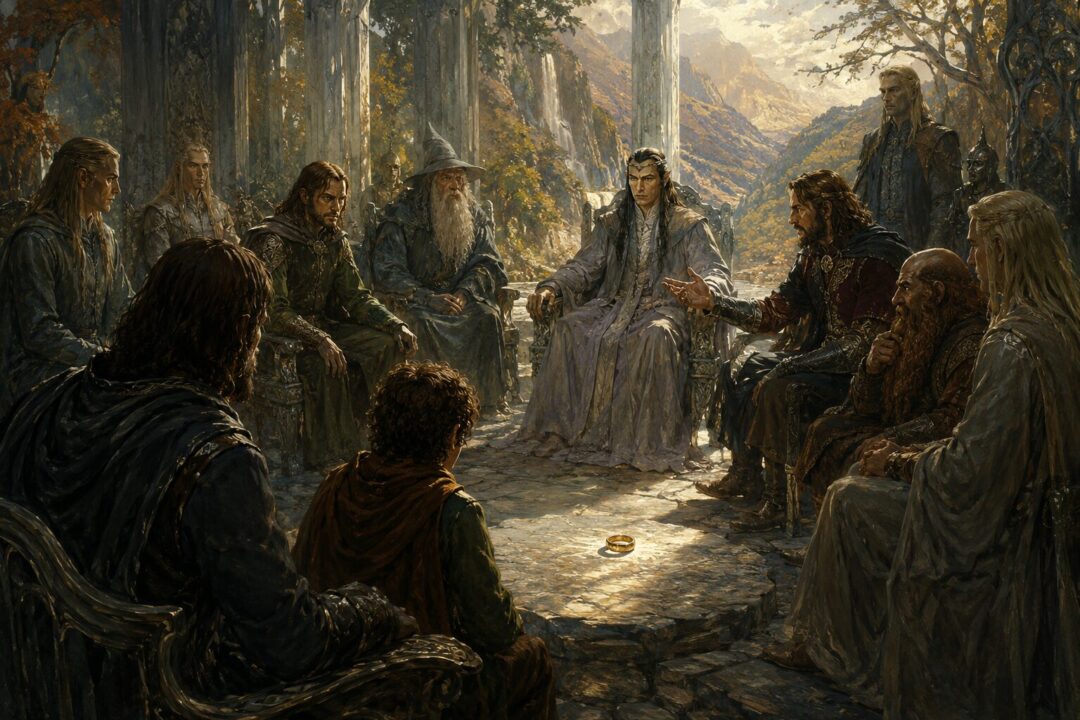
A broken sword, a plain gold ring, a wandering Ranger no one fully trusts, and a room filled with peoples who carry old wounds against one another. On the surface, the Council of Elrond looks like a classic war council: leaders gather, intelligence is exchanged, and a dangerous mission is planned.
But that is not what actually happens in The Fellowship of the Ring.
The Council of Elrond is one of the most consequential conversations in Middle-earth precisely because it is not a straightforward strategy meeting. It is part confession, part historical reckoning, part moral trial, and only finally a political decision. The council is less about military planning than about answering a deeper question: what do free peoples do when every obvious solution is corrupted by the nature of power itself?
That tension shapes everything that follows.
The Council Begins With Memory, Not Strategy
If the gathering were merely tactical, the first question would be simple: how do we defeat Sauron?
Instead, the council spends enormous time reconstructing the past.
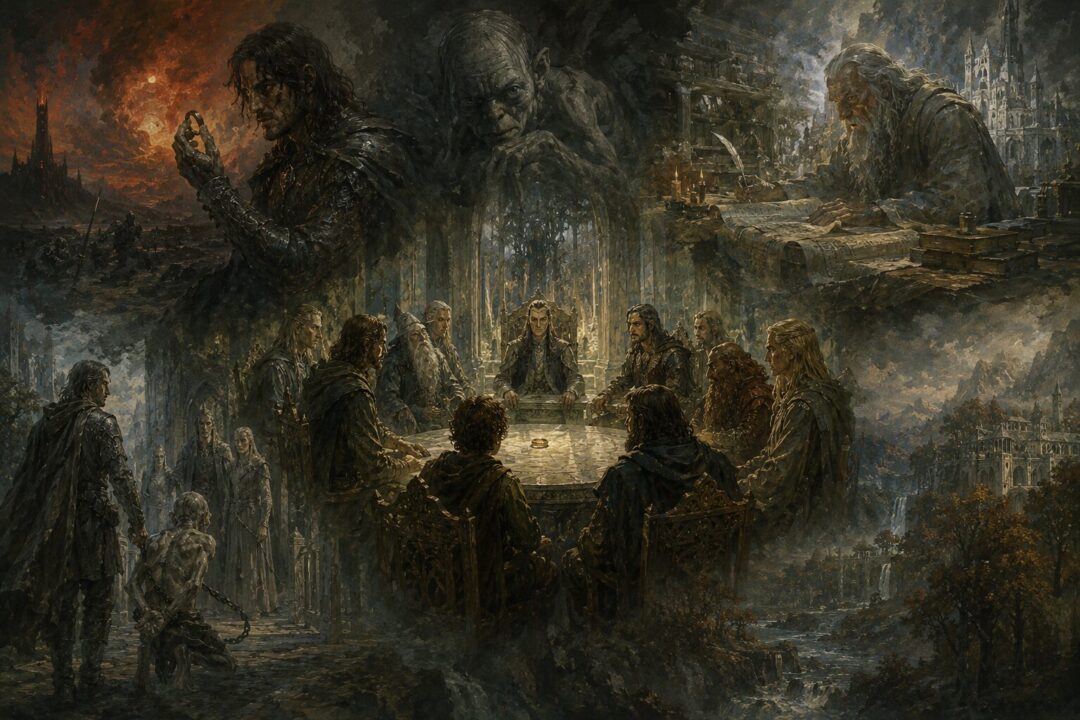
Elrond recounts the end of the Second Age, the fall of Gil-galad and Elendil, and the moment Isildur took the Ring. Gandalf tells the long story of discovering the Ring’s identity. Aragorn explains the capture of Gollum. Legolas brings news of Gollum’s escape from the Woodland Realm. Boromir recounts the prophetic dream that drove him north.
The meeting unfolds almost like testimony.
This structure matters. The danger facing Middle-earth cannot be understood without understanding how earlier peoples failed. The Ring is not merely a powerful weapon lying on a table awaiting deployment. It carries a history of temptation, denial, delay, and misplaced confidence.
The council’s first task is therefore epistemological: establish what is true.
Who knows what? What has Sauron learned? What does the Ring do? What options are illusions?
Before action comes shared understanding.
That is easy to overlook because modern readers expect councils to produce plans quickly. But in Tolkien’s world, wisdom depends on memory. Forgetting the past is not inefficiency. It is danger.
Every Delegate Arrives Carrying a Different Fear
The Council of Elrond is not a unified leadership summit. It is a collision of different civilizations under pressure.
Boromir arrives fearing Gondor’s exhaustion. His people have held the front lines against Mordor for generations. He seeks strength, relief, and answers.
The Elves bring another anxiety: fading. Rivendell and Lórien endure, but the Elder Days are ending. The long defeat has become familiar.
Dwarven concerns emerge through the message carried by Glóin. Sauron’s servants have already begun probing old grievances and offering bargains. The Enemy understands political fracture.
The Hobbits bring something stranger: provincial innocence suddenly dragged into world history.
Even Gandalf arrives burdened by failure. Saruman, once chief among the wise, has fallen.
This matters because the council is not simply coordinating allies who already share assumptions. It is navigating radically different experiences of loss, duty, and hope.
Boromir’s perspective is especially important here. He is often remembered primarily for later weakness toward the Ring. But at the council he voices concerns many practical leaders would recognize.
Why not use the Enemy’s weapon against him?
Why destroy an instrument of enormous power when the world desperately needs strength?
These are not foolish questions.
They are, in fact, exactly the questions the Ring is designed to provoke.
The Ring Breaks the Logic of Conventional Politics
Ordinary strategy assumes certain principles.
If a weapon is powerful, control it.
If an enemy is stronger, exploit available advantages.
If survival is at stake, use every tool.
The One Ring destroys those assumptions.
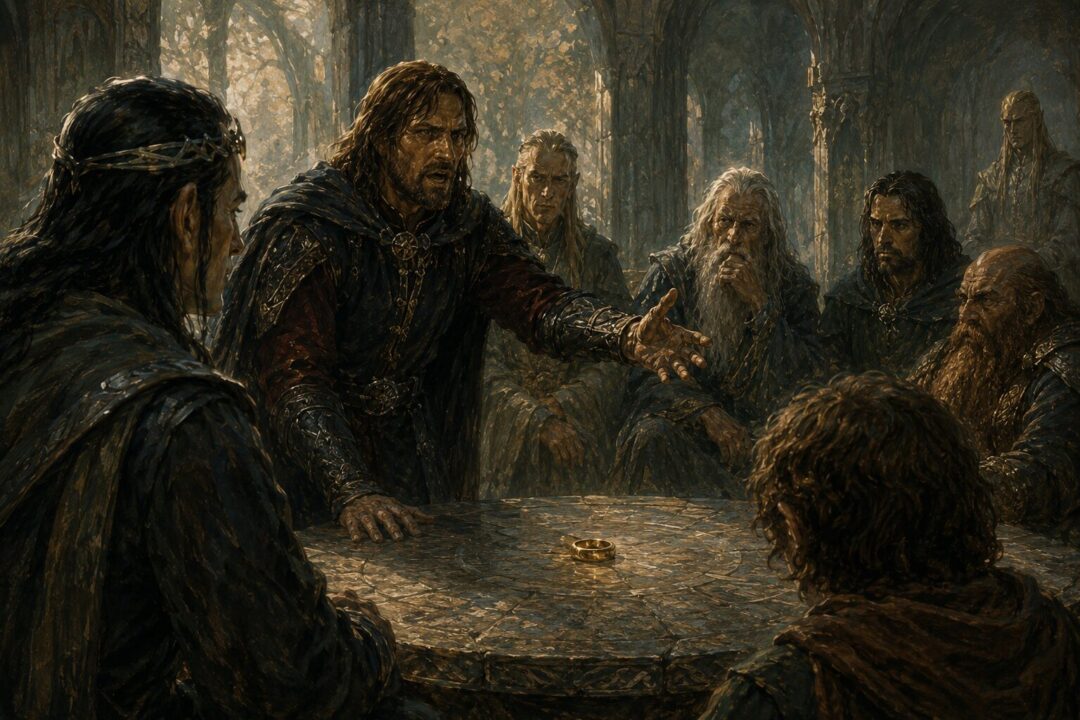
Again and again, the council examines alternatives that would make perfect sense in another story.
Hide the Ring?
Impossible. Sauron’s search will continue.
Send it west across the Sea?
The Elves will not become an escape route for burdens that belong to Middle-earth.
Guard it in Rivendell?
Elrond openly rejects the idea. Rivendell can be besieged or destroyed.
Use it against Sauron?
That path leads not to liberation but replacement.
This last point is crucial.
The council does not argue that a noble person would certainly fail to wield the Ring effectively. The danger is subtler. A powerful and righteous wielder might indeed overthrow Sauron — but would become something terrible in the process.
The Ring magnifies domination.
It bends good intentions toward coercion.
The logic of “use evil to defeat evil” becomes self-defeating.
That is why the council cannot operate like an ordinary war cabinet. The normal calculus of military necessity no longer applies.
The Debate Reveals a Crisis of Moral Imagination
One of the most striking features of the council is how often proposed solutions collapse.
There is no hidden army waiting in reserve.
No forgotten super-weapon.
No brilliant tactical shortcut.
The available options are progressively stripped away until something shocking remains: weakness, secrecy, endurance, and sacrifice.
Destroying the Ring in Orodruin is not chosen because it is the most efficient plan.
It is chosen because every more powerful alternative is spiritually compromised.
This creates a crisis of imagination.
Traditional heroic thinking expects victory through strength — stronger kings, stronger magic, stronger armies, stronger leadership.
The council arrives somewhere stranger.
Success may depend precisely on refusing the intoxicating logic of mastery.
That does not mean passivity. The quest requires courage beyond ordinary warfare. But it is courage expressed through renunciation rather than acquisition.
In that sense, the council becomes a philosophical turning point in the narrative.
The question ceases to be: who should wield ultimate power?
Instead it becomes: can anyone voluntarily relinquish it?
Elrond Does Not Command the Outcome
Because the meeting takes place in Rivendell, it is easy to imagine Elrond presiding like a ruler issuing strategic directives.
The text presents something more nuanced.
Elrond possesses immense authority, age, and knowledge. Yet he does not impose a solution by decree.
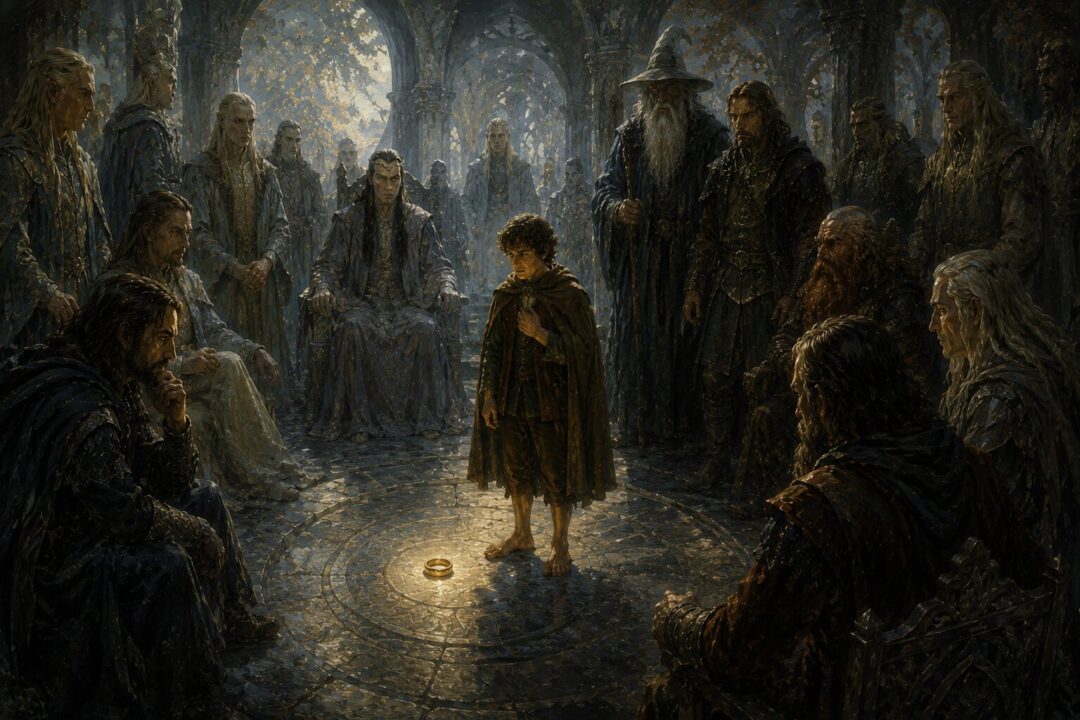
He guides discussion. He interprets history. He identifies dangers. But the eventual shape of the Fellowship emerges through consent, volunteered service, and accepted burden.
This matters deeply.
Middle-earth contains kings, lords, stewards, and powerful elders. Yet one of its defining themes is that legitimate authority has limits.
Even wisdom cannot simply command moral courage into existence.
The formation of the Fellowship illustrates this beautifully. Members step forward from different peoples and motivations. Some are chosen by necessity, but there is also voluntariness at the heart of the undertaking.
Most importantly, Frodo offers himself.
That moment is easy to romanticize, but within the council it carries tremendous emotional weight.
No one orders him.
The room falls silent.
Elrond recognizes the significance of what has happened.
The quest begins not with political assignment but with chosen responsibility.
Frodo’s Decision Changes the Nature of the Meeting
Before Frodo speaks, the council remains trapped within analysis.
People know the danger. They understand the stakes. They recognize the poverty of available options.
Yet recognition alone does not produce action.
Frodo breaks the paralysis.
“I will take the Ring,” he says, though he does not know the way.
This is not a triumphal warrior’s declaration. It is hesitant courage born from burden, fear, and necessity.
The emotional logic matters.
The council does not discover a perfect plan and then recruit a suitable operative.
Instead, a vulnerable individual accepts an impossible task, and strategy reorganizes around that moral act.
This reverses conventional political storytelling.
Powerful figures do not select the least important person for symbolic reasons. Rather, the person least invested in domination becomes central precisely because the Ring corrupts through ambition.
That does not make Hobbits magically immune. The story repeatedly shows otherwise.
But Hobbits often possess traits — humility, attachment to ordinary life, limited appetite for grand control — that complicate the Ring’s appeal.
The council recognizes this, even if no one treats immunity as guaranteed.
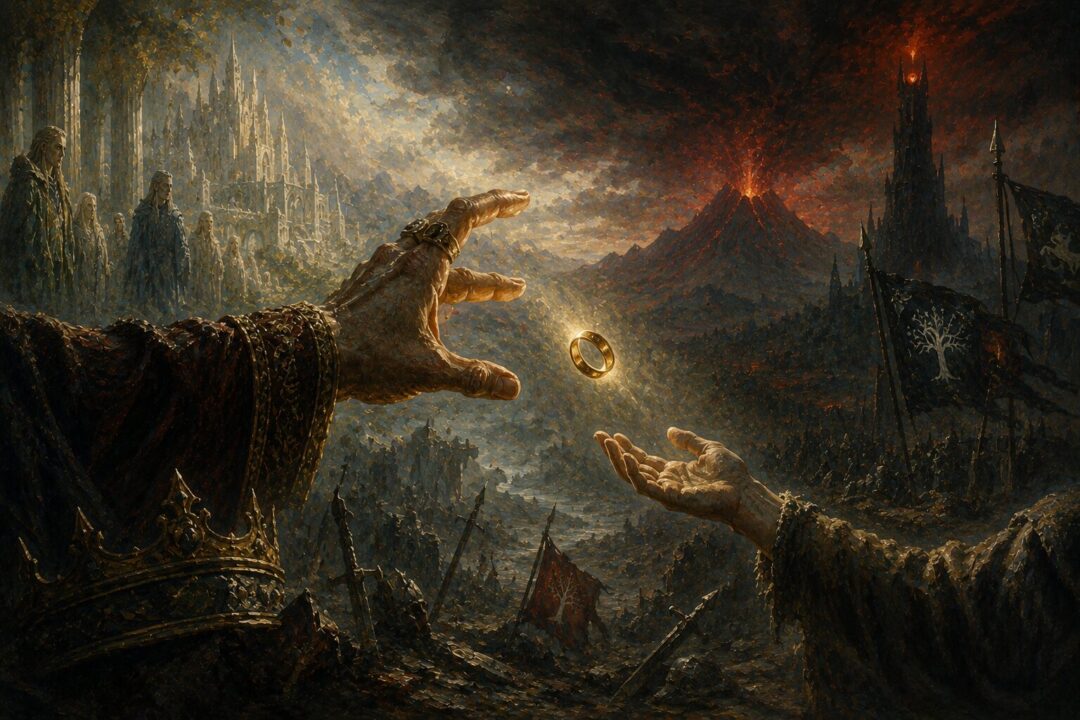
The Council Is Really About the Limits of Power
Seen clearly, the Council of Elrond is not fundamentally about logistics.
It is about the collapse of confidence in power itself.
Kings failed.
Great alliances failed.
Ancient wisdom did not prevent disaster.
Saruman’s brilliance became corruption.
Military resistance, however necessary, cannot solve the Ring’s problem.
The council gathers representatives of nearly every major free people not because coalition management alone will save the world, but because Middle-earth must collectively confront a hard truth: some evils cannot be mastered safely.
That insight makes the meeting one of the most radical episodes in the legendarium.
The solution to Sauron is not finding a stronger tyrant.
Not uncovering superior magical technology.
Not centralizing authority in the hands of the wise.
The chosen path involves relinquishment, trust, shared burden, and acceptance of vulnerability.
None of this guarantees success. The council never pretends otherwise.
Indeed, much of its emotional power comes from uncertainty. The quest appears desperately unlikely to succeed.
Yet that is precisely why the meeting matters.
The Council of Elrond is not a scene where clever leaders solve a problem through superior planning.
It is a gathering where free peoples slowly realize that their greatest enemy has already poisoned the normal language of strategy — and that survival may require a kind of courage that power alone cannot provide.
Sources & Notes
- J.R.R. Tolkien, The Lord of the Rings, Book II, Chapter 2, “The Council of Elrond” — primary source for the meeting’s testimony structure, rejected strategies for the Ring, and Frodo’s volunteered burden.
- J.R.R. Tolkien, The Lord of the Rings, Book I, Chapter 2, “The Shadow of the Past” — Gandalf’s explanation of the Ring’s corrupting nature and why using it against Sauron is perilous.
- J.R.R. Tolkien, The Silmarillion, “Of the Rings of Power and the Third Age” — background on Sauron, the Last Alliance, Isildur’s taking of the Ring, and the unresolved history Elrond recounts.
- J.R.R. Tolkien, The Lord of the Rings, Book II, Chapter 3, “The Ring Goes South” — the Fellowship’s formation around free consent, representation of the Free Peoples, and Frodo’s role as Ring-bearer.
- J.R.R. Tolkien, The Letters of J.R.R. Tolkien, Letter 131 — Tolkien’s own summary of the Ring as a means of domination and of the story’s moral conflict around power.