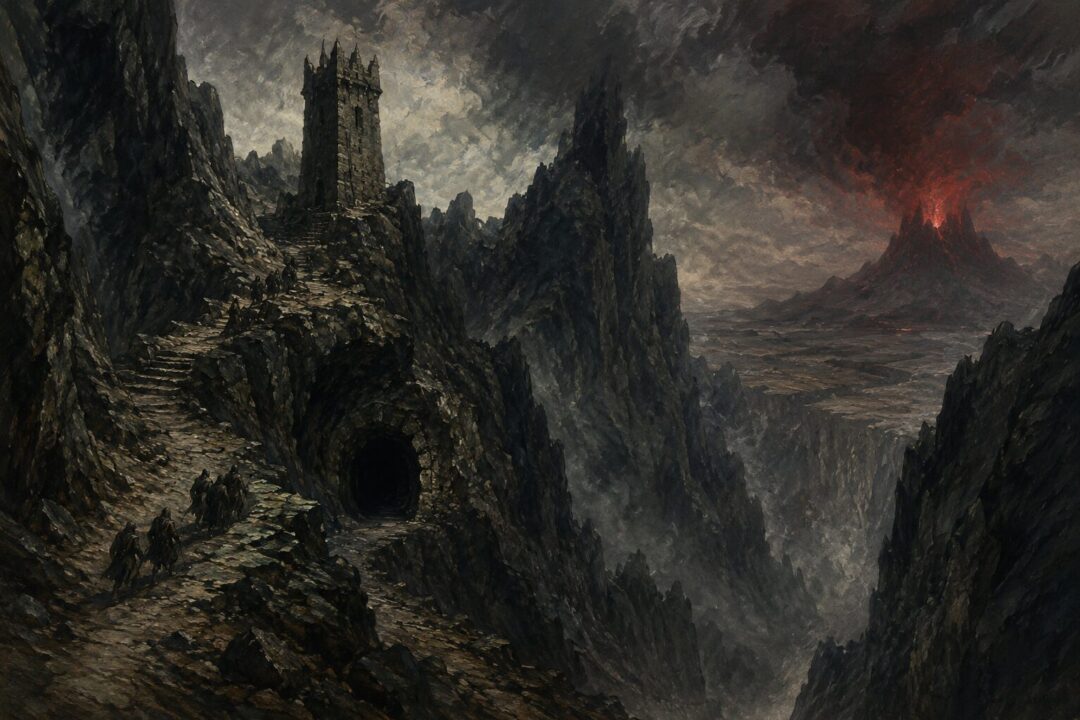
At the edge of Mordor, the road did not simply become dangerous. It became hungry.
The Black Gate was built to be seen. Minas Morgul glowed with terror. Barad-dûr dominated the land like a thought no one could escape. But the pass of Cirith Ungol offered something stranger: a way into Mordor guarded not by discipline, not by loyalty, not even by Sauron’s direct command, but by an ancient appetite crouched in the dark.
Shelob was not one of Sauron’s soldiers. She was not a captain, not a servant, not a beast bred in his pits. The texts present her as a power of older malice, “last child of Ungoliant” to trouble the world, dwelling in the mountains before Sauron’s fortress had even risen. Yet Sauron knew she was there, and he allowed it. More than that, it pleased him. She made the pass more dreadful than walls alone could make it.
That is the dark bargain at Cirith Ungol: Sauron tolerated what he could not truly command because Mordor still needed what Shelob provided.
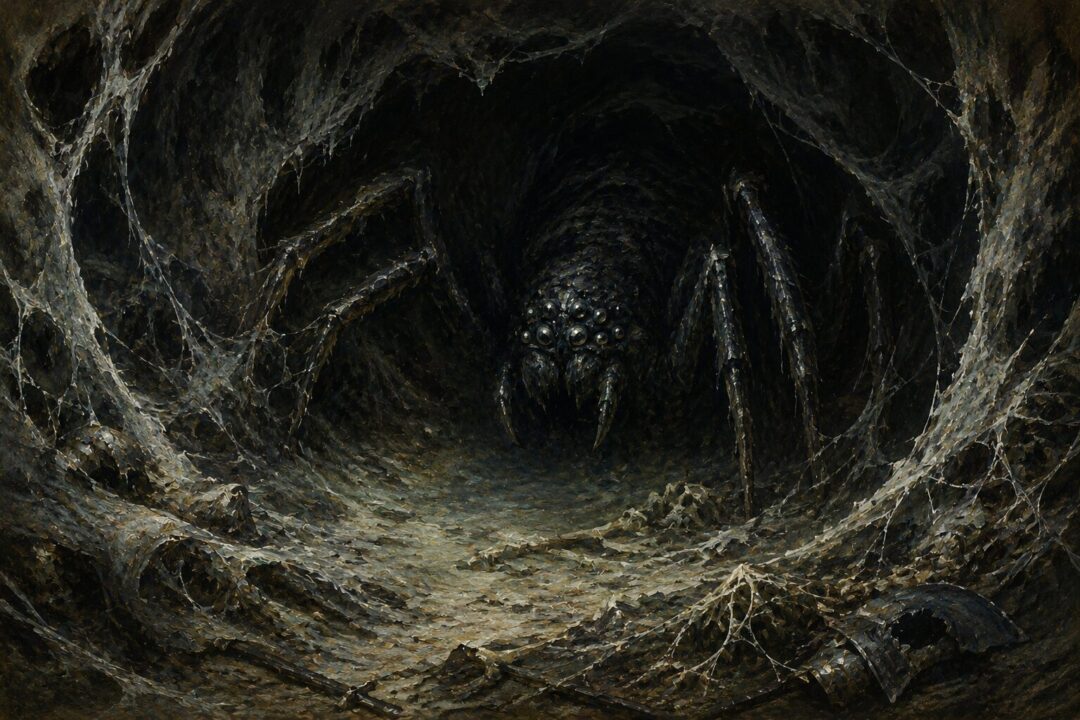
Shelob Was Useful Because She Was Not a Normal Guard
Sauron had armies, watchers, towers, spies, roads, and fortresses. If he had wanted a regular military checkpoint in the pass, he could have placed one there. In fact, there was already a tower above the pass: the Tower of Cirith Ungol, originally built by Gondor after the War of the Last Alliance to watch Mordor, and later occupied by Sauron’s servants.
But Shelob’s lair did something a tower could not.
A fortress can be observed, mapped, bribed, stormed, or avoided. A living horror hidden inside a tunnel is different. Shelob did not merely block the way. She turned the passage itself into a trap. The tunnel into Mordor became a place where courage, light, smell, sound, and memory all seemed to fail. It was not just a defended road; it was a devouring road.
That mattered because Cirith Ungol was not the main gate of Mordor. The Black Gate was the obvious route for armies. Cirith Ungol was the secret, desperate, almost unthinkable way: the path for spies, fugitives, or fools who believed they might slip through where strength could not pass. Shelob was perfectly suited to such intruders. She did not need orders. She did not need patrol rotations. Hunger made her vigilant.
In that sense, Sauron tolerated her because she closed the kind of gap that military power often leaves open: the small path, the overlooked crevice, the place where one or two desperate people might succeed precisely because an army could not.
The Thing Sauron Could Not Fully Own
The most revealing point is that Shelob was useful without being obedient.
The narrative is careful about this. Sauron knew where she lurked, but Shelob is not described as serving him in the ordinary sense. One of the sharp ironies of the passage is the image of Sauron sending prisoners to her “as a man may cast a dainty to his cat,” while the text undercuts even that comparison: he might call her his cat, but she did not belong to him.
Science Fiction & Fantasy Stack Exchange
That small distinction matters. Sauron’s evil usually seeks domination. He bends wills, organizes fear, and turns living beings into instruments. But Shelob is not presented as a will he has mastered. She is a tolerated monstrosity. Their arrangement is not loyalty; it is overlap. Sauron wants the pass guarded. Shelob wants prey. For a long while, those desires point in the same direction.
This is one reason Shelob is so disturbing in the moral landscape of Middle-earth. She is not merely “on Sauron’s side” in a simple military sense. She is a reminder that evil is not always orderly. Some evil serves. Some evil rules. Some evil only consumes.
Sauron tolerated that last kind because, at Cirith Ungol, consumption was strategically convenient.
The Cost Sauron Was Willing to Pay
What did Sauron tolerate? First, he tolerated the loss of his own servants.
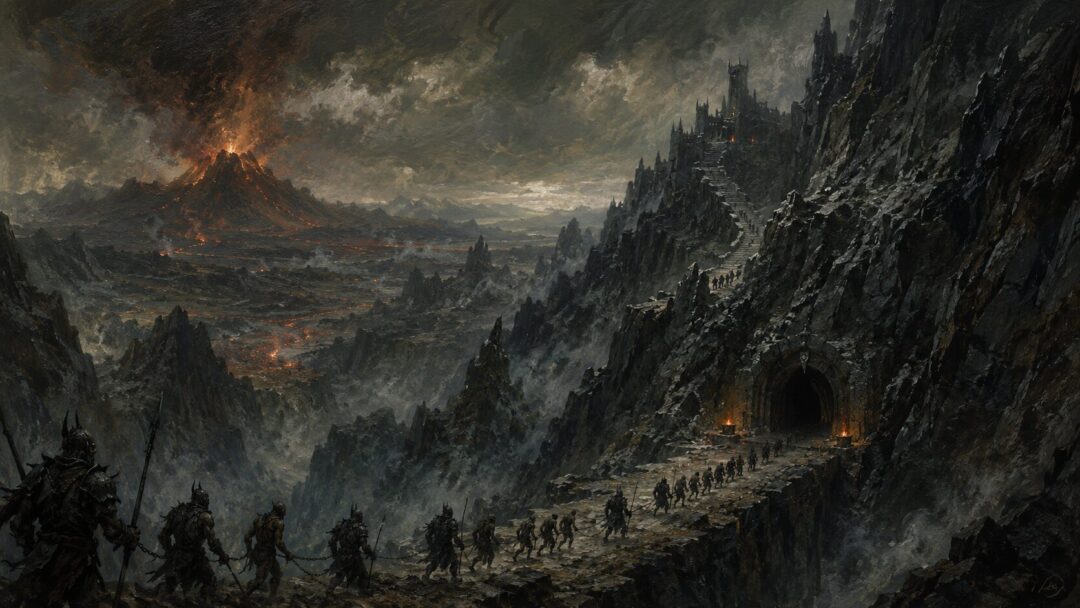
The texts indicate that Shelob sometimes caught Orcs, and Sauron could afford that cost. He also sent prisoners to her when he had no better use for them, apparently taking a cruel pleasure in reports of what she did with them.
That tells us something about Mordor’s economy of life. Orcs, slaves, and captives were expendable. If Shelob devoured a few, that was not a strategic failure. It was the price of keeping the pass dreadful. To Sauron, the occasional death of servants mattered less than the certainty that enemies would fear or perish in the tunnel.
This is not incompetence. It is moral arithmetic. Sauron’s rule can tolerate waste when waste produces terror. A garrison commander might resent losing Orcs. A slave might dread being driven toward the tunnel. But from the Dark Tower’s point of view, Shelob transformed disposable lives into border security.
That is one of the most chilling things about the arrangement. Shelob did not undermine Mordor enough to be destroyed. She consumed just enough to remain useful.
Why Mordor Needed Fear as Much as Force
Sauron’s realm was not held together by affection. It ran on fear, surveillance, hierarchy, and punishment. Shelob fit that world because she added a kind of fear even Sauron’s soldiers could understand.
An Orc can fear a captain. A captain can fear a Nazgûl. All can fear Sauron. But Shelob represented a different terror: not command, but appetite. She did not punish according to law or rank. She simply fed. That made her lair a place even Sauron’s servants would not treat lightly.
This helped Mordor in two directions. To enemies outside, the pass became a rumor of dread. To servants inside, the region remained dangerous enough to discourage wandering, desertion, or careless movement. The Tower of Cirith Ungol may have been a military structure, but the spider below gave the pass a mythic horror.
A normal guard post says: “You may be seen.”
Shelob’s lair says: “You may vanish.”
That difference is exactly why she was valuable.
The Ancient Evil Sauron Allowed to Remain
Shelob’s ancestry also matters. As a descendant of Ungoliant, she belongs to a lineage of darkness that is not simply an extension of Sauron’s own making. Ungoliant’s story in the Elder Days is bound to insatiable hunger and devouring darkness; Shelob is smaller in scope, but similar in nature. She is not a political creature. She is hunger given body.
This makes Sauron’s tolerance of her especially revealing. He did not have to love what she was. He did not have to trust her. He only had to recognize that her nature served his border.
Mordor, for all its appearance of centralized power, could incorporate older horrors when they were useful. Shelob’s presence shows that Sauron’s dominion was not purely clean machinery. It was also parasitic. He could occupy ruins built by Gondor. He could twist roads and fortresses to his purposes. He could permit an ancient monster to remain in her tunnel because she made his land harder to enter.
The result was not alliance in any noble or formal sense. It was a shared ecology of evil.
Gollum Understood the Arrangement Better Than Most
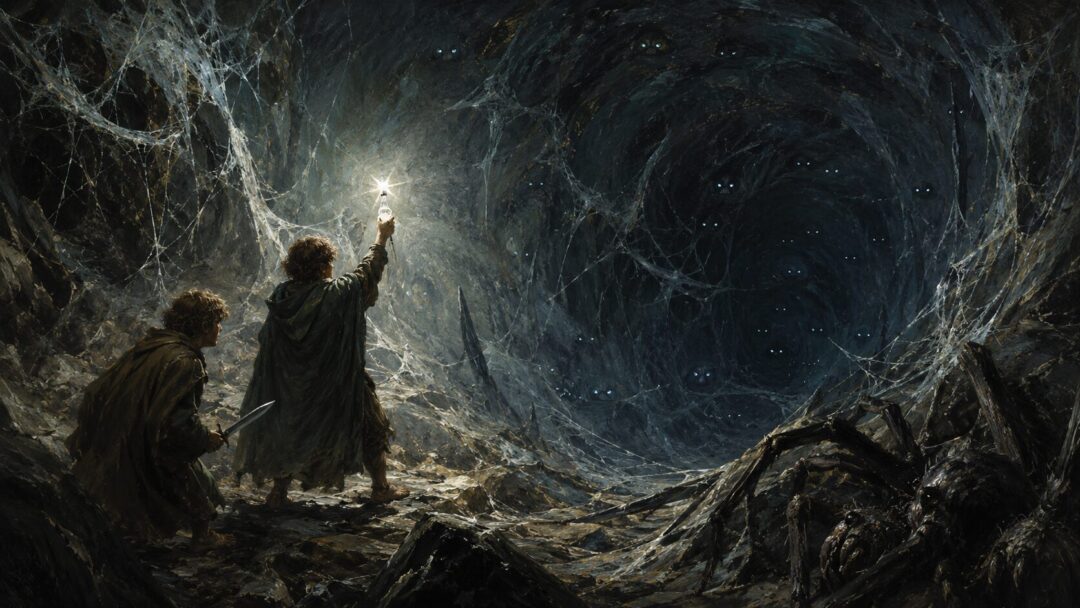
Gollum’s role sharpens the whole picture. He did not invent Shelob’s danger; he exploited it. He knew enough of her lair to lead Frodo and Sam there, hoping she would kill them and leave the Ring within reach.
His relationship with Shelob is described in terms of worship and service, though even here we should be careful: Shelob was not a goddess in any true theological sense. Rather, Gollum’s reverence shows how utterly he had placed his hope in a devouring thing. He imagined using Shelob, just as Sauron imagined benefiting from Shelob. Both calculations rested on the same dangerous assumption: that hunger can be directed without turning on the one who directs it.
Gollum’s plan nearly worked. Frodo was stung. Sam believed him dead. The Ring almost passed into disaster. But Shelob’s independence also created the unexpected break in the design. She did not understand the Ring. She did not serve Sauron’s will. She wanted flesh, not dominion.
That distinction helped save the Quest. A loyal servant of Sauron, finding Frodo and the Ring in that pass, might have acted very differently. Shelob’s usefulness to Mordor was real, but it was limited by her nature. She guarded the road because she fed there, not because she understood the war.
The Weakness Hidden Inside Sauron’s Practicality
Sauron tolerated Shelob because she solved a problem. Yet the very reason she was useful also made her unreliable.
She was not part of his chain of command. She did not report intelligently. She did not identify the Ring. She did not distinguish between a meaningless prisoner and the one person carrying the object Sauron most feared to lose. Her lair was an instrument of terror, but not of wisdom.
This is a recurring weakness in Sauron’s power. He can dominate, threaten, and organize, but he often misreads the small, humble, or merciful elements that do not fit his own logic. At Cirith Ungol, he trusted fear and hunger to do what fear and hunger usually do. Against almost anyone else, that would have been enough.
But Frodo and Sam were not an invading army. They were not proud warriors trying to conquer Mordor. They were two hobbits moving through a crack in the Enemy’s assumptions. Shelob could terrify them, wound them, and nearly end the Quest, but she could not comprehend them. She could not comprehend pity, loyalty, endurance, or the strange providence working through small hands.
Sauron’s tolerated monster became part of his blind spot.
Why He Did Not Simply Remove Her
It is tempting to ask why Sauron did not destroy Shelob and replace her with a more obedient guard. The most lore-grounded answer is practical rather than sentimental: the texts show that he knew of her, was pleased by her presence, and found her useful as a watch on the pass. They do not suggest he loved her, trusted her, or needed her in an absolute sense.
But removing her would have meant losing a uniquely effective terror. A garrison could be strengthened. A gate could be repaired. But Shelob was a living rumor, an ancient dread, and a trap that renewed itself through hunger. She required little maintenance beyond the occasional supply of victims. She made the pass infamous. She discouraged enemies and disturbed even servants.
So Sauron tolerated her independence, her appetite, her killing of Orcs, and her ancient separateness because the bargain favored him—until it did not.
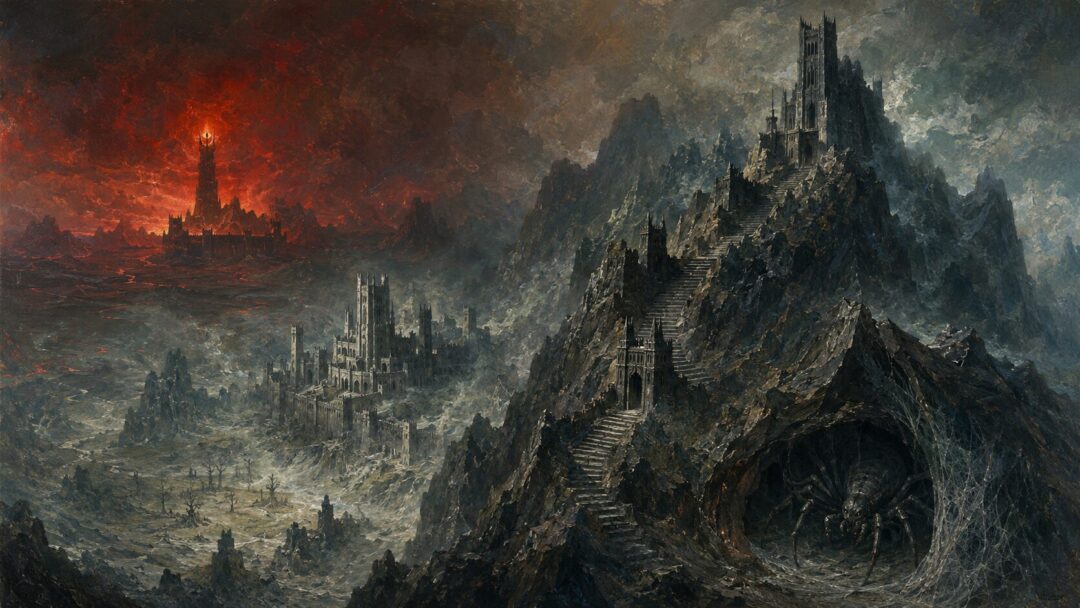
The Tragic Irony of the Spider’s Pass
Shelob’s lair is one of the darkest thresholds in The Lord of the Rings because it reveals how evil uses what it does not love. Sauron did not need Shelob to be loyal. He needed her to be hungry. He did not need her to understand his purposes. He needed her to make the hidden road into Mordor almost impossible.
For centuries, that may have seemed enough.
Yet the Quest succeeded through precisely the qualities that Shelob and Sauron lacked. Sam’s love for Frodo drove him into the dark. The Phial of Galadriel answered the darkness with light. A small sword in a small hand wounded a terror that mighty warriors might never have met. None of this made Shelob harmless. The texts leave her fate uncertain after she crawls away in pain; they do not clearly state that she dies. But her defeat at the pass breaks the illusion that Mordor’s hidden defenses are perfect.
What Sauron tolerated in Shelob was uncontrolled evil, so long as it served controlled evil.
What he failed to see was that uncontrolled evil is still blind. It may guard a door. It may devour the lost. It may make even Orcs whisper. But it cannot understand mercy, and it cannot recognize the full danger of the small.
That is why Mordor needed Shelob—and why, in the end, Shelob was not enough.
Sources & Notes
- https://tolkiengateway.net/wiki/Shelob — central background on Shelob as the last child of Ungoliant, her lair near Cirith Ungol, and Sauron’s knowledge/tolerance of her presence.
- https://tolkiengateway.net/wiki/Cirith_Ungol — context for the pass into Mordor, Shelob’s tunnel, and why this route was a dangerous alternative to the Black Gate.
- https://tolkiengateway.net/wiki/Tower_of_Cirith_Ungol — explains the tower’s Gondorian origin, later occupation by Mordor, and its strategic relation to the pass above Shelob’s lair.
- https://tolkiengateway.net/wiki/Ungoliant — provides mythic background for Shelob’s ancestry and the older, consuming darkness she represents apart from Sauron’s command structure.
Sources cover Shelob, Cirith Ungol, the tower above the pass, and Ungoliant’s older darkness.